
What is lead routing in a pool builder’s sales process?

- What does lead routing mean for my pool construction sales process?
- What does lead routing mean in plain terms?
- Why does a pool builder need lead routing at all?
- What are the common ways to route pool leads?
- How does lead routing work for phone calls?
- How does lead routing work for web forms and online leads?
- What should happen when the assigned person doesn't respond?
- How do I route pool leads after hours and on weekends?
- Who should get new pool leads: the owner, a salesperson or the designer?
- How does lead routing connect to qualifying and tracking?
- What are the signs my lead routing is broken?
- How do I set up lead routing in a small pool company?
- What's different about lead routing for pool builders
- A worked example: one spring week, routed by project type
- Frequently asked questions
- Key takeaways
- More in this section
- Sources
The short version
- Lead routing decides who gets each new inquiry, how it reaches them and how fast they act.
- Pool builders usually route by project type first, then by town or availability.
- Every lead needs one owner and a named backup for when that person can't answer.
- Calls, web forms, Google profile messages and ad lead forms all need a route, not just the phone.
For pool builders whose calls, web forms and messages land in different places, and who want every new inquiry to reach the right person fast.
Get a free visibility audit · Book a growth call
What does lead routing mean for my pool construction sales process?
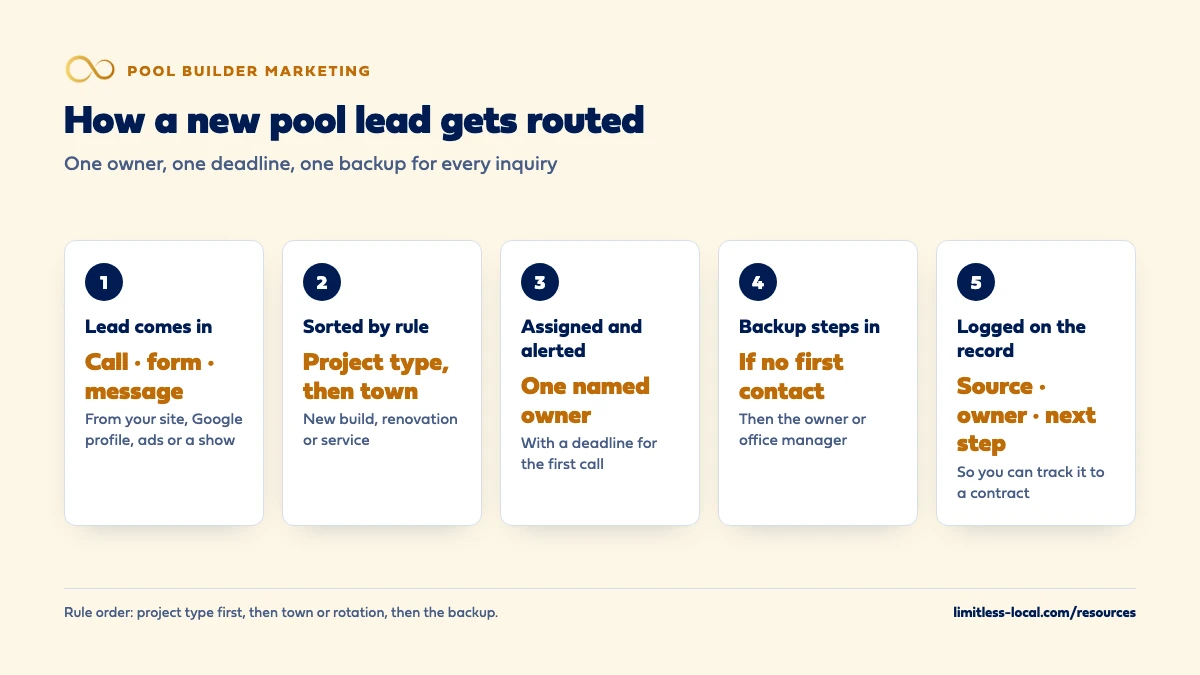
Lead routing is the set of rules that decides who gets each new inquiry, how it reaches them and how fast they have to act on it, set in advance instead of left to whoever happens to pick up the phone. For a pool builder, that usually means new-build leads go to the designer or salesperson, renovations to the renovation estimator and service requests to the service side, with a named backup when the first person is on a job site. Good routing gives every lead one owner and a deadline for the first call, so no inquiry you paid for sits unclaimed over a weekend.
Routing is where marketing hands off to sales, and it’s where a lot of paid-for leads quietly get lost. Our automation add-ons, including a lead tracking dashboard, unified messaging, calendar reminders, after-hours answering and AI website chat, plug into any package and are priced on the discovery call. The automation page covers them, our pool builder marketing page shows how we work with pool companies, and the pool builder marketing questions library goes question by question.
What does lead routing mean in plain terms?
It’s the answer to four questions, written down before the next lead arrives:
- Who gets it? One named person, picked by a rule, such as project type or town.
- How does it reach them? A call rings their phone, a web form lands in their inbox or CRM, a text alert goes out.
- How fast do they act? A deadline for the first call back.
- What if they don’t? Who it goes to next, and when.
Without routing, the answer to all four is “whoever notices it.” That works when the owner answers every call personally. It stops working the moment there’s a designer, an estimator and an office manager, and three of them each assume someone else has it.
Why does a pool builder need lead routing at all?
Because pool leads come in from more places than most owners realize, and they don’t all land in front of the same person:
- Phone calls from your website, Google profile and ads.
- Web forms requesting a design consultation.
- Messages through your Google Business Profile.
- Lead forms from Facebook and Instagram ads.
- Sign-up sheets from home shows.
- Referrals from past customers, landscapers and realtors.
Each one is a homeowner thinking about spending serious money on their backyard. If a web form goes to an inbox nobody checks on Saturdays, or a Facebook lead sits in an app only one person has on their phone, that lead may book a consultation with someone else first. Routing makes sure every door into your business has someone standing behind it.
What are the common ways to route pool leads?
Most pool builders combine two or three of these:
- By project type. New in-ground pools to the designer or salesperson, renovations and resurfacing to the renovation estimator, service and repair requests to the service manager. This is the rule that matters most for pools, because the work and the value are so different.
- By territory. If different people cover different towns, the town on the form or the caller’s area decides.
- By rotation. If two salespeople sell the same work, leads take turns. HubSpot’s guide to assigning and rotating record owners describes three ways to share them out: load balanced, which assigns the lead to the person with the fewest open items; round robin, in a rotating order; and random.
- By availability. Whoever is on call that day takes everything first, then hands it on.
Start with project type. Add the others only when you have enough people to need them.
How does lead routing work for phone calls?
Most call tracking tools let you build a call flow that decides which phones ring. CallRail’s help page on its Round Robin step is a good example of what’s possible: calls ring a queue of numbers in order, you set how long each one rings before moving to the next, and you can weight it so some numbers take calls more often.
One detail is worth knowing before you set it up. By default, a repeat caller is routed back to whoever answered last time, and if that person doesn’t answer, the call goes to voicemail. For a pool sale, that’s mostly a good thing: the homeowner keeps talking to the same designer for months. But it means the designer’s voicemail needs to be checked, or the repeat caller needs a path to someone else.
If you don’t track calls yet, whether a pool builder should use call tracking covers the setup that routing sits on.
How does lead routing work for web forms and online leads?
Your form does the sorting, so ask the right questions on it. A project type field (new pool, renovation, service) and a town or ZIP field are usually enough to route a lead without anyone reading it first.
From there, the form should create a lead in your CRM or job software, assign it, and alert the owner by text or app notification, not just email. Field software does some of this already. Jobber’s help page on requests in the Jobber app shows that you can assign team members to an assessment and add internal instructions for the assigned team, and Housecall Pro’s Pipeline guide shows a new lead as either Unassigned or Assigned. Make “Unassigned” a list somebody checks every day.
Ad lead forms from Facebook and Instagram need the same path. Connect them to your CRM so they’re routed like any other form, instead of sitting in an ads app.
Curious what your marketing is actually booking?
Get a free visibility audit — no obligation, no sales pitch.
What should happen when the assigned person doesn't respond?
The lead moves on, automatically if you can, by a rule everyone knows. A simple escalation looks like this:
- The assigned person gets the lead and an alert.
- If there’s no first contact by your deadline, the backup gets an alert.
- If there’s still no contact, the owner or office manager gets it.
Set the deadline to match how you sell. A homeowner who filled out a consultation form at lunch shouldn’t wait until tomorrow for a call. How fast a pool builder should respond to a new lead covers what that deadline should be. Routing is how you actually hit it.
How do I route pool leads after hours and on weekends?
Decide who owns them before the weekend starts. The common options:
- An on-call rotation, where one salesperson or designer covers evenings and weekends and hands leads over on Monday.
- After-hours answering, so a person or service takes the call, gets the basics and books a time for a callback.
- A quick written reply to forms and messages that says who will call and when, then a call first thing the next business morning.
Pool buyers often research in the evening and on weekends, when both decision-makers are home. Those leads are worth routing as carefully as the ones that come in on a Tuesday morning.
Who should get new pool leads: the owner, a salesperson or the designer?
It depends on your size:
- Owner-run shops: the owner takes every lead, with the office manager as backup when the owner is on a job site. Routing here is mostly about the backup.
- Small sales team: leads go to the designer or salesperson by project type, and the owner gets an alert for anything unclaimed.
- Larger builders: an office coordinator or inside sales person makes first contact, qualifies the lead and books the consultation, then routes it to a designer by territory or rotation.
Whichever fits, keep one rule: the person who makes first contact should be able to offer consultation times on that call. Routing a lead to someone who then has to check with someone else adds a day.

How does lead routing connect to qualifying and tracking?
Routing is the first step of both. When a lead is routed, three things should land on its record: the source it came from, the person who owns it, and the date of the next step. Those three fields are what let you qualify it, follow it through a months-long sale and, at the end, count which marketing produced the contract.
Qualifying usually happens on that first call, by the person the lead was routed to. How pool builders qualify leads before the design consultation covers what to ask. A lead that’s routed but never marked qualified or not leaves a hole in your numbers.
What are the signs my lead routing is broken?
- Leads in your CRM with no owner, or an owner who left the company.
- Two people calling the same homeowner, or nobody calling at all.
- A web form that still sends to an old inbox.
- Repeat callers reaching voicemail because the person they spoke to last is on a job site.
- Home show sign-ups that sit in a folder for a week.
- Nobody can answer “who’s handling this one?” without asking around.
Any one of these means leads you paid for are leaking. The fix is rarely a new tool. It’s usually a written rule and a weekly check of the unassigned list.
How do I set up lead routing in a small pool company?
- List every way leads come in: each phone number, form, ad lead form, messaging inbox and event.
- List who can take leads, and what kind of work each person sells.
- Write the rule in a few lines: project type first, then town or rotation, then the backup.
- Set the tools to follow it: call flows, form notifications, CRM assignment.
- Test every path. Place a test call from a number that isn’t part of your call flow and check it rings where it should. Do the same with each form.
- Check the unassigned list weekly and adjust the rule when people or services change.
If your leads already live in a CRM, most of this is settings, not software. Whether a pool builder needs a CRM covers what to look for if they don’t.
Want to see where your company stands?
A free visibility audit shows where you show up on Google, Maps and AI answers, and what it's costing you in calls.
What's different about lead routing for pool builders
Project types are worth very different amounts. A new in-ground pool and a pump repair shouldn’t land in the same queue. Routing by project type matters more for pools than for most trades.
The salesperson is often in the field. Designers spend much of the day in backyards measuring and presenting. Routing needs a backup who’s at a desk, or at least a phone that’s checked between consultations.
One owner for months. A pool lead can take a season to sign. Whoever it’s routed to should keep it, so the homeowner isn’t re-explaining their backyard to someone new.
Leads arrive in bursts. A home show weekend or the first warm days of spring can bring in more leads than one person can call back in time. A rotation or overflow rule keeps the burst from turning into a backlog.
A worked example: one spring week, routed by project type
These numbers are made up to show how a simple rule works, not a benchmark for pool builders. Say a pool company with a designer, a renovation estimator and an office manager gets 40 inquiries in a spring week:
- 22 new-build inquiries go to the designer, with the office manager as backup when the designer is in a consultation.
- 10 renovation inquiries go to the renovation estimator.
- 8 service and other requests go to the office manager.
Before the rule, all 40 landed in one shared inbox and whoever had a minute picked them up. After the rule, each person has a short list that’s clearly theirs, the backup knows when to step in, and the owner only sees the leads that went unclaimed.
Now say the shared inbox used to leave 6 of the 40 waiting until Monday. If even one of those was a homeowner who booked a different builder over the weekend, the routing rule paid for itself in a single week.
Frequently asked questions
Is lead routing the same as lead distribution?
They’re used to mean the same thing. Distribution usually refers to sharing leads among several salespeople, which is one kind of routing rule.
Do I need special software for lead routing?
Not always. A written rule plus the assignment settings in your CRM, job software and call tracking covers most pool builders. Dedicated tools help once you have several salespeople and lots of volume.
Should every salesperson get an equal share of leads?
Only if they sell the same work in the same area. Otherwise, route by project type and territory first, and use rotation only among people who are truly interchangeable.
What should I do with leads that come in while everyone's at a home show?
Pick one person at the booth to check new calls and forms between conversations, or send them to after-hours answering for the day. Shows are when leads pile up fastest.
Should the same person keep a lead until it signs?
For pool sales, usually yes. The homeowner builds trust with one designer over several meetings. Reassign only if that person leaves or the project type changes.
How often should I review my routing rules?
Check the unassigned list every week, and review the rule itself whenever someone joins or leaves, you add a service, or you start a new ad channel.
Key takeaways
- Lead routing is the written rule for who gets each inquiry, how it reaches them, how fast they act and who steps in if they don’t.
- Pool builders should route by project type first, because new builds, renovations and service calls are very different sales.
- Every lead source needs a route, including Google profile messages, ad lead forms and home show sign-ups.
- Give every lead one owner, a first-call deadline and a named backup.
- Test every path once, then check the unassigned list every week.
Not sure what's working right now?
Start with a free visibility audit: rankings, Google profile, reviews and tracking, checked against your service area.
More in this section
- How do pool builders qualify leads before the design consultation?
- How should pool builders follow up on leads during a long sales cycle?
- How many leads are needed for a pool builder to hit its revenue goal?
- What tracking shows a pool builder cost per qualified lead?
- How do pool builders keep leads coming in the off-season?
Sources
- Assign and rotate record owners using workflows — HubSpot Knowledge Base
- Round Robin step — CallRail Help Center
- Requests in the Jobber App — Jobber Help Center
- Getting Started with Pipeline — Housecall Pro Help Center