
How do reviews affect a pool builder in Maps and AI search?

- How do online reviews change where my pool company shows up in Google Maps and AI answers?
- How do reviews affect where a pool builder shows up in Google Maps?
- Why can a pool builder with fewer reviews outrank me in Maps?
- What does Google show from my reviews besides the star rating?
- How do AI review summaries describe a pool builder?
- Do reviews affect whether AI Overviews and AI Mode mention my pool company?
- Do reviews matter for ChatGPT and other AI assistants?
- What should pool customers' reviews say to help in Maps and AI search?
- Do my replies to reviews help in Maps or AI search?
- How do negative reviews show up in Maps and AI summaries?
- Do reviews on Yelp, Facebook and other sites matter too?
- What's different about reviews for pool builders
- A worked example: two builders, two sets of reviews
- Frequently asked questions
- Key takeaways
- More in this section
- Sources
The short version
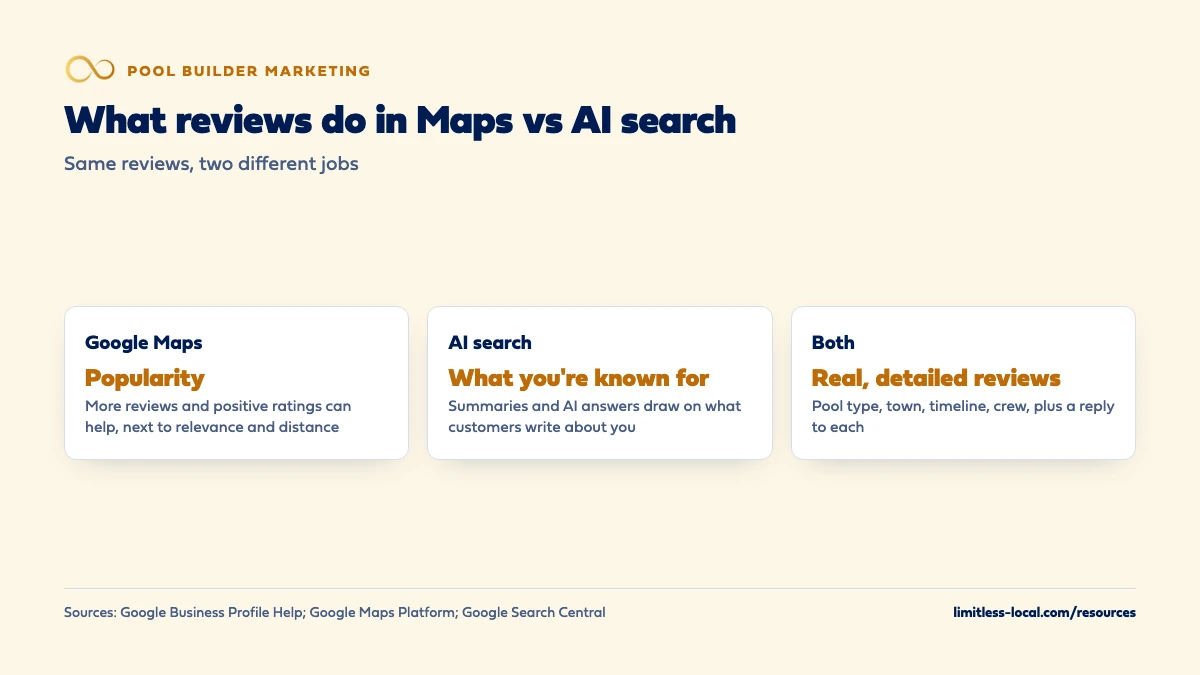
- In Maps, more reviews and positive ratings feed popularity, one of Google's three main local ranking factors.
- Reviews can't beat distance or relevance on their own, and there's no way to pay for a better local ranking.
- Google can summarize your reviews with AI and show ratings for parts of the job, like price.
- What customers write, including pool type, town and how the build went, shapes how AI tools describe you.
For pool builders who already ask for reviews and want to know what those reviews actually do: for your spot in Google Maps, and for how AI tools describe your company.
Get a free visibility audit · Book a growth call
How do online reviews change where my pool company shows up in Google Maps and AI answers?
Reviews affect a pool builder in two ways. In Google Maps, the number of reviews you have and how positive they are feed popularity, one of the three main things Google weighs alongside relevance and distance, so more good reviews can help you rank, but they can’t make up for being far from the searcher or a poor match for the search. In AI search, reviews are raw material: Google can summarize what reviewers say about a business with Gemini, and AI tools build answers from what they find about you online, so the words in your reviews, like the pool type, the town and how the build went, shape how you’re described.
Reviews sit right where Maps and AI search overlap, which is why we treat them as one job. Review generation and replies are part of our local SEO work, alongside your Google profile, your website and listings, all aimed at the three places owners need to show up: the regular Google results, the Maps 3-pack and AI answers like ChatGPT, Google AI Overviews and Siri. The local SEO page covers that work, our pool builder marketing page shows it for pool companies, and the pool builder marketing questions library goes question by question.
How do reviews affect where a pool builder shows up in Google Maps?
They feed one of the three main signals. Google’s page of tips to improve your local ranking says local results are mainly based on relevance, distance and popularity. The popularity side is about how well-known a business is, and Google says that’s based in part on how many websites link to your business and how many reviews you have. It also says more reviews and positive ratings can help your business’s local ranking.
So reviews count, and they count in a very specific place. They help Google see your pool company as an established, well-known builder. They don’t tell Google you build in a town 40 minutes away, or that you do fiberglass installs. That’s the job of your Business Profile, your categories and your website.
How many you need to compete is its own question, answered in how many Google reviews a pool builder needs.
Why can a pool builder with fewer reviews outrank me in Maps?
Because popularity is only one of the three factors. A builder whose office is closer to the homeowner searching, or whose profile matches the search better, can show up above you with half your reviews. Distance is the one you can’t change: it’s simply how far each business is from the person searching.
There’s also no way to request or pay for a better local ranking. Reviews are one input you can grow honestly, alongside a complete profile with the right categories and services, and a website that clearly covers the pools you build and the towns you build in.
If a competitor keeps beating you with fewer reviews, it’s usually a relevance gap, not a review gap. The signals that decide which pool builders show in Google Maps walks through all of them.
What does Google show from my reviews besides the star rating?
More than many owners realize. Google’s page about reviews for service businesses explains that customers reviewing a service business can rate specific aspects of their experience, and those ratings are collected and shown on your Business Profile. Searchers can scroll to the “Review summary” and filter reviews by an aspect, like “Price.”
Customers may also be asked what work you did for them, and that shows in their review. Google says the job choices come from your service list, your website or a standard list for your type of business, and that you can add a missing job type to your service list.
That’s a quick win. If your service list says “new pool construction,” “pool renovation,” “fiberglass pools” and “pool resurfacing,” your reviews can be tagged with the work you actually want more of. If it’s blank, they’ll be tagged with whatever the standard list offers.
How do AI review summaries describe a pool builder?
By boiling your reviews down to a few sentences. Google’s Maps Platform documentation on AI-powered review summaries describes them as AI-generated summaries of places based solely on user reviews. They pull together key elements such as place attributes and reviewer sentiment, and they carry the label “Summarized with Gemini.” Apps and sites built on Google Maps can show them.
Think about what that means for your company. A summary can only say what your reviews say. If most of them read “Great company!”, there’s little for a summary to work with. If they mention the pool type, the town, the design process, how the crew kept the yard clean and whether the build stayed on schedule, the summary has real detail to pass on to the next homeowner.
Curious what your marketing is actually booking?
Get a free visibility audit — no obligation, no sales pitch.
Do reviews affect whether AI Overviews and AI Mode mention my pool company?
Indirectly. Google’s guide to AI features and your website says AI Overviews and AI Mode work like the rest of Search: the same SEO basics apply, and both may run several related searches across subtopics and data sources, a technique Google calls query fan-out, to build a response. Its checklist for site owners includes making sure your Business Profile information is up to date.
Google doesn’t publish a rule about how reviews feed these answers. What’s clear is that AI answers are built from what Google can find about your business, and your profile, its rating and what customers write are a big part of that for a local builder. Treat reviews as one part of how AI search understands you, next to your website and listings. The full picture is in how a pool builder shows up in AI search results.
Do reviews matter for ChatGPT and other AI assistants?
They matter as part of what those tools can find. OpenAI’s help page on searching the web with ChatGPT says it can search the web for current information, include links to its sources, and use an approximate location to find local results. It also says ChatGPT search sometimes partners with other search providers, sending them rewritten versions of the question.
So when a homeowner asks an assistant for well-reviewed pool builders near them, the answer comes from whatever the tool’s searches turn up: your website, your listings, articles and the review sites it can reach. Strong, specific reviews on the platforms homeowners use give those searches something solid to find. A profile with a handful of old one-line reviews doesn’t.
What should pool customers' reviews say to help in Maps and AI search?
Whatever is true, in their own words. You can’t write reviews for customers, and you shouldn’t script them. Google’s page on requesting reviews with a link or QR code says reviews must reflect a genuine experience, and that offering incentives such as free or discounted services for reviews is strictly prohibited.
What you can do is ask in a way that brings out detail. At the handover walkthrough, try: “If you have a minute, we’d love a review. It really helps other families to hear what it was like building your pool with us.” Customers who are reminded of the whole experience tend to mention it: the design, the crew, the timeline, the first swim.
The details homeowners mention most are covered in what pool customers mention in Google reviews.

Do my replies to reviews help in Maps or AI search?
Replying to reviews is on the same list of local ranking tips, where positive reviews and helpful replies are described as something that can help your business stand out. Replies aren’t named as a ranking factor, so treat them as part of running a responsive business in public.
Replies also add context next to every review. A short, specific thank-you that names the project (“Glad the new spa spillover turned out the way you pictured it”) shows the next homeowner, and anything reading your profile, what kind of work you do and how you treat customers. A generic “Thanks!” on every review adds nothing.
How do negative reviews show up in Maps and AI summaries?
As part of the overall picture. One critical review among dozens of detailed good ones barely moves a summary. A pattern of the same complaint, like missed timelines or poor communication during the build, is exactly what a summary is designed to pick up, because it pulls together reviewer sentiment across all your reviews.
That makes the fix the same as it’s always been: answer every critical review calmly and specifically, fix the cause if there’s a pattern, and keep the steady flow of reviews from happy customers coming. Reviews that break Google’s policies can be flagged, but an honest bad review stays. How a pool builder should respond to negative Google reviews covers what to write.
Do reviews on Yelp, Facebook and other sites matter too?
Yes, for both Maps and AI search, in different ways. Google says businesses on Search and Maps may display third-party reviews from websites that aren’t Google, and that the type of business and its location decide which ones are shown. AI tools that search the web can also find review sites, not just Google.
Focus your asks on Google first, since that’s where most homeowners searching for a pool builder will see them. Then keep your other profiles claimed, accurate and answered, so whatever an AI tool or a homeowner finds there tells the same story.
Want to see where your company stands?
A free visibility audit shows where you show up on Google, Maps and AI answers, and what it's costing you in calls.
What's different about reviews for pool builders
Fewer jobs, bigger stakes. A pool builder finishes far fewer projects a year than a plumber or an HVAC shop, so each review counts for more, and a missed ask is a bigger loss.
The detail is the selling point. Homeowners spending this much want to know about the design process, the timeline, the crew and the cleanup. Reviews that mention those things help both the next homeowner and any summary built from them.
Reviews arrive in seasons. Most handovers happen in late spring and summer. Ask at every one, and ask past customers in the slow months, so your newest review isn’t from last August.
Renovations count too. Resurfacing, tile and equipment jobs finish faster and in larger numbers than new builds. Ask those customers as well, and make sure renovation services are on your service list so their reviews are tagged correctly.
A worked example: two builders, two sets of reviews
These builders and numbers are made up to show the difference, not a benchmark for pool builders. Say two pool companies serve the same suburbs:
- Builder A has 140 reviews averaging 4.8 stars. Most are one line: “Great company!” or “Love our pool.” The service list is empty.
- Builder B has 60 reviews averaging 4.7 stars. Many mention the pool type, the town, the designer by role, the timeline and the cleanup. The service list includes new pool construction, fiberglass pools and pool renovation.
In Maps, Builder A’s higher count may help its popularity, and distance and relevance will still decide a lot. But when a homeowner reads the review summary, filters by an aspect, or asks an AI tool which builders do fiberglass pools in their town, Builder B has given every one of those tools far more to work with.
The takeaway isn’t that count doesn’t matter. It’s that count and detail do different jobs, and a pool builder needs both.
Frequently asked questions
Does my star rating matter more than my number of reviews in Maps?
Google mentions both: it says more reviews and positive ratings can help your local ranking. Neither replaces relevance or distance, so aim for a steady flow of real reviews rather than chasing a perfect score.
Can I ask customers to mention the type of pool in their review?
You can remind them what you built and ask them to share what it was like. Don’t write the review for them or offer anything in return; the words need to be theirs.
Do photos in reviews help?
They help homeowners see your work, and pool photos are some of the most convincing content a builder can have. Encourage customers to add one of their finished pool when they post.
Will AI tools mention my pool company if I have no reviews?
They may still find your website and listings, but you’ll have little for a review summary or an AI answer to describe. A builder with no reviews looks unproven to people and tools alike.
Do old reviews still count?
They stay on your profile and in your count. But a homeowner, or a summary, will see when your latest one was posted, so keep new ones coming each season.
Should I reply to every review, even the short ones?
Yes, briefly. A specific thank-you that names the project adds useful detail next to the review and shows you pay attention.
Key takeaways
- In Google Maps, reviews feed popularity, one of three main factors with relevance and distance.
- Reviews can’t overcome distance or a poor match for the search, and better local rankings can’t be bought.
- Google can show review summaries, aspect ratings and the job each customer hired you for, so keep your service list complete.
- AI summaries and assistants can only describe what your reviews and online presence say, so detail matters as much as count.
- Ask every customer the same way, never offer incentives, and reply to every review specifically.
Not sure what's working right now?
Start with a free visibility audit: rankings, Google profile, reviews and tracking, checked against your service area.
More in this section
- How does a pool builder show up in AI search results?
- How does proximity affect a pool builder's Google Maps ranking?
- Will Google AI Overviews reduce a pool builder's leads?
- How can a pool builder measure progress in AI search and Maps?
- What signals decide which pool builders show in Google Maps?
Sources
- Tips to improve your local ranking on Google — Google Business Profile Help
- About reviews for service businesses — Google Business Profile Help
- AI-powered review summaries — Google Maps Platform
- AI features and your website — Google Search Central
- Searching the web with ChatGPT — OpenAI Help Center
- Create a Google link or QR code to request reviews — Google Business Profile Help
- About third-party reviews — Google Business Profile Help