
Does local SEO work faster for water damage than mold or fire?
- Does local SEO show results sooner for water damage, fire damage or mold remediation?
- Does local SEO really move faster for one restoration service than another?
- Why is water damage usually the hardest to rank for?
- Why can fire damage pages sometimes show up sooner?
- What makes mold different from water and fire?
- Does a page that ranks sooner bring more jobs?
- How do I check search demand for each service in my towns?
- How do I size up the competition for each service?
- Does my Google profile rank separately for water, fire and mold?
- Which service page should I build or improve first?
- How do I track which service page is moving?
- Should ads carry water damage calls while SEO ramps up?
- What's different about SEO timing for restoration service lines
- A worked example: the faster page and the busier page
- Frequently asked questions
- Key takeaways
- More in this section
- Sources
The short version
- No service line ranks faster by rule; SEO typically takes 3-6 months either way.
- Water damage has the most searches and the most competition.
- Fire and mold pages can sometimes move sooner, but bring fewer calls.
- Judge each service page on booked jobs, not just how fast it climbs.
For restoration owners deciding which service page to push first, and how long each one is likely to take to bring in calls.
Get a free visibility audit · Book a growth call
Does local SEO show results sooner for water damage, fire damage or mold remediation?
Not by any rule. Local SEO for any restoration service typically takes 3-6 months to show meaningful growth, whether the page is about water, mold or fire. What differs is the field you’re up against: water damage usually has the most searches and the most competitors, so it’s often the slowest to crack and the biggest payoff, while fire and mold searches are rarer and in some towns fewer companies have strong pages for them. Check search demand and competition in your own towns before deciding which page to push first.
Deciding which service to push first is part of the plan we build in month one, using search demand and competition in your own towns, not a guess. Local SEO and Google Business Profile work run through our local SEO service, and Google Ads can carry water damage calls while the pages climb. We won’t guarantee a ranking or a timeline; nobody honestly can, because platforms change how they work. The restoration marketing page shows how this fits water, fire and mold companies, the restoration marketing guide covers every channel, and there are more restoration marketing questions in the library.
Does local SEO really move faster for one restoration service than another?
Not by any rule you can count on. SEO typically takes 3-6 months to show meaningful organic growth, and that’s true whether the page is about water, fire or mold. Google’s SEO starter guide says some changes might take effect in a few hours and others could take several months, and that you’ll likely want to wait a few weeks to judge whether a change helped.
What owners notice is real, though. One service page often starts showing up sooner than another. That isn’t because Google treats fire or mold differently on a timer. It’s because each service has a different number of people searching for it and a different crowd of companies trying to rank for it, and both vary from town to town.
So the useful question isn’t which service is faster everywhere. It’s which service is less crowded and still worth the work in your towns. For the wider question of why restoration SEO can feel slow, see why restoration SEO takes longer than other trades.
Why is water damage usually the hardest to rank for?
Because it’s where the money and the crowd are. Water damage is the most common restoration emergency, so it draws the most searches and the most companies chasing them:
- Paid listings on top. Local Services Ads are available only for certain service categories, and water damage services is one of them in the US. Those ads, plus regular search ads, sit above the organic results.
- Big competitors. Franchises and national networks put real money into water damage pages in many metro areas.
- Everyone’s homepage. Nearly every restoration website leads with water damage, so the page you’re up against has often been around for years.
None of that makes water damage SEO pointless. It’s usually the biggest share of restoration jobs, so even a middling position can bring more calls than a top spot for a rarer service. It just tends to take longer to climb, and it’s the service where paid channels carry the most weight while you wait.
Why can fire damage pages sometimes show up sooner?
Fewer people search for fire damage help, and in many towns fewer local companies have a dedicated, detailed fire page. Fire damage also isn’t on the Local Services Ads category list, so there’s one less row of paid listings above the organic results.
That combination means a strong fire damage page, with your process for smoke, soot and odor, real job photos and the towns you serve, can sometimes reach the first page sooner than your water page. The trade-off is volume. A top spot for a search that a few dozen people make a month brings a few calls, not a steady stream.
Fire jobs tend to be large, though, so a few booked fire jobs can be worth a lot. That’s why the comparison has to end at booked jobs and job value, not at how fast the page climbed.
What makes mold different from water and fire?
Mold is usually researched, not an emergency, and it’s a health topic. Both change how the page needs to be written.
Google says in its guide to creating helpful, reliable content that its systems give even more weight to content with strong experience, expertise, authoritativeness and trustworthiness for topics that could significantly impact people’s health, financial stability or safety. A mold page falls squarely in that group. Thin copy, borrowed health claims or a page that reads like every other mold page is less likely to earn trust.
What works is first-hand detail: how you find moisture, how you contain an area, what the job looks like from start to finish, who on your team does the work, and photos from real jobs. Any health statement should repeat what a government source says, with a link. What a restoration website should say about mold and fire damage covers what to include and what to leave out.
Does a page that ranks sooner bring more jobs?
Not necessarily, and this is where owners get tripped up. A page can climb quickly because few people search for it. Another can sit lower for months and still bring more calls because so many more people search for it.
Three numbers decide what a service page is worth to you:
- How many people search for that service in your towns each month.
- How many of them call from where your page shows up.
- What a booked job is worth for that service.
A fire page near the top and a water page lower down can both be good outcomes. The worked example below shows why the slower page can still book more jobs.
Curious what your marketing is actually booking?
Get a free visibility audit — no obligation, no sales pitch.
How do I check search demand for each service in my towns?
Use Keyword Planner, Google’s free keyword tool inside Google Ads. Its location filter shows average monthly searches for the area you pick, down to your city, so you can see whether a term that’s popular nationally is popular where you work. It also notes that a keyword with high search volume may come with a lot of competition.
Look up a handful of terms for each service, such as water damage restoration, water extraction, fire damage restoration, smoke damage cleanup and mold remediation, for the towns you serve. Write down rough monthly searches for each. You’re not after exact numbers. You’re after the shape: water usually leads, and the gap between water and the others tells you how much each page could ever bring in.
How do I size up the competition for each service?
Search each service plus your main town on your phone, the way a homeowner would, and note what you see:
- How many paid listings sit above everything else.
- Which companies show up in the map results, and how many reviews they have.
- Whether the organic results are local companies with a dedicated page for that service, or homepages and national sites.
A service where the organic results are mostly thin pages or homepages is a service where a detailed page has a real shot. A service where every result is a strong, dedicated page from an established company will take longer, whatever the service is. Repeat it for your second and third towns, because the picture often changes a few miles away.
Does my Google profile rank separately for water, fire and mold?
No. You have one Business Profile, and it shows up in Maps for all your services. Google’s local ranking help says local results are mainly based on relevance, distance and popularity, and that you can’t pay for a better local ranking.
Distance and popularity, meaning your reviews and how well-known you are, help you across every service at once. Relevance is where each service needs attention: pick categories that describe your core business and list every service you actually offer, so the profile matches water, fire and mold searches. Your website pages back that up, because they tell Google more about each service than the profile can.
So in Maps, the services move together more than they do in the organic results. The bigger differences between water, fire and mold show up on your website pages.
Which service page should I build or improve first?
Use what you found about demand and competition, and match it to the work you want:
- Water first if it’s most of your jobs and you can run ads to cover water calls while the page climbs. It’s the slowest but the biggest prize. How to rank for water damage restoration in your city goes step by step.
- Fire or mold first if water is crowded with big competitors and you have real capability and capacity for the other service. A strong page there can be an earlier win while the water page builds.
- All three, in order in the end. Each service needs its own page, and each one makes the site look more complete for the rest.
Don’t build a page for a service you rarely take on. Ranking for work you don’t want is a cost, not a win.
How do I track which service page is moving?
Look page by page, not at the whole site. In Search Console, the Performance report can group your data by page or by query, so you can see the searches and clicks for your water, fire and mold pages separately and watch them over time.
Then follow it to the phone. A tracking number on the website shows calls from search, and your job software should record which service each booked job was. After a few months, you’ll know which page is bringing jobs, not just traffic. How to tell if restoration SEO is working before the leads arrive covers the early signs to watch.
Should ads carry water damage calls while SEO ramps up?
For most restoration companies, yes. Ads can generate leads within days of launch, and water damage is the service where organic rankings tend to take longest, so it’s the natural place for paid search and Local Services Ads to do the heavy lifting early on.
Fire and mold work the other way round: there’s no Local Services Ads category to lean on, so a separate search campaign or a stronger page does more of the work. As your pages start bringing in booked jobs on their own, shift money away from ads for that service. Whether to spend more on paid ads or local SEO for water damage leads walks through the split.
Not sure which of these is costing you jobs?
A free visibility audit checks the Google profile, reviews, site and tracking, and shows what to fix first.
What's different about SEO timing for restoration service lines
Emergency and planned work side by side. Water damage is mostly emergency searches made in a hurry; mold is often researched over days. The pages need different jobs: one gets a call fast, the other earns trust.
Paid listings on only one service. Water damage has a Local Services Ads category and fire and mold don’t, which changes how crowded the top of the page is for each.
Job values swing widely. A small water cleanup and a large fire job aren’t comparable, so judging pages by call counts alone misleads you.
Health topics need extra care. Mold pages carry health questions, so they need first-hand detail and government sources for any health statement.
A worked example: the faster page and the busier page
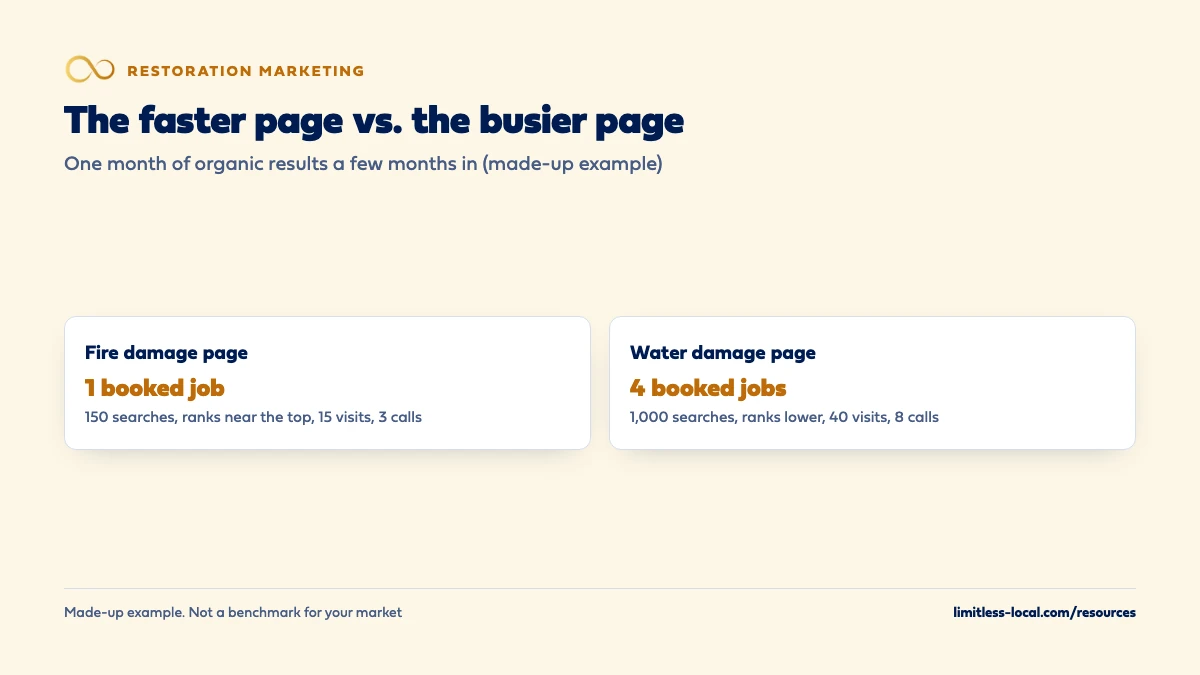
These numbers are made up to show the math, not a benchmark for your market. Say Keyword Planner shows about 1,000 monthly searches for water damage terms across your towns and about 150 for fire damage. A few months in, your fire page ranks near the top, while your water page sits lower down.
- Fire page: ranking near the top, it gets clicked on about 10% of those 150 searches, so 15 visits. About 1 in 5 visitors calls, so 3 calls, and 1 becomes a booked job.
- Water page: lower down, it gets clicked on about 4% of 1,000 searches, so 40 visits. About 1 in 5 calls, so 8 calls, and half book, so 4 booked jobs.
The fire page moved faster. The water page booked four times as many jobs. If that one fire job is a large loss, it may still be worth as much as the four water jobs, which is why you compare pages on booked jobs and job value together.
Frequently asked questions
Should I put water, fire and mold on one page to rank faster?
No. One page for each service gives Google and homeowners a clear match for each search, and lets each page say something specific about that work.
Does adding more fire or mold pages for each city speed things up?
Usually not. Google’s spam policies name pages targeted at specific cities that funnel visitors to one page as doorway abuse, and near-copy city pages for every service can drift into that. Build a strong page for each service first, then city pages only where you have something real to say.
How long should I wait before judging a new mold or fire page?
Give it a few months, and look for early signs like the page showing up for more searches in Search Console before you expect steady calls.
Is storm damage another service worth its own page?
If you take on storm work, yes. Storm searches spike after a storm, so a page that’s already built and indexed is ready when the searches come.
Can reviews help one service rank faster than another?
Reviews help your Google profile across all your services at once. A steady flow of genuine reviews after water, fire and mold jobs supports the whole profile rather than one service.
Key takeaways
- No restoration service ranks faster by rule; local SEO typically takes 3-6 months to show meaningful growth.
- Water damage usually has the most searches and the most competition, including Local Services Ads above the results.
- Fire and mold pages can sometimes move sooner, but they bring fewer calls.
- Mold is a health topic, so the page needs first-hand detail and government sources for health statements.
- Compare service pages on booked jobs and job value, not on how fast they climbed.
Want a second set of eyes on your setup?
We'll look at how you show up locally and where calls are leaking, then send you a plain-English breakdown.
More in this section
- Should I spend more on paid ads vs local SEO for water damage leads?
- How do I rank in Google for water damage restoration in my city?
- Which Google Ads keywords should a water damage company target?
- Is paying for SEO worth it for a restoration company?
- Do Google Ads help a restoration company's SEO rankings?
Sources
- SEO Starter Guide: The Basics — Google Search Central
- Getting started with Local Services Ads (United States) — Google Local Services Help
- Creating Helpful, Reliable, People-First Content — Google Search Central
- How to Find Keywords with Keyword Planner — Google Ads
- Tips to improve your local ranking on Google — Google Business Profile Help
- Performance report (Search results) — Search Console Help
- Spam Policies for Google Web Search — Google Search Central