
How do I vet a lead generation company for my plumbing business?

- What should I ask a plumbing lead generation company before I pay for a single lead?
- What kinds of lead generation companies sell to plumbers?
- Are the leads exclusive or shared?
- Where do the leads actually come from?
- What exactly counts as a lead I pay for?
- How are bad leads credited or refunded?
- Who owns the leads, phone numbers and accounts?
- What happens when I stop paying?
- What claims should I ask a lead company to back up?
- What are the red flags with plumbing lead companies?
- How do I test a lead company before committing?
- What's different about vetting lead companies as a plumber
- A worked example: why the definition of a lead matters
- Frequently asked questions
- Key takeaways
- More in this section
- Sources
The short version
- Get exclusivity, lead source, billing rules and credit terms in writing.
- Find out who owns the leads, numbers and accounts when you leave.
- Ask them to back up any claim about how often their leads book.
- Start with a short, capped trial and judge it on cost per booked job.
For plumbing owners being pitched by companies that sell leads or calls, who want to know what to ask before signing anything.
Get a free visibility audit · Book a growth call
What should I ask a plumbing lead generation company before I pay for a single lead?
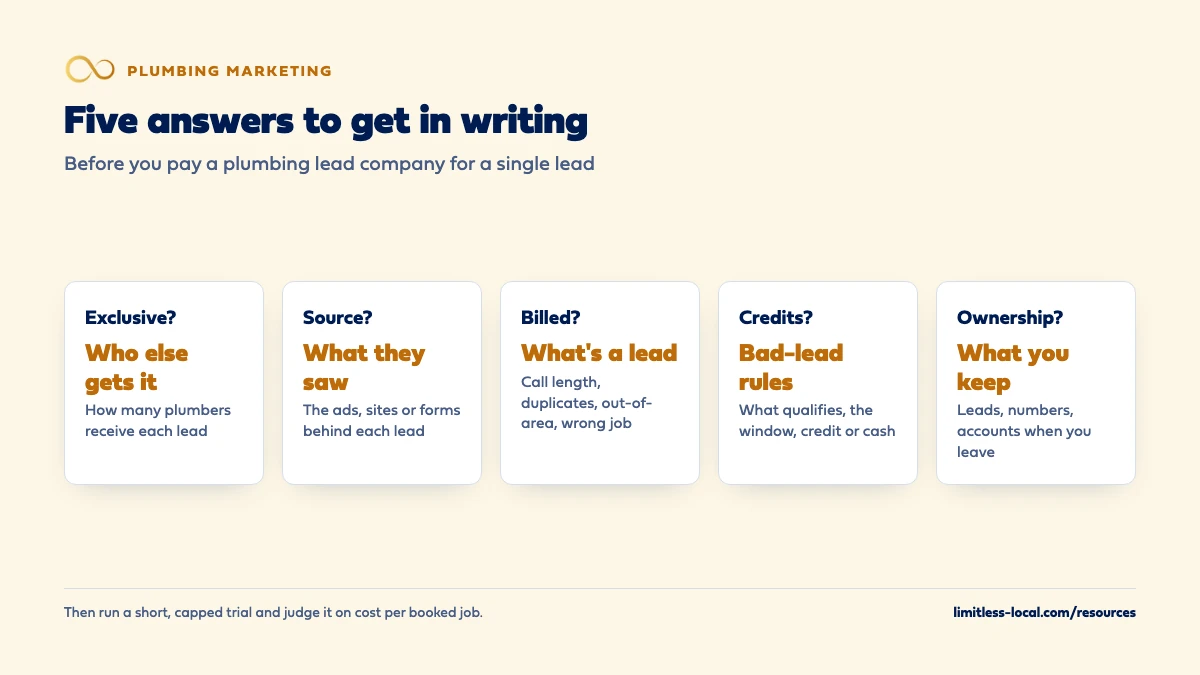
Vet a plumbing lead generation company by getting five answers in writing before you pay: whether each lead goes only to you or to several plumbers, where the leads come from and what homeowners see, exactly what counts as a billable lead, how bad leads are credited and within what window, and who owns the leads, phone numbers and any accounts or websites when you stop paying. Then ask them to back up any claim about booking rates, check for complaints under the company’s name, and start with a short, capped trial where every job is tagged by source. Judge it on cost per booked job, not on the price per lead.
We don’t sell leads, and we won’t guarantee a lead count, because nobody honestly can. Our local ads work runs Google Ads and, from the Growth tier up, Local Services Ads inside accounts in your name, with call tracking and a monthly cost-per-lead breakdown so you can compare them with any lead seller. How that fits a plumbing shop is on our plumbing marketing page, and the plumbing marketing questions library has more.
What kinds of lead generation companies sell to plumbers?
“Lead generation company” covers very different businesses, and the right questions depend on which one is pitching you:
- Lead networks and marketplaces. Homeowners fill in a request, and the company sends it to one or more plumbers who pay per lead.
- Pay-per-call sellers. The company runs its own ads or websites and forwards calls to you, charging for each call over a set length.
- Rented websites. A company ranks a site for “plumber in your town” on its own domain and rents the calls to one plumber at a time, usually for a monthly fee.
- Agencies that run your ads. These charge a fee to run Google Ads or Local Services Ads for you. You pay the ad platform for the clicks or leads, and the leads come from your own ads.
The first three sell you leads they control. The last one builds lead flow you own. That difference decides most of what follows, so ask early which one you’re talking to. If you’re still deciding whether to buy leads at all, whether it’s worth paying for plumbing leads covers that first.
Are the leads exclusive or shared?
Ask it straight: “How many other plumbers get this same lead?” Then get the answer in writing. An exclusive lead goes only to you. A shared lead goes to two, three or more plumbers, and the homeowner usually hires whoever calls back first with a clear answer.
Shared leads aren’t automatically bad, but they need a lower price and a faster response to pay off. Follow-up questions worth asking:
- If leads are shared, how many plumbers get each one, and is that a maximum or an average?
- Are “exclusive” leads exclusive for good, or only for a set time before they’re sold again?
- If you offer territory exclusivity, which zip codes or towns does it cover, and is it in the contract?
- Do you also sell leads to companies outside plumbing, like home warranty or remodeling firms, for the same homeowner?
Where do the leads actually come from?
A lead is only as good as the ad or page that produced it. Ask the company to show you:
- The ads or websites homeowners see before they’re connected to you. Search for them yourself from your service area.
- What those pages promise. Prices, discounts, round-the-clock availability or arrival times made in your name are promises your office has to keep, or explain away.
- Whether a call center screens callers, and what it asks before passing the call along.
- Whether any leads come from bought lists, contest entries or other sources where the homeowner didn’t ask for a plumber.
A homeowner who searched for an emergency plumber and called from the result is a very different lead from someone who filled in a long form for a free quote and got sold to several companies. If the seller won’t say where the leads come from, treat that as your answer.
What exactly counts as a lead I pay for?
This is where most disputes start, so get a precise definition. Google is a useful yardstick: for Local Services Ads, it spells out what counts as a valid lead, such as an answered call, a message or a booking request, and it only charges for a missed call during your business hours when the caller stays on the line for more than 20 seconds. A lead seller should be able to be just as specific.
Questions to ask:
- For calls, how long does a call have to last before it’s billed, and does ring time count?
- Are you billed for repeat calls from the same number, wrong numbers, sales calls and robocalls?
- What about callers outside your service area, or asking for a job you don’t do?
- For form leads, are you billed if the phone number is fake or the homeowner never answers?
- Can you listen to call recordings for every billed call?
Your own records matter too. Tag every lead in Jobber, Housecall Pro or ServiceTitan as booked, quoted, lost, never reached or junk, so you can check the bill against reality.
Curious what your marketing is actually booking?
Get a free visibility audit — no obligation, no sales pitch.
How are bad leads credited or refunded?
Every lead seller says it credits bad leads. The details decide what a bad lead really costs you. Ask:
- What qualifies? Spam and wrong numbers usually do. A homeowner who never calls back, already hired someone or was just shopping often doesn’t.
- How long do you have to ask? Some windows are a few days, some are weeks. A short window means someone in your office has to review leads daily.
- Who decides? If the seller has sole discretion, expect some disputes to go against you.
- Credit or cash? Many credits come back as credit toward more leads, not money back, and some expire.
- Is there a cap on how many credits you can request in a month?
Price the leads with those rules in mind. A cheaper lead with no real credit policy can cost more per booked job than a pricier one with fair terms. If you also run Local Services Ads, disputing bad Local Services Ads leads covers how Google handles credits.
Who owns the leads, phone numbers and accounts?
Ask what you keep and what you rent. For a lead seller, the usual answer is that you own the customers you book, but the phone numbers, websites and ad accounts stay with them. That’s fine as long as you know it going in.
- Lead data. Can the company resell a homeowner’s details after sending them to you? Who keeps the call recordings?
- Phone numbers. If a tracking number is printed on anything of yours, can you keep it when you leave?
- Ad accounts. If a company runs ads for you, the account should be in your name. Google’s help on ownership of client accounts says the client account still owns its data, and a client account can unlink a manager that has ownership.
- Your Google Business Profile. Anyone who manages your profile without owning it is, in Google’s words, an authorized representative, and Google’s guidelines say representatives must never claim a profile without the owner’s express consent. Add them as a manager; keep primary ownership yourself.
Who owns your plumbing website and ad accounts walks through each check.
What happens when I stop paying?
Ask this before you start, because the answer tells you how much you’re building and how much you’re renting:
- Notice and term. How much notice do you need to give, and is there a minimum term or setup fee you lose?
- Rented sites and numbers. Does the website that ranks for your town, and the number homeowners have been calling, go to the next plumber who pays?
- Prepaid balances. Is unused credit refunded or forfeited?
- Reviews. Reviews left on the seller’s platform usually stay there. Reviews on your Google profile stay with you.
With a rented website, the calls you’ve been getting may simply move to whoever pays next. With ads in your own account, the account, its history and the calls stop or start when you decide. How much control you have over plumbing leads in each channel compares the options.
What claims should I ask a lead company to back up?
Any claim about results. Under the FTC’s advertising guidance, advertisers must have evidence to back up their claims, and must have that proof before the ad runs. So when a seller says its leads book at a certain rate, or that plumbers in your area average a certain number of jobs, ask to see what that’s based on.
- Which trades, markets and time period is the booking rate from?
- Is it every customer, or the best ones?
- Can you talk to two or three plumbers who’ve used it for at least a year, in markets that don’t compete with yours?
Be wary of anyone who promises a set number of jobs or a level of revenue. Nobody controls whether a homeowner answers the phone, what they decide or what a competitor charges that week.
What are the red flags with plumbing lead companies?
- Pressure to sign today. The FTC’s guide to scams that target small businesses lists urgency as a common tactic and says not to let anyone rush you into paying.
- Odd payment requests. The same guide says not to pay anyone who demands payment by wire transfer, cryptocurrency or gift cards.
- A “free listing” call that asks you to confirm your details. The FTC describes scammers using these calls, and sometimes a recording of them, to pressure businesses into paying a big bill later.
- No written definition of a lead, or a credit policy they’ll only explain on the phone.
- Vague answers about where leads come from or how many plumbers get each one.
- Promises of a set number of jobs or a revenue figure. Nobody controls what homeowners decide.
- Large prepaid packages before you’ve tested a single lead.
Before signing, search the company’s name with the words “complaint” and “scam,” and read what other business owners say.
How do I test a lead company before committing?
- Start small. One or two job types you want more of, a short trial and a hard spending cap in writing.
- Answer every lead fast. A slow call-back makes any lead source look bad, and shared leads go cold in minutes.
- Tag every lead in your field software with the source and the outcome.
- Request every credit you qualify for, inside the deadline.
- Do the math: spend after credits, divided by paid jobs. That’s your cost per booked job.
- Compare it with the gross profit those jobs left, and with what your other channels cost per booked job.
If junk leads pile up during the test, how to cut down on junk plumbing leads covers the settings worth checking on your own channels too.
Not sure which of these is costing you jobs?
A free visibility audit checks the Google profile, reviews, site and tracking, and shows what to fix first.
What's different about vetting lead companies as a plumber
Speed decides plumbing leads. A homeowner with a burst pipe hires the first plumber who answers. Ask whether leads arrive in real time, by call or text, and whether you can pause delivery the moment every truck is out.
After-hours delivery needs a plan. If the company sends emergency leads at night, someone has to answer them. Ask whether you can set the hours you take leads, so you’re not billed for calls you can’t run.
Job types swing widely in value. A running-toilet lead and a sewer line lead aren’t worth the same. Ask whether you can choose job types and pay different prices for each, and switch off the small jobs that don’t cover the lead price.
A worked example: why the definition of a lead matters
These numbers are made up to show the math, not a benchmark for your market. Say a pay-per-call company bills $60 for any call over a short minimum. In a month you’re billed for 50 calls, or $3,000. Your call notes show 12 of them were outside your service area or asking for work you don’t do, and the contract doesn’t credit either. You book 10 jobs, so each booked job cost $300.
Now say you’d negotiated a definition that excluded out-of-area and wrong-service calls. You’d be billed for 38 calls, or $2,280, for the same 10 jobs. That’s $228 per booked job, with nothing else changed.
That’s why the paperwork matters as much as the price. Whether you buy leads or not, every package we offer includes call tracking with recording and a monthly report with a cost-per-lead breakdown, so you can put any lead seller next to your own channels.
Frequently asked questions
What is the best lead generation company for plumbers?
The one whose leads book jobs at a cost per booked job your margins can carry, in your market. That varies by town and job type, so test any seller with a capped trial instead of relying on rankings or reviews of the company.
Are exclusive plumbing leads worth paying more for?
Often, because you’re not racing other plumbers to the call. Compare them on cost per booked job: a lead that costs more but books far more often can still be the cheaper source.
Should I sign a long contract with a lead company?
Not before a trial. Ask for a short first term, a written spending cap and clear notice terms, and don’t prepay large balances you might not be able to get back.
Can a lead company run Local Services Ads for me?
A company can manage your Local Services Ads, but the ads, leads and account should be in your business’s name. If a seller runs the ads in its own account, the leads and history stay with it.
How do I check a lead company's reputation?
Search its name with “complaint” and “scam,” read what other business owners say, and ask for references from plumbers who’ve used it for at least a year in markets that don’t compete with yours.
Key takeaways
- Get exclusivity, lead source, the billing definition and credit rules in writing before you pay.
- Know what you keep when you stop paying: leads, phone numbers, websites and ad accounts.
- Ask for evidence behind any booking-rate claim, and walk away from promises of a set number of jobs.
- Watch for pressure to sign, odd payment requests and vague answers about where leads come from.
- Test with a short, capped trial and judge it on cost per booked job against your other channels.
Want a second set of eyes on your setup?
We'll look at how you show up locally and where calls are leaking, then send you a plain-English breakdown.
More in this section
- How do I get more plumbing leads?
- What makes a good plumbing marketing company?
- Is it worth paying for plumbing leads?
- Does my plumbing company need a CRM for leads and follow-up?
- What should I look for in a plumbing marketing agency contract?
Sources
- Scams and Your Small Business: A Guide for Business — Federal Trade Commission
- Advertising FAQ's: A Guide for Small Business — Federal Trade Commission
- How leads work — Google Local Services Help
- Manager Accounts (MCC): About ownership of client accounts — Google Ads Help
- Business eligibility and ownership guidelines — Google Business Profile Help