
How do electricians tell a junk lead from a real job?

- What separates a junk electrical lead from a real job you can book?
- What counts as a junk lead for an electrician?
- What makes a lead a real job?
- Where do price shoppers and tire-kickers fit?
- What should my office ask on the first call?
- How do I screen web forms and text leads?
- Why do my Google Ads bring in so much junk?
- Do I pay for junk leads from Local Services Ads?
- How should I tag leads so my numbers mean something?
- How much junk is normal?
- When does junk mean something is broken?
- Should I ever chase a lead that looks like junk?
- What's different about lead quality for electricians
- A worked example: what junk does to your cost per job
- Frequently asked questions
- Key takeaways
- More in this section
- Sources
The short version
- Real job: work you do, in your area, a clear scope, and hiring soon.
- Junk: spam, sales calls, job seekers, wrong numbers, out-of-area and work you don't do.
- Weak, not junk: price shoppers, curious homeowners and far-off plans.
- Tag every lead by group and source, then judge each source on booked jobs.
For electrical contractors who are tired of paying for calls that never turn into work, and want a simple way to sort every lead before a truck rolls.
Get a free visibility audit · Book a growth call
What separates a junk electrical lead from a real job you can book?
A real job is a lead that passes four checks: it’s work you do, at an address inside your service area, with a scope you can picture, from someone planning to hire soon. Junk is anything that fails before you’d ever send a truck, like spam, robocalls, sales pitches, job seekers, wrong numbers, out-of-area addresses and work you don’t do. Price shoppers and people who are only curious sit in between, so treat them as weak leads rather than junk, and track all three groups by source so you know where your marketing money really goes.
Sorting leads this way is part of how we report on electrical marketing. Every package includes call tracking with recording and transcription, form and chat lead tracking, source tagging and a monthly cost-per-lead breakdown, so you can see junk, weak and real leads by source instead of one big lead count. Our packages page shows what each tier covers, our electrical contractor marketing page explains how we work with electrical shops, and the rest of the electrical marketing questions library goes question by question.
What counts as a junk lead for an electrician?
A junk lead is a contact that was never going to become a paid job, no matter how well your office handled it. Most of it falls into two piles.
Not a lead at all. Spam calls and robocalls, people selling you SEO or a merchant account, job applicants, wrong numbers, suppliers and existing customers calling to reschedule. These show up in your call log and your ad reports, but there was never a job on the other end.
A real person you can’t serve. Someone three counties past where your trucks go, a homeowner who wants an appliance or garage door repaired, a do-it-yourselfer who only wants to know which breaker to buy. They’re genuine, but the work isn’t yours.
Keep the two piles separate when you count. The first pile is mostly a filtering problem. The second usually means your marketing is telling the wrong people you do the work.
What makes a lead a real job?
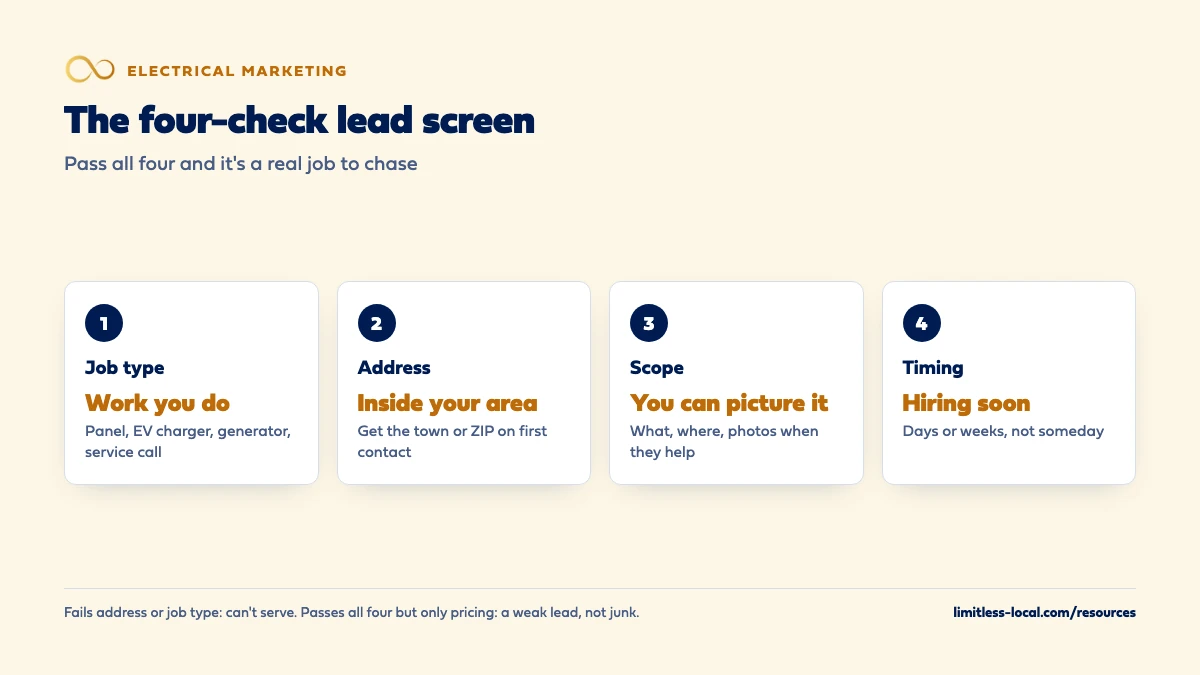
Use the same four checks on every call, text and form. A lead that passes all four is a real job to chase.
- Job type. It’s work you do and want: a panel upgrade, an EV charger, a generator, a rewire, a service call you’d take.
- Address. The job is in a town or ZIP code you actually serve. Get the address or at least the ZIP on the first contact.
- Scope. You can picture the job. “Two outlets dead in the kitchen” is a scope. “Need some electrical work” isn’t yet, so ask one more question.
- Timing. They plan to hire in days or weeks, not “sometime next year.”
One more check matters for electrical work: is the caller the person who can say yes? A tenant can’t approve a panel swap, and a property manager may need the owner to sign off. That doesn’t make the lead junk, but it changes who you need on the phone.
Where do price shoppers and tire-kickers fit?
In the middle. A homeowner calling four electricians for a number on an EV charger passes the four checks; they’re just less likely to pick you. The same goes for someone pricing a generator before storm season or a buyer getting quotes on a house they haven’t closed on yet.
Call these weak leads, not junk, for two reasons. First, some of them do book, especially if you answer fast and explain the job well. Second, if you lump them in with spam, your junk count tells you nothing useful. A source with lots of weak leads needs better screening and pricing conversations. A source with lots of junk needs fixing at the targeting level.
If price shoppers are eating your estimate time, stopping price shoppers from wasting your electrical estimates covers the screening and fee options.
What should my office ask on the first call?
Four or five questions are enough, asked like a conversation and not like a form:
- “What’s going on?” Let them describe it. You’ll hear the job type and the urgency in the first sentence.
- “What’s the address?” Asking for the address early sorts out-of-area calls before anyone spends time on them.
- “How old is the house, and what’s the panel like?” This helps you picture the scope and spot bigger work.
- “When are you hoping to get this done?” Separates today from someday.
- “Are you the owner?” Only when the job needs owner approval.
Then mark the lead in your software before the call ends. The person answering the phone is the best judge of what kind of lead it was, and memory fades by Friday.
How do I screen web forms and text leads?
Forms collect more junk than calls, because bots and bored people can fill them out for free. A few changes help a lot:
- Make the ZIP code and job type required fields, with job type as a short dropdown of the work you do.
- Add a timing question with three choices: urgent, within a few weeks, just planning.
- Let people attach photos of the panel or the problem. Serious homeowners will; spammers won’t.
- Use a spam check on the form.
Ad filters can’t stop fake form fills once someone reaches your site. Google’s help page About invalid traffic calls lead quality a shared effort and suggests securing lead forms with tools like reCAPTCHA and server-side validation. A text or chat lead gets the same four checks as a call, just in writing.
Curious what your marketing is actually booking?
Get a free visibility audit — no obligation, no sales pitch.
Why do my Google Ads bring in so much junk?
Usually because the ads are showing for searches that were never about hiring an electrician. Someone typing “electrician salary” or “how to wire a three-way switch” isn’t a customer, but a loose keyword can still put your ad in front of them.
The search terms report shows the actual searches that triggered your ads. Read it every week or two in the first months, and add the bad ones as negative keywords so your ads stop showing for them. The negative keywords electricians should add first gives you a starter list.
Out-of-area calls are the other big source. If a lot of your junk is from towns you don’t serve, the location settings are the fix, not the office script.
Do I pay for junk leads from Local Services Ads?
Often not. According to Google’s page on how leads work, leads are first assessed when the customer makes contact, and ones judged invalid or low quality aren’t charged. Charged leads keep being assessed over a 30-day period, and a poor-quality, duplicate or invalid lead gets credited back automatically. Each lead shows as Charged, Not charged, In review or Credited.
Two details help an electrician. Once you’re charged for a customer, follow-up calls or messages from the same phone number or email aren’t charged again as long as there’s contact within 15 days. And if you’re getting leads you don’t want, refine your service areas, categories and service types: narrowing them can help attract your ideal customers, though it may cut overall lead volume. Use the feedback survey on each bad lead, too. Whether Local Services Ads are worth it for electricians covers the rest.
How should I tag leads so my numbers mean something?
Give every contact one of four tags: not a lead, can’t serve, weak or real. Then, for the real and weak ones, track whether they booked and whether the job sold. Put the lead source on every record too. Housecall Pro’s lead source field works on customers, jobs and estimates, and most field software has something similar.
Watch how your tools count leads by default. ServiceTitan’s call classifications treat any answered call longer than a minute as a lead unless you set up call reasons first, and a call that lasts that long without a booking counts as unbooked. Google Ads can count a call as a conversion once it passes a minimum length you set, or by having Google’s AI review the call recording. Either way, a long wrong-number call or a chatty sales pitch can land in your lead count unless someone reclassifies it.
The point of tagging is a clean bottom line: cost per real lead and cost per booked job, by source.

How much junk is normal?
There’s no reliable published share for electricians, and any number you see online counts something different from what you count. The useful comparison is your own: the share of junk by source, month over month.
Some junk is part of any marketing that reaches the public. What you’re watching for is change. If one source’s junk share jumps, or junk starts coming mostly from one campaign, one keyword or one town, that’s a signal to dig in. On the ad side, two signs worth checking are a spike in clicks without more conversions and clicks from outside your targeted locations, and the same patterns are worth watching in your call log.
To compare sources on the quality of what’s left after the junk, which channel brings electricians the highest-quality leads walks through revenue per lead.
When does junk mean something is broken?
Look at what kind of junk you’re getting, because each kind points to a different fix:
- Lots of “not a lead” calls and fake forms: spam filtering on forms, and ad placements or keywords pulling in the wrong traffic.
- Lots of “can’t serve” by address: your Google profile service area, ad locations or city pages reach past where you work.
- Lots of “can’t serve” by job type: your profile, website or ads describe work you don’t do, or describe your work too loosely.
- Lots of weak leads: your ads and pages lead with price or “free estimates” and attract shoppers.
- Plenty of real leads but few bookings: that’s not a junk problem. It’s speed, follow-up or the sales conversation.
That last one matters most. Owners often blame lead quality when real leads are going cold. Whether your close rate is good shows how to split the funnel and find the weak stage.
Should I ever chase a lead that looks like junk?
Yes, when it’s unclear rather than clearly junk. A hang-up from a local number, a form with only a name and phone, or a voicemail that says “call me about my lights” can all be real jobs from people in a hurry. A quick callback costs a few minutes; a missed panel upgrade costs a lot more.
Set a simple rule: call back anything that might be local and might be your work, once, the same day. If it still fails the four checks after one conversation, tag it and move on. Don’t chase obvious spam, and don’t spend estimate visits on leads that failed the address or job-type check.
Not sure which of these is costing you jobs?
A free visibility audit checks the Google profile, reviews, site and tracking, and shows what to fix first.
What's different about lead quality for electricians
Emergencies sound rushed, not junky. A homeowner with half the house dark or a burning smell from an outlet will give you short answers and want someone now. That call can sound thin on scope, but it’s often the most real lead you’ll get all week. Ask the address and send help; the scope questions can wait.
Do-it-yourselfers call electricians a lot. Electrical questions draw people who want free advice on a breaker, a switch or a fixture. Your office can be friendly and brief, and your ads and pages can avoid “how to” topics that attract them.
Small calls can hide big jobs. A dead outlet in an older house can turn into a panel replacement or a rewire once you’re on site. Don’t tag small service calls as weak just because the first ticket is small.
Commercial leads need different questions. A property manager or business owner may need a bid, a certificate of insurance or a site walk before anything happens. Score them on fit and timing the same way, but expect a longer path to a booked job.
A worked example: what junk does to your cost per job
These numbers are made up to show the math, not a benchmark for any market or channel. Say one source brings you 50 contacts in a month and costs $3,000.
- 10 aren’t leads at all (spam, sales calls, wrong numbers).
- 6 are real people you can’t serve (out of area or work you don’t do).
- 9 are weak leads (price shoppers and far-off plans).
- 25 are real jobs to chase, and 12 of them book.
Counted the usual way, that’s $3,000 divided by 50 contacts, or $60 per lead. Counted honestly, it’s $3,000 divided by 25 real leads, or $120 per real lead, and $3,000 divided by 12 booked jobs, about $250 per booked job. The 16 junk contacts are 32% of everything this source sent you.
If $250 is well under what a booked job is worth to you, the source is paying its way despite the junk. If it isn’t, cutting the junk share is the cheapest place to start, because it lowers cost per booked job without needing a single extra lead.
Frequently asked questions
Is a short call always a junk lead?
No. Emergency callers often keep it short, and some hang up and call right back. Judge by the four checks, not by call length, and call back short calls from local numbers once.
Do I pay for junk clicks on Google Ads?
Not for traffic Google detects as invalid, such as bots, before billing; it’s removed automatically, and invalid traffic found later is credited where appropriate and possible. A real person who clicks and turns out to be a bad fit is still a paid click, which is why targeting matters.
Should my office or my techs do the screening?
The office, on the first contact. Techs should confirm scope on site, but the address, job type and timing checks belong before anyone gets in the truck.
Can junk leads make my Google Ads worse?
They can if junk calls count as conversions, because automated bidding learns from conversion data. Count only qualified calls or booked jobs as conversions where you can, and fix how calls are counted before trusting the cost per conversion.
Is an out-of-area lead worth anything?
Sometimes. If it’s a big job just past your line, it may be worth the drive. If not, passing it to an electrician you trust builds goodwill, but tag it as can’t serve so your numbers stay honest.
How long should I track before deciding a source is junk?
At least a couple of months, and long enough to see a few dozen contacts from that source. One bad week can make any channel look terrible.
Key takeaways
- A real job passes four checks: job type, address in your area, a clear scope and hiring soon.
- Split junk into “not a lead” and “can’t serve”, because each points to a different fix.
- Price shoppers and curious homeowners are weak leads, not junk.
- Tag every contact and its source, and watch how your software and Google Ads count calls by default.
- Judge each source on cost per real lead and cost per booked job, not cost per contact.
Want a second set of eyes on your setup?
We'll look at how you show up locally and where calls are leaking, then send you a plain-English breakdown.
More in this section
- Which channel brings electricians the highest-quality leads?
- Can an electrician get enough leads without paid ads?
- How can an electrical contractor get more leads?
- Should electricians pay for leads from Angi or Thumbtack?
- How do electricians work out profit per job and customer value?
Sources
- How leads work — Local Services Help
- About invalid traffic — Google Ads Help
- About the search terms report — Google Ads Help
- Measure calls from ads — Google Ads Help
- Understand call classifications — ServiceTitan Help
- How to Use Lead Sources — Housecall Pro Help Center