
Which parts of plumbing marketing need an expert?
- Which plumbing marketing tasks need specialist skill, and which can an owner handle alone?
- How do I tell which marketing tasks need an expert?
- Which plumbing marketing can an owner run alone?
- Why is Google Ads hard to get right without an expert?
- Why does call and conversion tracking need specialist skill?
- Which parts of plumbing SEO need an expert?
- Does a Google Business Profile need an expert?
- Do Local Services Ads need an expert?
- Does my plumbing website need an expert?
- How do I check an expert's work without being an expert?
- Which decisions should stay with the owner?
- Can I get expert help for just one part?
- What's different about the expert line for plumbing companies
- A worked example: what doing your own Google Ads really costs
- Frequently asked questions
- Key takeaways
- More in this section
- Sources
The short version
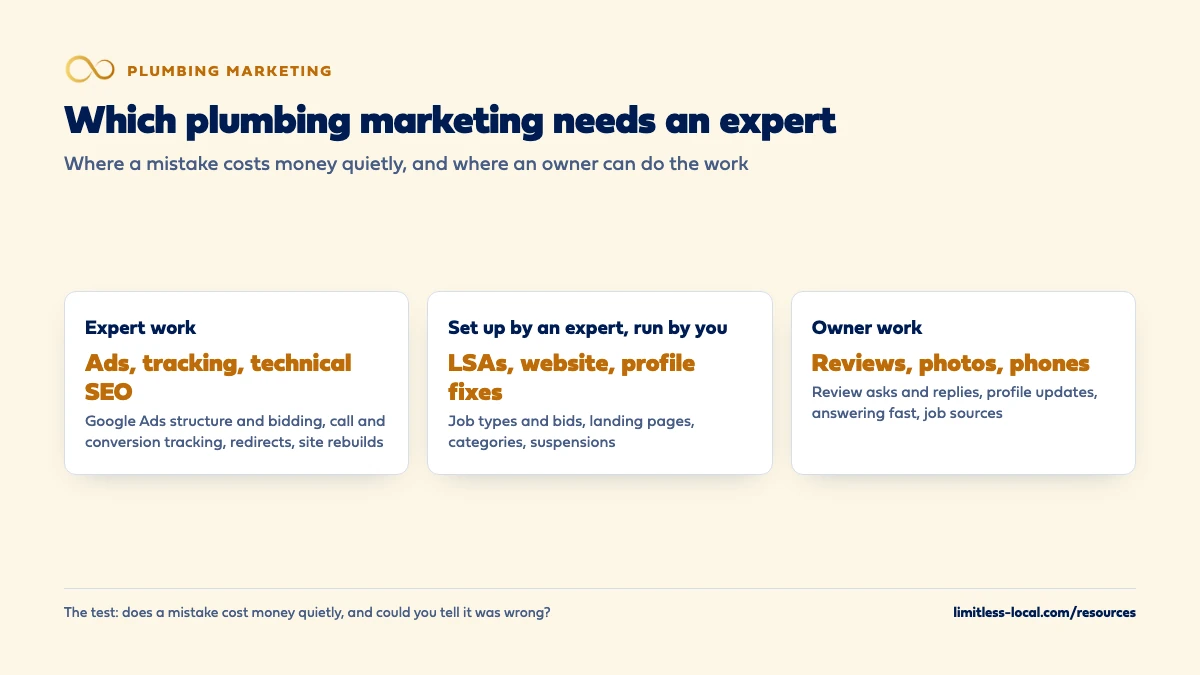
- Expert work: Google Ads setup and bidding, call and conversion tracking, technical SEO and website changes.
- Owner work: reviews, Google profile updates, job photos, answering calls, tagging job sources.
- The test: does a mistake cost money quietly, and could you tell it was wrong?
- Keep the decisions and the account ownership with you, whoever does the work.
For plumbing owners who are happy to roll up their sleeves on marketing but want to know where doing it yourself starts costing more than it saves.
Get a free visibility audit · Book a growth call
Which plumbing marketing tasks need specialist skill, and which can an owner handle alone?
The parts of plumbing marketing that most need an expert are Google Ads structure and bidding, call and conversion tracking, and technical website and SEO work, because mistakes there waste money quietly and are hard to spot without training. Most owners can run the rest themselves: asking for reviews, keeping the Google Business Profile current, posting job photos, answering calls fast and marking where each job came from. Bring in help for the specialist pieces first, and keep the decisions about jobs, towns and budget with you.
The specialist pieces on that list, Google Ads, call tracking with attribution, local SEO and the Google Business Profile, are what our packages bundle together for plumbing companies, with a real-time dashboard so you can check the work. The owner pieces stay yours. The rest of the plumbing marketing questions library covers each task in more depth.
How do I tell which marketing tasks need an expert?
Ask three questions about each task:
- Does a mistake cost money quietly? A badly set up ad campaign keeps spending every day whether it books jobs or not. A missed review request costs you one review.
- Does it need platform know-how that keeps changing? Google Ads settings, bidding options and tracking tools keep changing. Asking a customer for a review works the same way it did ten years ago.
- Could you tell if it was wrong? If you can’t look at the result and see a problem, you can’t catch one.
Three yeses means expert work. Three noes means owner work, even if it’s tedious. Mixed answers usually mean you do the task and an expert sets it up or checks it once in a while.
This is a different question from who does the hours. What plumbing marketing to keep in-house versus outsource is about time and cost; this page is about skill.
Which plumbing marketing can an owner run alone?
More than most agencies will tell you. Google’s own page, Do you need an SEO?, says that if you run a small local business, you can probably do much of the work yourself. The same goes for these:
- Asking for reviews. A text with your Google review link after every finished job. The tech or the office can own it.
- Replying to reviews. A short, specific thank-you to the good ones and a calm reply to the bad ones.
- Keeping your Google Business Profile current. Hours, holiday hours, services and new photos of real jobs.
- Answering the phone fast, including a plan for nights and weekends.
- Marking where each job came from in your field service software.
- Posting on Nextdoor and Facebook about finished jobs and seasonal reminders.
None of these needs training. They need a habit and someone whose job it is.
Why is Google Ads hard to get right without an expert?
Because the default settings are built to spend your budget, not to book plumbing jobs, and the mistakes don’t announce themselves. The usual ones:
- Paying for the wrong searches. “Plumber salary”, “how to fix a running toilet” and “plumbing supply store” can all trigger your ads unless someone keeps blocking them. Using negative keywords to stop wasted plumbing ad spend shows how.
- One campaign for every job. A drain cleaning and a sewer line replacement are worth very different amounts, so they need their own budgets and bids.
- Ads running when nobody answers. Emergency ads at 2 a.m. only make sense if someone picks up at 2 a.m.
- Automated bidding fed bad data. Google’s page About conversion measurement says Smart Bidding strategies need a standard 7 to 14 day learning phase, and that frequent changes to budgets, targets or conversion goals during that period reset it. If the conversions it’s learning from are wrong, the bidding learns the wrong thing.
You can learn all of this. The question is whether you want to spend a few hours a week on it, every week, while the account keeps spending.
Why does call and conversion tracking need specialist skill?
Because everything else is judged by it. If tracking is wrong, every report you get afterward is wrong, and you can’t tell.
Tracking for a plumber has several moving parts: call tracking numbers that don’t mess up the business details on your Google profile, a tag on your website that records calls and form fills, a rule for which calls count (a two-minute call from a new customer, not a 10-second wrong number), and a way to send booked jobs back to Google Ads. Google’s page on offline conversion imports explains that an ad often starts a path that ends in a sale over the phone, and that importing those offline conversions lets you measure what happened after the click or call.
It’s mostly a set-up-once job, but it has to be set up right and checked after every website or software change. Which conversions to track in plumbing Google Ads lists what should count.
Which parts of plumbing SEO need an expert?
Split SEO in two. The content side, describing your services, towns and real jobs in plain words, is something you know better than anyone. The technical side is where expertise pays.
Technical advice on hosting, redirects, error pages and JavaScript is the part of SEO that can quietly break rankings, and it’s where a good specialist pays for themselves:
- Moving or rebuilding your website. Google’s guide to site moves and migrations says to expect temporary ranking fluctuation during a move, recommends permanent redirects such as 301s, and says a small to medium-sized site can take a few weeks for most pages to move. A rebuild without redirects can lose years of work.
- City and service pages at scale. Ten near-identical town pages can hurt more than help.
- Site speed, mobile layout and indexing problems that only show up in Search Console.
A site redesign or a new site launch is the best time to hire for this. If you’re about to rebuild, bring someone in before the old site comes down.
Curious what your marketing is actually booking?
Get a free visibility audit — no obligation, no sales pitch.
Does a Google Business Profile need an expert?
Day to day, no. Google’s help on improving your local ranking comes down to things an owner can do: verify the business, keep the information complete and accurate, respond to reviews, and add photos and videos. It also says local results are mainly based on relevance, distance and popularity, and that there’s no way to request or pay for a better local ranking.
Bring in help for the tricky cases:
- Setting up as a service-area business, with no address shown, when you work from home.
- Choosing primary and secondary categories when you also do drains, water heaters or water treatment.
- Duplicate listings, or a listing someone else claimed.
- A suspended profile. What to do when a plumbing Google Business Profile is suspended covers the appeal.
Do Local Services Ads need an expert?
Less than regular Google Ads. There are no keywords to manage, and the setup is mostly your job types, service area, budget, hours and reviews, which an owner can handle.
Expertise starts to matter in three places: choosing which job types to turn on so you aren’t paying for leads you don’t want, setting the target cost per lead, and keeping the leads answered and marked so you can see which ones booked. As Local Services Ads move into the main Google Ads platform, they also sit next to your search campaigns, so whoever runs one should be able to see the other.
Does my plumbing website need an expert?
It depends on what you need it to do. A simple site from a good template, with your phone number at the top, a page per main job and real photos, is something many owners set up themselves.
An expert earns their fee when the website has to work hard: turning ad clicks into calls, loading fast on a phone, carrying tracking, ranking for jobs in several towns. If you’re sending paid traffic to it, it’s part of the ad campaign, and a slow page or a buried phone number wastes money on every click.

How do I check an expert's work without being an expert?
You don’t need to know how to build a campaign to see whether it’s working. Learn enough of the basics to ask good questions and to recognize a technique that isn’t recommended.
Then ask for these every month:
- Calls and form leads by source, with call recordings you can spot-check.
- Booked jobs and revenue by source, matched to your field service software.
- Cost per booked job for each paid channel.
- A plain list of what changed and why.
Nobody can promise a number one ranking, so walk away from anyone who does, claims a special relationship with Google, or won’t explain what they’re changing. If someone offers an SEO audit, grant only read access to Search Console. What makes a good plumbing marketing company has more questions to ask.
Which decisions should stay with the owner?
Even the best expert shouldn’t make these for you:
- Which jobs you want more of, and which you’d rather not get.
- Which towns your trucks will actually drive to.
- How much you’ll spend each month, and when to raise or cut it.
- Any offer, price or promise that goes in front of customers.
- Who owns the accounts. Your Google Ads account, Google profile, website and tracking should all be in your name.
An expert should bring you options and numbers for each one. How much control plumbers give up by outsourcing marketing goes through the rest of the line between their work and your decisions.
Can I get expert help for just one part?
Yes, and it’s often the smartest first step. Common one-part setups for a plumbing company:
- Tracking set up once, then you watch it yourself.
- A one-time audit of your ads, profile and website, with a fix list you work through.
- Ads only, while you keep reviews, the profile and posting in-house.
The catch with splitting work is the handoffs. If one person runs ads, another the website and a third the tracking, nobody owns the whole path from click to booked job. Whoever runs your paid ads should at least be able to see the tracking and the landing pages.
Not sure which of these is costing you jobs?
A free visibility audit checks the Google profile, reviews, site and tracking, and shows what to fix first.
What's different about the expert line for plumbing companies
After-hours ad scheduling is a specialist call. Plumbing emergencies come in at night and on weekends. Deciding whether to run ads then, how hard and on which jobs depends on who answers, and getting it wrong burns money fast.
Big tickets hide in the tracking. A call that starts as a leak check can turn into a repipe weeks later. Connecting that revenue back to the original call takes careful tracking setup in ServiceTitan, Housecall Pro or Jobber, and it’s exactly what makes the ad math work.
Freeze and storm surges. A cold snap can swamp the phones in a day. Raising budgets ahead of it, then pulling back, is easier for someone who watches the account daily than for an owner who’s out on calls.
A worked example: what doing your own Google Ads really costs
These numbers are made up to show the math, not a benchmark. Say an owner runs his own Google Ads and spends about 5 hours a week on it, and he values his time at $100 an hour, since that’s what an hour on a billable job is worth to him. That’s 5 hours times 4 weeks times $100, or $2,000 a month of his time.
Now say a review of the account finds $600 a month going to searches that never book, like DIY repair questions and job seekers. His real cost of running ads himself is $2,000 plus $600, or $2,600 a month, before the ad spend that does work.
Compare that with paying for it. Our Essentials package is $3,500 a month and includes Google Ads management for up to $2,500 a month in ad spend, plus local SEO, Google Business Profile management, review generation and call tracking with a real-time dashboard. Ad spend is paid to Google separately. If your spend is small and your hours are cheap, doing it yourself may well be the better deal. If your hours on the tools are worth more than the fee, it usually isn’t.
Frequently asked questions
Can I learn Google Ads well enough to run my own plumbing ads?
Yes, many owners do. Expect to spend a few hours a week on it, every week, and get the tracking right first, because bidding learns from whatever you count as a conversion.
Is SEO something a plumber can do alone?
Much of it, yes, especially for a small local business. The technical pieces, like redirects during a website rebuild, are where outside help is worth paying for.
Should I hire a freelancer or an agency for the expert parts?
Either can work. A freelancer can be a good fit for one task, like tracking setup. An agency makes more sense when ads, tracking and SEO need to work together and someone has to own the whole path to a booked job.
What's the most expensive marketing mistake a plumber makes alone?
Usually paid ads without working tracking. The money keeps going out, and there’s no way to see which calls or jobs it produced.
Do I need an expert to respond to bad reviews?
No. A calm, short, specific reply from the owner usually reads better than anything polished. Get help only when a review breaks Google’s rules and you need it reported.
Can my office manager handle the marketing?
The owner-work list, yes: review requests, profile updates, photos and job sources. Give the expert pieces to someone trained, and have the office manager check the monthly numbers with you.
Key takeaways
- Expert work is where mistakes cost money quietly: Google Ads structure and bidding, call and conversion tracking, and technical SEO.
- Owners can run reviews, profile updates, job photos, phones and job-source tagging themselves.
- Local Services Ads, the website and Google profile fixes sit in the middle: expert setup, owner upkeep.
- Learn enough to check the work: calls, booked jobs and cost per booked job by source, every month.
- Keep decisions about jobs, towns, budget and account ownership with you.
Want a second set of eyes on your setup?
We'll look at how you show up locally and where calls are leaking, then send you a plain-English breakdown.
More in this section
- What makes a good plumbing marketing company?
- What needs fixing before I launch my plumbing marketing?
- Should I hire a plumbing marketing agency or do it myself?
- What plumbing marketing should I keep in-house vs. outsource?
- What should a complete plumbing marketing plan include?
Sources
- Do you need an SEO? — Google Search Central
- About conversion measurement — Google Ads Help
- About offline conversion imports — Google Ads Help
- Site Moves and Migrations — Google Search Central
- Tips to improve your local ranking on Google — Google Business Profile Help
- Local Services Ads transition to Performance Max campaigns with pay-per-lead goals — Google Ads Help