
Does my marketing history affect selling my HVAC business?

- Which marketing records and accounts do buyers look at when you sell an HVAC company?
- Why would a buyer care about my marketing history?
- Which marketing assets does a buyer look at?
- Do my Google reviews transfer with the business?
- Who actually owns your marketing accounts right now?
- What happens to my phone numbers when I sell?
- Which marketing records should I have ready?
- Does it hurt if the business depends on me?
- What marketing problems can worry a buyer?
- How far ahead should I start getting the marketing ready?
- Should I cut marketing to make the profit look better?
- What should the sale paperwork say about marketing assets?
- What's different about selling an HVAC company's marketing history
- A worked example: turning marketing records into something a buyer can use
- Frequently asked questions
- Key takeaways
- More in this section
- Sources
The short version
- Buyers use your marketing history to judge whether the work keeps coming after you leave.
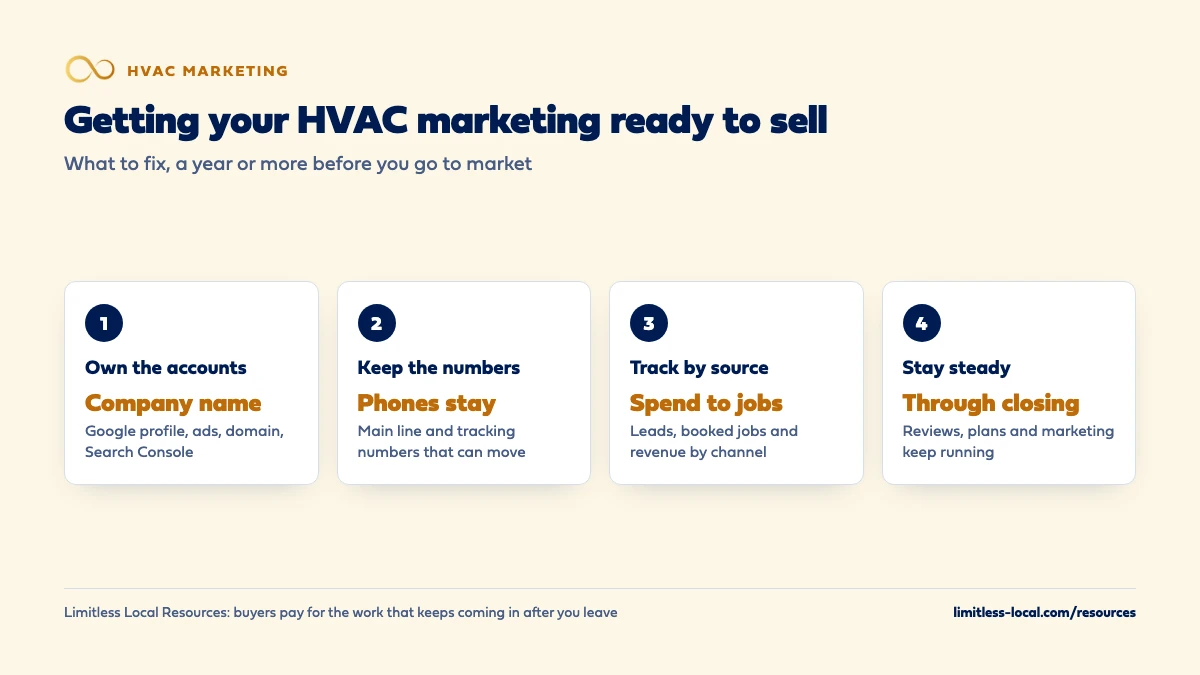
- Make sure the Google profile, website, domain, ad accounts and phone numbers are in the company's name.
- Keep records of spend, leads, booked jobs and revenue by source for the last few years.
- Start a year or more before you sell, and keep marketing steady through the sale.
For HVAC owners who plan to sell in the next few years and want the marketing side of the business to help the sale, not slow it down.
Get a free visibility audit · Book a growth call
Which marketing records and accounts do buyers look at when you sell an HVAC company?
Yes. A buyer is paying for work that keeps coming in after you leave, and your marketing history is the proof: years of steady Google reviews, a Google Business Profile, website and phone numbers that belong to the company, and records showing which lead sources produced which booked jobs and at what cost. Clean, transferable accounts and tracked results make the business easier to understand and easier to hand over. Accounts in an old agency’s or employee’s name, untracked spending, or a phone that only rings because of the owner’s personal network all give a buyer reasons to worry.
Tracked results are what make a marketing history worth something to a buyer. Every one of our packages includes monthly performance reports with a cost-per-lead breakdown, call tracking with recording, source tagging on every lead and a real-time dashboard, so the record builds itself while you run the business. Our HVAC marketing page shows how that works for the trade, the HVAC marketing guide covers every channel, and the HVAC marketing questions library goes question by question.
Why would a buyer care about my marketing history?
Because the buyer is betting on next year’s calls, not last year’s. When you sell, you’re handing over trucks and tools, but most of what someone pays for is the expectation that homeowners will keep calling once your name isn’t on every estimate.
The SBA’s guide to closing or selling your business says to value intangible assets like brand presence, customer information and projected future revenue, and it lists an income approach to valuation that looks at projected revenue and accounts for risk. Your marketing history speaks to all three. It shows how known the brand is, how many customers you have on file, and how predictable new work is.
That’s why two HVAC companies with the same revenue can look very different to a buyer. One can show where every booked job came from for the last three years. The other has a shoebox of invoices and an owner who says “the phone just rings.”
Which marketing assets does a buyer look at?
Expect a serious buyer to ask about most of these:
- Your Google Business Profile: its reviews, rating, review history and who controls it.
- Your website and domain: who owns them, how much traffic and how many calls and forms the site brings in.
- Your phone numbers: the main line, tracking numbers and whose account they sit in.
- Ad accounts: Google Ads and Local Services Ads, with their spend and lead history.
- Your customer list: past customers, open estimates and, in HVAC especially, maintenance plan members.
- Your brand: the name, logo, truck wraps and how well known it is in your service area.
- Results by source: what you spent on each channel and what it booked.
Some of these are assets that change hands at closing. Others are evidence that helps a buyer believe the revenue will continue. Both count.
Do my Google reviews transfer with the business?
They can, if the Google Business Profile itself is handed over properly. Google’s help page on transferring primary ownership says that if you’re transferring ownership of your business, you should transfer primary ownership of the profile to the new owner, which keeps your business info, like reviews. Only the primary owner can do that transfer, and a new owner or manager has to wait 7 days before they can manage every feature.
The catch is that you can only hand over what you control. If the profile’s primary owner is a former office manager, an old agency or a personal account you’ve lost the password to, fix that now, not during the sale. Google’s guide to managing owners and managers explains the roles: owners have full control, including adding and removing users, while managers can do most daily work but can’t add or remove users.
Buyers usually look at the review history as well as the total. A steady stream of reviews over several years reads as a business that keeps customers happy, while a burst followed by silence raises questions. The buyer’s side of this handover is covered in what to do with the marketing after buying an HVAC business.
Who actually owns your marketing accounts right now?
Run this check a year or more before you sell. For each account, write down who’s listed as the owner and which email address controls it:
- Google Business Profile: the primary owner.
- Google Ads: who has admin access. Google’s page on ownership of client accounts explains that an agency’s manager account can be made the owner of your account, but the client account still owns its data and can remove that ownership by unlinking the agency’s manager account.
- Search Console: the verified owner. Google’s Search Console permissions page notes a property must have at least one verified owner, or nobody can access it.
- Domain registrar and web hosting: the account holder and the renewal card on file.
- Call tracking, email marketing and social pages: the account holder and admins.
Anything owned by an employee’s personal email, a past agency or a freelancer is a problem to fix. Move ownership to a company email that will go to the buyer, and keep outside help as users, not owners. How much control over your HVAC brand to keep when hiring an agency covers how to set this up going forward.
What happens to my phone numbers when I sell?
Your main number is one of the most valuable things you hand over. It’s on years of invoices, magnets, truck wraps and directory listings, and past customers will dial it for years.
Phone numbers can move between carriers. The federal rule on porting intervals says carriers that must port numbers have to complete a simple port request within one business day, unless the new provider or the customer asks for longer. So if the buyer runs a different phone system, the number can usually move with the business.
Tracking numbers need more care. If they live in a vendor’s or agency’s account, find out now whether they can be moved to yours, and make a list of where each one is used, from your Google profile to your ads. A tracking number that goes dead after the sale can quietly cut off calls from the source it was measuring.
Curious what your marketing is actually booking?
Get a free visibility audit — no obligation, no sales pitch.
Which marketing records should I have ready?
ServiceTitan’s Contractor Playbook chapter on preparing your company for sale warns that buyers will ask lots of questions and dig deep into financials, and it tells sellers to get their processes, data and financials in order. It also notes that when buyers purchase a company, what they’re really buying is the team. On the marketing side, that means records like these, ideally for the last two or three years:
- Marketing spend by channel, by month.
- Leads by source, by month.
- Booked jobs and revenue by source.
- Cost per booked job for each channel.
- Review count and rating over time.
- Maintenance plan members, sign-ups and renewals.
- The share of jobs from repeat customers and referrals.
If you don’t track by source today, start now. Even a year of clean records is far more convincing than an estimate. How to track whether your HVAC marketing is paying off walks through the setup.
Does it hurt if the business depends on me?
Usually, yes. If the phone rings because homeowners know you personally, or because your cell is the number on the truck, a buyer has to wonder how much of that walks out the door with you.
A few ways to move demand from you to the company:
- Put the company name, not yours, at the center of the website, the ads and the truck wraps.
- Route calls to the office line instead of your cell, and let your team handle booking and follow-up.
- Have techs and office staff ask for reviews, so reviews mention the team and the company, not just you.
- Write down how leads are handled, so the next owner can see the process works without you in the room. How written office procedures help an HVAC company book more shows what to put on paper.
A business whose calls come from its brand, its reviews and a team that books them on its own is a business a buyer can step into.
What marketing problems can worry a buyer?
Most of these are fixable if you spot them early:
- Spending with no tracking. If you can’t say what a channel booked, a buyer can’t count it.
- One source for most of the work. Heavy reliance on a single lead platform or ad account looks fragile.
- Accounts the company doesn’t control. See the ownership check above.
- Unanswered bad reviews or a review count that stopped growing years ago.
- A long contract with a marketing vendor that the buyer would inherit.
- A sudden spike just before the sale. Pouring money into ads to push revenue up for a few months tends to show up in the records.
- Mismatched business details: different names, addresses or numbers across directories and listings.
If you’re unhappy with a current provider, switch well before the sale, not during it. How to switch HVAC marketing agencies without losing anything covers the handover.

How far ahead should I start getting the marketing ready?
A year or more is a sensible runway, and two or three is better. Reviews build slowly, tracking needs a full year to show seasonal patterns, and SEO typically takes 3 to 6 months to show meaningful organic growth. None of that can be rushed in the last quarter.
A rough order:
- Now: run the ownership check and move every account into the company’s name.
- Next: turn on call tracking and lead sources, and start a monthly record of spend, leads and booked jobs by source.
- Ongoing: keep reviews coming, keep the website and Google profile current, and grow maintenance plans.
- Before going to market: pull two or three years of marketing records into one clean summary.
Then keep running the business. Buyers watch the numbers right up to closing, and a dip during the sale is hard to explain away.
Should I cut marketing to make the profit look better?
It’s tempting, because marketing is an easy line to trim. But cutting it shortly before a sale usually backfires. Calls drop a few weeks later, the pipeline of estimates thins, and the buyer sees a business whose revenue is starting to slide just as they’re about to pay for its future.
Steady is better than lean. Keep spending on what you can show is working, cut what you can show isn’t, and be ready to explain both with your records. A channel you dropped because it cost too much per booked job is a good story. A channel you dropped to make the margins look nicer is not.
What should the sale paperwork say about marketing assets?
Leave no asset or liability out of the sales agreement, and decide ahead of time how the business will be run before closing and how much access the buyer gets to your information in the meantime. For marketing, that usually means listing:
- The domain name, website and hosting account.
- The Google Business Profile and any other listings.
- Phone numbers, including tracking numbers.
- Google Ads, Local Services Ads and social accounts.
- The customer list, maintenance plan members and email lists.
- The business name, logo and any truck wrap designs.
- Open marketing contracts and their terms.
Also agree on a handover period: who moves each login, by when, and who keeps the ads and the phones running in between. A clean handover protects the calls the buyer is paying for.
Want to see where your company stands?
A free visibility audit shows where you show up on Google, Maps and AI answers, and what it's costing you in calls.
What's different about selling an HVAC company's marketing history
Maintenance plans are your recurring revenue. In HVAC, a list of plan members with steady renewals is the most predictable next-year work you have. Keep clean records of sign-ups, renewals and the repair and replacement work that came from plan visits.
Seasonality needs full years of data. A record from May to August will look nothing like one from October to January. Buyers need at least one full year, and two or three show whether the peaks are growing.
Replacement work tells its own story. Show how many replacements came from marketing, from service calls and from plan members. It tells a buyer where the high-ticket work comes from.
Emergency calls lean on the brand. Homeowners with no heat call the name they remember from the magnet or the last visit. A well-known local brand with a long-held phone number is a real asset in this trade.
A worked example: turning marketing records into something a buyer can use
These numbers are made up to show the kind of math a buyer runs, not a benchmark or a valuation. Say your records show that last year you spent $180,000 on marketing and booked 1,200 jobs from tracked sources. That’s $150 per booked job, a number a buyer can plan around.
Say you also have 900 maintenance plan members and an 80% renewal rate. A buyer can expect roughly 720 renewals next year before spending a dollar on new marketing.
Compare that with a company that can only say it spent “around $180,000” and “stays busy.” The revenue might be identical, but only one of them gives the buyer numbers they can check and project forward.
Frequently asked questions
Do buyers really look at Google reviews when buying an HVAC company?
Many do, because reviews show how customers feel about the business and help it keep showing up on Maps. Expect questions about the rating, the count and how steadily new reviews come in.
Can I sell my customer list separately from the business?
What’s included is up to you and the buyer, and it should be spelled out in the sales agreement. Customer lists, job history and maintenance plan members are often part of the sale.
What if an old agency owns my Google Ads account?
Ask them to give your company admin access and remove their ownership. If they won’t, an admin on your account can unlink their manager account. Your account still owns its data, so the history can stay with you.
Should I rebrand before selling?
Usually not. A long-held name, phone number and review history are part of what you’re selling. Changes close to a sale can confuse customers and the buyer.
Does a strong website matter if most calls come from Google Maps?
Yes. Buyers look at whether the website is owned by the company, brings in calls and forms, and supports the Google profile, not just at how it looks.
How many years of marketing records should I keep for a sale?
Two or three full years is a good target for an HVAC company, so a buyer can compare peaks and slow seasons year over year.
Key takeaways
- Buyers use your marketing history to judge whether calls continue after you leave.
- Transfer primary ownership of the Google profile to keep its reviews with the business.
- Move every marketing account into the company’s name well before the sale.
- Keep two or three years of spend, leads, booked jobs and revenue by source.
- Keep marketing steady through closing; a dip during the sale is hard to explain.
Not sure what's working right now?
Start with a free visibility audit: rankings, Google profile, reviews and tracking, checked against your service area.
More in this section
- What should I do with the marketing after buying an HVAC business?
- How do I grow my HVAC company with marketing?
- How do I scale my HVAC business with marketing?
- How do I track whether my HVAC marketing is paying off?
- What happens to my HVAC calls if I stop marketing?
Sources
- Manage your business: Close or sell your business — U.S. Small Business Administration
- Selling Your Company: Chapter 15. Preparing Your Company For Sale — ServiceTitan Contractor Playbook
- Transfer primary ownership of a Business Profile — Google Business Profile Help
- Manage your Business Profile owners & managers — Google Business Profile Help
- Manager Accounts (MCC): About ownership of client accounts — Google Ads Help
- Managing owners, users, and permissions — Search Console Help
- 47 CFR 52.35 — Porting Intervals — Electronic Code of Federal Regulations