
Which marketing tasks should a roofer keep in-house?
- Which roofing marketing jobs should my own team handle, and which should I outsource?
- What does "in-house" mean for a roofing company's marketing?
- Which tasks should always stay with my team?
- Why should reviews and job photos stay with my crews?
- Who in my company should own lead tracking?
- Which marketing decisions should never leave the company?
- Which marketing tasks are usually better outsourced?
- Which tasks can go either way?
- How do I keep control of accounts when tasks are outsourced?
- How do in-house and outsourced work fit together each week?
- When should an outsourced task come in-house?
- What if I don't have office staff yet?
- What's different for roofers
- A worked example: splitting the work at a small roofing company
- Frequently asked questions
- Key takeaways
- More in this section
- Sources
The short version
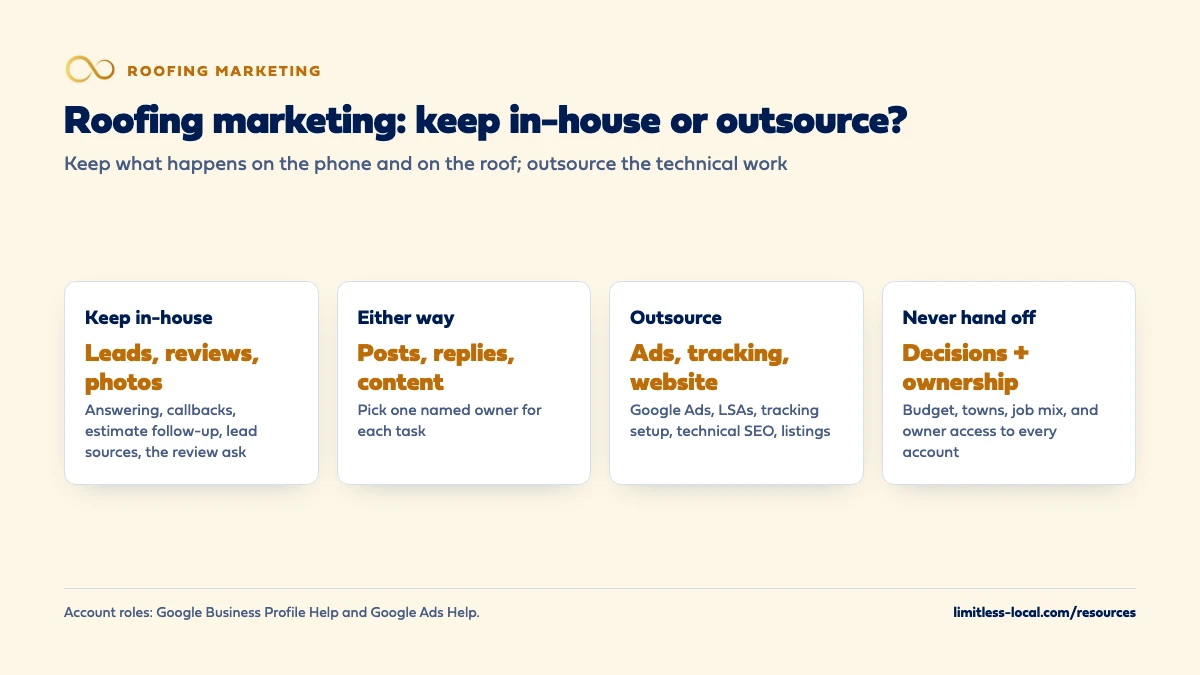
- Keep anything that happens on the phone or on the roof: leads, follow-up, reviews, photos.
- Keep the decisions: budget, towns, job mix, offers and pricing.
- Outsource ads, tracking setup, website and technical SEO, and listings.
- Whoever does the work, your company keeps owner access to every account.
For roofing company owners with an office manager, a salesperson or a few crew leads, deciding which marketing work stays with the team and which goes outside.
Get a free visibility audit · Book a growth call
Which roofing marketing jobs should my own team handle, and which should I outsource?
Keep in-house the marketing tasks that happen on the job site or on the phone: answering and calling back leads, booking inspections, following up on estimates, asking for reviews at the final walk-through, taking job photos, recording where each lead came from, and making the calls on budget, towns and job mix. Outsource the technical work where mistakes cost money quietly: Google Ads and Local Services Ads management, call and conversion tracking setup, website builds and technical SEO, and directory listings. Tasks like Google profile posts and review replies can go either way, as long as your company keeps owner access to every account.
We’re built for exactly this split. Our packages cover the technical side, Google Ads, Local Services Ads on Growth and Scale, Google Business Profile management, local SEO, review generation and call tracking, while your team does what only it can do: answer, inspect, sign and ask for reviews. Onboarding takes your team about 2 to 3 hours. See how it fits a roofing company on our roofing marketing page, read the roofing marketing guide, or browse the roofing marketing questions library.
What does "in-house" mean for a roofing company's marketing?
In-house doesn’t mean you, the owner, doing everything at night. It means the people already on your payroll: you, your office manager or call handler, your salespeople or estimators, and your crew leads. Each of them touches marketing every day, whether they think of it that way or not.
The question isn’t really “do it myself or hire someone”. It’s which tasks only your team can do well, because they happen on the phone, in the homeowner’s driveway or on the roof, and which ones are better done by a specialist who does them every day. Which roofing marketing tasks to do yourself or hand off looks at it from the owner’s own week. This page looks at the whole team.
A simple test helps. If a task depends on being at the job, knowing the customer or making a business call, keep it in-house. If it depends on platform know-how and mistakes are hard to spot, outsource it.
Which tasks should always stay with my team?
Lead handling. No outside company can do it as well as the people who know your schedule, your prices and your crews:
- Answering calls during your listed hours, by someone who can book an inspection on the spot.
- Calling back missed calls and web forms within minutes, not hours.
- Booking and confirming inspections, with a reminder the day before.
- Following up on every unsigned estimate on a set schedule.
These tasks decide whether the leads your marketing buys turn into roofs. An agency can build the ads and the tracking, but if calls ring out at your office, the money’s gone. How fast a roofing company should call back a new lead sets the standard.
Give one person clear ownership of lead handling, even in a small office. When everyone’s responsible, leads slip through.
Why should reviews and job photos stay with my crews?
Because the best moment for both happens on site. The homeowner is happiest at the final walk-through, looking at a clean yard and a new roof. That’s when the crew lead or salesperson should ask for a Google review, with a link or QR code ready. Google’s own tips for getting reviews recommend exactly that kind of reminder.
Photos work the same way. Nobody outside your company can stand on the roof and capture the old decking, the new underlayment and the finished ridge. Make it part of the job checklist:
- A few before shots, a few during, a few after.
- The street view of the finished house.
- Upload them to a shared folder the same day.
Never offer a discount or gift for a review. Google treats incentives for reviews as fake content. Your outside help can turn the photos into posts and send review-request texts, but the ask and the shots start with your crews.
Who in my company should own lead tracking?
Your office. Tracking tools can tag where a call came from, but only your team knows what happened next: inspection booked, estimate sent, signed, lost, and for how much. That information lives in your CRM or job software, and someone in-house has to keep it accurate.
The basics:
- Every lead gets a source, even if it’s just “referral” or “yard sign”.
- Every lead moves through clear stages: new, inspected, estimated, signed or lost.
- Every signed job has its value recorded.
The SBA’s advice on getting the most from a marketing budget points out that tracking can be as simple as reminding employees to ask new customers where they heard about you. It’s the cheapest marketing task there is, and without it nobody, in-house or outside, can tell you which marketing signs roofs.
Which marketing decisions should never leave the company?
You can hand off the work. Don’t hand off the decisions:
- The budget. How much you spend each month, and when it goes up or down.
- The towns. Where you want work, and where you don’t.
- The job mix. Replacements, repairs, storm work, metal, commercial, gutters.
- Offers and pricing. Financing, inspections, warranties and what your ads promise.
- Approvals. Ad copy, website pages and anything that speaks for your company.
Good outside help will make recommendations with the numbers behind them. The final call stays with you, because you’re the one who knows your crews, margins and plans. How much control a roofer should keep over marketing goes deeper on approvals and reporting.
Curious what your marketing is actually booking?
Get a free visibility audit — no obligation, no sales pitch.
Which marketing tasks are usually better outsourced?
The technical ones, where small mistakes cost money without anyone noticing:
- Google Ads and Local Services Ads. Keywords, negative keywords, bids, budgets, location settings and weekly search term reviews.
- Call and conversion tracking setup. Tracking numbers, form tracking and sending signed jobs back to Google so the ads learn.
- Website builds and technical SEO. Speed, mobile layout, service and town pages, and how Google reads the site.
- Directory listings. Getting your name, address and phone consistent across the web.
- Link building. Earning mentions from other local websites.
These reward someone who does them every day across many accounts. A part-time effort in-house usually means settings that drift and money that leaks. Whether you need one marketer or several specialists covers how to cover these skills without a gap.
Which tasks can go either way?
Some tasks fit wherever you have the time and the skill:
- Google profile posts. Easy to do in-house if someone has fifteen minutes a week. Easy to outsource if your team sends the photos.
- Review replies. An owner’s personal reply carries weight, especially to a bad review. Outside help can draft replies for you to approve.
- Social media. Job photos and crew stories are easy in-house. Paid social ads are better outsourced.
- Website content. Your team knows the jobs; a writer knows how to turn that into pages. Best done together.
- Email to past customers. Simple seasonal check-ins can be done in-house from your job software.
For each one, pick an owner and write it down. A task that’s “shared” without a name next to it usually means nobody’s doing it.
How do I keep control of accounts when tasks are outsourced?
Give outside help its own access. Never hand over your password, and never let someone else create accounts in their name for your business.
- Google Business Profile. Keep a company account as the primary owner. Google’s page on owners and managers explains that managers can edit info, respond to reviews and manage posts, but can’t add or remove users or remove the profile. That’s the right level for an agency.
- Google Ads. Keep your company as an admin. Google’s access levels show that standard access can edit campaigns, while only admin access can give account access and change access levels.
- Website, domain and hosting. Registered to your company, with your login.
- Call tracking and CRM. Your account, with outside users added.
When a vendor leaves, you remove their access and keep everything they built.

How do in-house and outsourced work fit together each week?
The split only works if information flows both ways. A simple weekly rhythm keeps it moving:
- Your team sends out: job photos, finished jobs and towns, reviews that need a reply, and any changes in capacity, like a crew out or a storm surge.
- Your outside help sends back: leads by source, what changed in the ads, and anything that needs your approval.
- Once a month, together: signed jobs by source, cost per signed roof, and what to change next month.
Keep it short. A shared folder for photos, one weekly email or message, and a monthly half-hour call cover most roofing companies. If your outside help can’t tell you which leads became signed roofs, the handoff is broken somewhere, usually in tracking or in the CRM.
When should an outsourced task come in-house?
When there’s a full week of marketing work, steady enough to keep one person busy, and the margin to carry a full employee. That cost is more than salary: the Bureau of Labor Statistics’ employer costs release shows benefits made up 31.5% of employer costs for full-time private-industry workers in June 2026.
The first things to bring in-house are usually the coordination tasks: profile posts, photo management, review replies, simple content and keeping the CRM clean. Technical work like ads and tracking often stays outside even after a hire, because one person rarely has every skill.
When a roofing company is ready for a full-time marketing hire walks through the signs and the math.
What if I don't have office staff yet?
Then the in-house list lands on you, and you have to be choosy. Keep the two things that matter most and are hardest to hand off:
- Answering and calling back leads. If you’re on a roof all day, use a forwarding setup that rings a phone someone can actually answer, and block time morning and evening for callbacks.
- Asking for reviews and taking photos. It takes a few minutes per job.
Outsource nearly everything else, and keep the decisions. As soon as you can, a part-time office person who answers calls and keeps the CRM clean is often a better first spend than a bigger ad budget. Whether to hire a roofing-specialist agency or run marketing yourself helps you weigh the outside side of the split.
Not sure which of these is costing you jobs?
A free visibility audit checks the Google profile, reviews, site and tracking, and shows what to fix first.
What's different for roofers
Your crews are your best content team. Roofs are hard for homeowners to see. The photos and short stories your crew leads capture are the raw material for your profile, website and ads, and nobody outside the company can get them.
Storms change the workload overnight. In a surge, lead handling in-house needs more hands fast, while outsourced ads may need to be turned down. Agree ahead of time who makes that call and how quickly.
Salespeople are part of marketing. In roofing, the inspection and estimate decide most jobs. Make sure your sales team records outcomes and sources, or your marketing numbers will never add up.
A worked example: splitting the work at a small roofing company
These numbers are made up to show the split, not a benchmark for your company. A roofer runs three crews with one office manager and one salesperson. Here’s how a week of marketing work divides up:
- Office manager, about 6 hours: answering and returning lead calls, confirming inspections, updating lead stages in the CRM, sending review-request texts.
- Salesperson, about 2 hours: following up on open estimates and recording why lost jobs were lost.
- Crew leads, a few minutes per job: before, during and after photos, and the review ask at the walk-through.
- Owner, about 1 hour: approving ads and pages, replying to the tough reviews, and the monthly numbers call.
- Outsourced: Google Ads, Local Services Ads, call tracking, Google profile management, website updates and SEO.
That’s roughly 9 hours of in-house time a week, spread across people who are already there, on the tasks only they can do. For the outsourced side, our Growth package is $4,500 a month and covers Google Ads, Local Services Ads, Google Business Profile posts three times a week, SEO and advanced attribution; ad spend is paid to Google separately.
Frequently asked questions
Should my office manager run our Google Ads?
Usually not. Google Ads rewards someone who manages accounts every week, and mistakes waste money quietly. Your office manager’s time is better spent answering and converting the leads the ads bring in.
Can I outsource answering my roofing company's phones?
You can, but whoever answers needs to book inspections, know your towns and services, and pass leads to you fast. Check how calls are handled and recorded before you hand it off.
Who should reply to bad reviews?
The owner, or someone who knows the job, usually. A reply from a person who knows what happened reads far better than a generic one. Outside help can draft it for your approval.
Should my sales team post on social media?
Only if they enjoy it and it doesn’t cut into inspections and follow-up. Their job photos and stories are valuable, so make it easy to share them with whoever posts.
Is it risky to have an agency set up my tracking?
Not if the tracking accounts and numbers are in your company’s name and you have admin access. Make sure you can still see your call and lead data if you ever change vendors.
What's the cheapest marketing task to keep in-house?
Recording where every lead came from. It costs a question on each call and a field in your CRM, and it’s what lets you judge every other marketing dollar.
Key takeaways
- Keep in-house what happens on the phone and on the roof: lead handling, follow-up, review asks and job photos.
- Your office should own lead stages and sources in the CRM, since only your team knows what signed.
- Keep the decisions on budget, towns, job mix, offers and approvals with the company.
- Outsource ads, tracking setup, website and technical SEO, and directory listings.
- Give outside help its own access and keep company ownership of every account.
Want a second set of eyes on your setup?
We'll look at how you show up locally and where calls are leaking, then send you a plain-English breakdown.
More in this section
- Which roofing marketing tasks should I do myself or hand off?
- How much control should a roofer keep over marketing decisions?
- How does a roofer run a profitable business with marketing?
- What share of revenue should a roofer put into marketing?
- What does a roofing marketer actually do each month?
Sources
- Manage your Business Profile owners & managers — Google Business Profile Help
- About access levels in your Google Ads account — Google Ads Help
- Tips to get more reviews — Google Business Profile Help
- Employer Costs for Employee Compensation, June 2026 (BLS release, FRASER archive) — U.S. Bureau of Labor Statistics
- How to Get the Most From Your Marketing Budget — U.S. Small Business Administration