
What share of revenue should a roofer put into marketing?

- What percentage of revenue should a roofing company spend on marketing for steady work?
- Is there a standard percentage of revenue for roofing marketing?
- Why is a flat percentage a rough fit for roofing?
- How do I size the budget from the jobs I want instead?
- What should count in my marketing number?
- Should the percentage be based on revenue or gross profit?
- Should I spend a bigger share while I'm trying to grow?
- What if sales drop: should the share go down?
- How does crew capacity change the right share?
- Should the share change with the season?
- How do I know if my share is too high or too low?
- What's different about setting a marketing share for roofers
- A worked example: from a revenue goal to a share of revenue
- Frequently asked questions
- Key takeaways
- More in this section
- Sources
The short version
- General rules of thumb put consumer-facing businesses at about 5% to 10% of revenue; none is specific to roofing.
- Size the budget from the signed jobs you need and what each one costs to win, then check the percentage.
- Count everything: ad spend, agency fees, website, software and signs.
- Spend a bigger share while growing, and less when crews are booked out.
For roofing owners setting a yearly marketing budget who want to know what share of revenue makes sense, and what should change it.
Get a free visibility audit · Book a growth call
What percentage of revenue should a roofing company spend on marketing for steady work?
There’s no standard percentage for roofing, but general small-business rules of thumb put marketing at roughly 5% to 10% of revenue for companies that sell to consumers, and higher while a business is just starting out. Treat that range as a check, not a target. A better way to size a roofing budget is to start from the signed jobs you need, multiply by what a signed job costs you to win, and then see what share of revenue that comes to, adjusting for crew capacity, growth plans and storm season.
Cost per signed roof is the number that matters, and the percentage of revenue falls out of it. Ad spend isn’t included in any of our marketing packages; it’s paid to Google or Meta directly, and we recommend a figure after a quick audit. If you count a management fee in your share, our Essentials package is $3,500 a month. The roofing marketing cost guide lays out what each roofing channel tends to cost, our roofing marketing page covers how we work with roofers, and the rest of the roofing marketing questions library goes question by question.
Is there a standard percentage of revenue for roofing marketing?
No primary source publishes one for roofing. What exists are general small-business rules of thumb, and they’re wide:
- BDC, Canada’s business development bank, says in an article updated in August 2023 that a common rule of thumb is 2% to 5% of revenue for companies that sell to other businesses, and that the share for companies selling to consumers is often higher, between 5% and 10% (What is an average marketing budget for a small business?).
- A guest post on the U.S. Small Business Administration’s blog, from 2019, quotes two outside reports: one that the average business spends 1.08% of revenue on advertising, and one that average marketing spending in 2018 was 7.9% of revenue, with consumer services companies at 11.8% (How to Get the Most From Your Marketing Budget).
Those figures cover every kind of business, not roofers, and the SBA post’s own advice is that there’s no hard and fast answer. It suggests checking with your industry trade association or trade publications for benchmarks. A roofer selling to homeowners sits on the consumer side of BDC’s split, so 5% to 10% is a reasonable range to check yourself against, in our judgement, but not a number to set the budget by.
Why is a flat percentage a rough fit for roofing?
A percentage of revenue was built for businesses whose sales come in fairly evenly. Roofing revenue doesn’t. A few things break the rule for a roofer:
- Storms move the year. A hail season can bring a surge of work in a few months, and a quiet year can cut it. A percentage of last year’s revenue can leave you overspending in a slow year and underspending right when homeowners are searching.
- Few jobs, big tickets. One replacement can be worth dozens of repair calls, so a handful of signed roofs more or less swings the revenue, and the percentage with it.
- Margins vary by job. Materials take a large bite of a replacement. Two roofers with the same revenue can have very different amounts left over to fund marketing.
None of that makes the percentage useless. It makes it a check you run after you’ve sized the budget another way, which the next section covers. That’s our judgement, not a rule from any of the sources above.
How do I size the budget from the jobs I want instead?
Work backward from signed jobs, then turn the answer into a percentage:
- Pick a revenue goal for the year and divide it by your average signed job. That’s how many jobs you need.
- Subtract the jobs that come without paid marketing: referrals, repeat customers, insurance agents and yard signs. What’s left has to come from marketing.
- Multiply those jobs by what a signed job costs you to win through marketing. If you don’t know that number yet, what cost per booked job a roofer should aim for shows how to set a ceiling from your margin and close rate.
- Divide the yearly budget by your revenue goal. That’s your share, and now it means something.
This is the same logic the SBA’s break-even point calculator uses for a whole business: fixed costs divided by what each unit leaves over after its variable costs. Here the unit is a signed roof and the cost is marketing.
What should count in my marketing number?
Count everything you spend to win a job, or the percentage will look better than it is. BDC suggests budgeting for a website, social media, online advertising, traditional media, email newsletters, video and training (BDC). Its cost-of-acquisition example goes further and counts a salesperson’s pay and costs alongside marketing spend (Calculating customer lifetime value and cost of acquisition).
For a roofer, that usually means:
- Ad spend paid to Google, Meta or any lead platform.
- Any agency or freelancer fee.
- The website, call tracking and any software used to follow up on leads.
- Truck wraps, yard signs, mailers and sponsorships.
- If you want the full cost of winning a job, the sales rep or estimator time spent on inspections that didn’t sign.
Whatever you include, keep it the same every month, so you’re comparing like with like.
Curious what your marketing is actually booking?
Get a free visibility audit — no obligation, no sales pitch.
Should the percentage be based on revenue or gross profit?
The published rules of thumb are a share of revenue, and the SBA says a startup should use projected revenue instead of past revenue. That’s the number to use when you compare yourself with those ranges.
For your own decisions, also check it against gross profit, in our judgement. A roofer with a 25% gross margin who spends 8% of revenue on marketing is spending about a third of what’s left after materials and labor (8 divided by 25). A roofer with a 40% margin spending the same 8% is using a fifth of it. Same percentage, very different pressure on the business. What ROI a roofer should expect from a monthly budget goes further into judging return on profit rather than on revenue.
Should I spend a bigger share while I'm trying to grow?
Usually, yes, for a while. The SBA says you’ll need to budget more for marketing when your business is just starting out, and that once you’re established you can reduce it because you’ll have a steady customer base, though you still need to keep marketing to attract new customers (SBA).
The same goes for a roofer trying to add a crew or move into new towns. The extra jobs have to come from marketing, because referrals don’t grow on command. In our judgement, those extra jobs also often cost more each than your first ones, because you’re reaching into towns where nobody knows your name yet. So a growth year can run above your usual share, and that’s fine if you planned it and the cost per signed job holds.
What if sales drop: should the share go down?
Not automatically. The SBA warns that marketing can turn into a chicken-and-egg problem: sales drop, you cut the marketing budget, and sales fall further. It adds that if sales are slowing, it might be the right time to increase marketing, particularly in a slow economy when other businesses are cutting back.
That’s a general point, not a roofing rule. For a roofer, first work out why the work slowed. If it’s winter or a year with no storms, demand is down across the market and more spend may simply cost more per job. If it’s that leads aren’t being answered or estimates aren’t closing, more marketing sends more people into the same leak. The percentage only follows once you know which one it is.
How does crew capacity change the right share?
Your marketing should never sell more roofs than your crews can install in a reasonable time. If you’re booked out for weeks, a higher share of revenue doesn’t buy you more revenue; it buys you longer wait times and homeowners who sign with someone else. In that case, holding the budget steady or trimming it to the jobs you most want is the better use of the money, in our judgement. Whether to pause marketing when crews are booked out walks through that decision.
It works the other way too. If crews are sitting idle, the share you can justify goes up, because the cost of an empty day is already being paid.
Should the share change with the season?
Plan the year as one number and let the months vary. A yearly share of revenue doesn’t mean spending one-twelfth every month. One way to do it, in our judgement, is to keep a base budget running all year, add to it in storm season, then step back down in winter. Ad platforms already pace spend unevenly: Google Ads can spend more on high-demand days, and over a month won’t charge more than your average daily budget times 30.4 for most campaigns (About average daily budgets). Local Services Ads work from an average weekly budget, with a monthly maximum of that weekly budget times 30.4 divided by 7 (How to edit your budget).
How a roofing ad budget should change from storm season to winter covers the month-to-month steps.
How do I know if my share is too high or too low?
Look at the results, not the percentage. It’s probably too high if your cost per signed job keeps climbing, crews are booked out, or a channel is spending without signing roofs. It’s probably too low if your cost per signed job sits comfortably below what a job earns, your ad campaigns show as Limited by budget, and you have room on the schedule.
If the share you can afford comes out small, it can still work when it’s aimed at one channel and a tight service area. Whether a small monthly budget is enough for roofing marketing shows how far a small budget goes, and how much a roofer should spend on ads before calls are steady covers the minimum for ads specifically.
Not sure which of these is costing you jobs?
A free visibility audit checks the Google profile, reviews, site and tracking, and shows what to fix first.
What's different about setting a marketing share for roofers
Storm years skew the base. If last year had a big hail season, a percentage of last year’s revenue can be far more than a normal year supports. In our judgement, it’s safer to base the share on an average of a few years, or on this year’s realistic goal.
Insurance work changes the mix. In our judgement, claim jobs can come with longer waits before a roof signs or gets paid, so revenue can land months after the marketing that won it. Judge the share over the year, not month by month.
Repairs and replacements earn differently. A budget that brings in mostly small leak repairs can look busy and still cost more than those jobs leave over. Set your cost-per-job targets separately for repairs and replacements before you decide what share of revenue to spend.
A worked example: from a revenue goal to a share of revenue
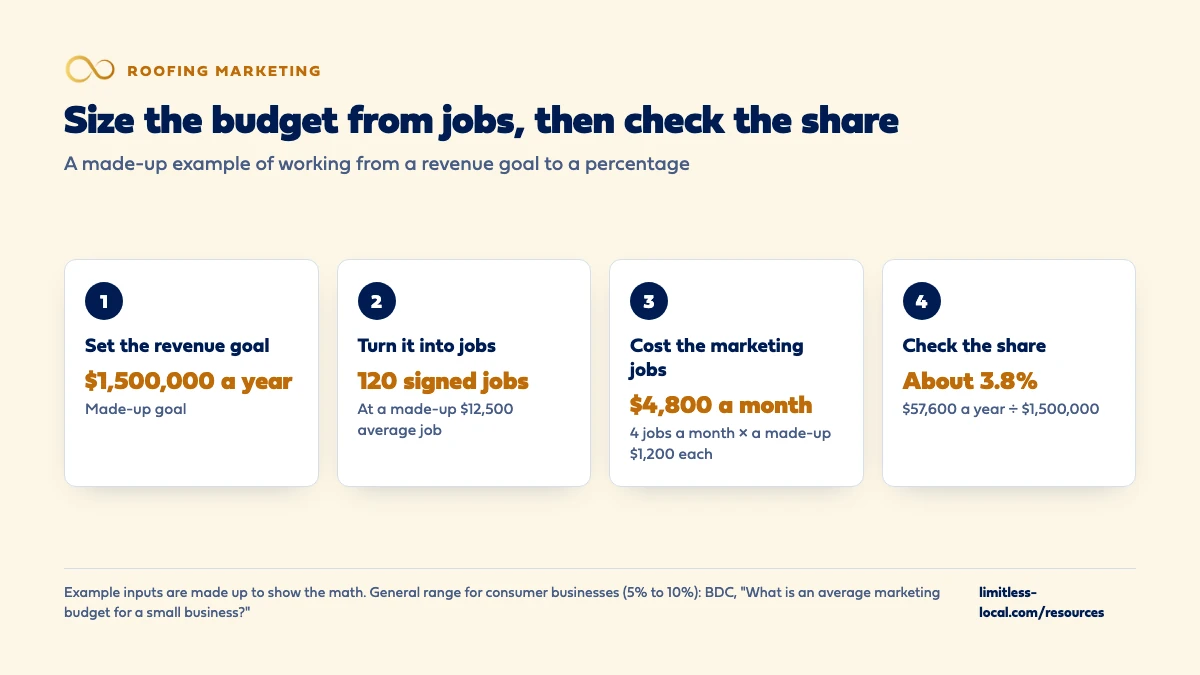
These numbers are made up to show the math, not a benchmark for your market. Say your goal is $1,500,000 in revenue this year and your average signed job is $12,500. That’s 120 signed jobs a year, or 10 a month.
Say 6 of those 10 come from referrals, repeat customers and yard signs, so 4 a month have to come from marketing. If a signed job from marketing costs you about $1,200 to win, that’s $4,800 a month, or $57,600 for the year. Divide by the revenue goal and your marketing share is about 3.8%.
Now say you want to grow to 14 signed jobs a month, and all 4 extra jobs have to come from marketing at the same cost. Marketing rises to $9,600 a month, or $115,200 a year, and revenue to $2,100,000. The share climbs to about 5.5%. Growth costs a bigger share, and if those extra jobs cost more than $1,200 each, as reaching new towns often does in our judgement, it climbs further. Run it with your own job value and cost per job; a free visibility audit checks the cost-per-job side for your towns.
Frequently asked questions
Does the marketing percentage include ad spend?
It should. Ad spend is usually the biggest part, and leaving it out makes the share look smaller than what you’re really spending to win jobs. Count agency fees, the website and software too.
Is 10% of revenue too much for a roofing company?
It depends on what it’s buying. If the cost per signed job is holding below what those jobs earn and your crews can handle the work, it can be fine, especially in a growth year. If the cost per job keeps rising, it’s too much for what you’re getting.
Should a new roofing company spend a bigger share of revenue?
Usually. The SBA says a business needs to budget more for marketing when it’s just starting out and building awareness, and suggests startups base the percentage on projected revenue.
Should I use last year's revenue or this year's goal?
For a steady business, last year’s revenue is a fair base if it was a normal year. If you’re growing, or last year had an unusual storm season, base it on this year’s realistic goal instead, in our judgement.
How much should I budget for Google Ads specifically?
There’s no roofing figure, but a BDC advisor suggests planning a minimum of $1,000 a month for search ads like Google Ads to be effective. Treat that as a general floor, not a roofing benchmark.
Is there a roofing trade association benchmark?
The SBA suggests asking your industry trade association or reading trade publications for budget benchmarks. If you find one, check who was surveyed and when before you compare yourself with it.
Key takeaways
- No primary source sets a roofing-specific marketing percentage; general rules of thumb for consumer businesses run about 5% to 10% of revenue.
- Size the budget from the signed jobs you need and the cost to win each one, then check the share.
- Count ad spend, fees, website, software and signs in the marketing number.
- Spend a bigger share in a growth year, and hold or trim it when crews are booked out.
- Judge the share by cost per signed job over the year, not month by month.
Want a second set of eyes on your setup?
We'll look at how you show up locally and where calls are leaking, then send you a plain-English breakdown.
More in this section
- What ROI should a roofer expect from a monthly marketing budget?
- Should a roofer pay per lead or pay a monthly marketing retainer?
- What marketing should a roofing company add first to grow?
- What should a roofer expect in the first 90 days of marketing?
- What does a roofing marketer actually do each month?
Sources
- What is an average marketing budget for a small business? — BDC (Business Development Bank of Canada)
- How to Get the Most From Your Marketing Budget — U.S. Small Business Administration
- Calculating customer lifetime value & cost of acquisition — BDC (Business Development Bank of Canada)
- Break-even point calculator — U.S. Small Business Administration
- About average daily budgets — Google Ads Help
- How to edit your budget — Google Local Services Help