
How much can an electrician afford to pay to get a new customer?

- What's the most an electrical business should spend to win one new customer?
- Is the cost of a new customer the same as the cost per booked job?
- How do I set a safe ceiling from the first job?
- How much can repeat work raise the ceiling?
- How long should it take to earn back what I paid for a customer?
- Which first jobs are worth paying more to win?
- What counts in the cost of winning a new customer?
- How do I find what I'm paying for a new customer now?
- Should each channel get a different ceiling?
- How do I use the ceiling in Google Ads?
- When is it worth paying more than the ceiling?
- What if I'm already paying more than I can afford?
- What's different about this for electricians
- A worked example: two first jobs, two ceilings each
- Frequently asked questions
- Key takeaways
- More in this section
- Sources
The short version
- Safe ceiling: a share of the gross profit on the first job, so new customers pay back right away.
- Stretch ceiling: a share of the gross profit a customer brings over a few years, using repeat work you can see in your own records.
- Count every cost of winning the customer: ad spend, lead fees, agency fees and first-time discounts.
- Set separate ceilings by first job, because a service call and a panel upgrade aren't worth the same.
For electrical contractors setting a ceiling on what ads, Local Services Ads and agencies can cost per new customer before the work stops paying.
Get a free visibility audit · Book a growth call
What's the most an electrical business should spend to win one new customer?
You can afford to pay up to the share of the first job’s gross profit you’re willing to give up, and a bit more only when your own job history shows new customers coming back for more work. Set a safe ceiling from the first job alone, so every new customer pays for themselves right away, and a stretch ceiling from the gross profit a customer brings over a few years. The ceiling changes with the first job: a new customer who starts with a panel upgrade or EV charger is worth paying more for than one who calls about a single outlet.
Judging every channel by what a new customer costs against what they’re worth is how we run local ads. Every package includes call tracking, source tagging and a monthly report with a cost-per-lead breakdown, so the cost of a new customer is a number you can check, not a guess. Our electrical contractor marketing page explains how we work with electrical shops, and the rest of the electrical marketing questions library goes question by question.
Is the cost of a new customer the same as the cost per booked job?
Not quite, and the difference matters. Cost per booked job counts every job your marketing books, including repeat customers who clicked an ad because it was the fastest way to find your number. Cost of a new customer counts only first-time customers, and everything it took to win them.
A new customer is worth more than one job, because a good one comes back. That’s why the ceiling on a new customer can sit a little higher than the ceiling on a single job, but only by as much as your records prove. If you haven’t set a per-job ceiling yet, what a good cost per booked job looks like for electrical marketing covers that first. This page is about the customer: what it’s worth to bring one in the door for the first time.
How do I set a safe ceiling from the first job?
- Find the gross profit on typical first jobs. The invoice minus labor, materials, permits and anything else that job cost to do. Look at first jobs only, because they’re often smaller than the work that follows.
- Decide what share you’ll give up to win the customer. This is your call, based on your margins and how much profit you need to keep. A quarter leaves you most of the profit; going as high as half only makes sense on work that brings strong repeat business.
- Multiply the two. That’s your safe ceiling: the most you’ll pay to win a new customer and still make money on day one.
The safe ceiling is the one to run on when cash is tight, when you’re new to a channel, or when you don’t yet know how often your customers come back. Every new customer pays for their own marketing on the first invoice, and anything that comes later is a bonus.
How much can repeat work raise the ceiling?
As much as your records support, and no more. A homeowner who first calls about a dead circuit might come back for a ceiling fan, then an EV charger, then a panel upgrade, and send a neighbor along the way. That later gross profit is real money the first lead started.
To count it, pull customers you first served two or three years ago and add up the gross profit from every job they’ve had since. Divide by the number of customers and you have repeat value per customer. Working out profit per job and customer value walks through the full calculation.
Your stretch ceiling is the same share you chose for the safe ceiling, applied to first-job gross profit plus repeat value. Two cautions. Use the repeat value you’ve actually seen, not what you hope new customers will do. And remember that most of that money arrives months or years after you paid to win the customer.
How long should it take to earn back what I paid for a customer?
The shorter, the safer. At the safe ceiling, you earn it back on the first job. At the stretch ceiling, you’re lending money to the future: you pay now and collect the difference over the next few years of repeat work.
That’s fine if the business can carry it. It’s a problem if you’re spending the stretch ceiling across every new customer while cash is tight, because the ad bill is due this month and the repeat work isn’t. A simple rule: the tighter your cash, the closer you stay to the safe ceiling. Once the business has a cushion and you’ve watched a year or two of customers come back, you can push toward the stretch ceiling on the work that earns it.
Which first jobs are worth paying more to win?
The ones that start a relationship rather than end one. For an electrician that usually means:
- Panel upgrades. Big gross profit on the first job, and often the start of more work as the homeowner adds circuits, chargers or a generator.
- EV chargers. A homeowner investing in their house now, who may want a second charger, a panel upgrade or lighting later.
- Generators. A standby generator owner needs someone to service it, which can turn into a yearly visit.
- Older homes. A small repair in an older house can lead to rewiring, a panel and more over time.
- Commercial accounts. A property manager or business owner can become steady recurring work, though the sales process and the marketing are different.
Small one-off fixes for renters or people moving away are the opposite: worth winning, but not worth paying much to win. Set your ceilings by first job so your ads don’t spend the panel-upgrade budget chasing outlet repairs.
Curious what your marketing is actually booking?
Get a free visibility audit — no obligation, no sales pitch.
What counts in the cost of winning a new customer?
- Ad spend on Google, Meta or anywhere else.
- Lead fees from Local Services Ads or lead marketplaces.
- Agency or freelancer fees for running the marketing.
- Tools you pay for only to market, like call tracking, if you pay for them separately.
- First-time discounts and coupons, because a $50 off coupon costs you $50 whether it’s printed on a postcard or not.
Then divide the total by new customers only. If a channel brought 20 jobs last month but 6 were repeat customers, you won 14 new customers, and that’s the number that goes underneath.
Leave out the costs you’d have whether or not you marketed, like the shop, the trucks and the office. They belong in your prices, not in the cost of a customer.
How do I find what I'm paying for a new customer now?
Your field software can do most of the work if every new customer gets a lead source. Housecall Pro’s Marketing Dashboard ROI Table has a New customers view that groups customers created in a date range by their lead source and includes the jobs, estimates and revenue tied to those customers, which is close to exactly what this question needs. Jobber’s Lead Source Report shows leads and revenue by channel, focused on the first revenue earned from each lead.
Then take what you spent on each channel over the same months and divide by the new customers it brought. Use at least a few months, because one month of new customers is too small and too seasonal to trust. If your sources are blank, start asking every new caller how they found you and recording it on the customer, not just the job.
Should each channel get a different ceiling?
The ceiling belongs to the customer, not the channel. But channels bring different customers, so the cost to win one will vary, and that’s fine as long as each stays under the ceiling for the jobs it brings.
Local Services Ads, Google Ads, your Google profile, referrals and past-customer marketing each bring a different mix. A channel that brings mostly service calls has to win them cheaply. A channel that brings panel upgrades and EV chargers can cost more per customer and still be your best one. Before cutting a channel because it looks expensive, check what its new customers bought and whether they came back. Whether Local Services Ads are worth it for electricians walks through that test for one channel.

How do I use the ceiling in Google Ads?
Two settings line up with it. With Target CPA bidding, you set your desired average cost per conversion and Google Ads sets bids based on how likely each ad is to convert. If your conversions are booked jobs or qualified calls rather than every click to call, your Target CPA can sit below the ceiling you worked out, with room for the leads that don’t book.
Conversion values go a step further: assigning a value to each conversion shows the total business value your ads produced rather than just the number of conversions, and helps you focus on high-value conversions. For an electrician, that’s how you tell Google a panel upgrade is worth more than an outlet repair.
Either way, the target only works if the conversions it counts are real. How much an electrician should spend on Google Ads each month covers building the budget around it.
When is it worth paying more than the ceiling?
A few times, on purpose and for a set period:
- You’re new and need reviews. Early customers are also your first reviews, and those make every later customer cheaper to win.
- You’re opening a new town. The first customers in an area cost more before the reviews, referrals and trucks in driveways start working for you there.
- A slow stretch with idle crews. If your electricians are paid either way, a job at thin margin still covers wages you’d otherwise pay for nothing.
- A customer type you’ve proven comes back. Generator owners who sign up for yearly service, for example.
Set an end date and check it. Paying above the ceiling to get something specific is a decision; paying above it month after month because nobody looked is a leak.
What if I'm already paying more than I can afford?
Work out which piece is off before you cut the budget:
- Booking rate. If calls come in but don’t book, the fix is answering faster and following up, not spending less.
- The jobs you’re winning. If ads bring mostly small jobs, point them at the work with more gross profit.
- Your prices. If first jobs leave too little to pay for marketing, the price may be the problem.
- Cheaper new customers. Referrals cost far less to win, and past customers cost less to bring back. What an electrician should send past customers to bring them back covers that side.
Fix the biggest gap first, then re-run the numbers after a couple of months.
Not sure which of these is costing you jobs?
A free visibility audit checks the Google profile, reviews, site and tracking, and shows what to fix first.
What's different about this for electricians
First jobs vary hugely. An outlet repair and a panel upgrade can be the same customer’s first call, so one blended ceiling will overpay for small work and underpay for big work.
Repeat work is real but lumpy. Electrical customers don’t come back on a schedule the way a maintenance trade’s might. They come back when they buy an EV, remodel, add a generator or sell the house, which is why the stretch ceiling should only use repeat value you’ve actually seen.
Safety builds loyalty. Homeowners who trust their electrician tend to call the same one next time instead of shopping around, which is part of why a well-handled first job is worth so much.
A worked example: two first jobs, two ceilings each
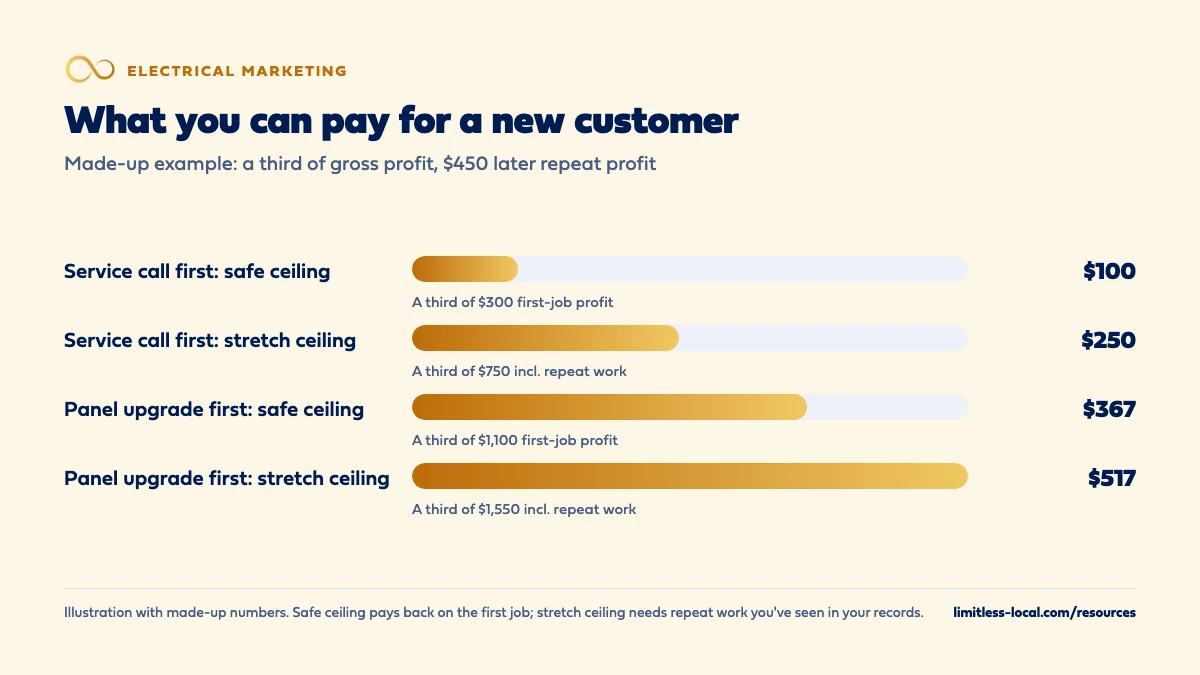
These numbers are made up to show the math, not a benchmark for your market. Say an electrician decides to give up a third of gross profit to win a new customer, and their job history shows customers bring about $450 in gross profit from later jobs over three years.
- New customer whose first job is a service call: $300 gross profit on the first job. Safe ceiling: $300 / 3 = $100. With repeat value, $300 + $450 = $750, so the stretch ceiling is $750 / 3 = $250.
- New customer whose first job is a panel upgrade: $1,100 gross profit on the first job. Safe ceiling: $1,100 / 3 = about $367. With repeat value, $1,100 + $450 = $1,550, so the stretch ceiling is $1,550 / 3 = about $517.
Now say their Google Ads spent $2,000 last month and won 10 new customers, so each cost $200. That’s well under both panel-upgrade ceilings. For service-call customers it’s above the safe ceiling and under the stretch ceiling, so it only works if those customers really do come back, and only if the business can wait for that money. If most of the 10 were service calls, the next move is to point the ads at more panel, EV charger and generator work, not to spend more.
Frequently asked questions
Is there a standard cost to win a new customer for electricians?
No reliable one. It depends on your market, your prices, the jobs you go after and how well your office books calls, so a number from another shop or a national average tells you little about yours.
Should referral rewards count as a cost of a new customer?
Yes. If you pay a reward or give a credit when a referred customer books, that’s what the customer cost you, and it’s usually far less than paid ads.
Do commercial customers get a higher ceiling?
Often, if they bring recurring work. Work out their gross profit separately, because the jobs, the sales cycle and the marketing that wins them are different from homeowner work.
Should I include the time I spend on estimates that don't book?
If it’s significant, yes, at least roughly. Unpaid estimate visits are part of what it costs to win the customers who do say yes, especially on bigger jobs.
How often should I update my ceilings?
Once a year, and whenever your prices, costs or job mix change. Repeat value in particular should be refreshed as you get another year of customer history.
What if I have no history to measure repeat value?
Use the safe ceiling only. Start tagging lead sources on every new customer now, and in a year or two you’ll have your own repeat numbers to work from.
Key takeaways
- Set a safe ceiling from first-job gross profit, so every new customer pays for their own marketing right away.
- Raise it to a stretch ceiling only by the repeat value your own records show.
- The tighter your cash, the closer to the safe ceiling you should stay.
- Set ceilings by first job: panel upgrades, EV chargers and generators earn a higher ceiling than one-off small fixes.
- Divide every cost of winning customers by new customers only, never by all jobs.
Want a second set of eyes on your setup?
We'll look at how you show up locally and where calls are leaking, then send you a plain-English breakdown.
More in this section
- How do electricians work out profit per job and customer value?
- How should a new electrical contractor get its first customers?
- What should an electrician charge per hour or per job?
- How many five-star reviews does an electrician need to raise prices?
- How much does a marketing agency cost for an electrician?
Sources
- Marketing Dashboard: ROI Table — Housecall Pro Help Center
- Lead Source Report — Jobber Help Center
- About Target CPA bidding — Google Ads Help
- About conversion values — Google Ads Help