
What should an electrician send past customers to bring them back?
- Which follow-up messages bring past electrical customers back, and how often should I send them?
- Why bother sending anything to past electrical customers?
- What should I send right after the job?
- What should the one-month check-in say?
- What job-based reminders bring electrical customers back?
- Which seasonal messages are worth sending?
- What should I send customers I haven't seen in a while?
- Should I ask past customers for referrals?
- When should I offer a maintenance agreement?
- How often can I message past customers before it's too much?
- What rules apply to emailing and texting past customers?
- How do I set this up without it eating my week?
- How do I know which messages bring customers back?
- What's different about past customers for electricians
- A worked example: one year of messages for 600 past customers
- Frequently asked questions
- Key takeaways
- More in this section
- Sources
The short version
- Right after the job: a thank-you, the warranty details and your review link.
- About a month later: a check-in asking if everything's working.
- Then: reminders tied to the job they had, a few seasonal notes and a yearly check-in.
- Keep it to a handful of messages a year; email freely within the rules, text only with written consent.
For electrical contractors with a list of past customers in their field software and no plan for staying in touch after the invoice is paid.
Get a free visibility audit · Book a growth call
Which follow-up messages bring past electrical customers back, and how often should I send them?
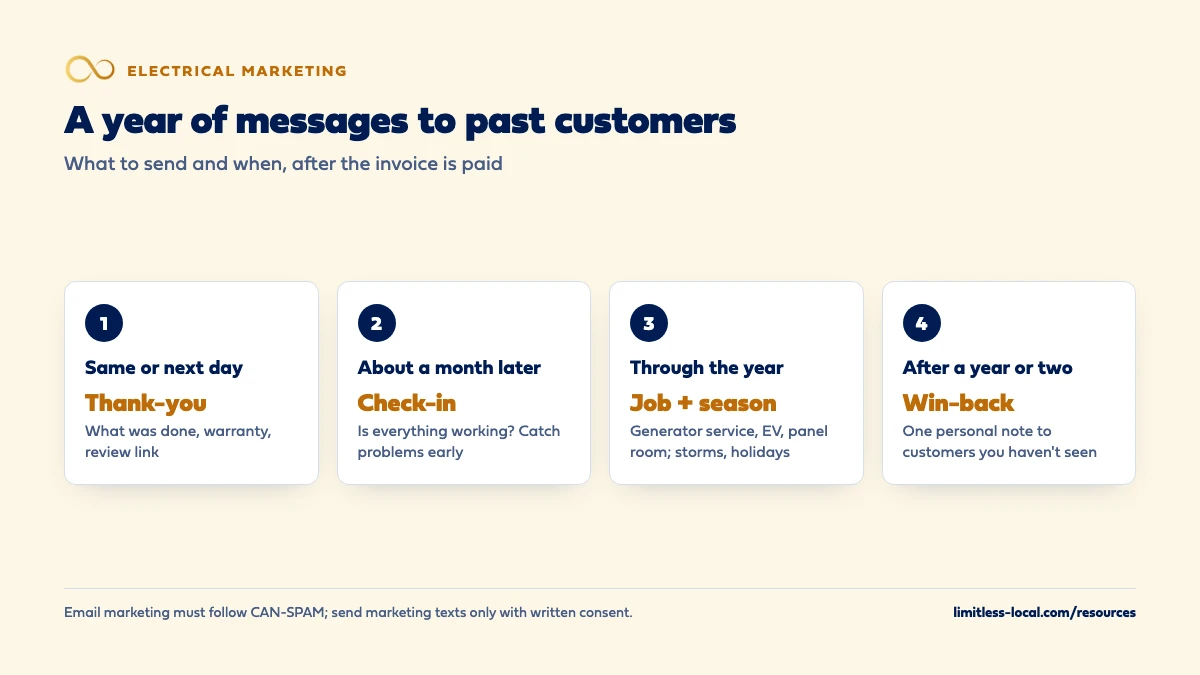
Send past customers a short, useful message at a few set moments: a thank-you with your review link right after the job, a check-in about a month later, reminders tied to the work they had done (a yearly generator service, a second EV charger, room on a new panel), a seasonal note before storm season or the holidays, and a win-back message to anyone you haven’t seen in a year or two. Keep it to a handful of messages a year, make every one about their house rather than a discount, and send marketing texts only to customers who gave written consent.
Staying in touch with past customers is follow-up work, and follow-up is what our automation add-ons cover: unified messaging and calendar reminders plug into any package, with pricing shared on the discovery call. Our electrical contractor marketing page explains how we work with electrical shops, and the rest of the electrical marketing questions library goes question by question.
Why bother sending anything to past electrical customers?
Because most homeowners don’t remember their electrician’s name a year later. The work was good, the customer was happy, and when they buy an EV or the lights start flickering, they search Google and call whoever shows up. A past customer who still has your number is the cheapest job you’ll ever book: no ad spend, no lead fee, and they already trust you.
That’s also why it changes what you can afford to spend on new customers. If past customers come back, each new one is worth more, which how much an electrician can afford to pay to get a new customer works through. The messages below are what keeps your name in their phone and their inbox until the next job comes up.
What should I send right after the job?
A thank-you, the same day or the next. Keep it short and useful:
- Thanks, from you or the tech by name.
- What was done, in plain words, and any warranty on the work or parts.
- Permit and inspection status if there was one.
- Your review link.
- The best number to call if anything isn’t right.
Sample wording: “Thanks for having us out today, Sarah. Mike replaced your panel and the inspection is booked for Thursday. Your work is under warranty; just call this number if anything seems off. If you have a minute, a Google review helps other homeowners find us: [link].”
Google’s tips to get more reviews suggest sending customers a Google link or QR code, and they’re clear that offering incentives, like free or discounted services, in exchange for reviews is prohibited. So the thank-you can include the review link, but never a discount tied to it. Automating Google review requests after each job covers setting up the review part.
What should the one-month check-in say?
About three to five weeks after the job, send one line asking how things are going: “Hi Sarah, it’s been a few weeks since we upgraded your panel. Is everything working the way it should? Reply here if you have any questions.”
This message does three things. It catches the occasional problem while it’s still a quick fix and not a bad review. It reminds the customer you’re the kind of shop that checks. And it often gets a reply like “actually, while I have you, the outlets in the garage…”, which is a booked job you didn’t pay for. No offer, no sales pitch; it works because it isn’t one.
What job-based reminders bring electrical customers back?
The best reasons to get in touch come from the work you already did. Tag each customer with their job type in your field software, then send the follow-up that fits:
- Panel upgrade: a few months later, a note that their new panel has room for an EV charger, a hot tub or a heat pump if they’re planning one.
- EV charger: a check-in after a year, and a note when they might be adding a second EV.
- Standby generator: a yearly service reminder, timed before your storm season.
- Older home or small repair: an offer of a whole-home safety check after a year or so, especially if you saw something on the first visit worth watching.
- Lighting: a spring note about outdoor and landscape lighting, a fall note about holiday lighting circuits.
- Commercial customers: a call, not an email, about scheduled maintenance and upcoming projects.
Each one is a reason they’d actually want to hear from you, which is why these get better responses than a generic “we’re still here” email.
Which seasonal messages are worth sending?
Two to four a year is plenty, timed to when electrical work is on homeowners’ minds:
- Before storm or outage season: generators, transfer switches and surge protection.
- Before summer: pool and hot tub circuits, ceiling fans, outdoor lighting.
- Fall: holiday lighting circuits and outdoor outlets before the decorations go up.
- Your slow month: a reason to book now, like open scheduling for panel upgrades or rewiring while your crews have room.
The slow-month message does double duty, filling the schedule when you need it most. Getting more electrical leads in the slow season covers the rest of that plan.
Curious what your marketing is actually booking?
Get a free visibility audit — no obligation, no sales pitch.
What should I send customers I haven't seen in a while?
A win-back message, once, to anyone who hasn’t booked in a year or two. Keep it personal and give them a reason: “Hi Tom, it’s been a while since we put in your EV charger. If anything’s changed at the house, a new car, a remodel, or a breaker that keeps tripping, we’d be glad to help. Just reply or call.”
Field software can send this automatically. Jobber’s Campaigns suggests a “Re-engage past clients” automated campaign that emails clients who haven’t booked in a while, and campaigns can send automatically when clients meet the conditions you set. If you’re on Housecall Pro, its Email Automation app can send a thank-you and encourage customers to rebook after a job is completed.
If they don’t answer, leave them on your normal seasonal list. Don’t chase.
Should I ask past customers for referrals?
Yes, but not in every message. Put a light referral line in the thank-you or the one-month check-in, when the work is fresh, and in one seasonal message a year. Ask for someone specific, like a neighbor buying an EV or a friend with an older house, instead of “anyone who needs an electrician.” Getting more referrals from past electrical customers covers the full approach, including keeping any referral reward completely separate from reviews.
When should I offer a maintenance agreement?
In the follow-ups for customers who’d actually use one: generator owners, older homes and customers with a lot of electrical equipment. The yearly generator reminder is the natural place; the second or third time you service it, offer to put it on a plan so it’s automatic. Don’t push agreements on someone who had one outlet replaced. Selling maintenance agreements to past electrical customers covers what to put in the plan and how to offer it.

How often can I message past customers before it's too much?
A handful of times a year is about right for most homeowners: the thank-you, the check-in, one or two job-based reminders and a few seasonal notes. Every message should give them something, a reminder, a heads-up or a check on their house. If a message is just “we’re still here,” skip it.
Watch the signals. If unsubscribes jump after a send, or people reply asking you to stop, you’re sending too often or saying too little. If nobody ever responds, the messages are probably too generic; make them about the job you did at that house.
What rules apply to emailing and texting past customers?
Email. The FTC’s CAN-SPAM compliance guide says the law covers all commercial email, not just bulk email. Marketing messages must have accurate sender information, an honest subject line, a clear note that the message is an ad, your valid physical postal address and a clear way to opt out, and you must honor opt-outs within 10 business days. Messages whose only purpose is a transaction the customer already agreed to, or warranty, recall, safety or security information about something they bought, count as transactional or relationship messages and are exempt from most of the law’s provisions. The FTC reads those categories narrowly, and a message that leads with a promotion counts as marketing. If you hire someone to send email for you, you’re still responsible.
Text. The FCC’s guide to unwanted robocalls and texts says commercial texts require written consent, informational texts may need only oral consent, and people can opt out at any time in any reasonable way. The simplest habit: ask for permission to text when the customer books, record it in your software, and send marketing texts only to customers who said yes.
Mail and phone. A postcard, or a personal call to your best customers, is often the message that sticks, especially with older homeowners.
How do I set this up without it eating my week?
- Clean up your customer list. Make sure every customer has an email, a mobile number if they agreed to texts, and a job type tag.
- Write the messages once. Thank-you, check-in, one reminder per main job type, three or four seasonal notes and a win-back. That’s about a dozen templates.
- Automate the timed ones. Thank-you, check-in and win-back can run on their own from Jobber, Housecall Pro or ServiceTitan.
- Schedule the seasonal ones on a calendar, a few weeks before each season starts.
- Give the office one job: reply fast when someone answers. A reply that waits two days loses the job the message just found.
How do I know which messages bring customers back?
Tag the jobs they produce. When a past customer books after a message, set the lead source on that job to the campaign, like “generator reminder” or “fall lighting”. Housecall Pro’s Marketing Dashboard ROI Table has a view that reads the lead source on each new job, estimate and lead, including from existing customers, which it describes as best for measuring repeat customers through reactivation and win-back campaigns.
Then compare. A message that books a few panel upgrades a year is worth keeping even if most people ignore it. One that brings nothing after a year, rewrite or drop. What first-party data means for an electrical business covers getting the most from the customer list itself.
Want to see where your company stands?
A free visibility audit shows where you show up on Google, Maps and AI answers, and what it's costing you in calls.
What's different about past customers for electricians
Customers come back for life events, not a schedule. A new EV, a remodel, a hot tub, a generator, selling the house. Electrical work isn’t a filter change every quarter, so your messages should be timed to those moments and the season, not sent monthly for the sake of it.
The first job tells you what’s next. A panel upgrade opens the door to EV chargers and new circuits; a generator install leads to yearly service; an older home leads to rewiring. Your job history is the best targeting you have.
Safety information is welcome. A useful note about surge protection before storm season, or what to check after an outage, reads as care, not marketing, and keeps your name tied to doing electrical work right.
A worked example: one year of messages for 600 past customers
These numbers are made up to show how it adds up, not a forecast for your list. Say an electrician has 600 past customers with email addresses and sends the plan above for a year.
- Generator reminder to 60 generator owners: 15 book a yearly service.
- Panel upgrade follow-up to 80 recent panel customers: 4 book an EV charger or new circuit.
- Seasonal notes to all 600: 18 jobs across the year, mostly small ones like outdoor outlets and lighting.
- Win-back to 200 customers not seen in two years: 8 book something.
That’s 15 + 4 + 18 + 8 = 45 jobs from customers who already knew you, with no ad spend and no lead fees. Tag every one of them, so next year you know which messages to keep.
Frequently asked questions
Should past-customer messages include a discount?
Usually not. A reason tied to their house works better and doesn’t train customers to wait for a coupon. Save offers for your slow month, and never tie one to a review.
Email or text: which works better for past electrical customers?
Email for the regular schedule, text for timely one-off messages to customers who agreed to it. A text gets read fast, so save it for things that matter, like a generator service reminder before a storm.
Should the owner or the office send these?
Automate the sending, but write them in the owner’s or tech’s voice and sign them with a real name. Replies should go to someone who can book the job that day.
What if my customer list is a mess?
Start with the last two years of customers. Export them from your field software, fix the obvious gaps and tag job types. A clean list of a few hundred beats a messy list of thousands.
Do newsletters work for electricians?
Only if they’re short and about the customer’s house. A monthly newsletter full of company news usually gets ignored; a seasonal note with one useful tip and one reason to call gets read.
Should I message customers after they move?
Remove anyone who tells you they’ve moved, and offer to help at their new place if it’s in your area. New owners at the old address are a different customer; reach them through your normal marketing.
Key takeaways
- Send a thank-you with the review link, then a check-in about a month later.
- Base most follow-ups on the job they had: generator service, EV chargers, room on a new panel.
- Add a few seasonal notes and one win-back to customers you haven’t seen in a year or two.
- Keep it to a handful of useful messages a year, never a discount for a review.
- Follow CAN-SPAM for email, text only with written consent, and tag every job a message brings back.
Not sure what's working right now?
Start with a free visibility audit: rankings, Google profile, reviews and tracking, checked against your service area.
More in this section
- How do I get more referrals from past electrical customers?
- What should an electrician's website have to get more calls?
- What website content helps electrician customers choose me?
- How should a new electrical contractor get its first customers?
- How should an electrical contractor market to commercial customers?
Sources
- CAN-SPAM Act: A Compliance Guide for Business — Federal Trade Commission
- Stop Unwanted Robocalls and Texts — Federal Communications Commission
- Tips to get more reviews — Google Business Profile Help
- Campaigns | Marketing Tools — Jobber Help Center
- Automated Email Campaigns Overview and FAQ — Housecall Pro Help Center
- Marketing Dashboard: ROI Table — Housecall Pro Help Center