
What lead-to-appointment rate should a pool builder expect?

- What share of pool leads should turn into booked design consultations?
- What does lead-to-appointment rate mean for a pool builder?
- Is there a typical lead-to-appointment rate for pool builders?
- What should count as a lead, and what shouldn't?
- Should I count consultations booked or consultations held?
- How do I measure my own lead-to-appointment rate?
- Why does the rate change so much by lead source?
- What drags down a pool builder's lead-to-appointment rate?
- Can a lead-to-appointment rate be too high?
- What do I do with leads who aren't ready for a consultation yet?
- How do I use the rate to plan marketing?
- Should I tell Google Ads about booked consultations?
- What's different about this rate for pool builders
- A worked example: one month of pool leads, three ways to read it
- Frequently asked questions
- Key takeaways
- More in this section
- Sources
The short version
- No trustworthy industry figure exists for pool builders; your own baseline is the benchmark.
- Count real leads, then track booked consultations and the ones that actually happened.
- Split it by lead source and by the month the lead came in, never one blended number.
- A low rate usually means slow follow-up or loose screening, not just bad leads.
For pool builders trying to tell whether enough of their leads are turning into design consultations, and where the drop-off is.
Get a free visibility audit · Book a growth call
What share of pool leads should turn into booked design consultations?
There’s no reliable published lead-to-appointment rate for pool builders, so the number to expect is your own, measured the same way every month and split by lead source. Count real leads only, leaving out spam, wrong-service calls and duplicates, then divide the design consultations that were booked, and the ones that actually happened, by those leads. Expect the rate to swing a lot by source and season: referrals usually book far more often than cold ad leads, and a low rate usually points to slow callbacks, a missing next step or loose screening more than to bad leads.
That’s why every one of our packages includes reporting built around the steps that matter: call tracking with recording, form and chat lead tracking, source tagging on every lead and a monthly cost-per-lead breakdown, so you can see where leads stall before a consultation, not just how many came in. The packages page lists what’s in each tier, our pool builder marketing page shows how it fits together, and the pool builder marketing questions library covers the rest of the sales funnel.
What does lead-to-appointment rate mean for a pool builder?
It’s the share of your leads that turn into a design consultation on the calendar. For a pool builder, that’s the first real commitment a homeowner makes: setting aside an hour or two, usually at home and often with both decision-makers, to talk about a pool with you.
It sits between two other numbers. Before it is your cost per lead, which tells you what marketing spent to get someone to call or fill in a form. After it is your close rate, the share of consultations that sign, which what close rate is good for pool construction leads covers. Lead-to-appointment rate is the step in the middle, and it’s the one most owners never measure, because the lead feels like the win.
It’s worth measuring because it’s the step you control most directly. You can’t change how many homeowners in your towns want a pool this year. You can change how fast they get a call, what they’re asked and how easy it is to say yes to a consultation.
Is there a typical lead-to-appointment rate for pool builders?
Not one you can rely on. There’s no published, trade-wide study of how often pool leads turn into design consultations, and the figures that float around online come from other trades, from software vendors’ own customers, or from definitions that don’t match yours. One company counts every phone call as a lead; another counts only form fills from homeowners in its area. Their rates can’t be compared.
That’s not a dead end. Your own rate, measured the same way for a few months, is a far better benchmark than an industry average would be, because it reflects your towns, your price point and your sales process. What matters is the trend and the difference between sources: is the rate rising after you sped up callbacks, and are Google Ads leads booking at half the rate of referrals?
What should count as a lead, and what shouldn't?
Decide once, write it down and stick to it, because the definition changes the rate more than anything you do on the phone. A good rule for a pool builder: a lead is a homeowner who reached out about the kind of work you do, in the area you build in.
Leave these out of the count, and tag them so you can still see them:
- Spam, sales calls and robocalls.
- Duplicates: the same homeowner calling and filling in a form.
- Existing customers calling about a build in progress or warranty work.
- Requests for work you don’t do, like weekly pool service if you only build.
- Homeowners outside your service area.
Keep those last two visible, though. If a lot of your leads are wrong-service or out-of-area, that’s a marketing problem worth fixing, just not a sales one. And homeowners who sign up to hear from you next season belong in their own bucket, not in this rate, until they ask for a consultation.
Should I count consultations booked or consultations held?
Both, as two separate numbers. The booked rate shows how well your team turns a lead into a yes. The held rate, consultations that actually happened, shows whether that yes was real.
A big gap between the two is its own warning sign. If a lot of booked consultations cancel or don’t show, the usual causes are booking too far out, not confirming the day before, or booking homeowners who agreed just to end the call. Reminder texts and emails help, and so does asking a couple of screening questions before you book, which how pool builders qualify leads before the design consultation covers.
For planning, the held number is the one to use, because your designer’s calendar and your close rate both run on consultations that happened.
How do I measure my own lead-to-appointment rate?
Use the stages in the software you already run, and record the lead source on every lead. Two common tools show what to look for:
- Housecall Pro organizes its Pipeline Leads Board into New Lead, First Contact, Second Contact, Third Contact, Won and Lost, and its lead reports can group conversion by lead source. Its conversion rate counts open leads in the total, so a recent month will look low until those leads are won or lost.
- Jobber’s Lead Source Report counts leads by source and shows how many have a request, a quote and a job, filtered by the date the lead was created.
If you run ServiceTitan or another CRM, look for the same two things: lead stages you can move leads through, and a source field on every lead.
Then make “consultation booked” and “consultation held” their own stages, and group each month’s report by the month the lead came in, not the month the consultation happened. That keeps a slow December from borrowing November’s bookings.
Curious what your marketing is actually booking?
Get a free visibility audit — no obligation, no sales pitch.
Why does the rate change so much by lead source?
Because homeowners arrive at different points in the decision. A referral from a neighbor whose pool you built has already been sold on you; the call is mostly about timing. A homeowner who clicked a Google ad may be calling three builders that afternoon. Someone who found you on Instagram might be dreaming, not planning.
So never judge one blended number. A month where the overall rate drops might just be a month where more leads came from ads and fewer from referrals, with nothing wrong in the sales process at all. Split the rate by source every month, and compare each source with its own history.
It also changes what each source is worth. A cheap lead that rarely books can cost more per consultation than an expensive one that usually does. Tracking which marketing produces signed pool contracts carries the same math through to the contract.
What drags down a pool builder's lead-to-appointment rate?
The common culprits, roughly in the order they cost the most:
- Slow first calls. A homeowner who reached out on Saturday and hears back on Tuesday has often booked someone else. How fast a pool builder should respond to a new lead covers the timing.
- No owner for the lead. When leads go to a shared inbox, everyone assumes someone else called.
- Giving up after one try. One missed call and one voicemail isn’t follow-up. A short, set sequence of calls, texts and emails over the first week catches the busy ones.
- No clear next step. The call ends with “we’ll be in touch” instead of a date and time on the calendar.
- A consultation that sounds like a sales pitch. Explain what happens at it and what the homeowner walks away with.
- Leads that were never a fit. Out-of-area and wrong-service leads drag the rate down until you count them separately.
Can a lead-to-appointment rate be too high?
Yes. If nearly every lead books, check what’s being booked. A team that books every caller to keep the number up fills the designer’s week with homeowners who were never going to buy, and the close rate on those consultations falls.
The goal isn’t the highest booking rate. It’s the most signed contracts for the designer’s time. A slightly lower booking rate with a much higher close rate is often the better trade, especially in spring when the calendar is full. Watch the two numbers together: if bookings go up and contracts don’t, the screening has gone too loose.

What do I do with leads who aren't ready for a consultation yet?
Keep them, and stop counting them against the rate. A homeowner who says “we’re thinking about next year” isn’t a lost lead; they’re an early one. Move them to a separate stage, such as nurture or next season, with a date to follow up.
That keeps your lead-to-appointment rate honest and gives those homeowners the attention they need: an occasional useful email, new projects in their area and a call when design season opens. How to nurture leads who plan to build next year covers what to send.
How do I use the rate to plan marketing?
It turns lead counts into consultations, which is what your designer’s calendar and your revenue goal run on. If you know you need a certain number of held consultations a month in spring, divide by your held rate for each source to see how many leads you need from each. How many leads a pool builder needs to hit its revenue goal runs the whole calculation from the revenue target down.
It also tells you what each source really costs. Divide what you spent on a source by the consultations it produced, and you have cost per consultation, a much better number to compare channels on than cost per lead.
Should I tell Google Ads about booked consultations?
Yes, once you track them reliably. A Google Ads account that only counts calls and form fills treats a spam call the same as a homeowner who booked. Recording booked consultations as a conversion, from your CRM or with an import, shows which keywords and campaigns produce appointments, not just contact.
Be deliberate about how Google uses it. Google’s page on primary and secondary conversion actions explains that primary actions are reported in the Conversions column and used for bidding, while secondary actions are for observation only. A sensible start is to add booked consultations as secondary, watch the numbers for a few weeks, and switch to primary once you trust them.
Want to see where your company stands?
A free visibility audit shows where you show up on Google, Maps and AI answers, and what it's costing you in calls.
What's different about this rate for pool builders
The appointment is a big ask. A design consultation takes real time from the homeowner, often both partners, so it’s a harder yes than a service-call booking. That’s why the number deserves its own tracking.
Season changes the rate. Leads in fall and winter often want to plan, not meet, so they book later or go to nurture. Compare each month with the same month last year, not with spring.
New builds and renovations book differently. A homeowner with a cracked, tired pool often has a more urgent reason to meet than one with an empty backyard. Track the two separately.
The designer’s calendar is the limit. In peak season, the number of consultations you can hold caps the whole funnel, so screening matters as much as speed.
A worked example: one month of pool leads, three ways to read it
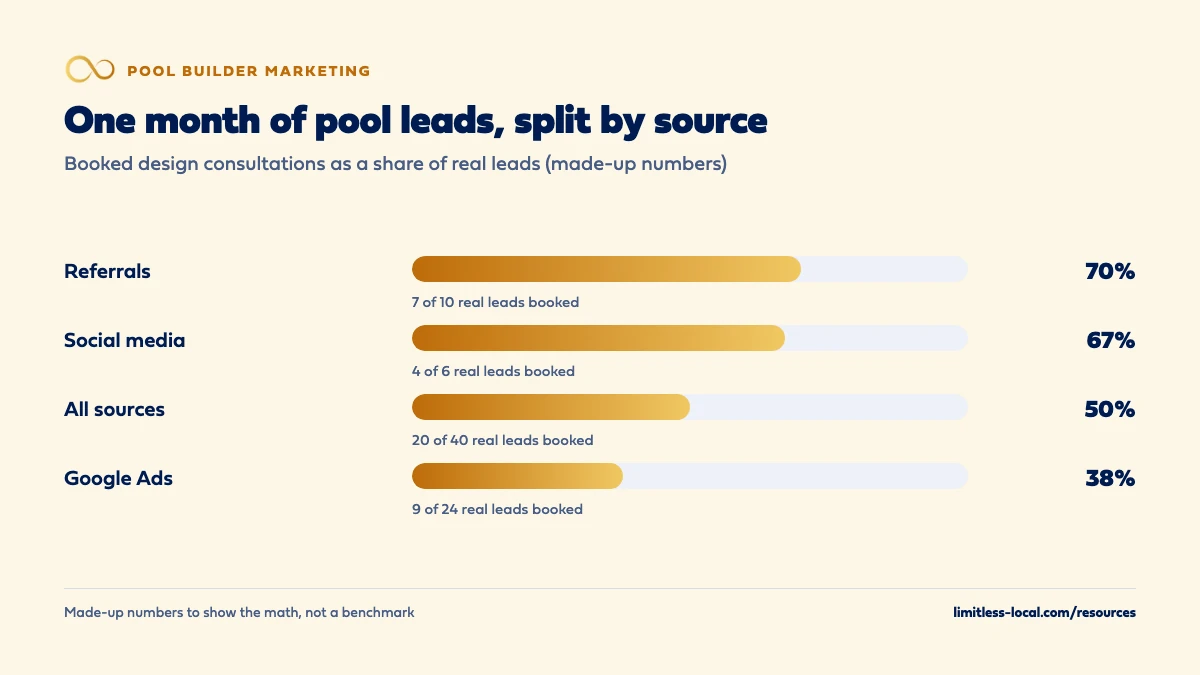
These numbers are made up to show the math, not a benchmark for your market. Say a pool builder logs 45 leads in April. 5 are spam, duplicates or out-of-area, leaving 40 real leads.
20 of those book a design consultation: a 50% booked rate on real leads. Counted against all 45, it would look like 44%, which is why the definition matters. 17 of the 20 consultations actually happen, an 85% show rate.
Split by source, the picture changes again:
- Google Ads: 24 real leads, 9 booked, about 38%.
- Referrals: 10 real leads, 7 booked, 70%.
- Social media: 6 real leads, 4 booked, about 67%.
None of those is good or bad on its own. Compared with the same sources next April, after the builder starts calling ad leads back within the hour, they show whether the change worked.
Frequently asked questions
Is a 50% lead-to-appointment rate good for a pool builder?
It depends entirely on how you count leads and which sources they came from. Fifty percent of real, in-area leads from a mix of referrals and ads is a different thing from half of every call that rang. Compare it with your own history, by source.
Should phone leads and form leads be tracked separately?
It helps. Callers are often further along and can be booked on the spot, while form leads need a fast callback. Tracking them separately shows whether your callback process or your phone answering is the weak spot.
Who on my team should own this number?
Whoever books the consultations, with the owner reviewing it monthly. If one person books and another takes calls, track the rate by person too; Housecall Pro’s lead reports, for example, can group conversion by employee.
How long should I wait before calling a lead lost?
Set a fixed follow-up sequence, then mark the lead lost or move it to nurture once it’s done. What matters is applying the same rule every month, so the rate stays comparable.
Does a virtual design consultation count as an appointment?
Yes, if it’s the same step in your process. Count it as a consultation, and tag it so you can see whether virtual and in-person consultations close at different rates.
Key takeaways
- There’s no reliable industry lead-to-appointment rate for pool builders; build your own baseline.
- Define a lead once, leave out spam, duplicates and wrong-service calls, and keep the definition fixed.
- Track booked and held consultations separately, by lead source and by the month the lead came in.
- Slow first calls, no lead owner and one-try follow-up drag the rate down most.
- A very high rate can mean loose screening; watch it alongside your close rate.
Not sure what's working right now?
Start with a free visibility audit: rankings, Google profile, reviews and tracking, checked against your service area.
More in this section
- How fast should a pool builder respond to a new lead?
- What close rate is good for pool construction leads?
- How do pool builders qualify leads before the design consultation?
- How many leads are needed for a pool builder to hit its revenue goal?
- Agency vs own lead quality: what should a pool builder expect?
Sources
- Getting Started with Pipeline — Housecall Pro Help Center
- Conversion Rate Reporting — Housecall Pro Help Center
- Lead Source Report — Jobber Help Center
- About primary and secondary conversion actions — Google Ads Help