
Which marketing channel brings an electrician leads fastest?
- What gets an electrical company qualified calls fastest: SEO, Google Ads or LSAs?
- Which channel gets an electrician's phone ringing first?
- How fast can Google search ads bring an electrician calls?
- How fast can Local Services Ads start for an electrician?
- Can fixing my Google Business Profile bring calls quickly?
- Why is SEO the slowest, and should I start it anyway?
- Are past customers really the fastest source?
- Does a fast lead mean a qualified lead?
- Which channel is fastest for emergency calls versus planned jobs?
- What slows every channel down?
- How should I plan the first few months for speed?
- What's different about speed for electricians
- A worked example: fast calls versus qualified calls
- Frequently asked questions
- Key takeaways
- More in this section
- Sources
The short version
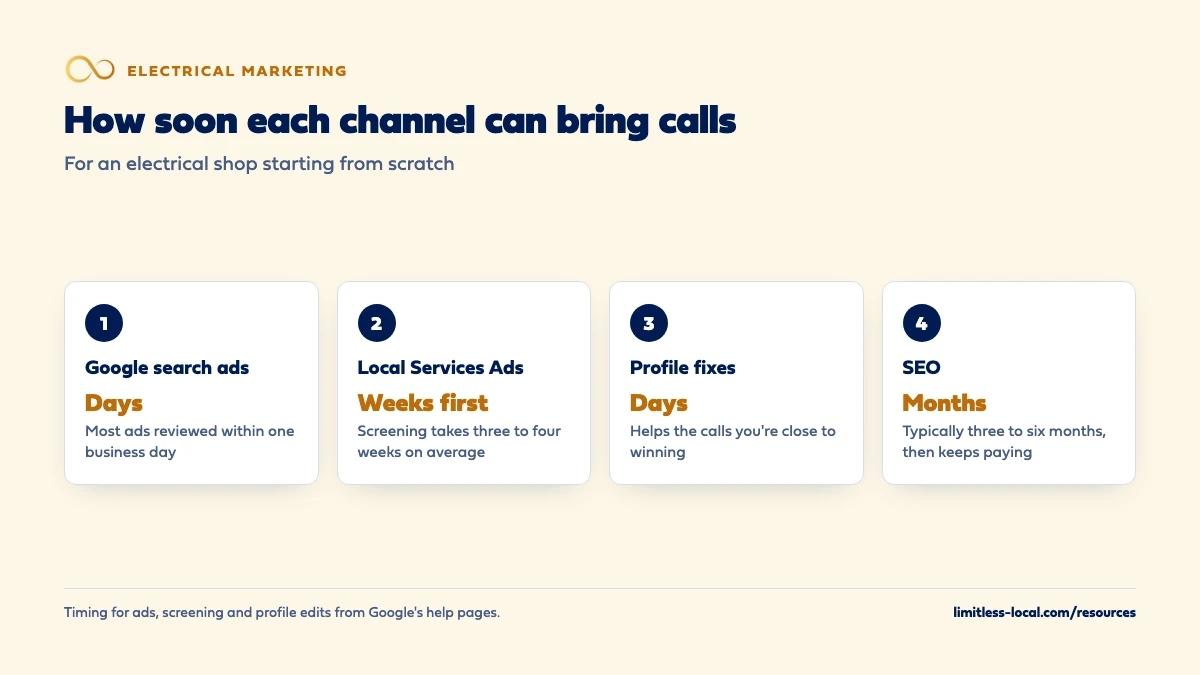
- Google search ads: fastest to start, usually days once the campaign and landing page are ready.
- Local Services Ads: fast once live, but plan for weeks of screening and background checks first.
- Google Business Profile fixes: days to take effect, best for calls you're already close to winning.
- SEO: slowest, typically three to six months, but it doesn't stop when the spending does.
For electrical contractors who need the phone ringing soon and want to know which channel gets there first, what has to be ready, and what each one costs you in the first weeks.
Get a free visibility audit · Book a growth call
What gets an electrical company qualified calls fastest: SEO, Google Ads or LSAs?
Google search ads are usually the fastest way for an electrician to get qualified calls: Google reviews most ads within one business day, so a well-built campaign can bring calls within days of launch. Local Services Ads can be just as quick once you’re live, but electricians go through background checks and Google says screening takes three to four weeks on average after you submit your documents. Fixing your Google Business Profile helps within days for the calls you’re already close to getting, while SEO is the slowest, typically three to six months, and the one that keeps paying after you stop spending.
Speed is only worth paying for if the calls turn into booked jobs, which is why we build the tracking and follow-up first and then turn on the lead flow around the towns and jobs you want. Our Google Ads and Local Services Ads management page shows how the paid side works, our electrical contractor marketing page explains how we work with electrical shops, and the rest of the electrical marketing questions library goes question by question.
Which channel gets an electrician's phone ringing first?
Ranked by how soon each one can bring a real, bookable call, for a shop starting from scratch:
- Past customers and referrals. If you have a customer list, a note to it can bring calls the same week, and it costs almost nothing. It only works if the list exists.
- Google search ads. Usually days once the campaign is built, approved and pointed at a page that turns clicks into calls.
- Local Services Ads. Days once you’re live, but the screening comes first, and for electricians that includes background checks.
- Google Business Profile fixes. Days to take effect, but they mostly help you win calls from searches you already show up for.
- SEO and new website pages. Months, not weeks. The calls build slowly and then keep coming.
Lead marketplaces like Angi or Thumbtack can send leads almost immediately too, but judge them on how many turn into booked jobs, not on how fast they arrive.
The order changes with your starting point. An established shop with hundreds of past customers and a strong Google profile already has two fast channels it may be ignoring. A brand-new shop has neither, so paid search is the fastest real option.
How fast can Google search ads bring an electrician calls?
Fast, once the pieces are in place. Google’s page on the ad review process says most ads are reviewed within one business day, though more complex reviews can take longer, and any new page the ad sends people to has to be finished before the ad can be reviewed. Ads can generate leads within days of launch.
What usually takes longer is the setup, not Google. Before the first dollar goes out, you want:
- Campaigns built around the jobs you want, like panel upgrades, EV charger installs and emergency service, not one catch-all ad group.
- Location targeting drawn around the towns your trucks actually go to.
- A landing page or service page with your number at the top and a short form.
- Call tracking, so you know which calls came from the ads.
- A starter list of searches to block, like jobs, training and do-it-yourself questions. The negative keywords electricians should add to Google Ads first has a list to start from.
With all of that ready, search ads are the closest thing to a tap you can turn on. The catch is that they’re also a tap you can turn off: when the spending stops, the calls stop.
How fast can Local Services Ads start for an electrician?
Local Services Ads are quick once they’re running, but they have the longest wait before the first lead. Google treats electricians as an urgent category, so the business, the owner and the field crew go through background checks on top of license and insurance checks. Google’s page on screening and verification requirements says the process takes three to four weeks on average after you submit your documents, and it recommends starting as soon as you create the account.
Two more things slow the first stretch:
- Bidding needs time to settle. Google’s page on how bidding works for Local Services Ads says it takes about two weeks to see accurate results as the model learns your business.
- Reviews and responsiveness matter. The same page says quality service still matters, including how fast you respond and your reviews. A shop with few reviews or a phone that goes to voicemail tends to get fewer leads.
So if you need calls this week, Local Services Ads aren’t the answer. If you can start the paperwork now, they can be running alongside search ads within the month. How electricians get verified for Google Local Services Ads walks through the paperwork.
Can fixing my Google Business Profile bring calls quickly?
Some fixes can, because they help you win calls from people who already see your profile. Google says profile edits usually take up to ten minutes to review, though some can take up to 30 days. The fixes that tend to pay off fastest:
- The phone number. Make sure it’s right and rings somewhere that gets answered.
- Hours. If you take emergency calls at night, your hours should say so.
- Services. List the jobs you want, like panel upgrades and EV chargers, so those searches match.
- Photos of real work. They give a homeowner a reason to call you instead of the next listing.
What doesn’t move fast is where you rank. Showing up for more searches in more towns builds over months with reviews and a stronger website. Which Google Business Profile edits give an electrician calls fastest ranks the quick edits one by one.
Curious what your marketing is actually booking?
Get a free visibility audit — no obligation, no sales pitch.
Why is SEO the slowest, and should I start it anyway?
SEO typically takes three to six months to show meaningful organic growth. Google has to find your new pages, decide what they’re about and compare them with every other electrician in your area, and the things that push you up, like reviews and links from other sites, build over time.
Start it anyway, on day one, alongside the ads. The calls it brings later don’t cost you per click, and they don’t stop the day you cut the ad budget. Shops that wait until ads get expensive to start SEO end up paying for ads for months longer than they had to. Why SEO takes longer than Google Ads for electricians explains the gap in more detail.
Are past customers really the fastest source?
For an established shop, often yes. The people who already hired you know your work, have your number and don’t need convincing. A short email to your customer list about a seasonal check, a panel inspection or an EV charger install can fill open slots in the same week, and it doesn’t cost you anything per lead.
It’s limited by the size and freshness of your list. If your customer records live in a field service program like ServiceTitan, Housecall Pro or Jobber, pull the list from there. If they live in a shoebox of invoices, start keeping them properly now so this channel exists next year.
Does a fast lead mean a qualified lead?
No, and that’s where most fast starts go wrong. The first two weeks of a new search campaign usually bring some junk: do-it-yourselfers, job seekers, people in towns you don’t serve, people looking for a parts store. Google’s search terms report shows the exact searches your ads appeared for, and checking it every few days in the first month is how you turn a fast campaign into a qualified one.
A qualified electrical lead has four things: work you do, an address in your area, a scope you can picture and someone ready to hire soon. Count only those when you compare channels. A channel that brings ten calls in week one but only three real jobs isn’t faster than one that brings five calls and four jobs.
Which channel is fastest for emergency calls versus planned jobs?
They split. Emergency work, like a dead circuit, a burning smell or half the house dark, goes to whoever shows up first and answers the phone. Local Services Ads and search ads on urgent searches are the fastest way to get in front of those homeowners, and your Google profile catches the rest.
Planned work, like a panel upgrade, an EV charger, a generator or a remodel, is slower by nature. The homeowner reads reviews, compares a few shops and may wait weeks to book. Ads still put you in front of them fast, but the booked job comes later, so judge planned-work campaigns on a longer window than a few days.
What slows every channel down?
- Nobody answering. The fastest channel in the world doesn’t help if calls go to voicemail while your crews are on jobs. How fast your office should answer electrical calls sets the target.
- No tracking. If you can’t tell which channel the call came from, you can’t tell which one was fast.
- No page to land on. Ads sent to a homepage with no clear call button waste the speed you paid for.
- A thin Google profile. Few reviews and no photos slow Local Services Ads and the map pack alike.
- Spreading too thin. A small budget split across four channels can leave each one too small to learn from.
How should I plan the first few months for speed?
Run the channels in parallel, not in a line. In the first week, fix the Google profile, set up call tracking, email past customers and start the Local Services Ads paperwork. Launch search ads as soon as the landing page and tracking are ready, and start SEO work on your service pages at the same time.
By the end of the first month, search ads should be bringing calls and the search terms cleaned up. Local Services Ads join when screening clears. Over the next few months, SEO starts adding calls, and you can shift ad money toward whichever channel books jobs at the best cost. Whether to start with LSAs, Google Ads or SEO covers the choice when you can only fund one.
Not sure which of these is costing you jobs?
A free visibility audit checks the Google profile, reviews, site and tracking, and shows what to fix first.
What's different about speed for electricians
The screening is heavier. Local Services Ads check the owner and the field crew, not just the license and insurance, so a shop that starts the paperwork late loses weeks it can’t get back.
Have the paperwork ready before you apply. Gather your license number, insurance certificate and the exact business name on your Google profile first, so nothing comes back for a mismatch halfway through.
Storms and outages create sudden demand. When a storm knocks out power, generator and repair calls spike. Paid ads are the only channel you can turn up in a day to meet that, so have campaigns built and paused before the season.
A worked example: fast calls versus qualified calls
These numbers are made up to show the math, not a benchmark for any market. Say a shop launches a search campaign and spends $700 in each of its first two two-week stretches.
- Weeks one and two: 14 calls, 6 of them real jobs in the service area. That’s $700 / 6, or about $117 per qualified call.
- Weeks three and four, after blocking junk searches and trimming the map: 12 calls, 9 of them real jobs. That’s $700 / 9, or about $78 per qualified call.
Fewer calls, more jobs, lower cost. The speed came on day one; the quality came from cleaning up what the speed brought in. That’s the comparison to run on any fast channel.
Frequently asked questions
Can Facebook ads bring electrical leads fast?
They can bring leads quickly, but people weren’t searching for an electrician when they saw the ad, so those leads tend to be earlier-stage. Search ads reach people who need the work now.
Should I pause SEO to put everything into ads?
Usually not. SEO is the channel that lowers your cost later, and pausing it just pushes that point further out. Trim it if you must, but keep the core work going.
How much do I need to spend for search ads to be fast?
Enough that the campaign gets clicks every day in your service area. A budget so small the ads only show for a few hours a day is slow by design.
Do I need a website to run Google Ads?
You need a page for the ad to send people to, and it has to be finished before the ad can be reviewed. One focused page with your number and a short form is enough to start.
Is there any way to get into the map pack fast?
Not reliably. Google’s local ranking tips say there’s no way to request or pay for a better local ranking. Profile fixes help you convert the views you get; ranking higher takes months.
What's the fastest channel if I can't answer the phone all day?
Form-based leads from your website or ads, as long as someone replies the same hour. Phone-heavy channels like Local Services Ads lose value fast when calls go unanswered.
Key takeaways
- Google search ads are usually the fastest way to qualified calls once the campaign, page and tracking are ready.
- Local Services Ads are fast once live, but electricians face background checks and weeks of screening first.
- Google profile fixes take effect in days; better rankings take months.
- SEO is slowest, typically three to six months, and keeps paying after you stop spending.
- Judge speed by qualified calls, not total calls, and clean up search terms in the first weeks.
Want a second set of eyes on your setup?
We'll look at how you show up locally and where calls are leaking, then send you a plain-English breakdown.
More in this section
- Which channel brings electricians the highest-quality leads?
- Which social media platforms help an electrician get local leads?
- Which channel gives an electrician the lowest cost per lead?
- Is social media worth it for getting electrical leads?
- How can an electrical contractor get more leads?
Sources
- About the ad review process — Google Ads Help
- Business screening and verification requirements – United States — Local Services Help
- How bidding works for Local Services Ads — Local Services Help
- Understand what happens to your Business Profile edits — Google Business Profile Help
- About the search terms report — Google Ads Help
- Tips to improve your local ranking on Google — Google Business Profile Help