
How should an electrician budget for residential vs commercial jobs?

- How does an electrical marketing budget change between residential and commercial work?
- Why should residential and commercial work get separate budgets?
- How do I size the residential budget?
- Where does the residential money usually go?
- How do I size the commercial budget?
- Where does the commercial money usually go?
- Does the percentage-of-revenue rule still apply?
- How does cost per job differ between the two?
- Can one Google Ads account cover both sides?
- How do I shift budget toward one side?
- How long before each side pays back?
- What does it cost to hand the residential side to an agency?
- What's different for electricians
- A worked example: two budgets for one shop
- Frequently asked questions
- Key takeaways
- More in this section
- Sources
The short version
- Keep two budgets: residential and commercial work are won through different channels.
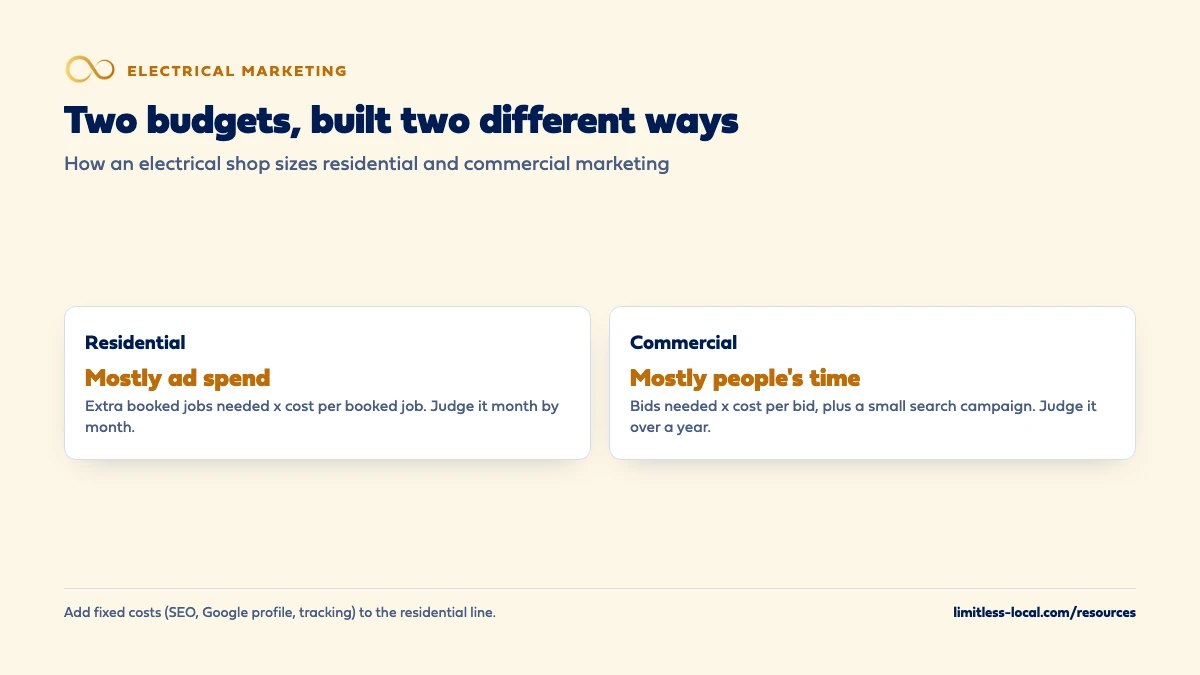
- Residential: extra booked jobs needed x cost per booked job, mostly ad spend and local search.
- Commercial: bids needed x cost per bid, mostly estimating time and relationships, plus a small search campaign.
- Judge residential monthly by cost per booked job, commercial yearly by bids won and account value.
For electrical contractors who do both kinds of work, or want to shift toward one, and need to know how much to spend on each side, where the money goes and how to judge it.
Get a free visibility audit · Book a growth call
How does an electrical marketing budget change between residential and commercial work?
Budget the two sides separately, because they’re bought differently. A residential budget is mostly ad spend and local search work, sized by multiplying the extra booked jobs you need each month by what a booked job costs you, and judged month by month. A commercial budget is mostly people’s time (estimating, bidding, follow-up and relationships with general contractors and property managers) plus a small search campaign for commercial service calls, and it’s judged on bids won and account value over a year. A mostly residential shop usually spends a bigger share of revenue on marketing than a mostly commercial one.
The residential side, from local search and your Google profile to Google Ads, Local Services Ads and tracking, is what our packages run; the commercial relationships stay with you and your estimators, and good tracking shows how both sides pay. Our packages and pricing page shows what each tier covers, our electrical contractor marketing page explains how we work with electrical shops, and the rest of the electrical marketing questions library goes question by question.
Why should residential and commercial work get separate budgets?
Because the money does different jobs. A homeowner with a dead circuit or a new EV finds you on Google, reads reviews and calls. A general contractor or property manager picks electricians from a bid list, a past job or a referral. Spending on one doesn’t do much for the other.
Mixing them in one number also hides what’s working. If residential ads are booking jobs at a good cost and a commercial bid push is eating estimator time without wins, a single blended budget looks fine while half of it is leaking. Two budgets, two sets of numbers, and you can see which side to grow. Which channels work best for residential vs commercial electricians covers the channel side; this page is the money side.
How do I size the residential budget?
Start from jobs, not a percentage:
- How many extra booked jobs do you need a month? Work it out from the open slots on your crews’ schedules, not from a revenue wish.
- What does a booked job cost you? Use your own numbers by channel if you have them. If you don’t, run a small test first and measure.
- Multiply. Extra jobs x cost per booked job is your residential ad and lead budget.
- Add the fixed costs. SEO, your Google profile, reviews, call tracking and any management fee run every month regardless of how many jobs you book.
Split it by job type if you can. A panel upgrade or a whole-home generator can carry a higher cost per booked job than a service call and still leave more profit. What a good cost per booked job looks like shows how to set the ceiling for each.
Where does the residential money usually go?
- Google search ads for planned work like panel upgrades, EV chargers and generators, and for urgent searches if you take emergency calls.
- Local Services Ads, paid per lead, for homeowners who want a licensed electrician fast.
- Local SEO and your Google profile, which cost the same each month and get cheaper per call as rankings build. SEO typically takes three to six months to show meaningful organic growth.
- Reviews, through a steady habit of asking after every job.
- Tracking, so every call and form is tied to the channel that brought it.
Ad spend is the part that moves. Raise it when crews have open slots and trim it when they’re booked out. The fixed work underneath stays steady so the cheaper calls keep building.
How do I size the commercial budget?
Commercial work runs on bids and relationships, so size it in bids, not clicks:
- How many new commercial accounts or projects do you want this year?
- What’s your win rate on bids? If you win one in four, you need four bids for every win.
- What does a bid cost you? Count estimator or owner hours for the walk-through, takeoff and proposal, plus follow-up.
- Multiply, then add the smaller cash costs: a commercial section on your website, a narrow search campaign for commercial service calls, printed capability sheets and any association dues.
Most of that budget is time, not ad spend. That’s the part owners forget to count, and it’s why commercial work can look free on paper while it’s actually one of the bigger costs in the business.
Where does the commercial money usually go?
- Estimating and bid prep. The biggest line for most shops, usually in hours rather than dollars.
- Relationships. Time spent with general contractors, property managers and facility managers, getting onto bid lists and staying there.
- A commercial search campaign. Small and narrow, for searches like commercial electrician or tenant improvement electrician, and for after-hours commercial service calls.
- A commercial page or section on your site with project photos, the work you do, your licensing and how to request a bid.
- Maintenance agreements. Selling preventive maintenance to commercial customers turns one-off jobs into repeat work.
How an electrical contractor should market to commercial customers covers each of these in more depth.
Curious what your marketing is actually booking?
Get a free visibility audit — no obligation, no sales pitch.
Does the percentage-of-revenue rule still apply?
As a sanity check, yes. The SBA’s guide to getting the most from your marketing budget says many businesses use a percentage of revenue as a guide, that there’s no hard and fast answer, and that companies selling to consumers generally need to budget more for marketing than companies selling to other businesses. It also suggests checking with your industry trade association for benchmarks.
For an electrician, that points the same way as the job math. A shop doing mostly residential work usually needs a larger marketing share of revenue than a shop doing mostly commercial work, because homeowners have to be found again and again while a good commercial account sends repeat work. If your percentage and your job math disagree badly, trust the job math and find out why. How much an electrical contractor should spend on marketing covers the overall number.
How does cost per job differ between the two?
On the residential side, cost per booked job is a monthly number you can manage: total spend on a channel divided by the jobs it booked. It reacts quickly when you change targeting, budget or how fast the office answers.
On the commercial side, a single job rarely tells you much. One won bid might be a one-off, or the start of years of work from the same general contractor. Measure cost per won bid, then look at what each account brings over a year. A commercial account that cost a lot of estimating time to win can still be the cheapest work you have if it keeps sending projects.
Can one Google Ads account cover both sides?
Yes, but give each side its own campaign. Google sets an average daily budget for each campaign, so separate residential and commercial campaigns let you control how much each side gets instead of letting homeowner searches eat the whole budget. Use different keywords, different ads and different landing pages for each.
Before you set the commercial budget, check demand. Google’s Keyword Planner shows search volume and the cost to target keywords in your area. Commercial searches are often far fewer than residential ones, which is one reason the commercial campaign stays small.

How do I shift budget toward one side?
In steps, and only as fast as your crews can follow. Shifting toward commercial means freeing estimator time and having crews ready for longer projects, often with slower payment, so plan cash flow before you chase it. Shifting toward residential means more ad spend and an office that can answer every call, because residential leads go cold in minutes.
Move a slice of budget at a time, watch the numbers for two or three months, then move the next slice. Knowing your margins by job type makes this easier. Jobber’s job costing, for example, tracks profit on each job from labor, line items and expenses, and most field service programs offer something similar.
How long before each side pays back?
Residential paid channels can pay back in weeks: ads can generate leads within days of launch, and many residential jobs are booked and invoiced within the month. Residential SEO takes longer, typically three to six months to show meaningful organic growth.
Commercial usually takes longer. Getting onto a bid list, bidding, winning and getting paid can stretch across several months, and the real payback comes from repeat work. Give a commercial push at least a year before judging it, and judge residential channels over two or three months.
What does it cost to hand the residential side to an agency?
On top of ad spend, which is paid to Google directly and isn’t included, our Essentials package is $3,500 a month for one location and covers local SEO, Google Business Profile management, review generation, call tracking and Google Ads management up to $2,500 a month in ad spend. Growth is $4,500 a month and adds Local Services Ads management, Meta remarketing and SEO for up to two locations. The commercial relationship side stays with you and your estimators either way. Whether that’s worth it comes down to the job math above: what the extra booked jobs are worth against what they cost.
Talk it through with someone who runs this every day
A 15-minute growth call: your market, your numbers, and what a realistic budget looks like. No pressure.
What's different for electricians
Many shops do both, with the same crews. A slow commercial month can be filled with residential service work, and the reverse. Keep the budgets separate, but plan them together around crew capacity.
Residential tickets range widely. An outlet repair and a panel upgrade can come from the same ad. Track cost per booked job by job type, or the small jobs will hide what the big ones cost to win.
Commercial EV charging and maintenance work sit in between. They fall between the two budgets: sold through relationships, but often found first through search. A narrow search campaign for them can be worth carving out on its own.
A worked example: two budgets for one shop
These numbers are made up to show the math, not a benchmark for any market.
Residential: the shop has room for 20 more booked jobs a month, and its booked jobs cost about $150 each in ad spend. That’s 20 jobs times $150, or $3,000 a month in residential ad spend, before the fixed SEO, profile and tracking work.
Commercial: the shop wants two new commercial accounts a quarter and wins one bid in four, so it needs 8 bids a quarter. Each bid takes about 6 hours of estimator time at $60 an hour, or $360. That’s 8 bids times $360, or $2,880 a quarter, or $960 a month in time, plus a $500-a-month commercial search campaign: $1,460 a month in total.
The residential budget is mostly cash and the commercial budget is mostly time, which is exactly why they need separate lines.
Frequently asked questions
Should a mostly commercial electrician bother with Google Ads?
A small, narrow campaign for commercial service calls and after-hours emergencies is often worth it. A large homeowner campaign usually isn’t, unless you want residential work too.
Do I count estimator time as marketing?
For budgeting, yes. Bid prep is what wins commercial work, so leaving it out makes commercial work look free when it isn’t.
Are Local Services Ads useful for commercial work?
They’re built around people contacting a local service business for a job, so they tend to bring residential and small-business calls rather than large commercial projects.
What if I want to stop doing residential work?
Wind residential spend down in steps while commercial bids pick up, so the crews stay busy. Keep your Google profile and reviews; they still help commercial buyers check you out.
Should I market maintenance agreements as residential or commercial?
Both, separately. Commercial maintenance is sold to facility and property managers; residential plans are sold to past customers.
How often should I rebalance the two budgets?
Look at both every month, but only move money every quarter or so. Commercial numbers need time to settle before they tell you anything.
Key takeaways
- Keep separate residential and commercial budgets so you can see which side pays.
- Size residential spend from extra booked jobs needed x cost per booked job, and judge it monthly.
- Size commercial spend in bids: bids needed x cost per bid, mostly estimator and owner time.
- Mostly residential shops usually spend a bigger share of revenue on marketing than mostly commercial ones.
- Run separate Google Ads campaigns for each side, and shift money between them in steps.
Ready to compare options?
Book a short growth call and we'll walk through the math for your service area, including when we're not the right fit.
More in this section
- Electrician growth: residential, commercial or emergency work?
- Which channels work best for residential vs commercial electricians?
- How should an electrical contractor market to commercial customers?
- How do electricians work out profit per job and customer value?
- How should an electrical contractor bid a job?
Sources
- How to Get the Most From Your Marketing Budget — U.S. Small Business Administration
- About average daily budgets — Google Ads Help
- Use Keyword Planner — Google Ads Help
- Job Costing — Jobber Help Center