
Should a pool builder diversify lead sources beyond referrals?

- Should I add SEO, ads or direct mail if most of my pool jobs come from referrals?
- Is it risky to rely on referrals for most of my pool work?
- What does diversifying actually mean for a pool builder?
- How do I know how much I depend on referrals right now?
- Isn't relying on one ad account or one Maps ranking just as risky?
- Which lead source should I add first?
- How do I keep referrals growing while I add other sources?
- Is direct mail worth testing for a pool builder?
- What about Facebook, Houzz, home shows and partners?
- How does the pool season change the mix?
- How do I know if diversifying is working?
- What's different about diversifying for pool builders
- A worked example: adding sources one season at a time
- Frequently asked questions
- Key takeaways
- More in this section
- Sources
The short version
- Referrals are usually your best leads, but you can't turn them up on demand.
- Any single source, referrals, one ad account or one Maps spot, is a risk.
- Add one new source at a time and give it a full season.
- Keep feeding referrals while you add the rest.
For pool builders whose work mostly comes from past customers and word of mouth, and who are wondering what happens if that ever slows down.
Get a free visibility audit · Book a growth call
Should I add SEO, ads or direct mail if most of my pool jobs come from referrals?
Yes, if referrals bring in most of your signed pools, because you can’t turn referrals up when you need more work, and a slow year for your past customers’ neighborhoods becomes a slow year for you. Keep referrals as your best source, and add others one at a time: usually your Google profile and reviews first, then search ads when you need contracts sooner, then SEO, direct mail or partners. The same goes for any single source, such as one ad account or one Maps ranking: no one channel should carry more of your work than you could afford to lose.
For a builder with good referral business and nothing that reaches homeowners who don’t already know a past customer, our local SEO work is usually the first step, cleaning up your Google profile, syncing your name, address and phone across 50+ directories and building steady reviews, with Google Ads added when you need calls sooner. It’s part of every Limitless Engine package, starting with Essentials at $3,500 a month. See how it fits a builder’s year on our pool builder marketing page, or browse the rest of the pool builder marketing questions.
Is it risky to rely on referrals for most of my pool work?
Referrals are often the best leads a pool builder gets. The homeowner already trusts you, they’ve seen a pool you built, and they tend to sign more readily and argue less about price. Nobody should give that up.
The risk is in depending on them. Referrals have some built-in limits:
- You can’t turn them up. When you add a crew or have a gap in the schedule, there’s no dial to make past customers talk more.
- They come in uneven. A good spring of referrals can be followed by a thin one for reasons you never see.
- They stay close to home. Referrals tend to come from the same neighborhoods, price points and pool styles you’ve already built. If you want to move into new towns or bigger custom work, your past customers can’t send you there.
- They depend on things you don’t control, like how your customers’ friends are doing financially in a given year.
If that describes your business, it’s worth reading whether word-of-mouth and a basic website are enough alongside this page.
What does diversifying actually mean for a pool builder?
It doesn’t mean being everywhere. A pool builder that tries ads, SEO, Facebook, direct mail, Houzz and three home shows in the same season usually ends up doing all of them badly and can’t tell which one worked.
It means having enough sources that losing any one of them wouldn’t empty your schedule. In practice that’s usually two or three channels you run well, plus referrals, each one tracked to signed contracts. The goal isn’t a perfectly even split. Referrals can stay your biggest source; they just shouldn’t be your only one.
It also means spreading risk inside a channel. Search ads aimed at one town, one Maps ranking you depend on, or one lead marketplace that sends half your work are all the same problem in a different shape.
How do I know how much I depend on referrals right now?
Count it. Go back through the last two seasons of signed contracts and write down where each one came from: a past customer, a realtor or landscaper, a home show, your Google profile, your website, ads, a yard sign. If you didn’t record the source at the time, your proposals, emails and memory will get you most of the way.
Then make sure you capture it from now on. Ask every new caller how they heard about you, and tag the source in your job software the day the lead comes in. Jobber’s Lead Source Report, for example, shows how many leads each source brought and how many went on to a quote and a job. Most job software can do something similar.
If one source accounts for most of your signed pools, that’s your concentration risk, whether it’s referrals or anything else.
Isn't relying on one ad account or one Maps ranking just as risky?
Yes. Builders who moved off referrals onto one channel often swap one dependency for another:
- One Google Ads account. Click costs can rise when a new competitor starts bidding, and an account problem can stop your ads overnight.
- One Maps ranking. A new competitor, a change in how Google ranks local results or a problem with your profile can drop you out of the top spots. What to do if you lost your map pack spot covers that situation.
- One lead marketplace or one partner who sends most of your work. Their rules, prices or relationships can change without you.
The fix is the same as for referrals: a second and third source that you’ve already built, so when one dips, the others carry you while you sort it out. Building a new source in a hurry, after the old one has dried up, is slower and costs more.
Curious what your marketing is actually booking?
Get a free visibility audit — no obligation, no sales pitch.
Which lead source should I add first?
For most referral-heavy builders, the order that works is:
- Your Google Business Profile and reviews. Many referred homeowners look you up before they call, so this protects your referrals as well as reaching new people. It’s also the cheapest place to start.
- Search ads, when you need more consultations this season. Ads can generate leads within days of launch.
- SEO for your website, with pages for the towns and pool types you want. It typically takes 3-6 months to show meaningful organic growth, so it’s a bet on next season and beyond.
- A local test: direct mail around your builds, a partner program with landscapers or realtors, or a home show, depending on your market.
Add one, run it properly for a season, track what it signs, then decide on the next. If you’re also adding a crew, see how a pool builder scales past referrals and a single crew for the order to do both in.
How do I keep referrals growing while I add other sources?
Don’t let the new channels pull your attention off the one that already works. Referrals grow when you ask, make it easy and stay in touch:
- Ask at the right moment, such as the first swim or the final walkthrough, when the homeowner is happiest.
- Ask for a review at the same time, because a review is a referral that strangers can read.
- Make it easy to pass you on: a card, a text with a link to your gallery, a simple thank-you for anyone they send.
- Stay in touch through the years with seasonal check-ins, so you’re the name they think of when a neighbor asks.
Job software can handle a lot of this. Jobber’s Referrals tool, for example, lets clients earn a credit when a friend books with you, can ask for referrals automatically after a job is completed, and tracks the jobs and revenue referrals brought in. For more, see how to turn reviews and referrals into more jobs.
Is direct mail worth testing for a pool builder?
It can be, as a targeted test rather than a blanket campaign. Pool buyers are concentrated in certain neighborhoods, and a mailer to the homes around a pool you’ve just built, with photos of that pool, can reach neighbors who’ve been watching the build go up.
USPS Every Door Direct Mail lets you map ZIP codes and neighborhoods and filter by age, income or household size. EDDM Retail requires at least 200 pieces and allows up to 5,000 per day per ZIP code, and USPS currently lists EDDM Retail marketing flats at $0.26 a piece for postage, before design and printing.
Track it like any other channel: a dedicated phone number or web address on the mailer, and the source recorded on every lead. Direct mail for pool builders covers it in more detail.

What about Facebook, Houzz, home shows and partners?
Each one suits some builders and not others:
- Facebook and Instagram are good for showing finished pools to homeowners who aren’t searching yet, and for staying in front of people who visited your site. They’re usually a support channel rather than the first new source.
- Houzz and similar directories can work for design-led builders with strong project photos.
- Home and garden shows put you in front of people already thinking about their yard, but they cost time as well as money, so track what each show signs.
- Partners, like landscapers, outdoor living contractors and realtors, are referrals you can actually grow on purpose, and they fit naturally beside your customer referrals.
Whatever you pick, judge it on signed contracts over a season, and drop the ones that don’t earn their place.
How does the pool season change the mix?
A lot. Referrals tend to follow the build calendar, because neighbors see pools going in and friends see them finished. Search demand follows the weather and the homeowner’s own timing, and can start well before your busy season.
That’s useful: a second source can fill the months referrals don’t. Google Trends shows how search interest for a term like pool builder rises and falls through the year, down to city level. Its FAQ explains the numbers are scaled from 0 to 100 to show relative interest, not actual search counts, so use it to see when interest climbs in your area, not how many people search.
Plan the new channel around that curve: start ads before interest climbs, get SEO work done in the slow months so it’s ready when homeowners start looking, and time mailers for when people are planning, not when they’re already swimming.
How do I know if diversifying is working?
At the end of each season, look at three things:
- Signed contracts by source. Has the share coming from any single source come down, while the total has held or grown?
- Cost per signed contract by source. Each new channel should sign pools at a cost your profit can carry. Working out what a lead is worth gives you the number to compare against.
- Referrals. They should be holding steady or growing, not shrinking because nobody had time to ask.
If a new channel hasn’t signed a pool after a fair season, fix it or drop it and try the next one. Diversifying is a slow build, a season or two at a time, not a switch you flip.
Want to see where your company stands?
A free visibility audit shows where you show up on Google, Maps and AI answers, and what it's costing you in calls.
What's different about diversifying for pool builders
Referrals are unusually strong. A finished pool is on display in the backyard for years, and owners show it off. That makes referrals a bigger share of the work for many pool builders than for most trades, and the dependency bigger too.
Every contract is big. Losing a handful of referral contracts in a season can mean a crew sitting idle. A second source is insurance against that.
The sale is long. A new channel takes a season to prove itself, because homeowners take months to sign. Start before you need it.
Neighborhoods matter. Pool buyers cluster, and builds are visible to the whole street. Direct mail and yard signs around active builds work for pools in a way they don’t for most trades.
A worked example: adding sources one season at a time
This builder is made up to show the approach, not a benchmark for your market.
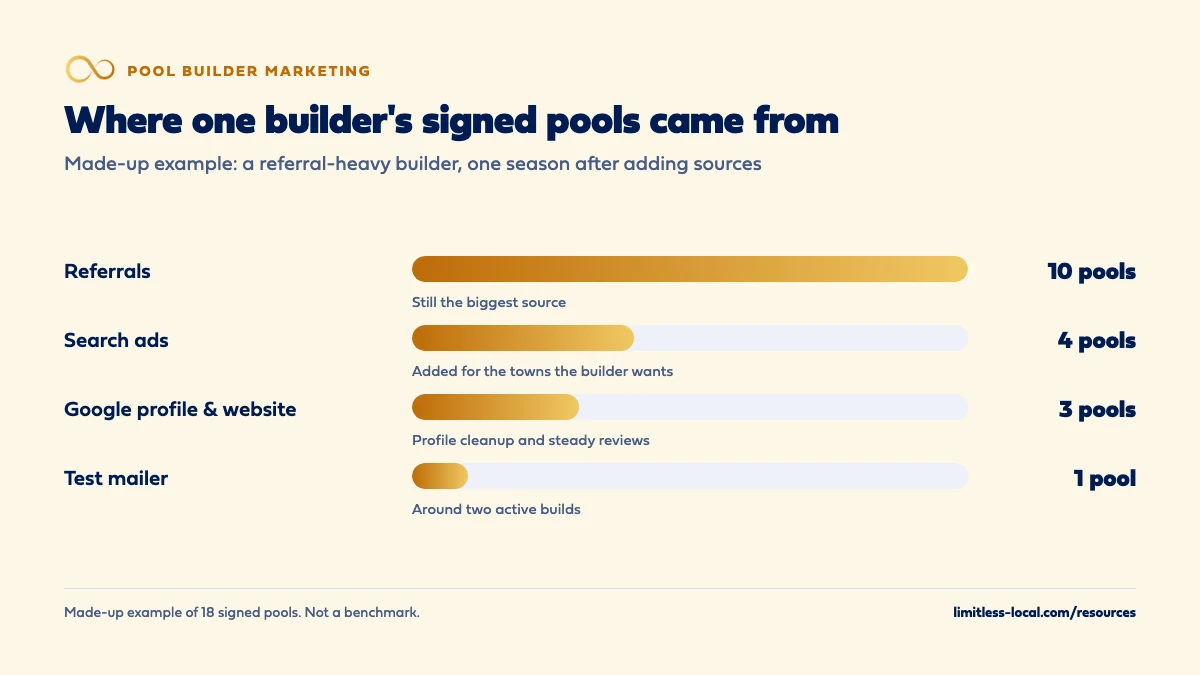
Over the last two seasons, a builder signed 14 pools a year, and 11 of them came from referrals. The builder wants 18 next season and has the crew for it, but past customers alone have never sent more than about a dozen.
Season one plan: keep asking every customer for a referral and a review at the first swim; clean up the Google profile and start a steady review habit; run search ads aimed at the towns the builder wants more work in. Every lead gets its source tagged.
End of season one: 18 signed pools. Referrals: 10. Search ads: four. Google profile and website: three. A test mailer around two active builds: one. Referrals dipped slightly but still lead, and no other source is carrying more than the builder could replace.
Season two adds SEO pages for the new towns, and keeps everything that signed pools at a cost the builder’s profit could carry.
Frequently asked questions
Will running ads hurt my referral business?
No, as long as you keep asking for referrals and reviews. A strong Google profile and website often help referrals, because referred homeowners look you up before they call.
Should I stop paying for leads if referrals keep me busy?
Not entirely. Keep at least one other source running at a level you can afford, so it’s already working if referrals slow down.
How many lead sources does a pool builder need?
There’s no set number. Two or three channels you run well, plus referrals, is enough for most builders, as long as no single one carries more of your work than you could afford to lose.
Should I stop asking for referrals once ads are working?
No. Referral leads usually cost you nothing and sign readily, so keep asking at every handover. Ads are there to add work and fill gaps, not to replace the source that already works.
What if a new channel brings leads but they don't sign?
Compare them with your referral leads on the same steps: consultation booked, proposal sent, contract signed. If they stall early, look at targeting; if they stall at the proposal, look at price and follow-up.
Key takeaways
- Referrals are usually your best leads, but you can’t turn them up when you need more work.
- Depending on one ad account, one Maps ranking or one partner is the same risk in another shape.
- Add one new source at a time, starting with your Google profile and reviews, and give each a full season.
- Keep asking for referrals and reviews while you add the rest.
- Judge each source on signed contracts and cost per contract, season by season.
Not sure what's working right now?
Start with a free visibility audit: rankings, Google profile, reviews and tracking, checked against your service area.
More in this section
- Should a pool builder budget for follow-up, not just lead generation?
- Should pool builders build referral relationships with realtors?
- How does a pool builder scale past referrals and a single crew?
- How can a pool builder turn reviews and referrals into more jobs?
- How can pool builders get referrals from landscapers and builders?
Sources
- Lead Source Report — Jobber Help Center
- Referrals | Marketing Tools — Jobber Help Center
- Every Door Direct Mail (EDDM) — USPS
- FAQ about Google Trends data — Google Trends Help