
What percentage of revenue should a plumber spend on marketing?

- What percentage of my plumbing revenue should I realistically spend on marketing this year?
- Is there a right percentage of revenue for plumbing marketing?
- How do I work out the percentage I'm spending now?
- How should my growth goal change the percentage?
- How does my techs' capacity limit the percentage?
- Should I base the percentage on last year's revenue or next year's goal?
- Why should the percentage be higher in the early years?
- How does my job mix change the right percentage?
- How do I check a percentage against cost per booked job?
- What should count inside my marketing percentage?
- Should I cut the percentage when revenue drops?
- How often should I reset my marketing percentage?
- What's different about the marketing percentage for plumbing companies
- A worked example: setting a plumbing marketing percentage from a growth goal
- Frequently asked questions
- Key takeaways
- More in this section
- Sources
The short version
- A percentage is a result of your plan, not a starting point.
- Holding steady needs a smaller share than growing; a push for growth needs a bigger one for a while.
- Your techs' open capacity caps what extra spend can buy.
- Check any percentage against cost per booked job before you commit to it.
For plumbing owners who think about marketing as a share of revenue and want to set that share on purpose, not by habit.
Get a free visibility audit · Book a growth call
What percentage of my plumbing revenue should I realistically spend on marketing this year?
There’s no single right percentage for a plumbing company; the right share depends on how fast you want to grow, how much open capacity your techs have and how much of your work already comes from repeat customers and referrals. Set the share by working backward from the extra jobs you want and what each booked job costs you to win, then divide by revenue to see the percentage. Holding steady usually needs a smaller share than growing, and a new or fast-growing shop will spend a bigger share for a while.
We price the same way we suggest you budget: in plain dollars you can set against booked jobs. Our marketing packages list each tier’s monthly price and the ad spend it covers, and ad spend is paid to Google separately. See how that fits plumbing companies, or browse more plumbing marketing questions.
Is there a right percentage of revenue for plumbing marketing?
Not one that fits every shop. The SBA’s guide to getting the most from your marketing budget says there’s no hard and fast answer, that many businesses use a percentage of revenue as a guide, and that there’s a wide range in what percentage to spend. It also suggests checking with your industry trade association for benchmarks.
Two plumbing companies with the same revenue can need very different shares. One gets most of its work from builders, property managers and repeat customers who call without being reminded. The other needs Google to bring nearly every new customer. The first can hold steady on a small share; the second can’t. So rather than copying a number, set yours from your own plan. If you’d rather start from a monthly dollar figure, how much a plumbing company should spend on marketing each month works it that way.
How do I work out the percentage I'm spending now?
Start with a real baseline. Add up a full year of everything that went to getting customers:
- Ad spend paid to Google, Meta or anyone else.
- What you paid an agency or freelancer, or a marketing employee’s pay.
- Tools: call tracking, review requests, website hosting and updates.
- Truck wraps, mailers, sponsorships and lead services.
Divide that total by your revenue for the same year. Use a full year, because plumbing months swing with freezes, storms and your own slow weeks, and one month can look wildly high or low. The total often comes out higher than expected, usually because the agency fee or the tools weren’t in the mental count of “marketing.”
Also write down how many jobs came from paid channels versus repeat customers and referrals. If your field software tags lead sources, it’s a few clicks. That split matters more than the percentage itself.
How should my growth goal change the percentage?
Decide which of three goals you’re actually funding this year:
- Hold steady. You want the same revenue with the crew you have. Marketing only needs to replace customers you naturally lose: people who move, landlords who sell, builders who slow down. This is usually the smallest share.
- Grow steadily. You want more work for the crew you have, or one added tech. Marketing has to replace lost customers and buy extra jobs on top.
- Push hard. You’re adding trucks, a new town or a new service line. The share goes up for a while, because you’re paying for jobs before the repeat business from those new customers comes back.
A growth year at a hold-steady percentage is the most common mismatch. The plan says grow, the budget says stay put, and the schedule follows the budget.
How does my techs' capacity limit the percentage?
Marketing can’t book jobs nobody can run. Before you raise your share, count the open slots: how many more jobs each tech could take in a typical week, after callbacks, warranty work and the jobs you already have.
If the real count is a handful a week across the whole crew, a big jump in spend mostly buys leads that wait, get lost to the next plumber or turn into frustrated reviews. Raise the share to fill the slots you have, then raise it again when you hire. How to match spend to the crew through the year is covered in whether plumbing marketing spend should change with seasons and tech capacity.
Should I base the percentage on last year's revenue or next year's goal?
Use last year’s revenue to measure where you are, and next year’s target to set where you’re going. If you’re planning to grow, a share of last year’s number will underfund the plan. New shops with no history use projected revenue for the same reason.
Don’t spend the whole target-year budget in the first month on faith, though. Spread it across the year, and only step up once the jobs from the earlier spend show up. If you’re setting a budget for a shop that’s brand new and has no revenue history at all, how much to budget for marketing to start a plumbing company walks through that case.
Curious what your marketing is actually booking?
Get a free visibility audit — no obligation, no sales pitch.
Why should the percentage be higher in the early years?
Because nobody knows you yet. A new business has to budget more to get noticed, and once it’s established it can spend less, but it shouldn’t stop. For a plumbing company, the reason is concrete: each customer you win in year one can call you again for the next leak, water heater and drain, and refer a neighbor. Those later jobs cost little or nothing to win.
So the percentage tends to fall as the customer base builds, even if the dollars stay flat. A shop that’s been around for years with a healthy repeat base can hold steady on a smaller share than a new one. If your share isn’t falling as you age, check whether you’re keeping in touch with past customers at all.
How does my job mix change the right percentage?
A lot. The percentage is a share of revenue, but what you can afford to pay for each job depends on the margin on that job. A drain clog and a water heater replacement can come from the same kind of search, but they don’t carry the same profit.
If most of your revenue comes from small service calls, a high percentage eats margin quickly. If a big share comes from water heater replacements, repipes and sewer lines, you can afford to pay more to win each one, and a higher overall share can still leave plenty. When you plan a growth push, plan it around the jobs you want more of, not a blended average. Work out how many jobs of each type it takes to cover a marketing push, and you’ll see quickly which work can carry the cost.
How do I check a percentage against cost per booked job?
Turn the percentage into dollars, then into jobs, and see if the jobs make sense.
- Multiply your target revenue by the percentage you’re considering. That’s the yearly marketing budget.
- Subtract fixed costs like tools and any agency fee. What’s left buys leads.
- Divide by your cost per booked job. That’s roughly how many paid-for jobs the budget buys.
- Compare that with your open capacity and the extra revenue you need.
If the jobs it buys are fewer than you need, the percentage is too low for the goal, or your cost per job is too high and needs fixing first. If they’re more than your crew can run, the percentage is too high for now. Finding your own cost per booked job takes real numbers, covered in working out your plumbing customer acquisition cost, and the full backward method is in how much a plumber should budget to book a set number of jobs.

What should count inside my marketing percentage?
Everything you spend to get and keep customers. If you count only ad spend, the percentage looks low and the plan looks cheap, then the agency invoice and the software bills arrive. Count:
- Ad spend, which goes straight to Google or Meta.
- Management: an agency fee, a freelancer or a marketing employee.
- Tools and the website.
- Your own time, if you run any of it yourself. It isn’t free just because you don’t write a check.
When you compare options, compare all-in numbers. An agency fee can look large next to an ad budget, but it may replace tools, a part-time hire and a lot of your evenings. A simple cost-benefit analysis does the job: add up the benefits and the costs over a set period, then subtract the costs from the benefits. Run it for each channel, not just the total.
Should I cut the percentage when revenue drops?
Not automatically. It’s a chicken-and-egg problem: sales drop, you cut marketing, and sales fall further. A percentage of revenue makes this worse, because a strict percentage cuts spend exactly when the phone is quietest.
Ask why revenue dropped first. If a channel stopped booking jobs, fix or cut that channel. If the whole market slowed, a steady budget can win work other plumbers stopped chasing. If cash is truly tight, protect the channels with the lowest cost per booked job and pause the rest. The signs on each side are in when a plumbing company should raise or cut its marketing budget.
How often should I reset my marketing percentage?
Set it once a year with your revenue goal, and check it every quarter against booked jobs. In between, let the monthly dollars move: more ahead of the season you know brings work, less when the schedule is already full.
For paid search, divide the monthly number by 30.4 to get an average daily budget, because Google’s average daily budget sets the monthly spending limit at the daily budget times 30.4. That keeps the yearly percentage and the actual ad account in step.
Talk it through with someone who runs this every day
A 15-minute growth call: your market, your numbers, and what a realistic budget looks like. No pressure.
What's different about the marketing percentage for plumbing companies
Repeat customers lower the share you need. Plumbing problems come back: another clog, an aging water heater, a slab leak in the house next door. A shop that stays in touch with past customers needs less paid marketing to hold steady than one that treats every job as a one-off.
Emergencies don’t keep a calendar. Burst pipes and backed-up sewers come in year-round, with spikes after freezes and heavy rain. Cutting marketing to zero in a slow month can mean missing the burst of calls when the weather turns.
Big tickets change the math. Water heaters, repipes and sewer work can carry far more margin per job than a service call. A shop that wants more of that work can justify a bigger share, as long as it tracks those jobs separately.
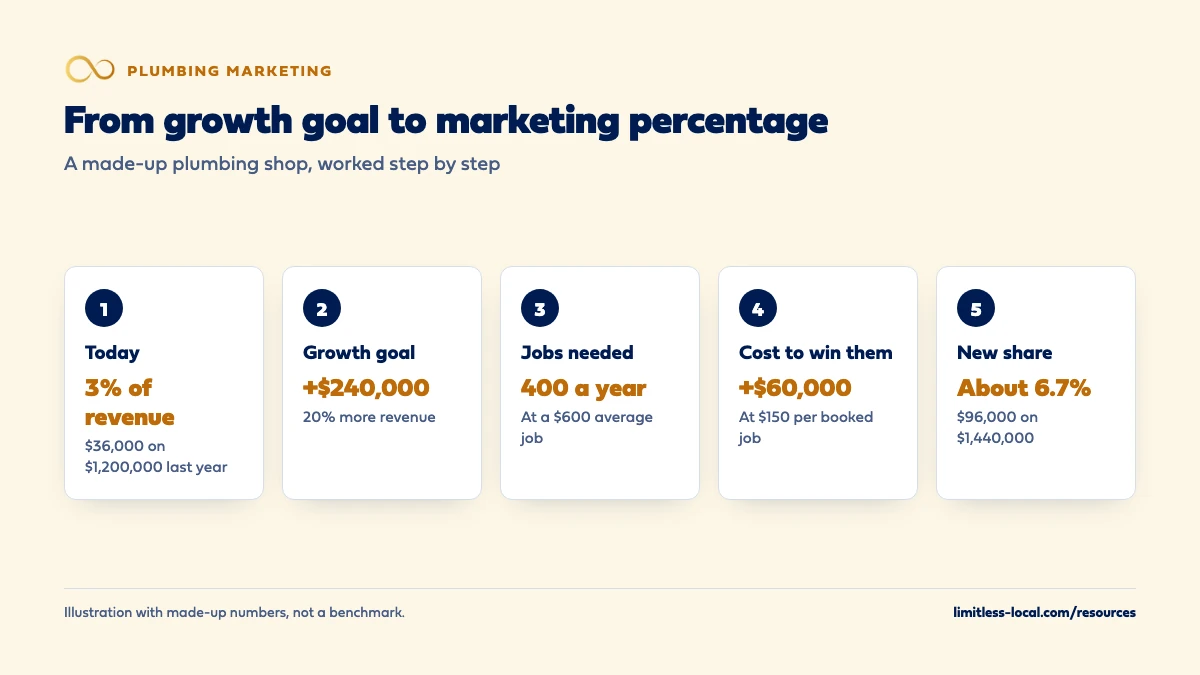
A worked example: setting a plumbing marketing percentage from a growth goal
These numbers are made up to show the math, not a benchmark for your market. A four-truck plumbing shop did $1,200,000 in revenue last year and spent $36,000 all-in on marketing. That’s 3%.
The owner wants to grow 20% this year, or $240,000 more revenue. The average job is $600, so that’s 400 more jobs a year, about 33 a month, or roughly 8 a month per truck. The techs have that room. Last year, each booked job from paid channels cost about $150 to win, so the extra jobs need about $60,000 more in marketing.
New budget: $36,000 plus $60,000 is $96,000, on target revenue of $1,440,000. That’s about 6.7%, more than double last year’s share. The percentage didn’t set the budget; the jobs did, and the percentage is just the result.
For comparison, our Essentials package is $3,500 a month, or $42,000 a year, and includes Google Ads management for up to $2,500 a month in ad spend, which is $30,000 a year paid to Google. Together that’s $72,000, inside the $96,000 with room for tools. A free visibility audit can run your own revenue and job numbers through the same steps.
Frequently asked questions
Should my marketing percentage include truck wraps and uniforms?
Truck wraps, yes, because they’re there to get you calls. Uniforms are closer to an operating cost. The point is to be consistent year to year, so the percentage means the same thing each time you check it.
What if my percentage is already high but revenue is flat?
Then the money isn’t buying jobs. Check cost per booked job channel by channel, and look for leaks like missed calls and slow callbacks before you spend another dollar.
Can a plumbing company spend too little on marketing?
Yes, if the schedule has open slots and paid channels are booking jobs under what you can afford to pay for each one. In that case, more spend is likely buying profitable work you’re leaving on the table.
Should a plumber with a full schedule keep marketing?
Keep the free and slow-building work going, like reviews and your Google profile, and trim paid spend until you have room. Turning everything off means starting cold when the schedule opens up again.
Does adding Local Services Ads change my percentage?
It adds lead spend, so the dollars go up. Whether the share should go up depends on whether those leads book at a cost per job your margins can carry.
Should I use gross revenue or profit for the percentage?
Revenue is the usual base, because it’s easy to compare year to year. Check the result against profit too, because a share that looks fine on revenue can eat most of the margin on small service calls.
Key takeaways
- No single percentage fits every plumbing company; the share depends on growth goal, capacity and how much work already comes back on its own.
- Work out what you spend now, all-in, over a full year before you set a new share.
- Set the budget from the extra jobs you want and what each costs to win, then read the percentage off the result.
- Your techs’ open slots cap what extra spend can buy; raise the share as you add capacity.
- Expect a bigger share in early or growth years and a smaller one as repeat customers build up.
- Don’t cut automatically when revenue drops; find out why first.
Ready to compare options?
Book a short growth call and we'll walk through the math for your service area, including when we're not the right fit.
More in this section
- How much should a plumbing company spend on marketing each month?
- How much should I budget for marketing to start a plumbing company?
- How do I turn plumbing marketing spend into more revenue?
- When should a plumbing company raise or cut its marketing budget?
- What return should a plumber expect from a marketing agency?
Sources
- How to Get the Most From Your Marketing Budget — U.S. Small Business Administration
- Manage your business — U.S. Small Business Administration
- About average daily budgets — Google Ads Help