
How to manage a restoration marketing agency without losing control?
- How does a restoration owner stay in charge of an agency without micromanaging it?
- What does staying in control of a marketing agency actually mean?
- Which decisions should stay with me?
- What should I leave to the agency?
- What access should my restoration agency have?
- What should the monthly report show me?
- How often should I talk with my agency, and about what?
- Which changes should need my OK first?
- How do I see what my agency changed in Google Ads?
- What does the agency need from me to do good work?
- What are the warning signs I'm losing control?
- When should I step in harder or think about leaving?
- What's different about managing an agency for a restoration company
- A worked example: a ten-minute monthly review
- Frequently asked questions
- Key takeaways
- More in this section
- Sources
The short version
- Own every account, and give the agency the access it needs, not more.
- You decide budget, towns, job types and capacity; the agency runs the campaigns.
- Review cost per booked job monthly, not clicks or impressions.
- Agree in writing which changes need your OK before they happen.
For restoration owners who already have an agency and want to stay in charge of the money, the accounts and the decisions without doing the agency’s job for it.
Get a free visibility audit · Book a growth call
How does a restoration owner stay in charge of an agency without micromanaging it?
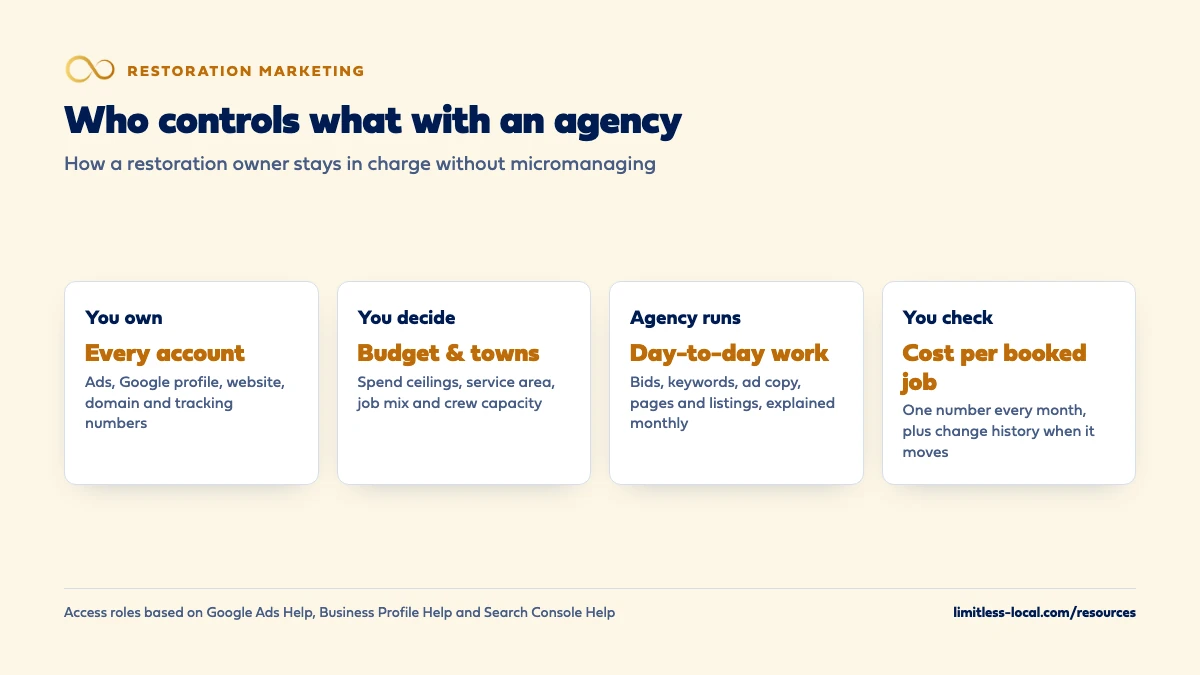
Keep three things in your hands: ownership of every account, the business decisions (budget, towns, job types and how much work your crews can take), and a monthly look at cost per booked job. Hand the agency the day-to-day work, like bids, keywords, ad copy, pages and listings, and ask it to explain every meaningful change in plain words. Agree up front which changes need your OK first, and check the account’s change history now and then so nothing important happens without you knowing.
That split is how we’d want any owner to run us. What we promise is transparency: you’ll know what we’re doing, why, and what it produced, and if something isn’t working, we’ll tell you and fix it. Every package on our packages page includes call tracking and a monthly report with a cost-per-lead breakdown, plus a real-time dashboard, and our restoration marketing has no long-term contracts: we ask for three months, and if you want to leave, we won’t make you stay. The restoration marketing guide covers every channel, and the restoration marketing questions library goes one question at a time.
What does staying in control of a marketing agency actually mean?
It doesn’t mean approving every keyword or reading every ad. Owners who try that burn hours and usually make the campaigns worse. Control means three things:
- You own the assets. The ad accounts, the Google profile, the website, the domain and the tracking numbers are in your company’s name.
- You make the business calls. How much to spend, which towns to work, which jobs you want more of, and when the crews are full.
- You can see the result. Every month you know what the marketing cost and how many jobs it booked.
If those three are in place, you can let the agency do its job and still pull the plug, change direction or switch agencies any time without losing anything.
Which decisions should stay with me?
Anything that depends on knowing your business better than an outsider can:
- The monthly budget and the ceiling during a storm.
- The service area: which towns your crews will actually drive to at 2 a.m.
- The job mix: more water mitigation, more mold, more fire, more commercial, or less of something.
- Crew capacity: when to push and when to pull back because the schedule is full.
- What the company promises: response times, certifications, warranties on the work. The agency should never write a claim you can’t back up.
- Sensitive review replies, especially anything touching an insurance dispute or a complaint about damage.
What should I leave to the agency?
The work that needs practice, tools and weekly attention: bids, keywords and negative keywords, ad copy and testing, landing pages, technical fixes on the website, business listings, and Google profile posts and updates. Ask for the reasons behind changes; don’t ask to approve each one.
A useful test: if a decision changes how much you spend, where you work or what you promise customers, it’s yours. If it changes how the agency gets there, it’s theirs. How much of your time managing a restoration marketer takes shows what that looks like week to week.
What access should my restoration agency have?
Enough to do the work, with your company holding the keys. Each Google tool has its own levels:
- Google Ads. Google offers several access levels, from email-only and billing up to read-only, standard and admin. Your company should hold admin, with a second admin from your side; Google notes that an account with only one administrator may lose access to its tags if that person becomes unavailable.
- Google Business Profile. Managers have mostly the same access as owners, except they can’t add or remove users or remove the profile. Keep your company as primary owner and add the agency as a manager.
- Search Console. A property owner has full control and can add and remove users; a full user can view all data and take some actions. Your company should be a verified owner.
If a new SEO offers to audit your site first, Google’s advice on hiring an SEO is to grant only read access to Search Console at that stage, not write access. For what happens to all of this if you part ways, read who owns your website and ad accounts if you fire your agency.
What should the monthly report show me?
One page you can read in ten minutes, built around booked jobs:
- Total spent, with ad spend and agency fees shown separately.
- Leads by source: calls, forms and messages from Google Ads, Local Services Ads, Maps and the website.
- Booked jobs by source, from the outcomes your team marked.
- Cost per booked job, overall and by channel.
- What changed this month and why, in plain words.
- What’s planned next month, and anything that needs your decision.
If a report is mostly impressions, clicks and rankings with no booked jobs on it, ask for the jobs. Whether your restoration marketing agency is producing real jobs covers how to check.
Curious what your marketing is actually booking?
Get a free visibility audit — no obligation, no sales pitch.
How often should I talk with my agency, and about what?
- Weekly, briefly: a short call or a message thread. You pass on crew capacity, new jobs or towns, and anything odd on the phones; they flag anything that needs a quick answer.
- Monthly: the report review. Look at cost per booked job, ask about anything that moved, and agree on next month’s priorities.
- Quarterly: the bigger questions. Is the budget right? Should you add a channel, a service or a town? What’s the plan for the next storm season?
Write down what you agree on each time. A shared doc with dates and decisions settles most “I thought we said” arguments before they start.
Which changes should need my OK first?
Agree on a short list at the start, in writing. A good default:
- Raising the budget above the agreed monthly ceiling.
- Adding or dropping towns, or widening the service area.
- Adding or removing a service, like starting mold ads.
- Big website changes: new navigation, removing pages, a rebuild.
- Anything that makes a promise to customers, like a new response time or an offer.
- Turning on Google Ads’ automatically applied recommendations. Google lets you choose which recommendations apply on their own and review the queue, and it notes that auto-applied recommendations won’t increase your budget. You still want to know which ones are switched on.
Everything else, the agency can just do and explain afterward.
How do I see what my agency changed in Google Ads?
Open the account’s change history. It lists changes made to the account, campaigns and ad groups over the past two years, like paused campaigns, added keywords and previous budgets, and shows the email of the person who made each change through the Google Ads interface. You can line those changes up against clicks, conversions and cost to see which ones may have moved results.
You don’t need to check it weekly. Look when something changes that you can’t explain: a jump in cost, a drop in calls, or a campaign that suddenly targets a new town. Then ask the agency about it. A good agency will have the answer ready.

What does the agency need from me to do good work?
Control runs both ways. An agency can only aim at booked jobs if it knows which leads booked. The owner’s side of the deal is short but it has to happen:
- Lead outcomes marked in your field software or a shared sheet within a day or two.
- A heads-up when crews are full or when you add a truck.
- Real job photos and a line about each job.
- Quick answers on anything they flag as needing your decision.
When the agency has those, you can hold it to cost per booked job. Without them, it can only report clicks, and you’ve lost the one number that keeps you in charge. What booked job tracking is for a restoration company explains the setup.
What are the warning signs I'm losing control?
- You can’t log in to your own ad account or Google profile, or you’re not sure who the admin is.
- Reports show activity but never booked jobs or cost per job.
- Costs or targeting change and nobody can explain why.
- The agency is vague or secretive about what it’s doing, or won’t explain the changes it makes to your site.
- You find out about changes from customers or from your own phones, not from the agency.
Any one of these is worth a direct conversation. Two or three together usually mean it’s time to take the accounts back into your own hands.
When should I step in harder or think about leaving?
Step in when cost per booked job climbs for two or three months with no clear reason, or when the warning signs above pile up. Start with a plain conversation: here’s the number, here’s what I need, what’s the plan. Give the plan a fair window to work, especially for SEO, which typically takes 3-6 months to show meaningful growth, while ads can produce leads within days.
If nothing changes, leave cleanly. Make sure every account is in your name first, then give notice. Switching your restoration marketing agency or going in-house covers the order to do it in.
Want to see where your company stands?
A free visibility audit shows where you show up on Google, Maps and AI answers, and what it's costing you in calls.
What's different about managing an agency for a restoration company
Storms need rules agreed ahead of time. When a freeze hits, there’s no time for a meeting. Agree in advance how high the budget can go, which campaigns get more, and who can pause ads when the crews are full. Then the agency can act within hours without waiting on you.
Capacity changes fast. A single large loss can tie up your crews for weeks. Tell the agency the same day, so it pulls back on the jobs you can’t take instead of paying for calls you’ll turn away.
Insurance wording is yours. Ads, pages and review replies that mention insurance should go past you first. The agency writes; you decide what your company says about claims.
Commercial work runs on relationships. Property managers and facility managers deal with you, not your agency. Keep those conversations in-house and let the agency support them with pages and ads.
A worked example: a ten-minute monthly review
These numbers are made up to show the math, not a benchmark for your market. A restoration company pays its agency $3,500 a month and spends $2,500 a month on Google Ads. That’s $6,000 a month in total.
- Last month: 20 booked jobs from tracked marketing, so $6,000 / 20 = $300 per booked job.
- This month: 15 booked jobs, so $6,000 / 15 = $400 per booked job.
The owner opens the change history and sees the agency widened the service area to two new towns mid-month. The agency explains it was testing demand. The owner points out that crews won’t drive there after dark, the towns come back out, and they agree any future service-area change needs the owner’s OK. One number, one question, one rule. That’s the whole review.
Frequently asked questions
Should my agency have admin access to my Google Ads account?
It can, as long as your company also holds admin and you have a second admin of your own. Standard access is enough for many day-to-day tasks; admin is needed to manage users and linked accounts.
How long should a monthly agency review take?
If the report is built around booked jobs, ten to twenty minutes. If it takes longer because you’re decoding jargon, ask for a simpler report.
Is it micromanaging to ask why a change was made?
No. Asking why is how you stay in control. Approving every keyword is micromanaging; asking about a change that moved cost or calls is managing.
What if my agency set up the accounts in its own name?
Ask it to make your company the owner or admin now, while things are going well. Transfers are much easier before a relationship sours.
Should I let my agency reply to Google reviews?
For routine thank-yous, yes. Keep the final word on negative reviews, complaints about damage and anything that touches an insurance claim.
Can I run some marketing myself alongside the agency?
Yes, if you agree who owns what. Referral partners, job photos and review requests often work best in-house, with the agency running ads, SEO and tracking.
Key takeaways
- Own every account in your company’s name and give the agency only the access it needs.
- Keep budget, service area, job mix, crew capacity and customer promises as your decisions.
- Review one number monthly: cost per booked job, by channel.
- Agree in writing which changes need your OK, and check change history when results move.
- Feed the agency lead outcomes and capacity updates, or it can only report clicks.
Not sure what's working right now?
Start with a free visibility audit: rankings, Google profile, reviews and tracking, checked against your service area.
More in this section
- What should a restoration company look for in a marketing agency?
- Should a restoration company split marketing in-house and agency?
- Can I switch my restoration marketing agency or go in-house?
- How do I vet a restoration marketing agency before signing?
- How much of my time does managing a restoration marketer take?
Sources
- About access levels in your Google Ads account — Google Ads Help
- About change history — Google Ads Help
- About applying recommendations automatically — Google Ads Help
- Manage your Business Profile owners & managers — Google Business Profile Help
- Managing owners, users, and permissions — Search Console Help
- Do You Need an SEO? Tips for Hiring an SEO — Google Search Central