
What happens to roofing marketing if my in-house marketer quits?
- What breaks in a roofing company's marketing when the in-house marketer leaves?
- What keeps running after my marketer leaves?
- What stops right away?
- Who owns my Google profile and ad account?
- What about my website, domain and tracking numbers?
- How do I check which marketing accounts I actually own?
- What should my marketer hand over before they leave?
- What happens to my leads during the gap?
- How long can roofing marketing coast with nobody running it?
- Should I hire a replacement, bring in an agency or split the work?
- How do I make the next resignation a non-event?
- What should I do in the first week after they give notice?
- What's different for roofing companies
- A worked example: what an unnoticed gap can cost
- Frequently asked questions
- Key takeaways
- More in this section
- Sources
The short version
- Ads, your Google profile and your website keep running at first; the weekly upkeep stops.
- The biggest risk is access: accounts, domains and phone numbers tied to the marketer's personal email.
- Make the company the owner of every account, with at least two people who can get in.
- Reroute form leads and tracking numbers to the office the day notice is given.
For roofing owners with one person running their marketing, who want to know what stalls, what they own, and how to keep the phone ringing if that person walks out.
Get a free visibility audit · Book a growth call
What breaks in a roofing company's marketing when the in-house marketer leaves?
If your in-house marketer quits, most of what’s already running keeps going for a while: ads keep spending, your Google profile stays up and the website stays online. What stops is the weekly work, like review requests, ad checks, posts and new pages, and the real damage comes if the logins, ad account, domain or call-tracking numbers sit under that person’s name or email. Protect yourself by making sure the company owns every account, the work is written down, and someone else can check the numbers before anyone gives notice.
This is also why our delivery is team-driven: no single person leaving should stall a roofer’s lead flow, and every account stays in your company’s name. Our marketing packages cover the same work an in-house marketer does, from your Google profile and reviews to ads and tracking, and our roofing marketing page shows how we work with roofers. For the bigger picture, the roofing marketing guide covers every channel, and the rest of the roofing marketing questions library goes question by question.
What keeps running after my marketer leaves?
More than you’d fear, at least for the first few weeks:
- Google Ads and Local Services Ads keep spending the budget they were given, as long as the card on file works.
- Your Google Business Profile stays live, with its reviews, photos and hours.
- Your website stays online as long as the hosting and domain are paid.
- The SEO work already done, like your service and town pages, keeps doing its job.
That’s also the trap. Because nothing looks broken on day one, owners put off dealing with it. Then a storm hits, the ads still target last spring’s towns, nobody’s asking for reviews, and the slide is a month old before anyone notices.
What stops right away?
Anything that needs a person every week. For most roofing companies, that’s:
- Review requests and replies. If the marketer sent the review link after each job, new reviews dry up fast, and unanswered one-star reviews sit there for weeks.
- Ad checks. Someone has to read the search terms, block junk like “roofing jobs” or “DIY shingle repair”, and move budget toward the towns and job types that sign.
- Posts, photos and new pages, such as a page for a new town or for metal roofs.
- The monthly numbers. Who’s adding up leads, inspections and signed roofs by source now?
Some of this was probably never written down. If your marketer handled form leads, find out today where those emails land, because a lead that goes to an inbox nobody reads is a job you’ll never hear about.
Who owns my Google profile and ad account?
This is the question that decides whether a resignation is an inconvenience or a crisis. Check two places first.
Google Business Profile. A profile can have several owners but only one primary owner, and owners have full control, including adding or removing users and deleting the profile. Managers can do almost everything else, like editing info, replying to reviews and posting, but they can’t add or remove users or remove the profile (Manage your Business Profile owners & managers). If your marketer is the primary owner and you’re not on the profile at all, fix that before anything else.
Google Ads. Access comes in levels. Admin access is the one that can give access, change access levels and remove people; Standard can edit campaigns but not manage users (About access levels in your Google Ads account). Google also warns that an account with only one administrator can lose access to its tags if that user becomes unavailable, and suggests adding a second admin. For a roofer, that second admin should be you.
The rule for both is simple. You, or a company-owned email, hold the top level. The marketer gets the level below it.
What about my website, domain and tracking numbers?
These are the accounts owners forget, because they were set up once and never touched again.
- Your domain. Registrars send renewal reminders by email, and ICANN policy requires two of them, roughly one month and one week before a domain expires (FAQs for Registrants: Domain Name Renewals and Expiration). If the registrar account uses your marketer’s email, those reminders go to someone who no longer works for you. Move the contact email to a company address and turn on auto-renew.
- Search Console. If the only verified owner of your site leaves, Google says you should verify ownership yourself to keep or regain access to the property (Managing owners, users, and permissions).
- Hosting and the website login. Find out who pays for hosting and whose card it’s on.
- Call-tracking numbers. The numbers on your ads and listings may forward to the marketer’s phone, or sit in an account only they can open. What call tracking is and whether a roofer needs it covers how those numbers work.
- Social pages, your email marketing tool and any design files.
How do I check which marketing accounts I actually own?
Sit down for an hour and try to log in to each account yourself, with your own login, not the marketer’s. For each one, write down your access level, who else has access, whose card pays for it, when it renews, and which email gets the alerts and invoices.
Start with the accounts that cost you money or leads if they lock up: Google Ads, your Google profile, the domain, hosting, call tracking and any Local Services Ads account. Then do social pages, email tools and analytics.
If you can’t get in somewhere, ask now, while the relationship is friendly. It’s a five-minute favor from someone who still works for you and a much bigger job once they’ve moved on. Which marketing tasks a roofer should keep in-house walks through which accounts and jobs should never leave the company.
Curious what your marketing is actually booking?
Get a free visibility audit — no obligation, no sales pitch.
What should my marketer hand over before they leave?
Logins are only half of it. The other half is what’s in their head. Ask for a short handover document that covers:
- Every account, with the access list above.
- What’s running: each ad campaign, its budget, the towns and job types it targets, and why.
- What’s been tried and dropped, so the next person doesn’t pay to learn it again.
- The blocked search terms and the reasons for them.
- The review process: when the request goes out, who sends it and what it says.
- Where leads go: which forms email whom, where calls forward, and how leads get logged in your software.
- The calendar: domain and hosting renewals, seasonal budget changes, anything scheduled.
- Vendors: web developer, printer, photographer, sign shop.
In Google Ads you have a backup even without notes. Change history lists the changes made to your account, campaigns and ad groups over the past two years, including who made them, if each person used their own login (About change history). It’s a good reason to never share one login between people.
What happens to my leads during the gap?
This is where a resignation actually costs you jobs. Ads and listings can keep bringing calls and forms, but if they’re routed to the wrong place, they die quietly.
The day notice is given, check three things:
- Website forms. Submit a test lead from your phone. Does it reach someone in the office within minutes?
- Tracking numbers. Call each number on your ads, Google profile and website. Does it ring the office or the marketer’s cell?
- Message and chat leads. Google profile messages, Local Services Ads messages, Facebook messages, website chat. Who gets the alert?
Point everything to a shared inbox or the office line, not to whoever replaces the marketer. That way the next change of staff doesn’t break it again. Then keep calling leads back fast, because a roofing lead that waits a day often calls the next roofer. How fast a roofing company should call back a new lead covers the timing.
How long can roofing marketing coast with nobody running it?
Not as long as it looks. Each channel fades at its own pace:
- Ads keep running but drift: search terms creep, a competitor raises bids, a campaign runs out of budget by noon. A week or two without checks is usually survivable; a season is not.
- Local Services Ads rank partly on how responsive you are and on your rating and number of reviews, and Google notes that missed calls may count against your responsiveness (About ad rankings). A gap in either shows up in where you rank.
- Your Google profile slips more slowly, but months with no new reviews leave you looking stale next to roofers still collecting them.
- SEO fades slowest. Pages that rank keep ranking for a while, but nothing new gets built.
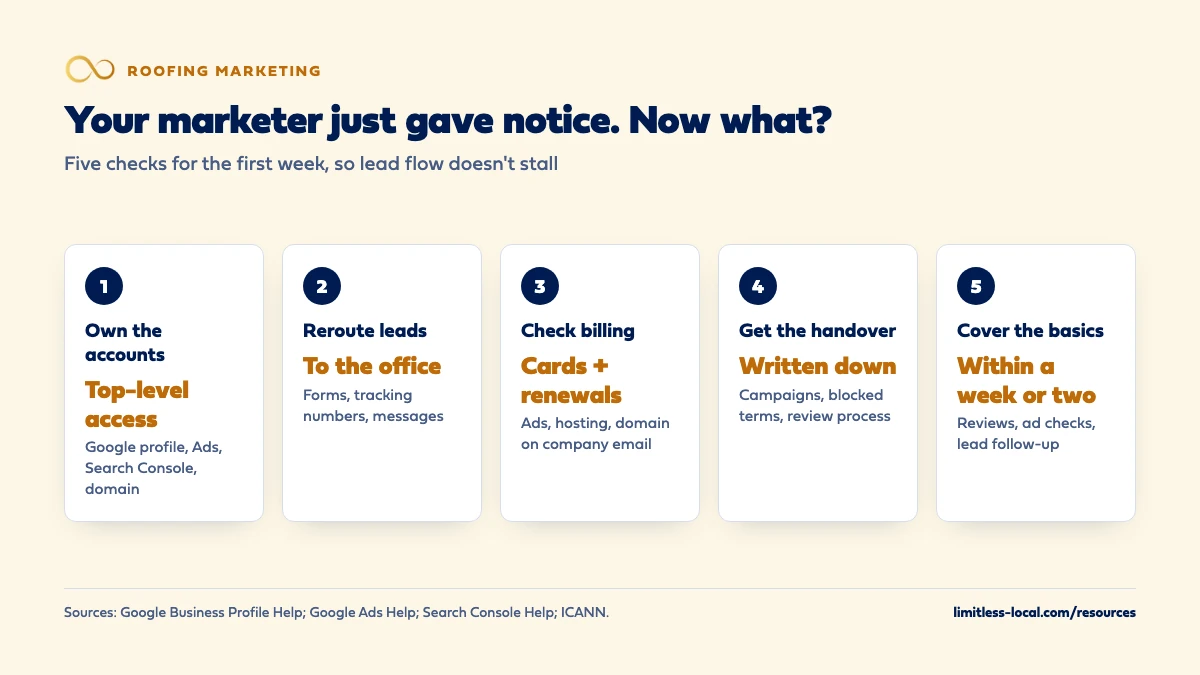
Plan for someone to cover the basics within a week or two, even if the long-term answer takes longer.

Should I hire a replacement, bring in an agency or split the work?
It depends on how much work there really is and how fast you need it covered.
- Hire a replacement if there’s a full week of marketing work every week and you want someone in the office who knows your crews. Expect the search and ramp-up to leave a gap. When a roofing company is ready for a full-time marketing hire covers what that role really costs.
- Bring in an agency if you need the work covered quickly. A team doesn’t stop when one person quits.
- Split it: keep a coordinator in-house for photos, reviews and lead follow-up, and hand ads, SEO and tracking to specialists. One marketer or several specialists lays out that trade-off.
Whatever you choose, the accounts stay in your company’s name. If you bring us in, onboarding takes your team about 2–3 hours, and campaigns go live in weeks 1–2.
How do I make the next resignation a non-event?
Set it up once, then check it every quarter:
- Company email for every login, such as a marketing address on your own domain, never anyone’s personal Gmail.
- Two people at the top level on every account: you and one other person you trust.
- Everyone gets their own login. Nobody needs to share a password, and you can remove one person without locking out everyone else.
- The monthly report lands in your inbox, with leads, inspections and signed roofs by source, so you’d notice a drop even if nobody told you.
- A quarterly access check: log in to each account and remove anyone who’s gone.
None of this is about distrusting your marketer. It’s the same as keeping the truck titles in the company’s name. How much control a roofer should keep over marketing decisions covers the rest of what stays with you.
What should I do in the first week after they give notice?
- Get top-level access to your Google profile, Google Ads, Search Console, domain, hosting and call tracking. Ask the marketer to add you before anything else.
- Reroute leads so forms, calls and messages reach the office.
- Check the cards on file for ads, hosting and the domain, and when each renews.
- Walk through the handover document together while they’re still around to answer questions.
- Pull the last few months of numbers, so you have a baseline to judge whoever comes next.
- On their last day, remove their access and confirm you can still get into everything without them.
Want to see where your company stands?
A free visibility audit shows where you show up on Google, Maps and AI answers, and what it's costing you in calls.
What's different for roofing companies
Timing around storm season. A marketer who leaves in late winter is an annoyance. One who leaves the week after a hailstorm, when the ads need more budget, new towns and tighter search terms, can cost you the best weeks of the year. If your season is building, cover the ads first and content later.
Insurance and warranty wording. Roofing ads often mention insurance claims, manufacturer warranties or financing. Whoever takes over should know which claims you’ve approved, so nobody edits an ad into a promise you can’t keep.
Results show up late. A replacement can sign weeks after the first call, so during the gap watch leads and inspections, not just contracts.
Job photos come from crews. If the marketer was the one reminding crews to shoot before-and-after photos, hand that reminder to a crew lead.
A worked example: what an unnoticed gap can cost
These numbers are made up to show the math, not a benchmark for your market. Say your Google Ads bring in 20 leads a month, one in four of them signs, and each signed roof leaves $4,000 in gross profit. That’s 5 signed roofs and $20,000 in gross profit a month from that one channel.
Now say the card on file for the ads expires the same month your marketer leaves, the ads stop, and nobody notices for a month because the alert emails go to the old marketer’s inbox. That’s 20 leads you never got, about 5 roofs you never signed, and roughly $20,000 in gross profit gone, with no error message to tell you why the phone went quiet.
The fix costs almost nothing: a company email on the billing alerts and a monthly look at the numbers. A free visibility audit checks the same things across your accounts, tracking and lead routing.
Frequently asked questions
Can my former marketer still log in after they leave?
Yes, until someone removes them. On your Google profile, owners can add and remove users; in Google Ads, that’s an Admin job. Remove their access on their last day, after you’ve confirmed you can get into everything without them.
Should my marketer have owner access or manager access?
Manager on your Google profile and Standard in Google Ads covers almost all the day-to-day work. Keep owner and Admin access with you or a company email, so you can always add and remove people.
Will my Google rankings drop if nobody works on marketing for a month?
Usually not overnight. Pages that rank keep ranking for a while. What you lose first is the steady stream of new reviews and the ad upkeep, and those gaps grow the longer they last.
Should I pause my ads until I find a replacement?
Only if nobody can watch them. If someone answers the phone and can glance at spend and search terms each week, keep them running, because pausing cuts off leads you’d otherwise get. If nobody can check them at all, lower the budget rather than leave them unwatched.
Can an agency cover the gap while I hire?
Yes, and it’s a common way to keep lead flow steady. With us there’s no long-term contract: we ask for three months and put it in our contract, but if you want to leave, we won’t make you stay.
What if my marketer won't hand over the accounts?
Start with what Google lets you recover: as the business owner you can request ownership of your Google profile and verify yourself as an owner in Search Console. For the domain, contact the registrar. It’s slower than a friendly handover, which is why you check access before anyone quits.
Key takeaways
- Ads, your Google profile and your website keep running at first; review requests, ad checks and reporting stop.
- The real risk is accounts, domains and tracking numbers tied to the marketer’s personal email.
- Keep owner or Admin access with the company, and give the marketer the level below it.
- Reroute forms, calls and messages to the office the day notice is given.
- Get a written handover, then remove the old marketer’s access and check you can still get into everything.
Not sure what's working right now?
Start with a free visibility audit: rankings, Google profile, reviews and tracking, checked against your service area.
More in this section
- What does a roofing marketer actually do each month?
- How do I switch roofing marketing agencies without losing leads?
- How does a roofer manage a new marketing agency better?
- Which marketing tasks should a roofer keep in-house?
- Which roofing marketing tasks should I do myself or hand off?
Sources
- Manage your Business Profile owners & managers — Google Business Profile Help
- About access levels in your Google Ads account — Google Ads Help
- Managing owners, users, and permissions — Search Console Help
- FAQs for Registrants: Domain Name Renewals and Expiration — ICANN
- About change history — Google Ads Help
- About ad rankings — Google Local Services Help
- Request ownership of a Business Profile — Google Business Profile Help