
How long should a pool builder run ads before judging 1k a month?

- How long should I run pool construction ads before I decide $1,000 a month is working?
- How long should I run $1,000 a month before I judge it?
- What does $1,000 a month actually buy in pool ads?
- Why is $1,000 a month so hard to judge quickly?
- What should I check in the first two weeks?
- Does the Google Ads learning period mean I have to wait?
- What should I judge at the end of the first month?
- When can I judge cost per design consultation?
- When can I judge signed contracts?
- When should I stop or change ads before the time is up?
- When is it time to raise the $1,000?
- Why the clock runs longer for a pool builder on $1,000
- A worked example: what $1,000 a month can tell you, and when
- Frequently asked questions
- Key takeaways
- More in this section
- Sources
The short version
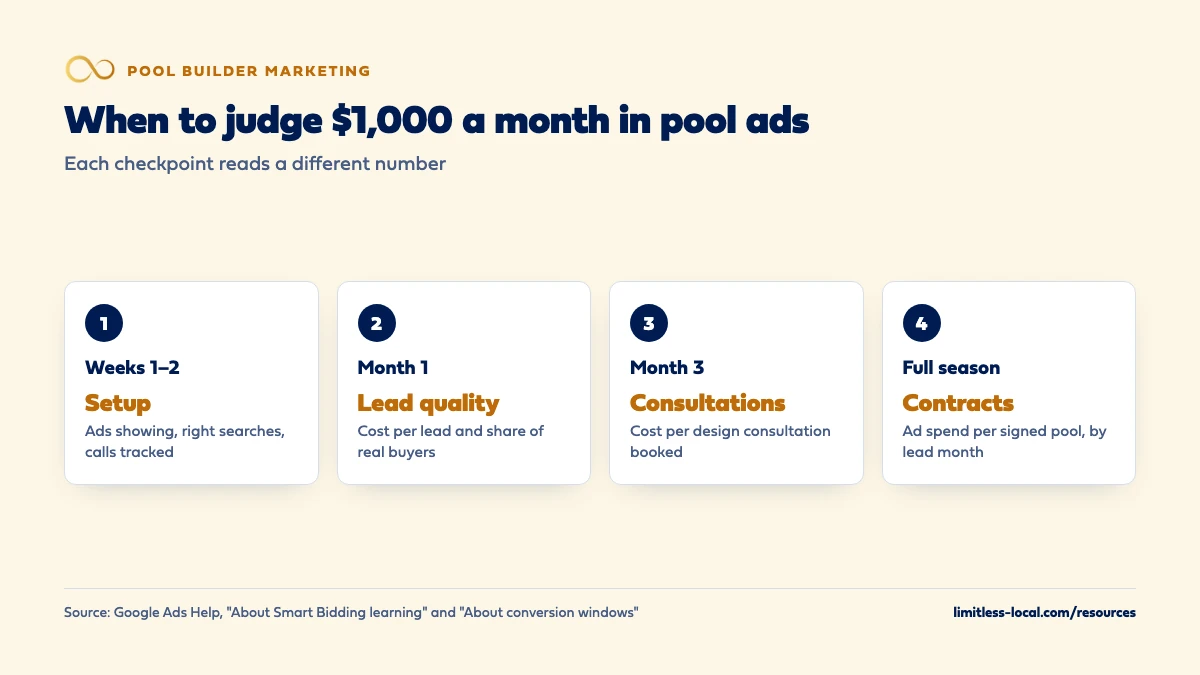
- Weeks 1–2: check the setup, not the results.
- Month 1: read cost per lead and how many callers are real pool buyers.
- Month 3: judge cost per design consultation.
- Full season: judge signed contracts, counted by the month each lead came in.
For pool builders testing Google Ads on about $1,000 a month and wondering when the results are real enough to keep, cut or raise the budget.
Get a free visibility audit · Book a growth call
How long should I run pool construction ads before I decide $1,000 a month is working?
Give $1,000 a month in pool ads about three months before you judge it on cost per design consultation, and a full selling season before you judge it on signed contracts. At roughly $33 a day, a month brings too few leads to tell a good campaign from a lucky or unlucky one, and pool buyers often take months to sign. The exception is a setup problem, like ads not showing, junk searches or untracked calls, which you should fix in the first two weeks instead of waiting.
That’s the same staged way we judge any new pool campaign: setup first, then consultations, then contracts. We’ll never promise you a date for results, but ads can generate leads within days of launch, and we set up tracking so every call and form can be traced to a signed job. Our local ads management page explains how we run campaigns, the pool builder marketing page shows the full picture for pool companies, and more answers are in the pool builder marketing questions library.
How long should I run $1,000 a month before I judge it?
Use three checkpoints, not one deadline, because each tells you something different:
- Two weeks: is the campaign set up right? Ads showing, the right searches, calls tracked.
- Three months: what does a design consultation cost you from these ads?
- A full selling season: how many signed contracts did the ads produce, and what did each one cost?
The budget is what stretches the clock. A builder spending $10,000 a month gets enough leads in a few weeks to see a pattern. At $1,000, the same number of leads takes months to pile up, so a fair read takes longer too. That’s not a reason to give up on a small budget; it’s a reason to judge it at the right time with the right number. For how quickly ads start bringing calls at any budget, see how long Google Ads take to bring a pool builder calls.
What does $1,000 a month actually buy in pool ads?
Fewer clicks than most owners picture. Google Ads runs on an average daily budget, and its page on average daily budgets says to divide your monthly amount by 30.4, the average number of days in a month. So $1,000 a month is about $33 a day.
Google also spends unevenly on purpose. It pushes more on days you’re more likely to get clicks and conversions and less on others, while, for most campaigns, never charging more than twice your average daily budget on a single day or more than 30.4 times it in a month. On a small budget, that means one busy Saturday can use a big piece of the week’s money.
Pool searches aren’t cheap clicks, so $33 a day might be a handful of visitors to your site. That’s enough to learn from, but only if you keep the campaign narrow: the towns closest to your yard, a short list of new-pool searches, and one strong landing page.
Why is $1,000 a month so hard to judge quickly?
Because the numbers are small enough that luck decides a single month. If $1,000 brings a dozen leads, one homeowner more or less changes your cost per lead by a big chunk. One good consultation that signs makes the month look brilliant; one that delays to next spring makes it look like a waste. Neither tells you much about the next month.
Then there’s the sales cycle. A homeowner who clicks in February might book a design consultation in March, sit with the drawings in April and sign in May. Judge February’s spend in February, and you’re only seeing its leads, not its contracts.
So stretch the window and change the yardstick as it grows: leads first, consultations next, contracts last. When $500 a month isn’t enough covers the same problem at an even smaller budget.
What should I check in the first two weeks?
The setup, not the results. Google’s ad review page says most ads are reviewed within one business day, so by the end of the first week you should be able to answer these:
- Are the ads running? Approved, not limited, and showing during the hours you want calls.
- Are they showing for the right searches? The search terms report lists the actual searches that triggered your ads. If it’s full of pool cleaning, pool supplies or above-ground pools, you’re paying for the wrong people.
- Are the right towns covered? Not the whole county if you only build in five towns.
- Is every call and form tracked? If you can’t count leads, nothing after this point can be judged.
Fix what’s wrong right away. Google suggests adding irrelevant search terms as negative keywords so your ads stop showing for things you don’t sell. Negative keywords for pool builders has a starter list.
Curious what your marketing is actually booking?
Get a free visibility audit — no obligation, no sales pitch.
Does the Google Ads learning period mean I have to wait?
A little, but less than people think. Google’s page About Smart Bidding learning says the Learning status appears after major structural changes, never lasts more than 7 days, and your ads keep running normally while it shows. It also says performance typically settles within 1 to 2 conversion cycles, the time it takes for a click to turn into a conversion, and that very restrictive settings, including low daily budgets and narrow targeting, can slow that ramp-up.
That last point matters at $1,000 a month. A small budget is slower for the bidding to learn from, so the worst thing you can do is restructure the campaign every few days. Google’s own advice is to evaluate over 2 conversion cycles or a 2-week window, whichever is longer, after it has settled. Make a change, leave it alone long enough to read it, then decide.
What should I judge at the end of the first month?
Leads and lead quality, not contracts. By now you should have a first read on:
- Cost per lead: ad spend divided by tracked calls and forms.
- Share of real buyers: how many leads were homeowners planning a new pool in your area, versus service calls, job seekers, vendors and price shoppers from three counties away.
- Speed to callback: how fast someone reached each lead. At this budget, a missed callback can be most of the month’s value.
Don’t cut a campaign because month one produced no contracts; that’s normal for pool ads. Do cut or fix one where most of the leads were never going to buy a pool from you. That’s a targeting or offer problem, and more time won’t solve it.
When can I judge cost per design consultation?
Around the three-month mark. By then you’ve usually got enough leads that one good or bad week doesn’t swing the number much, and enough time has passed for leads to book consultations.
Work it out simply: three months of ad spend divided by the consultations those ads booked. Then compare it with what you can afford. If about one in four consultations signs for you, a consultation is worth roughly a quarter of what you’d pay to win a contract. If your cost per consultation is well under that line, the ads are on track even before contracts arrive. Tracking cost per qualified lead covers how to tag leads so the count is clean.
When can I judge signed contracts?
Over a full selling season, with each contract counted against the month its lead came in. That’s the only fair way to judge a campaign with a long sales cycle.
Google can help count them, if you set it up. Its page About conversion windows says the default click-through window is 30 days, which is short for a pool sale, and that you can set it anywhere from 1 to 90 days depending on the source of the conversions. A conversion that happens after the window closes won’t show up in your reports.
To record the contract itself, Google’s page on offline conversion imports explains how to send sales that happen at your office or over the phone, such as signing a contract, back to Google Ads, and recommends starting with enhanced conversions for leads if you haven’t set up imports yet. Even if you never do, keep a simple list: lead date, source, consultation date, signed or not.
When should I stop or change ads before the time is up?
Waiting only makes sense when the setup is sound. Stop and fix it now if:
- The search terms are mostly people who’ll never buy a pool from you, even after adding negatives.
- Calls aren’t being tracked, or nobody is answering them.
- The landing page is broken, slow or doesn’t mention the pools you build.
- Ads barely show because the budget is spread across too many towns or keywords.
None of these gets better with time. A campaign with a fixable problem should be fixed, and the clock for judging it restarts from the fix.
When is it time to raise the $1,000?
When the campaign is working and the budget is what’s holding it back. The signs:
- Your cost per consultation is comfortably below what a signed pool can carry.
- Google marks the campaign Limited by budget, which it uses when a campaign is underperforming because the budget is limited.
- Your ads stop showing partway through busy days in peak season.
- Your crews have room for more pools next season.
Raise it in steps, not all at once, and give each step time to settle before you judge it. Whether $2,500 a month is enough ad spend for a pool builder covers what the next step up can and can’t do.
Talk it through with someone who runs this every day
A 15-minute growth call: your market, your numbers, and what a realistic budget looks like. No pressure.
Why the clock runs longer for a pool builder on $1,000
Few leads, big contracts. A service company on $1,000 a month might see dozens of small jobs to judge it by. A pool builder might see a handful of consultations and one or two contracts, so each one carries more weight in the math.
A long gap between click and contract. Design, financing, HOA approval and permits all sit between the first call and a signature. The ads have done their job long before the contract proves it.
Seasons skew short tests. A test that runs only in the slow months will look worse than the same campaign in spring. If you can, start a small test a little before your busy season, so the read covers both the ramp and the peak.
Small budgets need narrow targeting. On $1,000, cover the towns and pool types you want most. Spread across a whole metro, each town gets too few clicks to learn anything.
A worked example: what $1,000 a month can tell you, and when
These numbers are made up to show the math, not a benchmark for your market.
Say clicks on your pool searches cost about $8. At $1,000 a month, that’s about 125 clicks. If one in ten clicks turns into a call or form, that’s about 12 leads a month. If one in three leads books a design consultation, that’s about 4 consultations, and if one in four of those signs, about one contract a month on average.
After one month: 12 leads, maybe 4 consultations, maybe zero contracts, maybe two. The contract count tells you almost nothing yet.
After three months: about 37 leads and about 12 consultations, at roughly $250 each ($3,000 ÷ 12). Now you have a cost per consultation you can trust, and you can compare it with what a signed pool can afford.
After a full season of six months: about 24 consultations and perhaps 6 contracts, so each signed pool cost one month’s budget in ad spend ($6,000 ÷ 6). That’s the number to decide on: keep, cut or raise.
Run it with your own click cost and close rates. The point holds at any numbers: on $1,000 a month, the useful answers arrive in months, not weeks.
Frequently asked questions
Is $1,000 a month too little to run pool ads at all?
Not if you keep it narrow: a few towns, a short list of new-pool searches and one landing page. It’s too little to cover a big metro, but enough to learn your real costs.
Should I pause the ads in the off-season while I'm testing?
If your test spans the off-season, the read will look worse than it would in spring. Either start the test ahead of the busy months or judge off-season months separately rather than averaging them in.
Can I judge the ads by website traffic instead?
No. Traffic tells you people clicked, not that they were pool buyers. Judge by tracked calls and forms, then consultations, then contracts.
What if I get one big contract in the first month?
Enjoy it, and keep going. One contract on a small budget can be luck either way, so keep the three-month and full-season checkpoints.
Should I switch to Facebook ads if Google hasn't worked in a month?
Not after one month. Check the search terms, tracking and follow-up first; switching channels resets the clock without fixing whatever was wrong.
Does changing my budget restart the learning period?
No. Google says changes to budgets take effect in the next auction and never trigger the Learning status. Big structural changes, like a new bid strategy or adding and removing campaigns or keywords, can.
Key takeaways
- $1,000 a month is about $33 a day, which means few clicks and slow, noisy results.
- Check setup in the first two weeks and fix problems immediately; don’t wait them out.
- Judge cost per design consultation at about three months.
- Judge signed contracts over a full season, counted by the month each lead came in.
- Raise the budget in steps once cost per consultation is healthy and the budget is the limit.
Ready to compare options?
Book a short growth call and we'll walk through the math for your service area, including when we're not the right fit.
More in this section
- Is 10k a month too much ad spend for a pool builder?
- Is $2,500 a month enough ad spend for a pool builder?
- How long should a pool builder wait to judge a marketing agency?
- What skills does a pool builder need to run its own ads?
- What monthly ad spend gets a pool builder steady leads?
Sources
- About average daily budgets — Google Ads Help
- About the ad review process — Google Ads Help
- About the search terms report — Google Ads Help
- About Smart Bidding learning — Google Ads Help
- About conversion windows — Google Ads Help
- About offline conversion imports — Google Ads Help
- Fix “Limited by budget” status — Google Ads Help