
How long until my electrical marketing spend pays for itself?

- How many months should it take for electrical marketing to earn back what I spend?
- What does "pays for itself" actually mean?
- How do I work out my own payback month?
- How long do Google search ads take to pay back?
- How long does SEO take to pay back?
- Why do panel upgrades and generators stretch the clock?
- Should repeat customers count toward payback?
- What makes electrical marketing slower to pay back?
- What makes it pay back faster?
- When should I decide a channel isn't going to pay back?
- How should I track payback each month?
- What's different about payback for electricians
- A worked example: six months of running totals
- Frequently asked questions
- Key takeaways
- More in this section
- Sources
The short version
- Payback month: when running gross profit passes running spend.
- Search ads bring calls within days; payback usually takes a few months.
- SEO typically takes 3-6 months to show meaningful growth.
- Quoted jobs count when sold, not when the lead came in.
- Use gross profit, not revenue, and include every cost.
For electrical contractors who want to know when the money going into ads and SEO starts coming back as profit, and how to tell if it’s on track.
Get a free visibility audit · Book a growth call
How many months should it take for electrical marketing to earn back what I spend?
It depends on the channel and your job mix. Search ads can bring calls within days, so a well-run ad campaign can start covering its monthly cost within the first few months once tracking and targeting are dialed in, while SEO typically takes 3-6 months to show meaningful growth and usually pays back later but then keeps bringing calls without a per-click charge. Work out your own payback month by keeping a running total of what you’ve spent and the gross profit from jobs the marketing booked; it pays for itself in the month the profit total passes the spend total. Quoted jobs like panel upgrades and generators, and repeat customers, stretch the clock, so count them when they’re sold, not when they call.
This is the number our monthly reports are built around. Every package includes a monthly performance report with a cost-per-lead breakdown, call tracking and a real-time dashboard, and campaigns go live in weeks 1-2 after a 15-minute discovery call. There are no long-term contracts: the standard ask is three months, written into the contract, but we won’t make you stay. See our packages for what each tier includes, our electrical contractor marketing page for how we work with electrical shops, and the rest of the electrical marketing questions library for more.
What does "pays for itself" actually mean?
It means the gross profit from jobs your marketing brought in has caught up with everything you spent on that marketing. Three details make the difference between a real answer and a wishful one:
- Gross profit, not revenue. A $1,000 invoice that cost you $600 in labor and materials returned $400, not $1,000.
- All the costs. Ad spend, agency or freelancer fees, call tracking, website work and the hours you or your office spend on it.
- Only new work. Jobs from repeat customers, builders and referrals who would have called anyway don’t count.
This is the same break-even idea the SBA’s break-even point calculator uses for a whole business: fixed costs divided by what each sale leaves after its variable costs. For marketing, the fixed cost is the monthly spend, and each sale is a booked job.
How do I work out my own payback month?
Keep two running totals, starting the month the marketing begins:
- Total spent so far, all costs added up month by month.
- Total gross profit so far from jobs the marketing booked, added in the month each job is sold.
Payback is the month the second total passes the first. Before that, the marketing is still in the hole. After it, every month that brings in more profit than it costs is money ahead.
There’s a second, earlier milestone worth watching: the first month where that month’s profit covers that month’s cost. That’s when the marketing stops digging the hole deeper, even though it hasn’t paid back the early months yet. The worked example below shows both.
How long do Google search ads take to pay back?
Ads can generate leads within days of launch, so you’ll know fast whether the phone rings. Payback takes longer. The first few weeks usually go to cutting out searches you don’t want, fixing tracking and moving budget to the job types that book. Most of the payback comes after that.
Judge search ads on two to three months of tracked booked jobs. If the monthly profit is climbing toward the monthly cost by then, the trend is right. If it’s flat and well below, change something before spending more. How long until electrician Google Ads start bringing in leads covers what happens in those first weeks.
How long does SEO take to pay back?
Longer to start, longer to last. SEO typically takes 3-6 months to show meaningful organic growth, and Google’s SEO Starter Guide says some changes take effect in a few hours while others could take several months. So SEO costs run for months before the calls build, which pushes the payback month later than ads.
What SEO has going for it is what happens after payback. Service pages that rank and a Google Business Profile that shows in the map pack keep bringing calls without a per-click charge, and they don’t switch off the day a budget runs out. Over a year or two, that often makes SEO the cheaper channel per booked job, even though it was the slower one to earn back. Why SEO takes longer than Google Ads for electricians explains the difference.
Curious what your marketing is actually booking?
Get a free visibility audit — no obligation, no sales pitch.
Why do panel upgrades and generators stretch the clock?
Because the money arrives weeks after the lead. A homeowner asks for a panel upgrade quote, compares bids, waits on a utility or permit, and the job is sold and done later. Your payback math should count that profit in the month the job is sold, not the month the call came in, so quoted work always lags.
The same lag shows in Google Ads. Google defines the conversion cycle as the time it takes for a click to result in a conversion, and its page on conversion windows says the default window for counting a conversion after an ad interaction is 30 days, and that you can set a longer one if your buying cycle doesn’t fit. If you send sold jobs back to Google Ads, a long quote cycle means the account will look worse in the first weeks than it really is.
Quote follow-up shortens the wait. How to follow up on electrical quotes automatically covers a simple sequence.
Should repeat customers count toward payback?
Count them, but separately. Canada’s business development bank, BDC, describes customer lifetime value as the revenue or profit a customer brings over the whole relationship: average sale times repeat transactions times years they stay, plus any maintenance or after-sale service.
For an electrician, that might mean a service call this year, a panel upgrade next year and an EV charger after that. If your marketing wins a customer like that, the lifetime profit is real. But it arrives over years, and you pay for the marketing now.
A sensible way to handle it: judge payback on the first job, so the marketing has to earn its keep in the near term, and use lifetime value to decide how far you can stretch on a channel that wins customers who come back. How electricians work out profit per job and customer value walks through both numbers.
What makes electrical marketing slower to pay back?
- Missed calls. Every paid call that goes to voicemail is spend with no chance of profit.
- Wrong job mix. Spending on broad “electrician near me” searches that fill up with small service calls, when bigger jobs carry far more profit.
- Towns too wide. Leads from places your trucks can’t reach easily book less and cost more to run.
- Thin reviews. Homeowners who find you and then pick someone with more reviews.
- No tracking. If you can’t tie jobs to the marketing, you can’t see payback at all, and you can’t fix what’s slowing it.
- A new website or new business. Ads can still work from day one, but SEO starts from scratch and takes longer.
- Full crews. Leads you can’t schedule turn into lost jobs, not profit.
What makes it pay back faster?
- Point spend at your best job types first, the ones with the highest gross profit and steady demand in your area.
- Answer every call, and call back missed ones within minutes.
- Follow up on every quote, so quoted work closes sooner and more often.
- Keep the service area tight to the towns you serve best.
- Ask every customer for a review, so more of the people who find you choose you.
- Ramp spend in steps instead of starting high, so early months don’t dig a deep hole. Whether $10,000 a month is too much for electrical marketing shows the step-up approach at a bigger budget.
When should I decide a channel isn't going to pay back?
Give each channel a fair test before calling it:
- Search ads: two to three months of tracked booked jobs, after the obvious fixes. If monthly profit is still well below monthly cost and not climbing, cut or rebuild it.
- Local Services Ads: a similar window once you’re live and showing, judged on booked jobs, not lead count.
- SEO: six months or more, judged on the trend in calls from search and your Google profile. A flat line at six months, with the work actually being done, is a real warning.
Before you cut, check the leak isn’t on your side: missed calls, slow quotes or crews too full to take the work. Those slow every channel, and switching channels won’t fix them.
How should I track payback each month?
One sheet, one row per month, per channel if you can:
- What it cost, all in.
- Leads, and how many you reached.
- Jobs sold, by type, and the gross profit on them.
- Running total spent and running total profit.
Pull the jobs from ServiceTitan, Housecall Pro or Jobber with the lead source attached, so you’re counting real invoices, not guesses. What to expect from electrical marketing in the first 90 days shows what those rows usually look like early on.
Talk it through with someone who runs this every day
A 15-minute growth call: your market, your numbers, and what a realistic budget looks like. No pressure.
What's different about payback for electricians
Small and big jobs pay back on different clocks. A service call is booked, done and paid within days. A panel upgrade, service change or generator can take weeks from quote to invoice. Track them in separate columns so the slow ones don’t hide the fast ones.
Permits and utilities add waiting. Some jobs wait on inspections or utility work before you can finish and bill. That’s normal lag, not a marketing problem.
Storm season can pull payback forward. Generator and emergency demand jump after outages. Marketing that’s already running when it hits can earn back months of cost quickly, which is a reason not to start from zero right before your busy season.
Commercial work runs on longer cycles. Bids, approvals and project schedules mean commercial marketing may take much longer to show profit. Judge it on its own timeline.
A worked example: six months of running totals
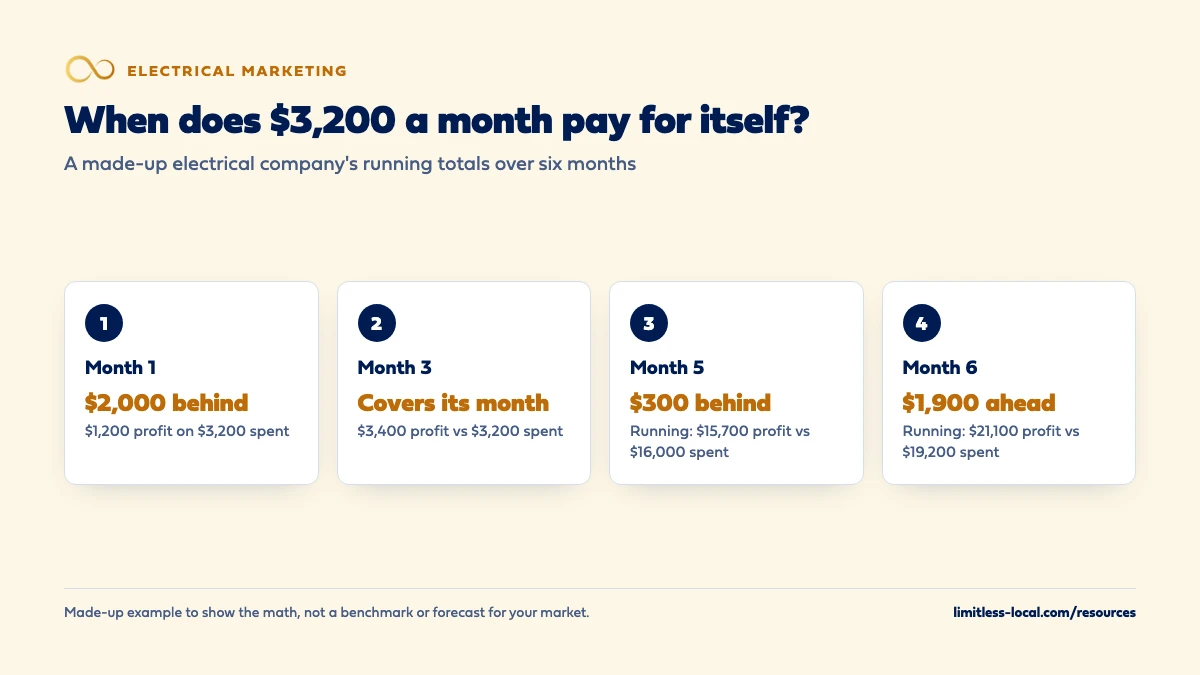
These numbers are made up to show the math, not a benchmark or a forecast for your shop. Say an electrical company spends $3,200 a month: $2,200 on search ads and management, and $1,000 on SEO and Google profile work. The gross profit column counts only jobs the marketing booked, in the month each was sold.
| Month | Spent this month | Gross profit booked | Running total spent | Running total profit |
|---|---|---|---|---|
| 1 | $3,200 | $1,200 | $3,200 | $1,200 |
| 2 | $3,200 | $2,600 | $6,400 | $3,800 |
| 3 | $3,200 | $3,400 | $9,600 | $7,200 |
| 4 | $3,200 | $3,900 | $12,800 | $11,100 |
| 5 | $3,200 | $4,600 | $16,000 | $15,700 |
| 6 | $3,200 | $5,400 | $19,200 | $21,100 |
- Month 1: $1,200 of profit on $3,200 spent, so $2,000 in the hole.
- Month 3: that month’s profit, $3,400, covers that month’s cost for the first time.
- Month 5: the running total is still $300 short.
- Month 6: running profit passes running spend, $21,100 against $19,200, so the marketing has paid for itself and is $1,900 ahead.
If the owner had judged it after month 2, it would have looked like a loss. The rising monthly profit was the sign to keep going.
Frequently asked questions
Should I count revenue or profit when judging payback?
Gross profit. Revenue makes marketing look like it pays back much faster than it really does, because it ignores the labor and materials each job used.
Does it pay back faster if I spend more at the start?
Not usually. A big early budget digs a deeper hole while tracking and targeting are still being fixed. Start smaller, find what books, then add spend.
What if my marketing never quite pays back but keeps the crews busy?
Then it’s not paying for itself, even if the schedule is full. Check whether it’s booking low-profit jobs, then shift spend toward the work that leaves more.
Does a maintenance agreement change the math?
It adds to customer value over time. Count the first job toward payback, and treat the agreement as a reason you can afford to stretch a little further on that channel.
How do I count jobs when I can't tell which marketing brought them in?
Ask every new caller how they found you and note it in the job, and use a tracking number on each ad and listing. Partial tracking is much better than none.
Key takeaways
- Marketing pays for itself in the month running gross profit passes running spend.
- Search ads bring calls within days but usually need a few months to pay back; SEO typically takes 3-6 months to show meaningful growth and pays back later.
- Count quoted jobs like panel upgrades and generators in the month they’re sold.
- Judge payback on the first job and use customer value to decide how far to stretch.
- Watch the trend: monthly profit climbing toward monthly cost is the sign to keep going.
Ready to compare options?
Book a short growth call and we'll walk through the math for your service area, including when we're not the right fit.
More in this section
- Is spending 10k a month too much for electrical marketing?
- What should I expect from electrical marketing in the first 90 days?
- Which electrical marketing costs are one-time and which are monthly?
- What is a good cost per booked job for electrical marketing?
- How do I know if my electrical marketing agency is getting results?
Sources
- SEO Starter Guide: The Basics — Google Search Central
- About conversion windows — Google Ads Help
- Conversion cycle: Definition — Google Ads Help
- Do you know the lifetime value and cost of acquisition of your customers? — BDC (Business Development Bank of Canada)
- Break-even point calculator — U.S. Small Business Administration