
Is spending 10k a month too much for electrical marketing?

- Is $10,000 a month too much to spend on marketing when I'm trying to grow an electrical company fast?
- Is $10,000 a month a lot for an electrical contractor?
- How many booked jobs does $10,000 a month need to pay for itself?
- Can my crews actually handle what $10,000 a month brings in?
- What does $10,000 a month typically pay for?
- Will spending more on ads actually bring more calls?
- Where should $10,000 a month go first?
- Should I jump straight to $10,000 or ramp up?
- When is $10,000 a month too much?
- When is $10,000 a month not enough?
- What should I track every month at $10,000?
- How long should I give $10,000 a month before judging it?
- What's different about a $10,000 budget for electricians
- A worked example: does $10,000 a month pay?
- Frequently asked questions
- Key takeaways
- More in this section
- Sources
The short version
- Break-even = $10,000 ÷ gross profit per booked job.
- At $500 profit a job, that's 20 extra booked jobs every month.
- Check crew capacity before spend: unbooked calls are wasted money.
- More budget only helps while ads are being held back by budget.
- Step up to it over a few months, judging cost per booked job at each step.
For electrical contractors thinking about a big jump in marketing spend to grow fast, and wondering whether $10,000 a month will pay off or just burn cash.
Get a free visibility audit · Book a growth call
Is $10,000 a month too much to spend on marketing when I'm trying to grow an electrical company fast?
Not if it books enough profitable work and your crews can take it on. Divide $10,000 by the gross profit on an average booked job to get your break-even, so at $500 a job you need 20 extra booked jobs a month just to cover it. It becomes too much when crews are already full, when you can’t see which calls booked, or when extra budget stops buying extra calls because your ads are already showing for most of the searches you can get. Build up to it in steps, and judge each step on cost per booked job by channel and job type.
At this level, part of the $10,000 is usually someone running it and the rest is ad spend. Our Growth package is $4,500 a month and covers Google Ads management up to $5,000 a month in spend plus Local Services Ads management, so with the ads fully funded you’d be at $9,500 a month, with ad spend paid directly to Google. Shops running several locations or markets go to Scale, which is custom. Our electrical contractor marketing page explains how we work with electrical shops, and the rest of the electrical marketing questions library goes question by question.
Is $10,000 a month a lot for an electrical contractor?
It depends on what you invoice. The SBA’s guide How to Get the Most From Your Marketing Budget says there’s no hard and fast answer to how much a small business should spend, that many businesses use a percentage of revenue as a guide, and that consumer-facing companies generally need to budget more than business-to-business ones.
Run your own numbers. $10,000 a month is $120,000 a year. For a shop doing $1,500,000 in revenue, that’s 8%. For a shop doing $3,000,000, it’s 4%. The same check can be a stretch for one company and routine for another.
Percentage is a sanity check, not the decision. What percent of revenue an electrician should spend on marketing goes deeper on that method. The more useful question at this budget is how many jobs $10,000 has to book, and whether you can do them.
How many booked jobs does $10,000 a month need to pay for itself?
One line of math:
Break-even jobs per month = $10,000 ÷ gross profit per booked job
Gross profit is the invoice minus materials and the labor to do the job. Pull it from the last few months of invoices in ServiceTitan, Housecall Pro or Jobber, not from memory, and split it by job type, because electrical work swings so widely:
- Mostly service calls. If small repairs and troubleshooting leave a few hundred dollars each, break-even takes a lot of them.
- A real mix. At $500 of gross profit on an average booked job, you need 20 extra booked jobs a month.
- Bigger jobs. Panel upgrades, EV chargers, generators and commercial work cover far more of the $10,000 per job, so fewer bookings carry the month.
Count only the jobs this money brought in. Repeat customers, builder work and referrals that would have called anyway don’t count toward break-even.
Can my crews actually handle what $10,000 a month brings in?
This is the question owners skip. Twenty extra booked jobs a month is close to one extra job every working day, on top of what you already do. If your techs are booked out a week or more, new calls turn into long waits, lost jobs and bad reviews, and you’re paying full price for every one of them.
Before you raise spend, check three things:
- Open slots. How many more jobs a week can you schedule without overtime or pushing existing customers back?
- Hiring. If you need another tech or crew to take the work, is that person hired, licensed and trained, or still a plan?
- The office. Someone has to answer more calls, quote more panel upgrades and follow up on more estimates.
If the answer is that you’d need to hire first, grow the budget and the team together. How to scale an electrical contractor past one or two crews covers the hiring side.
What does $10,000 a month typically pay for?
At this budget the money usually splits three ways:
- Ad spend paid to Google and other platforms. If all $10,000 went to Google Ads, Google’s page on average daily budgets says to divide a monthly amount by 30.4, so that’s about $329 a day.
- Management of the ads, Google Business Profile, website, SEO and reviews, whether that’s an agency, a freelancer or someone on your payroll.
- Tools such as call tracking and your field software’s marketing features.
Ask anyone quoting you $10,000 how much of it actually reaches homeowners and businesses as ads, and how much is fees. Both matter, but they do different jobs. Management keeps the ads pointed at work you want and catches wasted spend. Ad spend is what makes the phone ring.
At this level you can usually fund several channels properly at once: search ads for your best job types, Local Services Ads, steady SEO and Google profile work, and remarketing to people who visited your site but didn’t call.
Will spending more on ads actually bring more calls?
Only up to a point. In Google Ads, impression share is the share of eligible impressions your ads actually got, and Google’s page on impression share says it’s a good way to see whether your ads might reach more people if you raise your bid or budget. If you’re already showing for most of the searches you’re eligible for, more budget mostly buys pricier clicks, not more of them.
Two signs that more budget would help:
- The campaign shows a Limited by budget status, which Google shows when, among other cases, a campaign is underperforming because of a limited budget.
- Your impression share is low and the lost impression share columns show budget, not Ad Rank, as the reason you’re missing searches.
If neither is true, the answer is new territory, new job types or a different channel, not a bigger number on the same campaign. What impression share means for electrical Google Ads explains how to read it. Google’s Performance Planner can also forecast how changes to your spend might affect results; treat its numbers as forecasts, not promises.
Curious what your marketing is actually booking?
Get a free visibility audit — no obligation, no sales pitch.
Where should $10,000 a month go first?
Fund the channels that book work soonest, then the ones that build:
- Search ads for the jobs you want most. Panel upgrades, EV chargers, generators and emergency repairs, in the towns your trucks reach easily, sent to a page about that job.
- Local Services Ads, if you’re verified and have a healthy set of reviews. You pay per valid lead instead of per click.
- SEO and your Google Business Profile. Service pages, city pages where they make sense, reviews and photos. Slower to start, but it keeps paying when you pull back on ads.
- Remarketing, so people who looked at a generator or EV charger page and didn’t call see you again.
- Tracking that ties it together, so every call and form is tagged by source and job type.
Keep the commercial side separate. Builder and property-manager relationships usually come from sales work and referrals, not ad budgets.
Should I jump straight to $10,000 or ramp up?
Ramp up. Going from a small budget to $10,000 overnight makes it hard to tell what’s working, and it hits the phones and the schedule all at once.
A steadier path, using made-up steps: $6,000 a month, then $8,000, then $10,000, moving up only when the last step held its cost per booked job and the crews kept up. Give each step about a month, or longer if you’re adding SEO or a new channel.
If cost per booked job climbs sharply at a step, stop there. That’s usually the sign you’ve bought most of the easy searches in your area and the next dollars are going to more expensive clicks, wider towns or job types that don’t book as well.
When is $10,000 a month too much?
- The crews are full. Fix capacity first: hire, raise prices or both.
- Nobody tracks booked jobs. At $10,000 a month, guessing is expensive. If you can’t say what each channel’s booked jobs cost, cut back until you can.
- Calls go to voicemail. Paid calls that ring out during a job are paying for someone else’s booking.
- The budget isn’t the limit. If your ads already show for most eligible searches, more money mostly raises your cost per click.
- Cash flow can’t carry a slow month. SEO takes months to build, and even ads take a few weeks to settle. Only spend what you can keep spending while it ramps.
- Most of it is fees. If very little reaches the ads, you’re paying for activity, not calls.

When is $10,000 a month not enough?
For some electrical companies, $10,000 is a middle budget, not a high one:
- Several locations or markets, each needing its own ads, Google profiles and pages.
- A big, crowded metro where clicks on electrician searches are expensive.
- Many job types at once, such as residential service, solar tie-ins, generators and commercial bids, each needing its own campaigns and pages.
- A hiring plan that adds more trucks than the current budget can keep busy.
In those cases the same math applies, just at a bigger scale: work out the booked jobs each new truck needs and what each booked job costs you, and let that set the budget.
What should I track every month at $10,000?
At this spend, a single cost-per-lead number hides too much. Track these by channel and by job type:
- Total cost of each channel, ad spend and fees together.
- Booked jobs from each channel, and how many quotes turned into sold work.
- Gross profit on those jobs, not just revenue.
- Cost per booked job, next to your break-even for that job type.
A channel that books small service calls cheaply and one that books panel upgrades at a higher cost can both be good. Comparing them on cost per lead alone would cut the wrong one. How to track which electrical marketing brings in real jobs walks through the setup in your field software.
How long should I give $10,000 a month before judging it?
Ads can generate leads within days of launch, so you’ll know quickly whether the phone rings. Whether it pays off takes longer: the first month goes to cutting out wrong searches and checking tracking, and quoted work like panel upgrades and generators can take weeks to sell.
Judge the paid channels on two to three months of tracked booked jobs. Give SEO longer: it typically takes 3-6 months to show meaningful organic growth. How long until electrical marketing pays for itself goes through the payback math month by month.
Every channel also needs its own lead counting. Google’s page on how Local Services Ads leads work says every lead you receive counts toward your budget, so a busy Local Services Ads month can use up its share quickly.
Not sure which of these is costing you jobs?
A free visibility audit checks the Google profile, reviews, site and tracking, and shows what to fix first.
What's different about a $10,000 budget for electricians
Job values swing more than in most trades. A $10,000 month can be carried by a few panel upgrades and generators or need dozens of small service calls. Point the biggest share at the job types with the best gross profit and the fewest competitors.
Licensing sets the map. Ads can reach any town, but spend only where your license, permits and drive time let you serve well. Spreading a big budget across too many towns raises cost per booked job fast.
Emergency calls need coverage. At this spend, ads will run into evenings and weekends. If nobody answers then, schedule the ads around the hours you cover.
Commercial and builder work runs on relationships. Ads rarely win a general contractor’s trust. Keep that sales effort separate from the $10,000.
A worked example: does $10,000 a month pay?
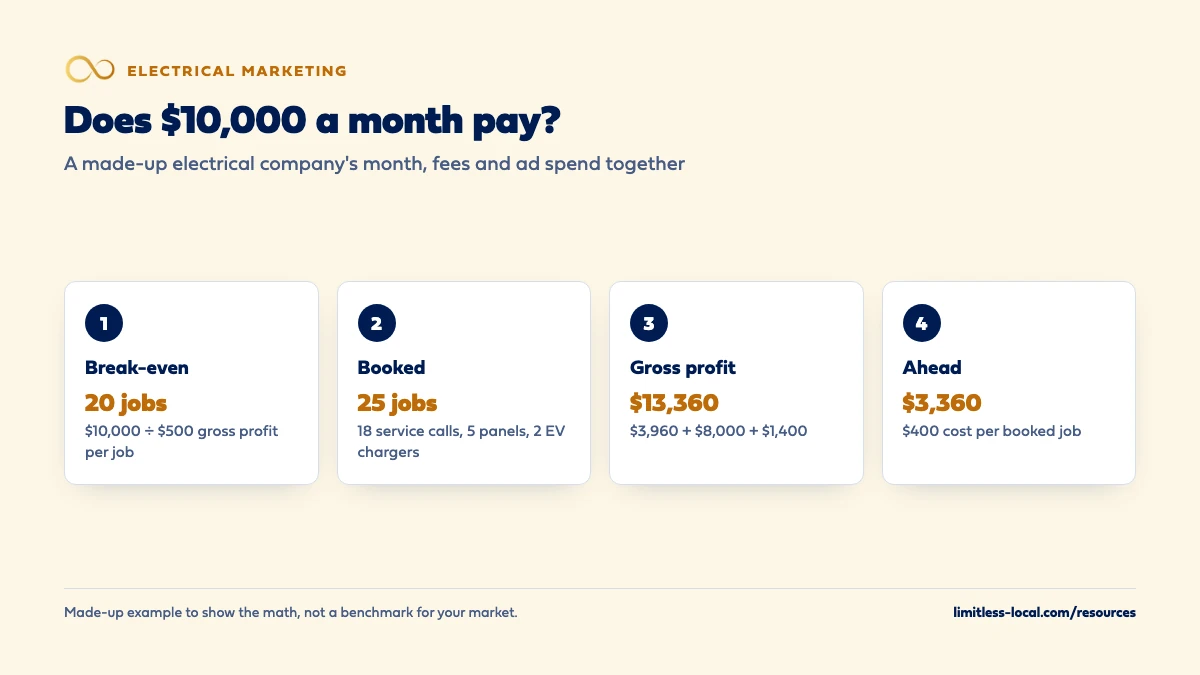
These numbers are made up to show the math, not a benchmark for your market. Say an electrical company spends $10,000 a month in total, fees and ad spend together, and its tracking shows the marketing booked 25 jobs in a month:
- 18 service calls at $220 gross profit each: $3,960.
- 5 panel upgrades at $1,600 gross profit each: $8,000.
- 2 EV charger installs at $700 gross profit each: $1,400.
Total gross profit is $13,360, so the company is $3,360 ahead for the month. Cost per booked job is $10,000 divided by 25, or $400, and the average job left about $534.
Now say the crews could only fit 15 of those jobs and the other 10 went elsewhere. If the 10 lost were mostly service calls, the month might still break even. If two of them were panel upgrades, it likely wouldn’t. That’s why capacity and job mix matter as much as the budget itself.
Frequently asked questions
Does $10,000 a month include ad spend?
On this page, yes: $10,000 is the total, fees and ad spend together. When an agency quotes a monthly price, ask whether ad spend is on top, because it’s usually paid to Google separately.
Should a one-truck electrician ever spend $10,000 a month?
Rarely. One truck can’t take the 20 or so extra jobs a month it needs to pay for itself at $500 of gross profit a job. Grow spend alongside hiring instead.
Can I cut back to a lower budget in slow months?
Yes. Lower search ad budgets when demand drops, but keep SEO and Google profile work going, since stopping and restarting them wastes the months it took to build.
Is it better to spend $10,000 on one channel or several?
At this budget, several channels can each be funded properly. Start with the one that books work fastest, add the next once the first is clearly paying, and track each separately.
How do I know if my agency is spending the $10,000 well?
Ask for booked jobs and cost per booked job by channel each month, checked against the jobs in your own field software. A report full of clicks and impressions isn’t enough at this spend.
Key takeaways
- Break-even on $10,000 a month is $10,000 divided by gross profit per booked job; at $500 a job, that’s 20 extra jobs.
- Check crew and office capacity before raising spend, or new calls turn into lost jobs.
- More budget only buys more calls while your ads are held back by budget; check impression share and Limited by budget first.
- Ramp up in steps and stop where cost per booked job jumps.
- Track cost per booked job by channel and job type, using gross profit, not revenue.
Want a second set of eyes on your setup?
We'll look at how you show up locally and where calls are leaking, then send you a plain-English breakdown.
More in this section
- Is $500 a month too much for electrician marketing?
- Is $1500 a month too much for electrician marketing past referrals?
- How much should an electrical contractor spend on marketing?
- What is a good cost per booked job for electrical marketing?
- Which electrical marketing costs are one-time and which are monthly?
Sources
- How to Get the Most From Your Marketing Budget — U.S. Small Business Administration
- About average daily budgets — Google Ads Help
- About impression share — Google Ads Help
- Fix “Limited by budget” status — Google Ads Help
- Get impression share data — Google Ads Help
- About Performance Planner — Google Ads Help
- How leads work — Google Local Services Help