
What should I do when a new HVAC competitor opens near me?

- How should an HVAC company respond when a new competitor moves into town?
- What should I do first when a new HVAC company opens nearby?
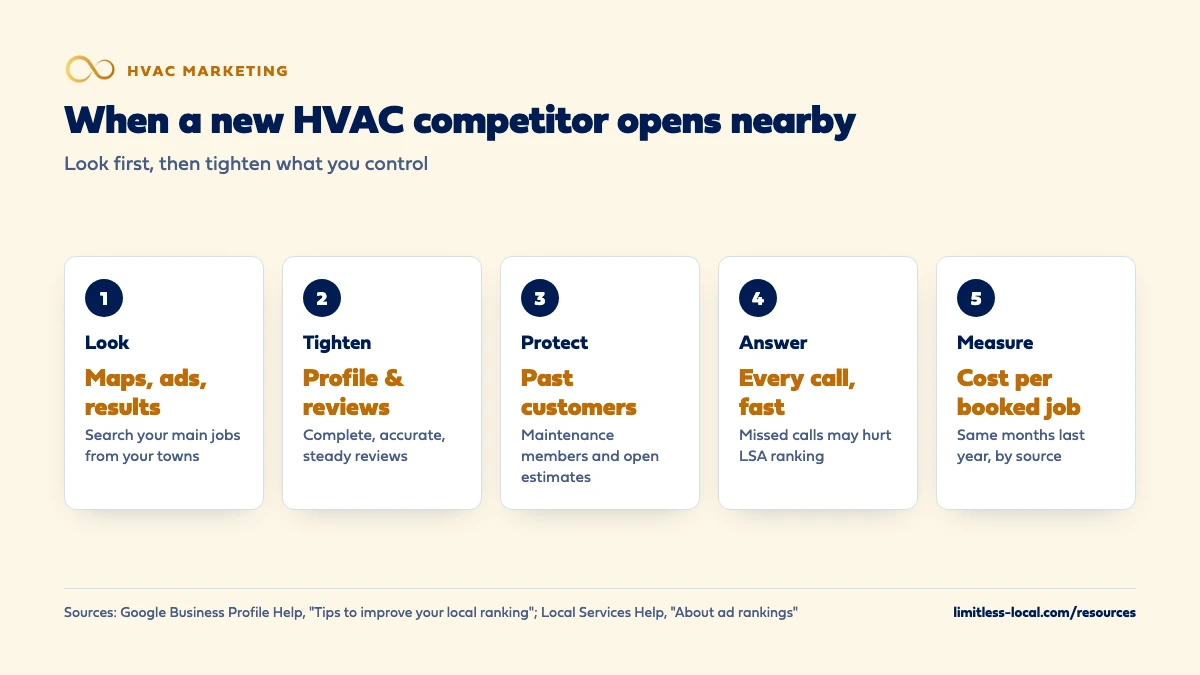
- Step 1: Where is the new competitor actually showing up?
- Step 2: Is my Google Business Profile complete and accurate?
- Step 3: How do I keep my reviews ahead of a new company?
- Step 4: How do I protect the customers I already have?
- Step 5: Should I raise my Google Ads bids to stay on top?
- Step 6: How do I win the calls the new company is chasing?
- Should I lower my prices when a new competitor undercuts me?
- What if the new competitor is breaking Google's rules?
- What if I start getting suspicious reviews?
- How do I tell if the new competitor is really costing me calls?
- What's different for HVAC companies
- A worked example: reading your ad costs before a bidding war
- Frequently asked questions
- Key takeaways
- More in this section
- Sources
The short version
- Look before you react: check Maps, the ads and the regular results for your main jobs.
- Tighten your Google profile, reviews and phone answering; a newcomer has to earn those too.
- Protect past customers and maintenance members first; they're the easiest work to lose quietly.
- No price cuts on reflex, no bidding wars, no posting about them; report only real rule-breaking.
For HVAC owners who just saw a new name on the map, a new truck in the neighborhood or new ads above theirs, and want a plan that isn’t panic.
Get a free visibility audit · Book a growth call
How should an HVAC company respond when a new competitor moves into town?
Find out where the new company actually shows up before you change anything, then tighten what you control: a complete and accurate Google Business Profile, a steady flow of genuine reviews, calls answered fast, and regular contact with your past and maintenance customers. Google says there’s no way to request or pay for a better local ranking, so a newcomer has to earn the map the same way you did. Don’t cut prices or start a bidding war on reflex, never post about them, and report them to Google only if they’re actually breaking its rules.
Most of that list is the steady work of local SEO: the Google profile, reviews, and name, address and phone synced across 50+ directories, all part of our HVAC marketing. For every channel in one place, the HVAC marketing guide covers the basics, and the HVAC marketing questions library goes question by question.
What should I do first when a new HVAC company opens nearby?
Nothing drastic. A new company starts with no reviews, no call history and no repeat customers, and the things that decide local search take time to build. Your first job is to figure out what you’re actually up against:
- A new local shop, often a tech who used to work for someone else, competing on price and availability.
- A branch or franchise of a bigger company, with a known name, a bigger ad budget and a playbook.
- A listing with nobody behind it, such as a lead-generation profile or a virtual address. That one is a Google rules question, covered further down.
Each one calls for a slightly different response, but the first steps are the same: look, then tighten what you control.
Step 1: Where is the new competitor actually showing up?
Search your main jobs (“AC repair”, “furnace repair”, “HVAC company”, “AC replacement”) from the towns you care about most, on a phone, and write down where the newcomer appears:
- Maps. Are they in the local results, and in which towns?
- Ads. Are they running Google Ads or Local Services Ads above you?
- Regular results. Does their website rank yet?
Repeat it every few weeks, because a new company’s position changes as it builds reviews. If they only show up in ads, they’re buying attention and you’ll see it in your ad costs. If they show up in Maps near their shop, distance is doing some of the work for them. Checking how competitive your area is has the full method, including how to count ads and read Keyword Planner.
Step 2: Is my Google Business Profile complete and accurate?
This is the one place a newcomer can’t outspend you. Google’s page on improving your local ranking says local results are mainly based on relevance, distance and popularity, describes popularity as how well-known a business is, and says there’s no way to request or pay for a better local ranking. It also says businesses with complete and accurate info are more likely to show up in local results, and that a profile with inaccurate info might not show up for relevant searches.
So check the basics now, before the new company’s profile matures: the right primary category, the services you want calls for, the towns you actually serve, accurate hours, and real photos of your crew and trucks.
Be realistic about distance. Google defines it as how far each business is from the customer who’s searching. If the newcomer opened closer to some of your towns, they’ll have that edge in those towns, and no amount of profile work changes where their shop is. Put your effort into the towns where you’re closer or better known. How a small HVAC company competes with bigger ones covers playing to those advantages.
Step 3: How do I keep my reviews ahead of a new company?
Keep asking, every job, and keep replying. Google says popularity is based partly on how many reviews you have, and that more reviews and positive ratings can help your local ranking. A new company’s review count will grow; what you control is your own pace.
Google’s tips to get more reviews suggest reminding customers with a review link or QR code from your Business Profile, and they rule out offering anything in exchange. Replies matter too: Google’s tips are to keep replies short and simple and, for negative reviews, to acknowledge any mistakes and explain what you can and can’t do.
In our experience, the shops that hold their ground are the ones where the review request is part of the job close-out, not something the owner remembers in a slow week. How much Google reviews affect your calls goes into what reviews do and don’t change.
Step 4: How do I protect the customers I already have?
Contact them before the new company does. Past customers and maintenance plan members are the work a newcomer can win quietly, with a door hanger, a mailer or a low tune-up price, and you won’t see it in your search rankings until the renewals drop.
- Maintenance members. Book their next visit early and confirm it in writing.
- Past repair customers. A seasonal reminder for a tune-up keeps your name in front of them.
- Open replacement estimates. Follow up now; a homeowner comparing quotes is exactly who a new company is chasing.
None of this mentions the competitor. It’s just good service, done on time. Getting more repeat customers and referrals covers the setup.
Curious what your marketing is actually booking?
Get a free visibility audit — no obligation, no sales pitch.
Step 5: Should I raise my Google Ads bids to stay on top?
Not on reflex. Look at what the new advertiser is doing to your results first. If you run Search campaigns, the auction insights report compares you with other advertisers in the same auctions. Its overlap rate shows how often another advertiser’s ad got an impression when yours did, and its outranking share shows how often your ad ranked above theirs or showed when theirs didn’t. Google notes the report doesn’t show insights when impression share is under 10%, so very small campaigns may not see it.
Then judge by the number that matters: cost per booked job. If it holds, a new name in the auction isn’t hurting you. If it climbs, first check your ads and landing pages, your target towns and whether calls are being answered. A bidding war mainly raises costs for everyone in it. The worked example below shows the math.
Step 6: How do I win the calls the new company is chasing?
Answer faster and book sooner. A new company is often hungry for work and quick to pick up. You don’t beat that with a slogan; you beat it by answering every call during the hours on your profile and calling back missed leads quickly.
On Local Services Ads, it also affects where you show up. Google’s ad rankings page lists your responsiveness to customer inquiries as a factor and says missed calls may hurt it, alongside your rating, number of reviews and how relevant your services are. A newcomer with few reviews is already behind on part of that list. Don’t hand them the rest by letting calls ring out.
Should I lower my prices when a new competitor undercuts me?
In our judgement, rarely. A price war is a fight the company with the thinnest costs wins, and a new shop with one truck and no office may have thinner costs than you, for now. Cutting prices also trains your existing customers to expect the lower number.
Compete on what a newcomer can’t show yet: years of reviews, a track record on the jobs you’re known for, maintenance plans, warranties you’ve honored and techs customers ask for by name. If you’re getting more price-shopping calls since they opened, attracting fewer price shoppers covers how to change who calls.
What if the new competitor is breaking Google's rules?
Report it, with facts, through Google’s own forms. Google’s page on reporting a business on Maps covers the main cases:
- Misleading info that makes you believe the business may not exist: submit a report from the listing. For misleading names, phone numbers or website addresses that look like fraud, Google points to its Business Redressal Complaint form.
- Incentivized reviews. Reviews posted in exchange for a payment, deal or discount are prohibited, and Google has a report for businesses that offer them or pressure people into reviews.
- Wrong information that isn’t about conduct, such as an address: suggest an edit.
Report what you can show, not what you suspect, and don’t expect overnight results. Why other HVAC companies rank above you covers keyword-stuffed business names and the other patterns worth reporting.
What if I start getting suspicious reviews?
Flag the ones that break Google’s rules, reply calmly to the rest, and don’t respond in kind. Google’s Maps content policy says fake engagement and rating manipulation are not allowed, including posting content on a competitor’s business to undermine its reputation and content based on a conflict of interest, which it says can include industry competitors.
Google’s page on reporting inappropriate reviews says you can flag any review, but only those that violate its policies are eligible for removal, that you shouldn’t report a review just because you disagree with it, and that evaluation typically takes several days. You can check the status in the Reviews Management Tool.
The same rules apply to you. Never post about the new company, ask staff or friends to review it, or offer customers anything for reviews of your own.
How do I tell if the new competitor is really costing me calls?
Compare like with like. HVAC calls swing with the weather, so this month against last month tells you very little. Compare calls, booked jobs and cost per booked job by source against the same months last year, and look at whether the drop is in one channel or all of them:
- Ads only: the newcomer is probably bidding on your searches. Auction insights will usually show them.
- Maps calls in the towns near their shop: distance is likely working in their favor there.
- Repeat and maintenance work: they may be reaching your customers directly.
- Everything at once: look at your own side first: tracking, the phone line, your profile’s status.
In our experience, many “the new guy is stealing my calls” moments turn out to be a broken tracking number, a mild month or a profile issue. Check those before you change the plan.
Not sure which of these is costing you jobs?
A free visibility audit checks the Google profile, reviews, site and tracking, and shows what to fix first.
What's different for HVAC companies
New companies often open before a season. A new shop that launches in spring meets its first rush in the first heat wave, which is also when your phones are busiest. Have your profile, reviews and answering in order before then, and you’ll see quickly whether the newcomer can keep up with emergency calls.
Maintenance agreements are your moat. Members who already have their next visit on the calendar are much harder for a newcomer to win with a cheap tune-up offer. If you don’t have a plan, a new competitor is a good reason to start one.
Techs talk. If the new company was started by a former employee, they may know your prices, your customers and your weak spots. Compete on service, not on what you say about them, and keep customer contact and estimates in your field software, not in someone’s personal phone.
A worked example: reading your ad costs before a bidding war
These numbers are made up to show the math, not a benchmark for your market. Say that before the new company opened, your Google Ads spent $2,400 a month and booked 16 jobs, a cost per booked job of $150. In the two months since their ads appeared, the same $2,400 booked 12 jobs, or $200 each.
Raising bids might win back position, but it also raises what you pay per click, and the newcomer may simply match it. Before you do, check whether calls from the ads are still being answered, whether the jobs you lost were in the towns closest to their shop, and whether $200 still leaves a profit on the repairs you’re booking. If it does, holding steady and putting the effort into reviews and past customers may be the cheaper way to ride out their launch.
Frequently asked questions
Should I mention the new competitor in my ads or on my website?
No. Talking about them gives them attention and rarely books jobs. Talk about your own reviews, warranties and how fast you answer.
Can I bid on the new company's name in Google Ads?
In our judgement it’s usually not worth it for an HVAC shop: it invites the same back, and homeowners searching a specific company’s name mostly want that company. Spend the money on the jobs and towns you want.
The new company has a city name and "AC repair" in its Google business name. Is that allowed?
Google’s guidelines for representing your business say the name should reflect the real-world name used consistently on the storefront, website and stationery, and that adding unnecessary information isn’t permitted. If the extra words aren’t part of their actual name, you can suggest an edit or report it.
How long before a new HVAC company is a real threat in Maps?
There’s no fixed timeline; it depends on how close they are to the searcher, how complete their profile is and how fast they collect reviews. Check where they show up every few weeks instead of guessing.
Should I hire away the new company's techs?
That’s a hiring decision, not a marketing one, and it has its own legal and practical questions for your HR adviser. On the marketing side, your best defense is your own service record.
Will Google remove a competitor's profile if I report it?
Only if Google finds it breaks its rules. Reports aren’t a way to remove a legitimate business you’d rather not compete with.
Key takeaways
- Find out where the new company shows up (Maps, ads, regular results) before changing anything.
- Google says there’s no way to pay for a better local ranking; a complete profile and steady reviews are your defense.
- Contact past customers and maintenance members before the newcomer does.
- Judge ad changes by cost per booked job, not position, and avoid a bidding war on reflex.
- Report only real rule-breaking through Google’s forms, and never post about a competitor.
Want a second set of eyes on your setup?
We'll look at how you show up locally and where calls are leaking, then send you a plain-English breakdown.
More in this section
- How can a small HVAC company compete with the big companies in town?
- How competitive is HVAC marketing in my area, and how do I check?
- How do I market a second HVAC location?
- How do I market my HVAC company in a new city where nobody knows us?
- How should a commercial HVAC company market itself?
Sources
- Tips to improve your local ranking on Google — Google Business Profile Help
- Tips to get more reviews — Google Business Profile Help
- Use auction insights to compare performance — Google Ads Help
- About ad rankings — Google Local Services Help
- Report a business on Google Maps — Google Maps Help
- Prohibited & restricted content — Maps User Generated Content Policy Help
- Report inappropriate reviews on your Business Profile — Google Business Profile Help
- Guidelines for representing your business on Google — Google Business Profile Help