
Is $75 per lead too high for plumbing ads?

- Is $75 per lead a normal cost for plumbing ads, or a warning sign?
- Is $75 a lot to pay for a plumbing lead?
- What does a $75 lead cost once it becomes a job?
- How much profit does a job need to leave to justify $75 leads?
- Is $75 per lead too high for drain and service calls?
- Is $75 per lead too high for water heater, repipe and sewer leads?
- Does it matter whether the $75 lead came from Local Services Ads or Google Ads?
- What makes a lead worth $75?
- How many leads should I buy before deciding $75 is too high?
- What should I fix before deciding $75 leads cost too much?
- When is paying more than $75 per lead the right call?
- How can I bring the cost per lead down without losing good calls?
- What's different about lead costs for plumbers
- A worked example: same $75, two different answers
- Frequently asked questions
- Key takeaways
- More in this section
- Sources
The short version
- Cost per booked job = $75 ÷ your booking rate.
- At 1 in 3 booking, that's $225 per job.
- Compare it with the gross profit per job, by job type.
- Big-ticket leads can carry $75 easily; small drain calls often can't.
For plumbing owners looking at a $75 cost per lead on Google Ads or Local Services Ads and wondering whether to cut it, keep it or spend more.
Get a free visibility audit · Book a growth call
Is $75 per lead a normal cost for plumbing ads, or a warning sign?
$75 per lead isn’t too high for plumbing ads if enough of those leads turn into paid jobs that leave more gross profit than they cost to win. Divide $75 by the share of leads that book: if 1 in 3 books, each job cost $225, which is cheap for a water heater replacement and may lose money on a small drain call. $75 becomes a warning when the leads are for the wrong jobs, the calls go unanswered or too few of them book, not because of the number itself.
Cost per booked job is how we judge ads too. Our local ads work covers Google Ads management in every package, with Local Services Ads management from the Growth package at $4,500 a month, and every package includes monthly reports with a cost-per-lead breakdown plus call tracking with recording, so you can see which $75 leads became jobs. Our plumbing marketing page shows how that fits plumbing companies, and the plumbing marketing questions library goes question by question.
Is $75 a lot to pay for a plumbing lead?
On its own, the number can’t tell you. A lead is a phone call, a message or a form, not a job, and $75 for a lead that turns into a water heater replacement is a very different buy from $75 for a caller who only wanted a price over the phone. What decides it is what the lead turns into and what that job leaves you.
The price also depends on where you buy it. Google’s page on how Local Services Ads leads work says lead prices vary with your location, the job type, the type of lead and your bidding. In Google search ads, your cost per lead is whatever your clicks cost, divided by the calls and forms they produced. Either way, a figure someone quotes from another market says little about yours. What a qualified plumbing lead costs in your market shows how to find your own.
So the useful question isn’t whether $75 is high. It’s whether $75 leads are turning into enough paid work, of the right kind, to pay for themselves.
What does a $75 lead cost once it becomes a job?
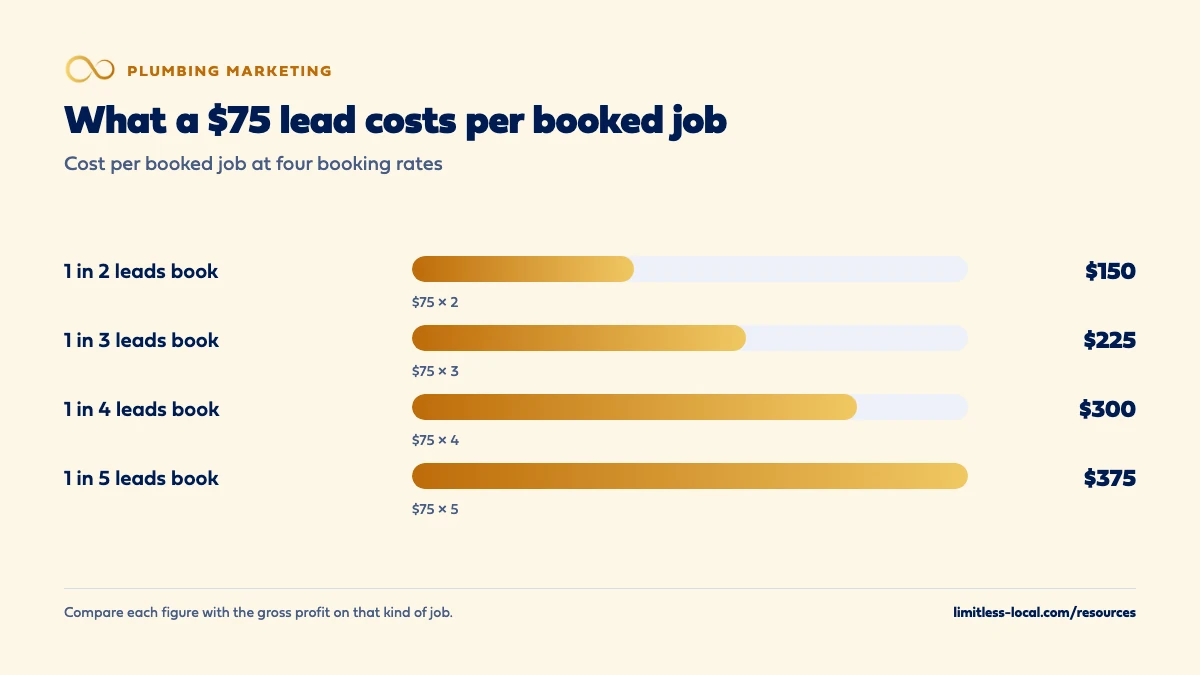
Divide the lead price by your booking rate, the share of those leads that become paid jobs. That gives you cost per booked job, the number that actually matters:
- If 1 in 2 leads books, each job cost $150 in lead spend.
- If 1 in 3 books, each job cost $225.
- If 1 in 4 books, each job cost $300.
- If 1 in 5 books, each job cost $375.
Same $75 lead, more than double the cost per job between the best and worst rows. That’s why two plumbers paying the same price per lead can reach opposite verdicts: the one who answers fast, quotes well and follows up books more of them.
Count a lead as booked only when it became paid work, not when it became an appointment. A no-show or a “just looking” estimate isn’t a job, and counting it makes $75 look cheaper than it is.
How much profit does a job need to leave to justify $75 leads?
Compare your cost per booked job with the gross profit on that kind of job. Gross profit is the invoice minus the direct costs of doing the work; the Business Development Bank of Canada’s glossary entry on gross profit margin defines it as net sales minus the cost of goods sold. For a plumbing job, that means parts and the tech’s paid time on it.
Then decide how much of that profit you’re willing to hand over to win the job. If a job leaves well more than your cost per booked job, $75 leads are paying. If it leaves about the same, the first job only breaks even, and you’re counting on repeat work to come out ahead. If it leaves less, $75 is too high for that job type. Working out the average profit on one plumbing job gets you the number to compare against, and how much you can afford to pay for a plumbing lead turns it into a ceiling for each lead type.
Is $75 per lead too high for drain and service calls?
It can be. Small service calls and drain clearings leave less profit per job, and if many of those callers are ringing around for the cheapest price, fewer of them book. If a drain call leaves $180 of gross profit and only 1 in 3 of those leads books, each job cost $225 to win. You’re losing money on the first visit.
That doesn’t automatically mean stop. A drain customer who comes back, signs up for a maintenance plan or later needs a water heater can make up the gap. But be honest about how often that happens in your records, not in theory. If it’s rare, either raise the booking rate on these calls or stop paying $75 for them and point the budget at bigger work.
Is $75 per lead too high for water heater, repipe and sewer leads?
Usually not. These are the big tickets in plumbing, and even if only 1 in 5 of those leads books, $375 per job is a small slice of what a replacement, a repipe or a sewer line leaves you. On this kind of work, $75 can be cheap, and an owner who cuts these leads to save on lead costs can end up cutting the most profitable calls of the month.
Two things to watch: some of these leads are really repair calls (a water heater that needs a part, not a new tank), and estimates on big jobs take longer to close. Give them a few weeks before you count them as lost, and follow up on every open estimate.
Curious what your marketing is actually booking?
Get a free visibility audit — no obligation, no sales pitch.
Does it matter whether the $75 lead came from Local Services Ads or Google Ads?
Yes, because each one counts a lead differently.
- Local Services Ads charge per valid lead. A missed call during your business hours still counts if the caller stays on the line more than 20 seconds, so unanswered calls raise your real cost per job. Google keeps assessing lead quality over a 30-day period and credits leads it decides are invalid or low quality.
- Google search ads charge per click, so your cost per lead depends on how many clicks become calls or forms, and on what you count as a lead. With phone call conversion tracking, you set a minimum call length and every call that lasts at least that long counts as a conversion. Set that length too short and hang-ups count as leads.
- Leads sold to several plumbers at once book less often for any one of them, because the homeowner hears from more than one company. The same $75 buys a smaller chance at the job.
Judge each source on its own cost per booked job, not one blended average.
What makes a lead worth $75?
A lead you’d happily pay $75 for has four things: a real homeowner, in the area your trucks cover, asking for work you do, who reached someone who could book them. Strip out what fails those tests before you judge the price:
- Spam, sales calls and wrong numbers.
- Callers outside your service area.
- Jobs you don’t take, like commercial work if you only do residential.
- Repeat calls from the same customer about the same job.
If a big share of your $75 leads fail these tests, the problem is targeting, not price. Tighter service areas, the right job types and negative keywords fix it faster than a lower bid.
How many leads should I buy before deciding $75 is too high?
Enough to see a booking rate you can trust. With only a handful of leads, one lucky or unlucky week swings the answer. Wait until you have a few dozen leads of one kind, and track them through to paid jobs, before you call $75 too high or too low.
Your field software can do most of the counting. Jobber’s lead source report, for example, ties leads to the first revenue earned from each source, which is the comparison you need. Whatever you use, fill in the lead source on every job, every time.
Judge drain calls and big-ticket leads separately. Mixed together, a good month of water heaters can hide a drain campaign that’s losing money.
What should I fix before deciding $75 leads cost too much?
Often the lead price is fine and something after the lead isn’t. Check these first:
- Answer speed. A homeowner with a leak calls the next plumber if you don’t pick up. How fast a plumbing office should answer a new call covers what to aim for.
- What happens on the call. Listen to a few recorded calls. Are prices quoted before anyone books a visit? Is the caller asked for an address and a time?
- Estimate follow-up. On big jobs, a quote that gets no follow-up call is a lead you paid for and walked away from.
- Targeting. Service area, job types and search terms set to the work you want.
If you’re not sure which one is costing you, working out whether it’s a lead volume, quality or closing problem is the place to start.
When is paying more than $75 per lead the right call?
When the jobs behind the leads are worth it. Paying more makes sense when:
- The leads are for big-ticket work and your booking rate on them is solid.
- Your schedule has gaps and an idle tech costs you more than a pricier lead.
- New customers tend to come back, join a maintenance plan or send referrals.
- A cheaper source can’t give you the volume you need.
The test stays the same at any price: cost per booked job against gross profit per job, by job type.
How can I bring the cost per lead down without losing good calls?
- Narrow the area. Cut towns where your trucks rarely go and where the leads rarely book.
- Block the wrong searches. Add negative keywords for DIY, supplies, jobs and plumbing school searches.
- Run ads when someone answers. Paying for calls nobody picks up raises cost per job, not just cost per lead.
- Turn on message leads in Local Services Ads. Message leads are typically priced lower than phone leads, although that’s not always the case.
- Use a target, not a guess. In Google Ads, Target CPA bidding lets you set your desired average cost per conversion, and Google sets bids to match. It only works if your conversions are real leads.
If $75 leads are part of a small budget, whether $500 a month is too much for plumbing marketing shows how far that money goes.
Not sure which of these is costing you jobs?
A free visibility audit checks the Google profile, reviews, site and tracking, and shows what to fix first.
What's different about lead costs for plumbers
Two kinds of lead in one account. A plumbing company buys emergency and service-call leads and big-ticket replacement leads at the same time, and they’re worth very different amounts. Set a separate ceiling for each instead of one number for all of them.
After-hours calls change the math. Plumbing is emergency-heavy, and many of those calls come at night and on weekends. A lead nobody answers is a lead you paid for and lost, so your after-hours setup affects your cost per job as much as your bids do.
Freezes and storms bring rushes. On a hard-freeze day, leads arrive faster than you can run them. If the schedule is already full, more $75 leads only become longer wait times.
Repair calls turn into replacements. A tech on a leak or no-hot-water call often finds the water heater or the pipes are the real problem. Track those upgrades back to the original lead, or the first ticket undersells what that $75 bought.
A worked example: same $75, two different answers
These numbers are made up to show the math, not a benchmark for your market. Say a plumbing company buys 36 leads in a month at $75 each, for $2,700 in total. 24 are drain and service-call leads, and 12 are water heater leads.
- Drain and service calls: 24 leads cost $1,800. 1 in 3 books, so 8 jobs, at $225 each. Each leaves $180 of gross profit, $1,440 in all, so these leads lose $360 on the first visit.
- Water heaters: 12 leads cost $900. 1 in 4 books, so 3 jobs, at $300 each. Each leaves $1,100 of gross profit, $3,300 in all.
- Together: 11 booked jobs, $4,740 of gross profit, $2,040 ahead after the $2,700 in leads.
Overall, $75 a lead looks fine. Split by job type, it’s a bargain on water heaters and a loss on drain calls. The owner shouldn’t cut the budget; they should raise the drain booking rate, cut the drain bids or move more of the money to water heater leads.
Frequently asked questions
Is $25 per lead good for a plumbing company?
Only if those leads book. A cheap lead that rarely becomes a paid job can cost more per job than a $75 lead that books often. Run the same math: lead price divided by booking rate, compared with gross profit per job.
Should I lower my bids to get leads under $75?
Try fixing targeting first: service area, job types and negative keywords. Cutting bids across the board tends to cost you the leads you want most, along with the ones you don’t.
What booking rate should a plumber aim for on paid leads?
There’s no single right rate, because it depends on the job type and the lead source. Track your own by source and job type for a few months, then work on raising the weakest one.
Do Local Services Ads charge me for spam calls?
Google filters out invalid activity such as spam and duplicate contacts, and it credits leads it later decides are low quality. You can also leave feedback on individual leads.
Should I count the whole customer's value, or only the first job?
Start with the first job, because it’s the number you can check. Add repeat work only if your own records show customers really do come back, and how often.
How often should I recheck whether $75 is too high?
Monthly is enough for most plumbing companies, with separate numbers for each source and job type. Recheck sooner after a big change in bids, service area or how calls are answered.
Key takeaways
- A lead’s price means little until you divide it by your booking rate to get cost per booked job.
- At $75 a lead, cost per booked job runs from $150 at 1 in 2 booking to $375 at 1 in 5.
- Big-ticket water heater, repipe and sewer leads can carry $75 easily; small drain calls often can’t.
- Before calling $75 too high, check answer speed, call handling, estimate follow-up and targeting.
- Judge each lead source and job type on its own, never on one blended average.
Want a second set of eyes on your setup?
We'll look at how you show up locally and where calls are leaking, then send you a plain-English breakdown.
More in this section
- Is $500 a month too much for plumbing marketing?
- Is it worth paying for plumbing leads?
- How much do lead generation services cost for plumbers?
- How much can I afford to pay for a plumbing lead?
- Should a plumber use lead form extensions in Google Ads?
Sources
- How leads work — Google Local Services Help
- About phone call conversion tracking — Google Ads Help
- About Target CPA bidding — Google Ads Help
- What is the gross profit margin — Business Development Bank of Canada
- Lead Source Report — Jobber Help Center