
What restoration marketing can wait until you have a bigger team?
- Which marketing can a small restoration crew put off until it grows?
- Why should a small restoration team do less marketing, not more?
- What has to keep running no matter how small you are?
- Which paid channel should a small team run first?
- Can city and location pages wait?
- Can blogging and content wait?
- Can social media and Facebook ads wait?
- Should a small team buy leads or wait?
- Can referral partners and commercial work wait?
- What about a second location or new services?
- In what order should marketing get added as the team grows?
- How do I know the team is ready for the next channel?
- What's different about this for a restoration company
- A worked example: what a two-tech restoration company keeps and defers
- Frequently asked questions
- Key takeaways
- More in this section
- Sources
The short version
- Keep now: Google profile, reviews, answered phones, service pages, tracking.
- Run one paid channel, sized to your crews.
- Defer: extra town pages, blogging, social ads, bought leads, second locations.
- Add each channel when the team changes and someone owns it.
For owners of small restoration companies who can’t run every channel at once and want to know what to keep going now and what to add later.
Get a free visibility audit · Book a growth call
Which marketing can a small restoration crew put off until it grows?
Most of the slow, expensive or hands-on marketing can wait: pages for towns you rarely serve, a regular blog, social media ads, bought leads, commercial sales programs and a second location. What can’t wait is the work that turns today’s emergencies into booked jobs: a complete Google Business Profile, steady reviews, a phone answered around the clock, a simple website with a page per core service, tracking, and one paid channel sized to what your crews can run. Add everything else one piece at a time, when there’s a person or a partner to run it and the crews to take the work.
The core list is where we start too. Every Limitless Engine package begins with the foundation, meaning tracking, follow-up and a clean online presence, before adding lead flow, and onboarding takes your team about two to three hours, so a small crew doesn’t lose weeks to it. Our Essentials package ($3,500 a month) covers one location: Google Business Profile management, review response and basic review generation, Google Ads management up to $2,500 a month in spend, and call tracking. See how it fits on our restoration marketing page, read the restoration marketing guide for every channel, or browse the rest of the restoration marketing questions library.
Why should a small restoration team do less marketing, not more?
Because every channel you add needs a person behind it. Ads need someone watching the budget and the search terms. Leads need someone answering at 2 a.m. and calling back the forms. Reviews need someone asking. With two technicians and an owner who’s also the estimator, each new channel takes hours from the work that’s already paying.
Spreading thin also hides what’s working. Run five things at once with a small budget and none of them gets enough money or attention to show a clear result. The SBA’s advice on getting the most from a marketing budget points the same way: when the budget is tight, ramp up the low-cost methods, be very selective about the expensive ones, and put your effort into what has brought the best results.
So the test for every piece of marketing is the same: does it turn into booked jobs soon, and can your current team run it well? If the answer to either is no, it can wait.
What has to keep running no matter how small you are?
A short list, and none of it is optional:
- A complete Google Business Profile. Google’s tips to improve your local ranking say businesses with complete and accurate info are more likely to show up in local results, and that local results are mainly based on relevance, distance and popularity. Hours, services, photos of your own crews and equipment, and replies to reviews all count.
- A steady trickle of reviews. Ask after every finished job, the same way every time.
- A phone that gets answered around the clock. Water doesn’t wait for business hours, and a missed emergency call is usually a lost job.
- A simple website. One page per core service, the towns you serve, a tap-to-call number and real photos.
- Tracking. A tracked number per source and a note on every lead: where it came from, what kind of job, signed or not.
This core is cheap in money and doesn’t take much time once it’s set up. It’s also the base every later channel depends on, so cutting it to save time costs more than it saves.
Which paid channel should a small team run first?
One, sized to the work your crews can actually take. For most small restoration companies that’s either Local Services Ads, where you pay for valid leads and your service areas and job types, not keywords, decide which searches can show your ad, or a tight Google search campaign on your core emergency services in the towns you can reach fast. Pick the one that fits your setup and give it enough budget to produce a steady flow, rather than splitting a small budget across both.
Size it from the bottom up: how many more jobs a month can your crews run, how many leads does that take at your close rate, and what do those leads cost? That’s your budget. More than that buys leads you can’t serve. Which channel to start with compares the options in detail, and getting emergency calls cheaply with one truck covers the very smallest setups.
Can city and location pages wait?
Mostly, yes. Pages for the towns you really serve and can reach quickly are worth having on your site from the start, written with something specific about each one. A page for every town within 60 miles is not, and it’s a lot of writing for a small team.
It can also backfire. Google’s spam policies list doorway abuse, which includes having multiple pages targeted at specific regions or cities that funnel users to one page, and they count blocks of text that list the cities a page is trying to rank for as keyword stuffing. A stack of near-identical town pages written in a hurry looks a lot like that.
Add town pages as you add crews and can genuinely serve each place well, and keep your Google Business Profile service area to the places you go. Google says your service area shows customers where you can provide your services. Which cities to target without spam pages covers how to choose them.
Can blogging and content wait?
A regular blog can. Your service pages can’t. If you have time for writing, put it into the pages people land on when they need help today: water damage, mold, fire and smoke, sewage, each with what you do, how fast you come and where you go.
After that, a handful of pages answering the questions homeowners ask you on every job, like how long drying takes or what to do before the crew arrives, are worth more than weekly posts. Google’s guidance on helpful, people-first content warns against content made mainly for search engines, such as summarizing what others say without adding much value. A small team writing filler to hit a posting schedule is exactly that.
Content pays off slowly. SEO typically takes three to six months to show meaningful organic growth, so it’s worth starting with a few strong pages now and adding a regular schedule when someone has time to do it properly.
Curious what your marketing is actually booking?
Get a free visibility audit — no obligation, no sales pitch.
Can social media and Facebook ads wait?
Facebook and Instagram ads can wait. Almost nobody with water coming through the ceiling scrolls social media for a restoration company; they search. Social ads also need fresh creative and someone to handle comments and messages, which is a lot for a small office.
Keep a basic business page with your phone number, hours and a few real job photos, because some homeowners and property managers check it before calling. Post when you have something worth showing, like a before-and-after with the owner’s permission, not on a schedule.
Remarketing to people who visited your site without calling is a reasonable later step, once your search traffic is big enough for it to matter.
Should a small team buy leads or wait?
Wait until you know what a booked job costs you from your own channels. When a lead service sends the same request to several companies, it rewards whoever calls back first, and a small team that’s on a job site when the lead arrives usually isn’t first. That makes those leads expensive per booked job even when the lead price looks low.
If you try them, set a small, fixed monthly limit, call every lead back within minutes, and track them like any other source: what you paid divided by the jobs they actually signed. Compare that with your cost per booked job from Google. If they lose, stop.
Can referral partners and commercial work wait?
Don’t wait on the simple version. A few relationships with plumbers, insurance agents and property managers cost time, not money, and they send water jobs before anyone searches. A visit, a card with your number and a fast response the first time they send you someone can be worth more than a month of ads. Never pay for referrals; earn them by showing up fast and doing the job well. Building a referral network with plumbers and property managers covers how.
The heavier versions can wait: a full commercial sales program, regular networking-group meetings, vendor programs with long applications and paperwork. They take hours every week and often a long time to produce the first job. Start them when someone besides the owner can own the follow-up.

What about a second location or new services?
Both wait until the first location runs without the owner holding it together. A second location doubles the marketing work: another Google Business Profile, another service area, another set of reviews, another budget to watch. A new service line, like adding mold or rebuilds, needs its own pages, its own ads and its own way of tracking whether it pays.
The signal that you’re ready is boring: steady jobs from your current channels, cost per booked job you know and are happy with, and crews that are consistently full. Expansion marketing built on a shaky base usually just spreads the shakiness.
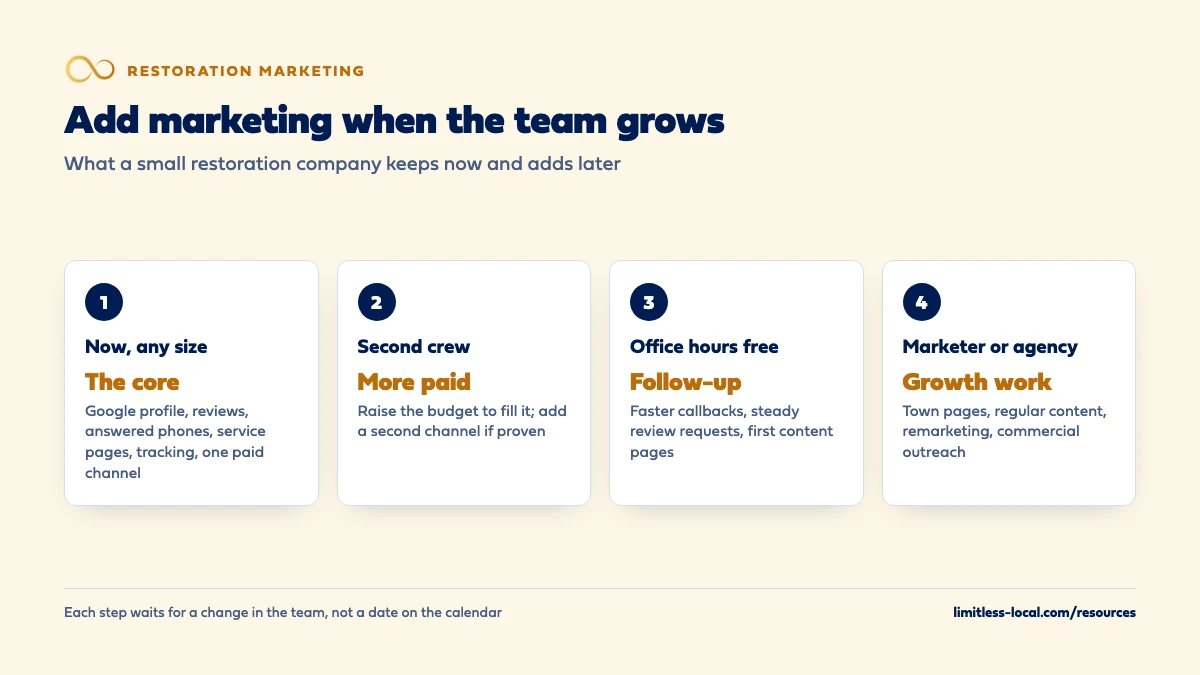
In what order should marketing get added as the team grows?
Tie each addition to a change in the team, not to the calendar:
- Now, at any size: Google Business Profile, reviews, answered phones, a simple site with service pages, tracking, one paid channel and a few referral partners.
- When a second crew is ready: raise the paid budget to fill it, then add the second paid channel if the first is limited by budget and still under your ceiling.
- When someone in the office has hours for it: faster follow-up on forms and messages, more consistent review requests, and the first content pages beyond your core services.
- When there’s a marketing person or an agency: town pages for the places you’ve grown into, a regular content schedule, remarketing and commercial outreach.
- When the first location runs itself: a second location or a new service line, marketed as its own small business.
How do I know the team is ready for the next channel?
Four checks, and all of them should be true:
- The phones are covered. Calls get answered day and night, and forms get a callback within minutes.
- The current channel is proven. You know its cost per booked job, and it’s comfortably under the most you’ll pay for a job.
- There’s room on the schedule. Crews aren’t already full, or you’re about to add one.
- Someone owns it. A named person will run the new channel every week, or you’ve handed it to someone outside who will.
If one is missing, fix it first. Adding a channel to a team that can’t answer the phone just buys more missed calls. Keeping marketing steady while hiring techs covers the in-between stage, and whether one in-house person can keep up during storms covers what happens when the first marketing hire arrives.
Not sure which of these is costing you jobs?
A free visibility audit checks the Google profile, reviews, site and tracking, and shows what to fix first.
What's different about this for a restoration company
Emergency work punishes missed calls. In many trades a missed call can be returned tomorrow. In water and sewage work it usually can’t, so answered phones belong in the core, not in the later list.
Equipment caps capacity. Drying equipment sits on a job for days, so a small company can run out of dehumidifiers before it runs out of people. Size marketing to both.
Storms change the math overnight. A small team can go from slow to overloaded in a day. Keep paid channels easy to turn down, so a surge doesn’t bury you in leads you can’t serve.
Referrals matter more than in most trades. Plumbers, property managers and agents see water damage first, which makes a few good relationships one of the cheapest things a small restoration team can keep going.
A worked example: what a two-tech restoration company keeps and defers
These numbers are made up to show the thinking, not a benchmark for your market. Say you have one truck, two technicians and an owner who runs estimates. Your crew can take about 10 jobs a month, and referrals already bring around 4, so marketing needs to find about 6 more.
At a close rate of about one signed job in four leads, 6 jobs takes about 24 leads. If Local Services Ads leads cost you $90, that’s about $2,160 a month in ad spend. That’s the paid budget: enough to fill the schedule, no more.
Kept running: the Google Business Profile, review requests after every job, a phone answered day and night, five service pages and a tracked number per source, plus that one paid channel.
Deferred: pages for a dozen towns you rarely reach, a weekly blog, Facebook ads, a shared-lead subscription and a commercial sales program.
When the second crew starts and capacity rises to about 20 jobs a month, marketing needs to find about 16. At the same close rate and lead price, that’s about 64 leads and $5,760 a month, which is the point to check whether the first channel is limited by budget or whether a second channel should take some of the load.
Frequently asked questions
Is it a mistake to stop all marketing when we're busy?
Yes. Turn paid ads down to what your crews can take, but keep the Google Business Profile, reviews and website going. Those take months to build back if you let them slide.
Should a small restoration company have a Facebook page at all?
A basic one, yes: your phone number, hours and a few real job photos. Some homeowners and property managers look before they call. Paid Facebook ads can wait.
Can I skip a website and rely on my Google Business Profile?
For a short while, but not for long. A simple site with one page per core service gives your ads somewhere to send people and gives Google more to understand what you do and where.
How much time should the owner spend on marketing each week?
As little as the core needs once it’s set up: asking for reviews, replying to them, and checking where last week’s jobs came from. If marketing takes more than that, it’s time to hand some of it to someone else.
Is it worth hiring an agency before we have a bigger team?
It can be, if the cost fits and it takes work off the owner’s plate rather than adding meetings. Compare its fee with the jobs it needs to produce to pay for itself, and keep ownership of your accounts either way.
Key takeaways
- Keep the core running at any size: Google Business Profile, reviews, answered phones, service pages and tracking.
- Run one paid channel, sized to the jobs your crews can actually take.
- Town pages beyond the places you really serve, a regular blog, social ads, bought leads and second locations can wait.
- Start a few referral relationships now; heavier commercial programs can wait for someone to own them.
- Add each new channel when the team changes and someone can run it, not when the calendar says so.
Want a second set of eyes on your setup?
We'll look at how you show up locally and where calls are leaking, then send you a plain-English breakdown.
More in this section
- What skills do I need to hire to run restoration marketing in-house?
- How much of my time does managing a restoration marketer take?
- What marketing does a brand-new restoration company need first?
- How profitable is a restoration company, and where does marketing fit?
- How to manage a restoration marketing agency without losing control?
Sources
- How to Get the Most From Your Marketing Budget — U.S. Small Business Administration
- Tips to improve your local ranking on Google — Google Business Profile Help
- Spam Policies for Google Web Search — Google Search Central
- Manage your service areas for service-area & hybrid businesses — Google Business Profile Help
- Creating Helpful, Reliable, People-First Content — Google Search Central
- How leads work — Local Services Help
- About reaching customers with your Local Services Ads — Local Services Help