
How many leads and booked jobs to justify hiring an HVAC agency?

- How many extra booked jobs a month does an HVAC agency need to bring in to pay for itself?
- Is there a set number of leads that justifies hiring an agency?
- What goes into the monthly cost I'm trying to cover?
- How do I work out gross profit per booked job?
- How many booked jobs does it take to break even?
- How many leads does that take?
- Should I count every job after I hire, or only the extra ones?
- Does a customer's future work count toward the break-even?
- How long should it take an agency to reach break-even?
- What if the math says I can't justify an agency yet?
- How do I check the agency is clearing the bar after I hire?
- What's different about the break-even for HVAC companies
- A worked example: the break-even on a $7,500 month
- Frequently asked questions
- Key takeaways
- More in this section
- Sources
The short version
- Break-even booked jobs = (agency fee + ad spend) ÷ gross profit per booked job.
- Break-even leads = break-even booked jobs ÷ your booking rate.
- For replacements, divide by your estimate close rate too.
- Count only extra jobs above your normal baseline for the same season.
For HVAC owners who want a number, not a feeling, before signing with an agency: the booked jobs and leads it takes to cover the fee and the ad spend.
Get a free visibility audit · Book a growth call
How many extra booked jobs a month does an HVAC agency need to bring in to pay for itself?
An HVAC agency is justified once it brings in enough extra booked jobs for their gross profit to cover the monthly fee plus ad spend. Divide that monthly total by the gross profit on an average booked job to get the break-even jobs, then divide by your booking rate, and your estimate close rate for replacements, to get the leads it takes. A handful of sold replacements can carry most of that number, so run the math on your own job mix, and count only jobs above what you were already booking.
That break-even is the number we’d want you to hold us to. Our HVAC marketing packages publish the fee up front, ad spend is paid directly to Google, and every package reports leads and booked jobs by source so you can check the math each month. If you’re still comparing options, our page on choosing an HVAC marketing agency covers what to look for, and the rest of the HVAC marketing questions library goes question by question.
Is there a set number of leads that justifies hiring an agency?
No single number fits every HVAC company, because the answer depends on three things that are yours: what the agency and ads cost each month, how much gross profit a booked job makes you, and how many leads it takes to book one. A shop with strong replacement margins might break even on a few extra sold systems a month. A shop that mostly runs service calls at thin margins might need dozens of extra jobs to cover the same bill.
So the question to answer isn’t “how many leads do agencies get?” It’s “how many extra booked jobs would this agency need to bring me, and is that realistic for my market and my crews?” You can work that out in about fifteen minutes with your own numbers, before you ever sign anything.
What goes into the monthly cost I'm trying to cover?
Add up everything you’d spend because you hired the agency:
- The management fee. The monthly retainer or package price.
- Ad spend. Usually paid straight to Google or Meta, separate from the fee. It still has to be covered by the jobs.
- Anything extra. Call tracking, software or add-ons that aren’t in the package.
Then subtract what you’d stop paying. If you’re dropping a DIY ad budget, a freelancer or a tool you’d no longer need, that money comes off the total. And if hiring the agency gives you back hours you were spending on marketing, that time has value, even if it doesn’t show on the bill.
What’s left is the monthly cost the extra jobs need to cover. If you’re unsure whether to put the next dollar into a fee or into more ad budget, whether to pay an HVAC agency fee or spend more on ads covers that choice.
How do I work out gross profit per booked job?
Gross profit is what a job brings in minus what it directly costs: equipment, parts, the tech’s labor, permits and any subcontracted work. The Business Development Bank of Canada’s definition of gross profit margin puts it as net revenue minus direct expenses, divided by net revenue.
Use gross profit, not revenue. A $10,000 system replacement doesn’t put $10,000 toward your marketing bill, because most of it goes to equipment and labor.
Work it out by job type if you can:
- Service and repair calls: average invoice minus parts and tech time.
- Maintenance visits: small on their own, but note how many turn into repairs or plans.
- Replacements: average sold job minus equipment, install labor and permits.
Then allow for jobs that fall through. If one booked service call in ten cancels or no-shows, your gross profit per booked job is lower than per completed job.
How many booked jobs does it take to break even?
Divide the monthly cost by gross profit per booked job:
Break-even booked jobs = (fee + ad spend) ÷ gross profit per booked job
If you only ran service calls, that’s the whole answer. Most HVAC companies run a mix, so do it in two passes. First, estimate how many extra replacements a month the agency’s work could realistically help you sell, and take their gross profit off the monthly cost. Then divide what’s left by the gross profit on a service call. That gives you a break-even that looks like “2 replacements plus a certain number of service calls,” which is much closer to how your month actually works.
Be conservative with the replacement guess. One extra sold system can cover a big share of the bill, which makes it tempting to assume more of them than your market will give you.
Curious what your marketing is actually booking?
Get a free visibility audit — no obligation, no sales pitch.
How many leads does that take?
Work backward from booked jobs to leads with your own conversion rates:
- Service calls: break-even service jobs ÷ your booking rate. If your office books 6 in 10 service leads, you need about 10 leads for every 6 jobs.
- Replacements: break-even sold replacements ÷ your estimate close rate gives the estimates you need; divide that by your booking rate to get replacement leads.
Add the two and you have the monthly lead count the agency would need to deliver. That’s the number to put in front of any agency you’re talking to, and to ask whether it’s realistic for your towns and budget.
If you don’t know your booking rate, find it before you hire anyone, because it changes the answer more than almost anything else. How to calculate your HVAC lead-to-booked-call rate shows how. A better booking rate means fewer leads to break even, which is why answering every call is part of this math.
Should I count every job after I hire, or only the extra ones?
Only the extra ones. You’d have booked a certain number of jobs without the agency: repeat customers, referrals, maintenance plan members, people who already knew your name. Those don’t pay for the agency.
Set a baseline before you start. Pull the booked jobs from new customers for the same months last year, so the season is the same. After you hire, the jobs above that line are the ones that count toward break-even.
Two cautions. A cooler summer or a mild winter can push the whole year below baseline, so compare against the weather as well as the calendar. And some of the agency’s work, like a better Google profile or more reviews, lifts calls that get tagged as “Google” or “referral” anyway. Look at total new-customer booked jobs as well as the ones tagged to the agency’s channels.
Does a customer's future work count toward the break-even?
It should count for something, but not in the first-month math. A new repair customer can turn into a maintenance plan, more service calls and eventually a replacement. A guide to lifetime value from the same Canadian development bank uses a simple formula for that: average value of a sale, times average repeat transactions, times average years a customer stays. It also says to include maintenance and after-sale service in overall revenue.
Use it as a second check, not the first. Decide on the first-job break-even, because that’s the cash that pays the bill each month. Then look at lifetime value to judge whether a channel that only just breaks even on first jobs is still worth keeping because the customers it brings in stick around.

How long should it take an agency to reach break-even?
It depends on which channels do the work. Ads can generate leads within days of launch, so paid search and Local Services Ads should be heading toward break-even within the first few months. SEO typically takes 3 to 6 months to show meaningful organic growth, so if a big part of the plan is SEO, expect the early months to run below break-even and the later ones above it.
That means you need enough cash to carry a few months of cost before the math catches up. Our standard ask is three months, written into the contract, but if you want to leave, we won’t make you stay. Whether your HVAC company is big enough for an agency retainer covers the cash and capacity side in more detail.
What if the math says I can't justify an agency yet?
Then don’t hire one yet, and fix what the math exposed. Common answers:
- The break-even needs more jobs than your crews can run. Hire or raise prices first; more leads won’t help.
- Your booking rate is low. Fixing call handling lowers the number of leads every channel needs, agency or not.
- The fee is large next to your ad budget. At small budgets, running a tight Google profile and a small ad account yourself may make more sense for now.
- You need specific help, not a full program. A freelancer for one job, like a website fix, can be the right step. Whether a freelancer or VA can stand in for an HVAC agency covers when that works.
Rerun the numbers each season. A shop that can’t justify an agency this spring might clear the bar easily a year later.
How do I check the agency is clearing the bar after I hire?
Ask for a monthly report built around the same break-even math: leads and booked jobs by source, cost per booked job, and how the extra jobs compare with your baseline. If the report leads with clicks and impressions, ask for booked jobs instead.
Keep your side of the data clean, too. Tag every job with its lead source in your field software. Housecall Pro’s lead conversion reporting, for example, can show win rates by lead source if you use its Pipeline feature. For Google Ads, offline conversion imports let you send what happened after the call, such as a sold replacement, back into the account, so the ads learn from jobs and not just calls.
Then check the gross profit from extra booked jobs against the monthly cost, every month. How to know if your HVAC marketing agency is getting results goes deeper on reading the report.
Not sure which of these is costing you jobs?
A free visibility audit checks the Google profile, reviews, site and tracking, and shows what to fix first.
What's different about the break-even for HVAC companies
Replacements carry the math. A sold system brings in far more gross profit than a service call, so a small change in how many replacements you sell moves the break-even more than a big change in service volume. Track replacement leads, estimates and sales on their own lines.
Two seasons, two break-evens. Peak months can clear the bar easily while shoulder months fall short. Judge the agency over a full cooling or heating season, not one slow October.
Capacity is part of the threshold. If your techs are already booked out in July, extra leads that month can’t become extra jobs. Plan the break-even around the months you actually have room to grow.
A worked example: the break-even on a $7,500 month
These numbers are made up to show the math. They aren’t a benchmark for HVAC margins, conversion rates or results.
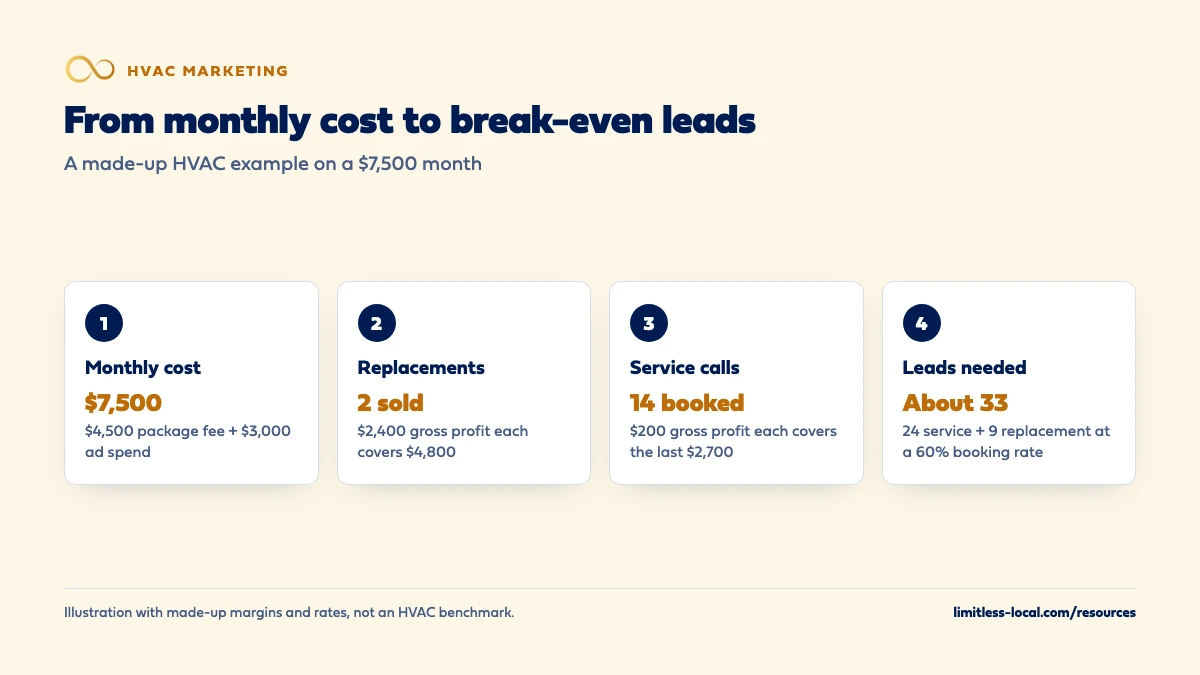
Say you’re looking at our Growth package at $4,500 a month, with $3,000 a month in Google Ads spend paid to Google. That’s $7,500 a month to cover.
- Service calls only: at $200 gross profit per booked service call, you’d need $7,500 ÷ $200 = 37.5, so 38 extra booked service calls a month.
- With replacements: say each sold replacement brings $2,400 in gross profit and you sell 2 extra a month. That covers $4,800. The other $2,700 needs 13.5, so 14 extra service calls.
Now turn that into leads. With an office that books 60% of leads, 14 service calls take about 24 service leads. If you close 40% of replacement estimates, 2 sales take 5 estimates, and booking 5 estimates at 60% takes about 9 replacement leads.
So the bar is roughly 33 extra leads a month, turning into 14 service calls and 2 sold replacements above your baseline. If that looks realistic next to what you book now, and your crews can take it, the agency is worth a serious look.
Frequently asked questions
Should I use revenue or gross profit for the break-even?
Gross profit. Revenue includes equipment and labor you’d pay whether or not the job came from marketing, so using it makes the agency look like it pays off sooner than it does.
Do maintenance visits count toward the break-even?
Count their gross profit, which is small. Their real value shows up later, in repairs, plans and replacements, which belongs in the lifetime check, not the monthly break-even.
What if the agency hits the lead number but booked jobs don't follow?
Look at the office first: answer rate, speed of callback and how calls are handled. Then look at lead quality with call recordings. The fix is different for each.
Is it fair to judge an agency in the first month?
Not on break-even. The first month is mostly setup. Judge it on whether tracking works and leads are coming in, and judge break-even from the third month on.
Should ad spend count against the agency?
Yes. The jobs have to cover the full cost of the program, fee and ad spend together. An agency that only looks good when you leave out the ad budget isn’t paying off.
Key takeaways
- Break-even booked jobs equal the monthly fee plus ad spend, divided by gross profit per booked job.
- Turn booked jobs into leads with your own booking rate, and your estimate close rate for replacements.
- Count only extra new-customer jobs above the same season last year.
- Replacements carry most of the math, so be conservative about how many you assume.
- Expect early months below break-even if SEO is a big part of the plan, and have the cash to carry them.
Want a second set of eyes on your setup?
We'll look at how you show up locally and where calls are leaking, then send you a plain-English breakdown.
More in this section
- How long does it take an HVAC lead to turn into a booked job?
- How can an HVAC company get more leads?
- What percentage of calls should my HVAC office be booking?
- Should I pay an HVAC agency fee or spend more on ads?
- What software does an HVAC company need to handle leads?
Sources
- What is the gross profit margin — Business Development Bank of Canada
- Calculating customer lifetime value & cost of acquisition — Business Development Bank of Canada
- Conversion Rate Reporting — Housecall Pro Help Center
- About offline conversion imports — Google Ads Help