
Is my HVAC company big enough to pay a monthly agency retainer?

- How do I know my HVAC business is ready for a monthly marketing retainer?
- What does "big enough" actually mean for an HVAC company?
- How do I work out my break-even on a retainer?
- How many extra jobs a month is a realistic ask?
- Do I have the trucks and techs to run more work?
- Does my office answer every call?
- How much cash should I have before I sign?
- Is the retainer the whole cost?
- Do I need tracking in place before a retainer?
- What if I'm a one- or two-truck shop?
- When is a bigger shop still not ready?
- What does a retainer buy at different sizes?
- What's different about retainer math for HVAC companies
- A worked example: break-even for a mid-size HVAC shop
- Frequently asked questions
- Key takeaways
- More in this section
- Sources
The short version
- Break-even jobs = (monthly fee + ad spend) ÷ gross profit per average job.
- Ready: that number is a modest bump on what you already book.
- Also ready: trucks with room, phones answered, and cash for a few months of ramp.
- Not yet: tight cash, no capacity, or calls going to voicemail.
For HVAC owners weighing their first monthly agency retainer, who want a way to decide that’s based on their own margins, trucks and phones, not a sales pitch.
Get a free visibility audit · Book a growth call
How do I know my HVAC business is ready for a monthly marketing retainer?
Your HVAC company is big enough for a monthly agency retainer when the extra jobs needed to cover the fee plus ad spend are a modest slice of what you already book, you have the techs to run those jobs, and someone answers every call. Size alone doesn’t decide it; margin, capacity and cash do. Work out the break-even: the monthly fee plus ad spend, divided by the gross profit on an average job, is how many extra jobs a month the retainer has to bring in. If that number looks easy next to your current volume and you can carry the cost for a few months while it ramps, you’re ready.
That break-even math is the same conversation we have on a growth call: what the retainer costs, how many booked jobs it has to produce, and whether your trucks and phones can handle them. Our packages start with Essentials at $3,500 a month, and ad spend is always paid to Google separately. For how that fits HVAC marketing specifically, see the industry page; the HVAC marketing guide covers every channel, and the HVAC marketing questions library goes deeper one question at a time.
What does "big enough" actually mean for an HVAC company?
It isn’t a truck count or a revenue number. Two shops with the same revenue can be in very different spots: one has fat margins on replacements and room on the schedule, the other runs thin on service calls and is already turning work away. “Big enough” means four things are true at once:
- Margin: the gross profit on the jobs the marketing brings in can pay for the marketing.
- Capacity: you have the techs and install crews to run more jobs without wrecking the schedule.
- Phones: someone answers every call during business hours, so you’re not paying for calls that ring out.
- Cash: you can carry the cost for a few months while the work ramps up.
If all four are there, the size of your company barely matters. If one is missing, more marketing makes that problem louder, not smaller.
How do I work out my break-even on a retainer?
Use the same math you’d use for a new truck. The SBA’s break-even calculator uses a simple formula: fixed costs divided by (price minus variable costs) gives the number of units you need to sell to break even. For marketing, that becomes:
- Fixed cost: the monthly agency fee plus your monthly ad spend.
- Price minus variable costs: the gross profit on an average job, after parts, equipment and labor.
- Units: the extra booked jobs a month the retainer has to bring in to pay for itself.
Run it twice: once with your average repair or service call, once with an average replacement. Replacements break even in very few jobs; service calls take many more. Your real answer is a mix of the two, which is why it helps to track results by job type, not just by total calls.
How many extra jobs a month is a realistic ask?
Compare the break-even number with what you already book. If you run a lot of calls a month and the retainer needs a small bump on top, it’s a reasonable ask of any decent marketing program. If the break-even is close to what you book today, you’re asking the marketing to nearly double the business, and that’s a lot to put on one program, especially early on.
Also look at how lumpy the math is. If the whole thing pays off on one or two system replacements a month, a single lost sale can make a month look like a failure. That’s fine if you know it going in. It’s a problem if you’ll pull the plug after one slow month.
To set the number properly, work backward from your revenue goal. How many booked calls your HVAC company needs walks through that math step by step.
Do I have the trucks and techs to run more work?
Check your schedule before you check your budget. If your techs are already booked out a week in peak season, a retainer that brings in more calls in July mostly brings in calls you can’t run. You pay for the lead either way.
Good signs you have room:
- Techs have open slots most weeks outside the first heat wave and cold snap.
- Your install crew could take one or two more replacements a month.
- You’d rather fill the shoulder months than turn away summer calls.
If you’re full, the better move might be hiring before marketing, or aiming the marketing at the shoulder months and higher-ticket work. Whether to market before or after hiring another HVAC tech covers that call.
Does my office answer every call?
This one decides more retainers than size does. A retainer pays for calls and form fills. If a third of them hit voicemail, you’re paying full price for a fraction of the jobs, and the marketing looks worse than it is.
Before you sign anything, call your own number at lunch, after 4pm and on a Saturday morning. Count how many times a real person picks up and can book. If the answer isn’t “every time” during your listed hours, fix that first. It’s the cheapest marketing improvement you’ll ever make. How your HVAC office should handle incoming calls lays out the basics.
Curious what your marketing is actually booking?
Get a free visibility audit — no obligation, no sales pitch.
How much cash should I have before I sign?
Enough to carry the fee and ad spend for a few months without sweating payroll. Ads can generate leads within days of launch, but SEO typically takes 3 to 6 months to show meaningful organic growth, and the first month of any good program is setup: cleaning up your Google profile, fixing tracking, building missing pages.
A simple test: multiply the monthly fee plus ad spend by three. If losing that much would put payroll or a supplier bill at risk, you’re not ready for a full retainer yet. That’s not a judgment of your company. It just means you’ll make better decisions with a cushion than without one.
Ad spend is easier to plan than owners expect. Google says your monthly charge in a campaign won’t go above 30.4 times your average daily budget for most campaigns, so a set daily budget gives you a predictable monthly ceiling.
Is the retainer the whole cost?
No. A retainer is the agency’s fee for doing the work. Ad spend is separate and goes straight to Google (or Meta). So a retainer quote of a few thousand a month is really a few thousand plus whatever your ads budget is.
Then there’s your team’s time. Onboarding with us takes your team about 2 to 3 hours, and after that, someone in your office needs to answer the extra calls and follow up on estimates. If you’d have to hire someone just to keep up, count that too.
When the total feels tight, the question becomes whether to put the money into management or more ads. Whether to pay an HVAC agency fee or spend more on ads helps you decide.
Do I need tracking in place before a retainer?
You need some way to tell which jobs came from the marketing, or you’ll never know if you hit break-even. It doesn’t have to be fancy to start. The SBA’s article on getting the most from your marketing budget points out that tracking can be as simple as reminding your employees to ask new customers where they learned about your business.
That’s a fine start. Better is call tracking that tags every call by source, connected to your field software so you can see which calls turned into booked jobs and what they were worth. A good agency sets that up in the first month. Ours includes call tracking with recording, form tracking and a monthly report with a cost-per-lead breakdown in every package.

What if I'm a one- or two-truck shop?
A full retainer may not make sense yet, and that’s fine. The cheapest calls for a small HVAC shop usually come from work that costs time, not money:
- A complete Google Business Profile with every service, your real service area and real photos.
- Asking every happy customer for a Google review.
- Calling past customers before the season for tune-ups.
Google says local results are mainly based on relevance, distance and popularity, and that more reviews and positive ratings can help your local ranking. That’s work an owner can do from the truck. The simplest marketing setup for a small HVAC company lays out a lean version.
The move to a retainer usually makes sense when you’ve hired your next tech and need the calls to keep them busy, or when doing the marketing yourself is costing you jobs you’d otherwise run.
When is a bigger shop still not ready?
Size doesn’t fix these. Hold off, or start smaller, if:
- Cash is tight after a slow season and the retainer would come out of payroll money.
- Nobody owns the phones or follow-up, so more leads would just pile up.
- You can’t say which jobs you want more of. Repairs, replacements and maintenance plans need different marketing.
- You’re about to change something big, like a new name, a new location or selling the business.
- You won’t give it a fair test. If you’ll cancel after one slow month, you’ll pay for setup and never see the payoff.
None of these is permanent. Each is a reason to fix one thing first, then come back to the math.
What does a retainer buy at different sizes?
The scope should match the business, not the other way around. Our packages, as an example of how scope steps up:
- Essentials, $3,500 a month: one location, Google profile management, local SEO content, Google Ads management up to $2,500 a month in ad spend, call and form tracking.
- Growth, $4,500 a month: up to 2 locations, Google Ads up to $5,000 a month in spend, Local Services Ads management, Meta remarketing and a dedicated account manager.
- Scale, custom pricing: multiple locations and markets.
A single-location shop doesn’t need multi-market work, and a shop with several locations will outgrow a one-location plan fast. HVAC marketing once you have 10 or more trucks covers what changes as you grow.
Not sure which of these is costing you jobs?
A free visibility audit checks the Google profile, reviews, site and tracking, and shows what to fix first.
What's different about retainer math for HVAC companies
Two very different tickets. A service call and a full system replacement can be worth wildly different amounts in gross profit. A retainer that looks expensive against service calls can look cheap against a couple of extra replacements a month, so run the break-even both ways.
The season moves the math. In peak season, you may not have room for more calls. In the shoulder months, you need them. A retainer often earns its keep by filling April and October, not July.
Maintenance plans pay over time. A new maintenance-plan customer is worth more than the first visit: the tune-ups, the repairs you catch early, and the replacement years later. Count some of that long-term value when you judge whether the marketing paid off.
A worked example: break-even for a mid-size HVAC shop
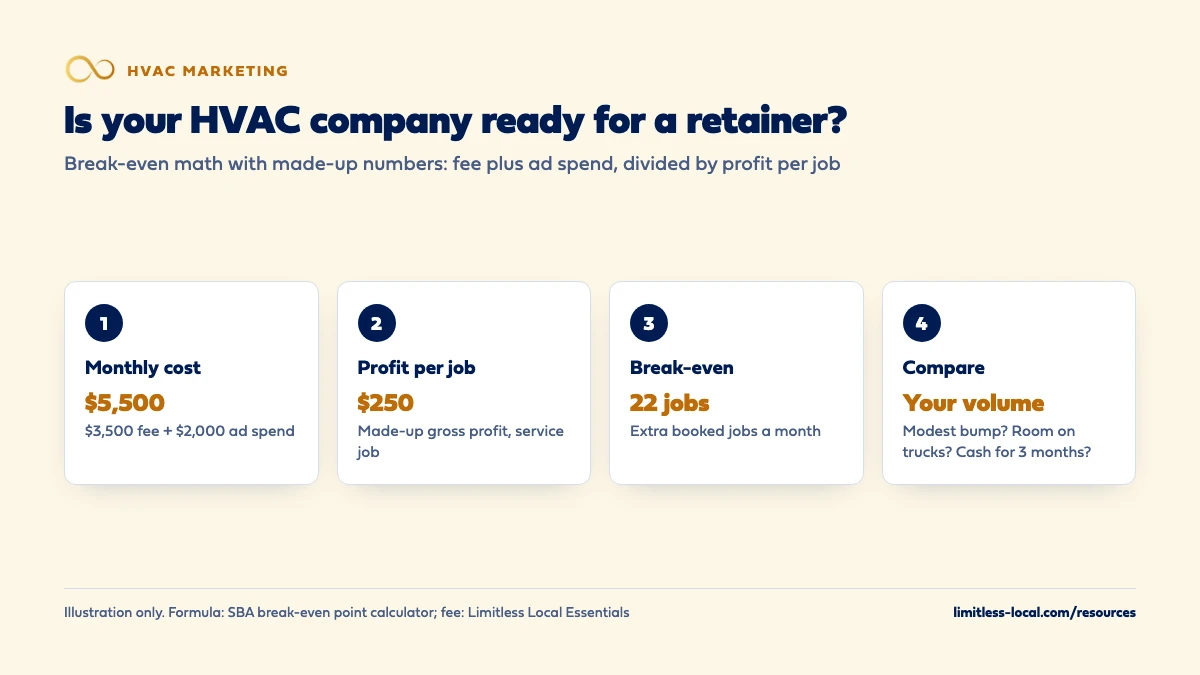
These numbers are made up to show the math, not a benchmark for your market. Say you’re looking at our Essentials package at $3,500 a month, with $2,000 a month in Google Ads spend paid to Google. That’s $5,500 a month all in.
- If the average service job brings in $250 in gross profit, you need 22 extra service jobs a month to break even ($5,500 ÷ $250).
- If an average replacement brings in $3,000 in gross profit, you need 2 extra replacements a month (about 1.8, rounded up).
Now compare that with what you book today. A shop running 150 jobs a month needs 22 more, a modest bump. A shop running 30 jobs a month needs the same 22 more, which means growing by more than two-thirds. Same retainer, very different decision.
Then the cash test: three months at $5,500 is $16,500. If you can carry that while the program ramps, and you have the trucks and phones to handle the extra work, the math says you’re ready.
Frequently asked questions
Is there a minimum revenue to hire an HVAC marketing agency?
Not a fixed one. What matters is whether the extra jobs needed to cover the fee and ad spend are realistic for your volume, and whether you can carry the cost while it ramps.
Should I count gross profit or revenue in the break-even math?
Gross profit. A $250 profit on a job pays for marketing; the revenue that went to parts and labor doesn’t.
How long should I give a retainer before judging it?
Long enough for the slow parts to work. Ads can bring leads within days, but SEO typically takes 3 to 6 months to show meaningful growth, so judge each piece on its own clock.
Is a cheaper retainer a safer first step?
Only if it still covers the basics: tracking, your Google profile and well-run ads. A low fee that can’t show you which calls became jobs makes it harder to decide anything.
Do I have to sign a long contract?
Not with us. We ask for three months and put it in the contract, but if you want to leave, we won’t make you stay.
Can I start with ads only and add the rest later?
Yes. Many owners start where calls come fastest and add SEO and the rest once the first channel is booking jobs at a cost they’re happy with.
Key takeaways
- “Big enough” is about margin, capacity, phones and cash, not truck count.
- Break-even jobs = (monthly fee + ad spend) ÷ gross profit per average job.
- Run the math for service calls and for replacements; the answer is usually a mix.
- Make sure every call gets answered before you pay for more of them.
- Have enough cash to carry the cost for a few months while the work ramps.
Want a second set of eyes on your setup?
We'll look at how you show up locally and where calls are leaking, then send you a plain-English breakdown.
More in this section
- Should I pay an HVAC agency fee or spend more on ads?
- How much control over my brand do I lose hiring an HVAC agency?
- What should I look for in an HVAC marketing agency contract?
- How do I know if a marketing agency really understands HVAC?
- Can a small HVAC company afford TV advertising?
Sources
- Break-even point calculator — U.S. Small Business Administration
- How to Get the Most From Your Marketing Budget — U.S. Small Business Administration
- About average daily budgets — Google Ads Help
- Tips to improve your local ranking on Google — Google Business Profile Help