
What is a hybrid roofing marketing setup?
- What does a hybrid marketing setup look like for a roofing company?
- What does "hybrid" mean in roofing marketing?
- How is a hybrid setup different from all in-house or all outsourced?
- Which marketing work sits on my side of a hybrid setup?
- Which work sits with the outside side?
- What are the common hybrid setups for roofing companies?
- Where do the two sides hand work to each other?
- Who should own the accounts in a hybrid setup?
- How do I keep a hybrid setup from leaving gaps or doubling up?
- What does a hybrid roofing marketing setup cost?
- How do I know if my hybrid setup is working?
- When does a hybrid setup stop fitting?
- What's different about a hybrid setup for roofers
- A worked example: the cost of a hybrid month
- Frequently asked questions
- Key takeaways
- More in this section
- Sources
The short version
- Your team handles leads, reviews, photos and job outcomes.
- Outside help handles ads, the website, SEO and tracking.
- Every task has exactly one owner, written down.
- Your company owns every account; both sides read the same report.
For roofing owners who want to keep some marketing inside the company and hand the rest to outside help, and want to know how the two halves fit together.
Get a free visibility audit · Book a growth call
What does a hybrid marketing setup look like for a roofing company?
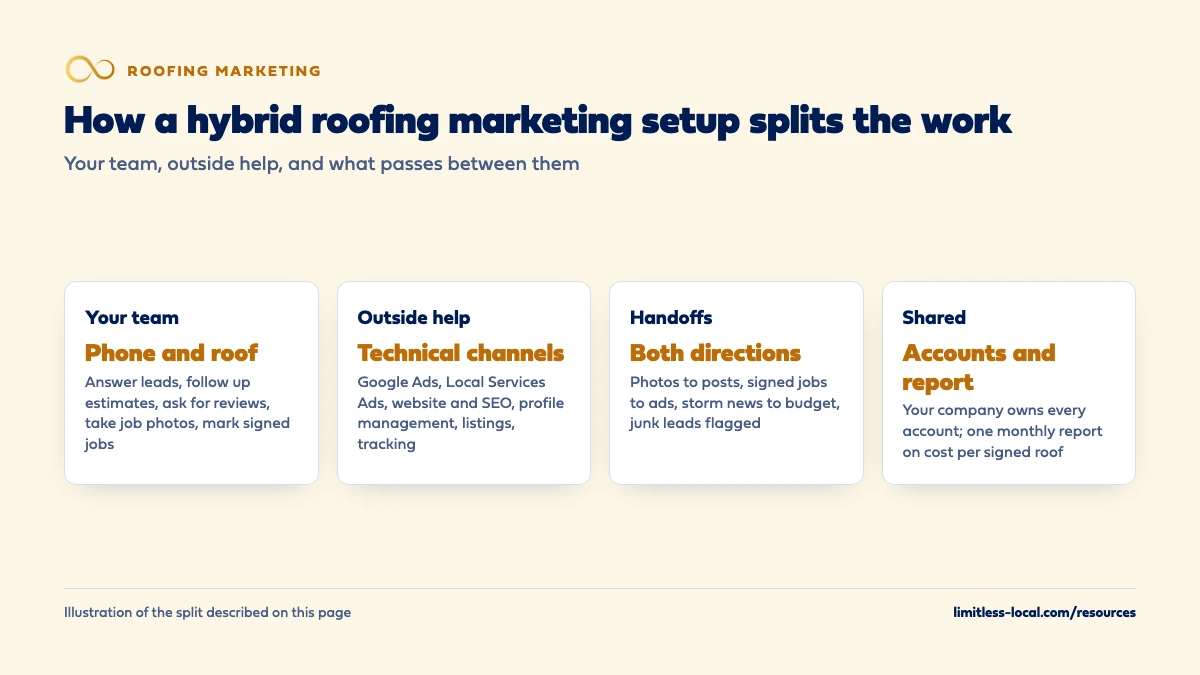
A hybrid roofing marketing setup splits the work between your own team and outside help on purpose. Your people handle what happens on the phone and on the roof: answering and following up on leads, asking for reviews, taking job photos and recording which leads signed. An agency or specialist runs the technical channels, such as Google Ads, Local Services Ads, the website, SEO and tracking. It works when every task has one clear owner, your company owns every account, and both sides judge results by the same number: cost per signed roof.
A hybrid split is how our Limitless Engine packages are built to run: we take the technical side (Google Business Profile management, local SEO, Google Ads, Local Services Ads on Growth and Scale, review generation and call tracking), and your team keeps answering, inspecting, signing and asking for reviews. Onboarding takes your team about 2 to 3 hours. See how it fits a roofing company on our roofing marketing page, read the roofing marketing guide, or browse the roofing marketing questions library.
What does "hybrid" mean in roofing marketing?
Hybrid means some of your marketing is done by people on your payroll and some by people you pay from outside, with a deliberate line between the two. For most roofing companies past the one-truck stage, it’s the setup that fits best.
The reason is simple. Roofing marketing has two very different kinds of work. One kind happens in the homeowner’s driveway, on the roof and on the phone: picking up the call, booking the inspection, following up on the estimate, asking for the review at the final walk-through. Nobody outside your company can do that as well as your crew lead or office manager.
The other kind happens inside Google Ads, your website and your tracking, and it punishes small mistakes quietly. A hybrid setup gives each kind of work to the people best placed to do it, then connects the two halves so they feed each other.
How is a hybrid setup different from all in-house or all outsourced?
Think of three setups side by side:
- All in-house. You, your office manager or a marketing hire do everything, from ads to the website to review replies. You keep control, but technical work gets done in the gaps between jobs.
- All outsourced. An agency or lead company does everything, including answering or qualifying leads for you. It saves time, but leads get handled by people who don’t know your schedule or prices and can’t book the inspection.
- Hybrid. Your team keeps the work that needs your knowledge of the jobs. Outside help takes the work that needs platform know-how. Both sides share the accounts, the tracking and the report.
Most roofers end up hybrid whether they planned it or not. An accidental hybrid has tasks nobody owns, like a Google profile untouched for a year, and tasks two people do at once.
Which marketing work sits on my side of a hybrid setup?
The work that depends on being at the job or knowing the customer:
- Lead handling. Answering calls, calling back forms and missed calls within minutes, booking and confirming inspections.
- Estimate follow-up. A set schedule for every unsigned estimate, run by the person who gave it.
- Review asks. The crew lead or salesperson asks at the final walk-through, with a link or QR code ready.
- Job photos. Before, during and after shots from every roof, dropped in a shared folder the same day.
- Job outcomes. Marking each lead as inspected, estimated, signed or lost, with the job value, in your CRM or job software.
- The decisions. Budget, towns, job mix, offers and approvals.
None of these needs marketing training. They need habits and one named person for each. Which marketing tasks a roofer should keep in-house goes through each one in detail, including who on a small team should own it.
Which work sits with the outside side?
The technical channels, where mistakes cost money without anyone noticing:
- Google Ads. Keywords, negative keywords, location settings, bids, budgets and the weekly search term review.
- Local Services Ads. Job types, service areas, budgets and disputes.
- Website and SEO. Service and town pages, speed, mobile layout, and how Google reads the site.
- Google Business Profile management. Posts, categories, services, photos (from your crews) and keeping the details right.
- Listings. Your name, address and phone consistent across directories.
- Tracking. Call tracking numbers, form tracking and the report that ties leads to signed jobs.
Review replies and profile posts can sit on either side; pick one and write it down. Which roofing marketing tasks to do yourself or hand off covers the in-between tasks from the owner’s own week.
What are the common hybrid setups for roofing companies?
The split shifts as the company grows. Four versions cover most roofers:
- Owner plus outside help. One or two crews, no office staff. You answer the phone, ask for reviews and decide the budget. An agency runs ads, the profile, the website and tracking. The weak spot is lead handling while you’re on a roof, so missed calls need a fast callback habit.
- Office manager plus outside help. The most common version. Your office manager owns lead handling, follow-up and job outcomes; crew leads own photos and review asks; the agency runs the technical side. You make the decisions in a short monthly review.
- In-house coordinator plus outside specialists. A growing company adds a marketing coordinator who handles posts, review replies, photos, local events and the day-to-day contact with the agency. The agency keeps ads, SEO and tracking.
- In-house marketer plus specialists. Larger companies hire a marketer who plans the calendar and manages vendors, with outside specialists for paid ads and technical SEO.
Each step moves a little more work inside. When a roofing company is ready for a full-time marketing hire covers the jump from version two to version four.
Curious what your marketing is actually booking?
Get a free visibility audit — no obligation, no sales pitch.
Where do the two sides hand work to each other?
The handoffs are where a hybrid setup wins or fails:
- Photos to posts. Your crews shoot the job; outside help turns the photos into profile posts and project pages. If the folder stays empty, the profile goes stale.
- Job outcomes to ads. Your office marks which leads signed; the ads side uses that to see which keywords and towns produce roofs, not just calls. Without it, the ads get tuned for cheap leads instead of signed jobs.
- Storm news to budget. You know when hail hit a town and when your crews have room. The ads side needs that the same day to shift budget and targeting.
- New services to pages. When you add metal roofing or gutters, the website, profile services and ads need to know before you start taking calls for it.
- Review asks to review replies. Your crews ask; whoever owns replies answers each review within a few days.
- Bad leads back to the source. Your office flags junk calls and wrong-service leads so they can be blocked or disputed.
Write each handoff down: what moves, who sends it, who receives it, and by when.
Who should own the accounts in a hybrid setup?
Your company, always. Outside help gets access; it doesn’t get ownership. That way, if you change agencies or a staff member leaves, you keep your history, your reviews and your settings.
The platforms are built for this. Google Business Profile has owners and managers: managers can edit details, respond to reviews and manage posts, but only owners can add or remove users or remove the profile, according to Google’s page on managing profile owners and managers. Give outside help manager access and keep the primary owner role with you. Note that a new owner or manager has to wait 7 days before managing some profile features, so add people before you need them.
Google Ads works the same way, with access levels from email-only and read-only up to standard and admin, as Google’s page on access levels in your Google Ads account lays out. Keep an admin login of your own. Do the same for your website hosting, domain, Search Console, analytics and call tracking: your login, their access. How much control a roofer should keep over marketing goes deeper on approvals and access.
How do I keep a hybrid setup from leaving gaps or doubling up?
Three habits prevent most problems:
- One owner per task. Make a simple list of every marketing task and put one name next to each, either a person on your team or the outside company. Two names means nobody owns it.
- One shared calendar. Storm season, slow months, new crews, a new service, a home show. Both sides see what’s coming so nobody is surprised.
- One monthly review. A short meeting, the same report, the same questions: how many leads, how many inspections, how many signed roofs, and what each signed roof cost. Then agree on what changes next month.
Watch for doubling up: a salesperson running his own Facebook ads alongside the agency’s, or a second website built by a nephew. Each one splits your budget and muddies the tracking.
Watch for gaps too. The most common is lead follow-up after the first call: the agency assumes your office does it, your office assumes the CRM does it, and estimates sit unsigned.

What does a hybrid roofing marketing setup cost?
Three costs add up:
- The outside help. Our Essentials package is $3,500 a month for one location, including Google Ads management up to $2,500 a month in ad spend, Google Business Profile management, local SEO, review response, call tracking and reporting. Growth is $4,500 a month and adds Local Services Ads, Meta remarketing, up to two locations and a dedicated account manager. Scale is custom.
- Ad spend. Paid straight to Google or Meta, never included in an agency fee. We recommend a budget after a quick audit of your market.
- Your team’s time. The hours your office manager and crews spend on lead handling, photos, review asks and job outcomes. It’s real payroll, so count it.
The total only means something next to what it books. Divide the whole monthly cost by the roofs it signed, and compare that with your average job margin. The worked example below shows the math.
How do I know if my hybrid setup is working?
Look at signed roofs, not activity. A good monthly report answers four questions: how many leads came in by source, how many became inspections, how many signed, and what each signed roof cost. If the report shows clicks and impressions but not signed jobs, the tracking handoff is broken.
Tracking doesn’t have to be fancy to start. The SBA’s guide to getting the most from your marketing budget notes it can be as simple as reminding your employees to ask new customers where they learned about your business. Call tracking and a CRM make it automatic; tracking which roofing leads turn into signed jobs walks through the setup.
Then check the people side:
- Are calls answered, and are missed calls returned within minutes?
- Is the photo folder filling up every week?
- Are review asks happening on every finished job?
- Does the outside help act on what your office tells it, like junk leads and storm news?
When does a hybrid setup stop fitting?
It stops fitting in a few situations:
- Nobody on your side can hold up their half. If calls go to voicemail and estimates never get followed up, no outside help can fix it. Sort out lead handling first.
- You’ve outgrown the outside help. Several locations, a big commercial division or a dedicated marketing team may need a larger in-house role, with specialists only for paid ads or technical SEO.
- The split has drifted. If the outside company is now doing your follow-up calls, or your office is fiddling with ad settings, redraw the line.
A brand-new one-truck roofer can run a lighter version: reviews, photos and the Google profile yourself, outside help for ads or a website later. The marketing skills a growing roofing owner needs covers what you should understand yourself, whichever way you split the work.
Want to see where your company stands?
A free visibility audit shows where you show up on Google, Maps and AI answers, and what it's costing you in calls.
What's different about a hybrid setup for roofers
Storms test the handoffs. When hail hits, demand jumps in specific towns within days. A hybrid setup only keeps up if storm news reaches the ads side the same day and your office can answer the extra calls. Agree in advance who calls whom when a storm hits.
The sale is long. A roofing lead goes from call to inspection to estimate to signature, sometimes over weeks. That’s why job outcomes must flow back from your office: outside help can see the call, but only your team sees the signature.
Your best content is on the roof. Roofing work is visible and photogenic. Good before-and-after photos from your crews give the outside side real proof to post.
A worked example: the cost of a hybrid month
These numbers are made up to show the math, not a benchmark for your market. Say you run our Essentials package at $3,500 a month and spend $2,000 a month on Google Ads, paid to Google. Your office manager spends about 20 hours a month on lead handling, follow-up and job outcomes, and you value that time at $25 an hour, or $500 a month.
Your total monthly marketing cost is $3,500 plus $2,000 plus $500, which is $6,000. If those leads sign 8 roofs that month, each signed roof cost $750 in marketing. Compare that with your average margin on a roof. If it’s comfortably higher, the setup pays its way. If the same spend signed only half as many roofs, look at the in-house half first: answer times, follow-up and close rate, before blaming the ads.
Frequently asked questions
Is a hybrid setup cheaper than hiring a full-time marketer?
Often, for a small or mid-sized roofer, because one employee rarely covers ads, SEO, the website and tracking well, and you still pay their full cost in slow months. Compare the total cost of each option against the signed roofs it books.
Can I start hybrid with just ads outsourced?
Yes. Many roofers start by outsourcing Google Ads or the website and keep the Google profile and reviews themselves. Add more to the outside side as your own time runs out.
Should the agency answer my roofing leads?
Usually not. Whoever answers should be able to book an inspection on the spot, which takes knowledge of your schedule and prices. Keep lead handling in-house and let the outside side make sure every lead reaches you fast.
What if my office manager quits?
That’s why the task list matters. With every task written down and every account owned by the company, a new hire can pick up the in-house half in days instead of rebuilding it.
Do I need a CRM for a hybrid setup?
You need somewhere to record what happened to each lead. Job software like JobNimbus, AccuLynx, ServiceTitan or Jobber can do it; so can a simple spreadsheet at first, as long as someone keeps it current.
Key takeaways
- A hybrid setup gives on-site work to your team and technical channels to outside help, on purpose.
- Every task gets one owner, written down; two owners means nobody owns it.
- Your company owns every account; outside help gets access, not ownership.
- The handoffs, especially signed jobs back to the ads side, decide whether it works.
- Judge the whole setup on cost per signed roof, counting agency fee, ad spend and your team’s time.
Not sure what's working right now?
Start with a free visibility audit: rankings, Google profile, reviews and tracking, checked against your service area.
More in this section
- What does a good roofing marketing plan look like for 2027?
- What does a roofing marketer actually do each month?
- How should a roofing company market commercial roofing?
- Hire a roofing-specialist agency or run marketing myself?
- How does a roofer run a profitable business with marketing?
Sources
- Manage your Business Profile owners & managers — Google Business Profile Help
- About access levels in your Google Ads account — Google Ads Help
- How to Get the Most From Your Marketing Budget — U.S. Small Business Administration