
What mistakes do plumbers make handling their own marketing?

- Where does do-it-yourself plumbing marketing usually go wrong?
- Which do-it-yourself mistakes cost plumbers the most?
- Why is marketing only when the phone is slow a mistake?
- What goes wrong when I don't track which marketing booked the job?
- How do I lose leads while I'm out on a job?
- Why is judging by clicks, likes and rankings a mistake?
- What happens when I leave Google Ads on autopilot?
- Which Google Business Profile mistakes do owners make on their own?
- What review mistakes can get a plumber in trouble?
- Why is trying every channel at once a mistake?
- Why does changing everything at once hurt?
- What account mistakes come back to bite owners?
- How do I fix these without hiring anyone?
- What's different for plumbers doing their own marketing
- A worked example: what tracking can reveal
- Frequently asked questions
- Key takeaways
- More in this section
- Sources
The short version
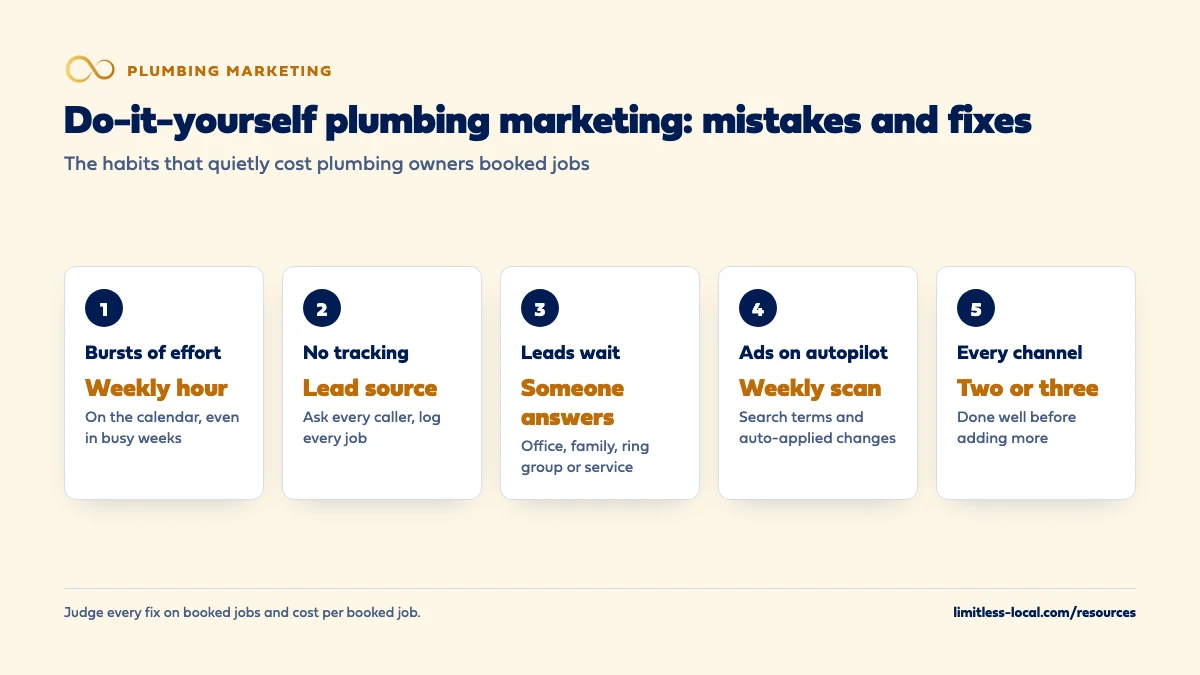
- Steady effort every week beats bursts when the phone is slow.
- Track every call to a booked job, or you're guessing.
- Leads that wait while you're on a job go to someone else.
- Do a few channels well instead of every channel badly.
For plumbing owners running their own marketing between jobs, who want to know which habits quietly cost them calls and booked jobs.
Get a free visibility audit · Book a growth call
Where does do-it-yourself plumbing marketing usually go wrong?
The most common mistakes plumbers make with their own marketing are habits, not tactics: marketing only when the phone goes quiet, not tracking which calls became booked jobs, and letting new leads wait while everyone is on a job. Close behind are judging results by clicks or rankings instead of booked jobs, leaving Google Ads on autopilot, breaking Google’s rules on the business profile or reviews without knowing it, and spreading a little effort across too many channels. Most of these are fixed with a weekly routine and a few settings, not a bigger budget.
These are the pieces owners most often drop, and the ones our packages keep running every week. Essentials is $3,500 a month and includes Google Business Profile management with a post every week, review response and basic review generation, Google Ads management, and call, web and form tracking with a real-time dashboard and a monthly report. Onboarding takes your team about 2-3 hours. See what each package includes, how it works for plumbing companies, or the rest of the plumbing marketing questions library.
Which do-it-yourself mistakes cost plumbers the most?
The expensive ones repeat every month without anyone noticing. In rough order of cost:
- Marketing in bursts, only when the phone is slow.
- No tracking from call to booked job.
- New leads waiting while everyone’s on a job.
- Judging results by clicks, likes or rankings.
- Google Ads left on autopilot.
- Breaking Google’s or the FTC’s rules without realizing it.
- Too many channels, none done well.
Ad-account settings that waste money, like ads showing in the wrong towns, are their own list. The marketing traps that waste the most money for plumbers covers those. This page is about the habits of running it yourself.
Why is marketing only when the phone is slow a mistake?
Because almost everything in marketing works on a delay. A review asked for today helps your Maps listing for years. A service page written this month may not bring calls for a season. When you only market in a slow stretch, you’re planting in the week you’re hungry.
It also makes the swings worse. Busy weeks crowd out the marketing, which sets up the next slow week, which brings on a panicked burst of spending. It’s easy to decide marketing “never works” when it never got a steady run.
The fix is small and boring: a set hour or two every week, on the calendar, that survives busy weeks. Even in a slammed week, the review ask and a quick look at the numbers still happen.
What goes wrong when I don't track which marketing booked the job?
Every decision becomes a guess. You keep paying for the channel that feels busy, which isn’t always the one that books jobs, and you can’t tell whether a change helped.
Tracking doesn’t have to be fancy. The SBA’s guide to getting the most from your marketing budget notes it can be as simple as reminding employees to ask new customers where they learned about your business. Write the answer in the lead source field in Jobber, Housecall Pro or ServiceTitan on every job, and add call tracking numbers once you’re paying for ads.
Tracking which plumbing marketing books jobs walks through the full setup, and the worked example below shows what it can reveal.
How do I lose leads while I'm out on a job?
When the owner is also the plumber, the phone rings while your hands are in a crawl space. The call goes to voicemail, the form waits until lunch, and the Google message waits until tonight. By then most of those homeowners have booked someone who picked up.
Doing your own marketing well and answering your own phone are often at odds. The more calls the marketing brings in, the more get missed. Before you push for more leads, decide who answers when you can’t: an office person, a family member, a ring group or an answering service. How fast a plumbing lead needs an answer helps you set the standard.
Why is judging by clicks, likes and rankings a mistake?
Because none of them pay the bills. Rankings move day to day and differ by town and by searcher. Clicks include people who bounced. Likes on a Facebook post rarely turn into a water heater job.
Judge everything on two numbers: booked jobs and what each booked job cost. If a channel looks great on clicks and bad on booked jobs, believe the booked jobs. If it looks quiet but books well, keep it.
Curious what your marketing is actually booking?
Get a free visibility audit — no obligation, no sales pitch.
What happens when I leave Google Ads on autopilot?
Google Ads makes it easy to set up a campaign once and leave it. That’s where do-it-yourself accounts drift. Two habits help:
- Read the search terms. The search terms report shows the actual searches that triggered your ads. A weekly scan catches the jobs you don’t do and the towns you don’t serve.
- Watch what gets applied automatically. Google’s page on applying recommendations automatically explains that once it’s turned on, recommendations apply regularly, and the list includes adding keywords and broad match keywords. You can review the queue, check the History tab and turn it off at any time. Make sure each change fits the jobs you want before it runs.
Neither takes long. Skipping both for months is how small leaks become big ones.
Which Google Business Profile mistakes do owners make on their own?
The common one is stuffing extra words into the business name, like adding “24/7 Emergency Plumber” and a city. Google’s guidelines for representing your business say your name should reflect your real-world business name, and that including unnecessary information in it isn’t permitted and could result in suspension of your profile. A suspended profile means no Maps calls at all.
Other frequent ones: hours that don’t match when anyone answers, a phone number that changed on the truck but not on the profile, categories picked once and never revisited, and no new photos for a year. All of these are free to fix and take minutes.
What review mistakes can get a plumber in trouble?
Two opposite ones. The first is asking for reviews only now and then, so your count stalls while newer shops keep climbing. Make the ask part of closing every job.
The second is offering something in return for good reviews. The FTC’s questions and answers on its consumer reviews rule says the rule doesn’t prohibit incentives for reviews as long as there isn’t an express or implied requirement that the reviews express a particular sentiment. It gives a direct example: paying incentives for 5-star reviews on third-party platforms violates the rule, even if reviewers disclose the incentive. A “leave us 5 stars and get a discount” card fails that test. Google is stricter still: its prohibited and restricted content policy doesn’t allow offering incentives, such as payment, discounts or free services, in exchange for posting any review, so on your Google profile, skip rewards altogether.
Ask every customer the same way, whatever you expect them to say, and you’re on solid ground.

Why is trying every channel at once a mistake?
A plumber with a few hours a week can’t run Google Ads, LSAs, SEO, Facebook, Nextdoor, a newsletter and three directory listings well. Each one gets a little attention, none gets enough to work, and the owner concludes that marketing doesn’t work.
Pick two or three and do them properly: usually your Google profile and reviews, plus one paid channel, plus the website pages for your biggest jobs. Add another only when those are steady and you have time to spare. If you’re building town pages, building city pages without spam shows how to do it without copying the same page for every town.
Why does changing everything at once hurt?
Because you can’t tell what worked. If you rewrite the website, switch ad campaigns and add a coupon in the same week, and calls go up, which one did it? If calls go down, which one do you undo?
Change one thing, note the date, and give it a fair stretch before the next change. Paid ads need a few weeks to settle after a big change, and SEO changes take longer still. A simple log of what changed and when makes your own results readable.
What account mistakes come back to bite owners?
Setting up the Google Ads account, the website domain or the Google profile under a nephew’s email, a freelancer’s login or a past employee’s personal account. It works until that person moves on, and then you’re locked out of your own marketing.
Put every account in your company’s name, with you as an owner or admin, and give helpers their own logins. Who should own your website and ad accounts has the checklist.
How do I fix these without hiring anyone?
A weekly routine covers most of them:
- Every job: ask for a review and record the lead source.
- Weekly, about an hour: count calls and booked jobs by source, scan the ad search terms, check any auto-applied changes, reply to reviews, add a few job photos to the profile.
- Monthly: work out cost per booked job for each channel and decide one change for next month.
- Always: someone assigned to answer the phone when you can’t.
If that hour keeps disappearing, or the ads have grown past what you can watch, it may be time to hand some of it off. When a plumber should stop doing their own marketing covers how to do that without losing what works.
Not sure which of these is costing you jobs?
A free visibility audit checks the Google profile, reviews, site and tracking, and shows what to fix first.
What's different for plumbers doing their own marketing
Emergencies punish slow answers. A homeowner with water on the floor won’t wait for you to finish a job. A do-it-yourself plan has to start with who answers the phone, or more marketing just means more missed calls.
Freezes wreck the routine. During a cold snap, the weekly marketing hour is the first thing to go. Plan for it: get the profile, hours and ads ready before the forecast turns, and keep the review ask going through the rush, when you’re finishing the most jobs.
Big tickets need their own pages. Water heater replacements, repipes and sewer lines are where the money is. Owners doing it themselves often have one generic services page; a clear page for each big job is one of the most useful things you can write yourself.
A worked example: what tracking can reveal
These numbers are made up to show the math, not a benchmark. Say a plumbing owner spends $1,200 a month on Google Ads and the account shows 40 calls. That looks like $30 a call, and he’s happy with it.
Then he starts asking every caller how they found him and checking each call. Of the 40, 10 were existing customers calling about scheduled work, a few were spam and sales calls, and 22 were new homeowners who needed a plumber. Of those 22, 9 booked a job.
The real number is $1,200 divided by 9 booked jobs, or about $133 per booked job. That may still be a good deal, depending on the jobs. But now he can compare it with his other channels, and he knows the 13 new callers who didn’t book are worth a look: were they price-shoppers, out of area, or calls nobody returned?
Frequently asked questions
Is it a mistake to do my own marketing at all?
No. Plenty of plumbing owners handle their Google profile, reviews and even a small ad campaign well. The mistakes come from doing it in bursts, without tracking, and without someone answering the calls it brings in.
How many hours a week should I spend on my own marketing?
Enough to keep a steady weekly routine, which for many small shops is an hour or two, protected on the calendar. If you can’t keep even that, it’s a sign to hand part of it off.
Should I let Google's AI write my ads?
It can save time, but read every headline before it runs. Make sure it names the jobs you want, the towns you serve and nothing you don’t offer.
Is it a mistake to copy a competitor's website?
Yes. Copied text does nothing to show homeowners why to call you, and it won’t describe your own jobs, crew or towns. Write about the work you actually do.
What's the first mistake to fix?
Who answers the phone. Every other fix brings in more calls, and they’re only worth something if a person picks up.
Do I need expensive software to fix these?
No. Your job software’s lead source field, your Google profile’s performance report and your ad account’s search terms cover most of it. Call tracking is worth adding once you’re paying for ads.
Key takeaways
- Market every week on a set schedule, not only when the phone goes quiet.
- Record the lead source on every job, so you can judge each channel on cost per booked job.
- Decide who answers when you’re on a job before you chase more leads.
- Scan ad search terms and auto-applied changes weekly, and keep your Google profile name to your real business name.
- Ask every customer for a review the same way, and don’t offer rewards for Google reviews at all.
Want a second set of eyes on your setup?
We'll look at how you show up locally and where calls are leaking, then send you a plain-English breakdown.
More in this section
- When should a plumber stop doing their own marketing?
- What marketing traps waste the most money for plumbers?
- How much control do plumbers give up by outsourcing marketing?
- What will I still pay for if I do plumbing marketing myself?
- What needs fixing before I launch my plumbing marketing?
Sources
- How to Get the Most From Your Marketing Budget — U.S. Small Business Administration
- About the search terms report — Google Ads Help
- About applying recommendations automatically — Google Ads Help
- Guidelines for representing your business on Google — Google Business Profile Help
- The Consumer Reviews and Testimonials Rule: Questions and Answers — Federal Trade Commission
- Prohibited & restricted content — Maps User Generated Content Policy Help