
What marketing skills does a growing roofing owner need?
- Which marketing skills should a roofing company owner learn as the business grows?
- Does a roofing owner need to be good at marketing?
- Skill 1: Do I know my numbers?
- Skill 2: Do I know who I want as customers, and why they'd pick me?
- Skill 3: Can I turn leads into signed roofs?
- Skill 4: Can I read a marketing report and ask the right questions?
- Skill 5: Do I keep control of my accounts and data?
- Skill 6: Can I manage the people doing my marketing?
- Skill 7: Can I get my team to do their part?
- Which marketing skills can a roofing owner skip?
- How do the skills change as the roofing company grows?
- How can a busy roofer learn these skills?
- What's different about marketing skills for roofing owners
- A worked example: the most you can pay for a lead
- Frequently asked questions
- Key takeaways
- More in this section
- Sources
The short version
- Know your numbers: job value, close rate, cost per signed roof.
- Know your best customers and why they pick you.
- Run the sales side: answer, inspect, follow up, close.
- Read reports, own the accounts, and manage the people doing the work.
For roofing owners who’ve grown past word of mouth and want to know what they personally need to understand about marketing, and what they can leave to others.
Get a free visibility audit · Book a growth call
Which marketing skills should a roofing company owner learn as the business grows?
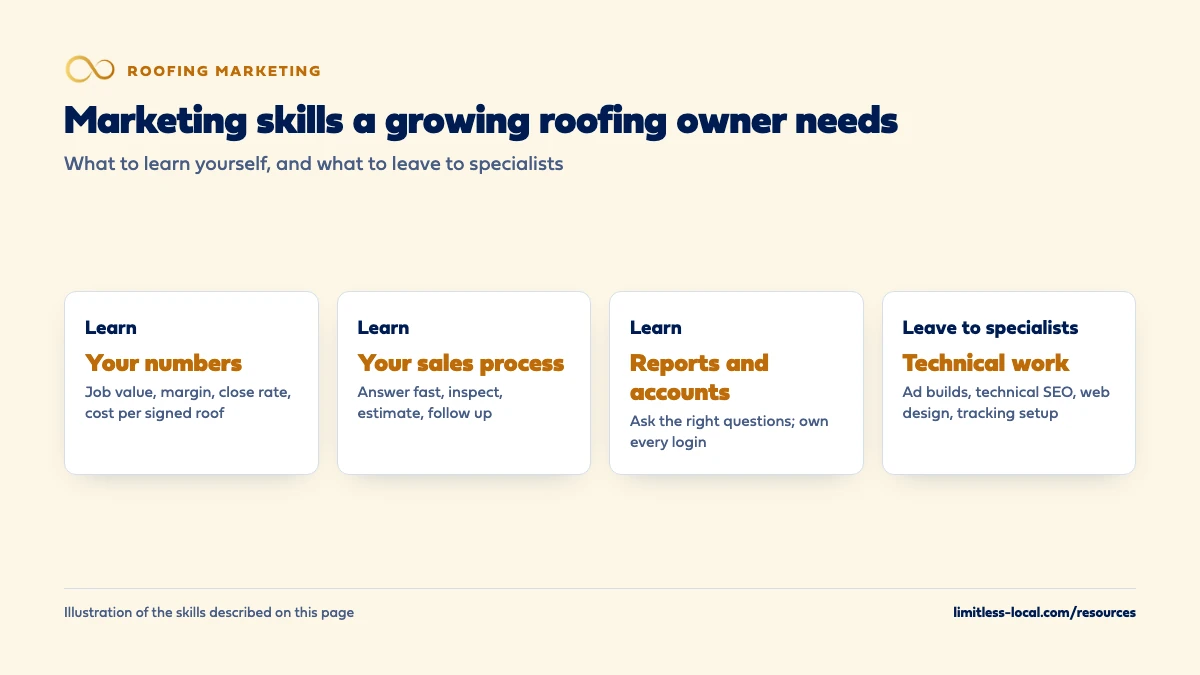
A growing roofing owner doesn’t need to build ads or websites. You need to know your numbers (what a signed roof is worth and what you can afford to pay for one), know who you want as customers and why they should pick you, run a sales process that turns leads into signed roofs, read a marketing report well enough to ask sharp questions, keep ownership of your accounts, and manage whoever does the marketing work. As the company grows, the job shifts from doing marketing to directing it.
Those skills are what make outside help work. Our Limitless Engine packages include monthly reports with a cost-per-lead breakdown, call tracking with recordings and a real-time dashboard, so you can see what’s working without learning to run the platforms yourself. You’ll know what we’re doing, why, and what it produced; if something isn’t working, we’ll tell you and fix it. See how it fits a roofing company on our roofing marketing page, read the roofing marketing guide, or browse the roofing marketing questions library.
Does a roofing owner need to be good at marketing?
You need to be good at judging marketing, not at doing it. The roofers who grow steadily usually aren’t the ones who learned to build Google Ads campaigns at midnight. They’re the ones who know what a signed roof is worth, can tell a useful report from a useless one, and hold whoever does the work to clear numbers.
Think of it like your crews. You don’t have to be the fastest installer on the roof to run a roofing company, but you’d better know a good install from a bad one, what a job should cost, and when something’s off. Marketing is the same. You’re the buyer and the boss of it.
The skills below are the ones that pay off whether you do some marketing yourself, hire someone in-house or work with an agency. Skip them, and you’ll depend on someone else’s word for whether your money is working. Learn them, and you can spot waste, back what works and make faster calls when storms hit or crews open up.
Skill 1: Do I know my numbers?
This is the skill everything else rests on. You should be able to answer these without looking anything up:
- Average job value for a replacement and for a repair.
- Gross margin on each.
- Close rate: out of every ten inspections, how many sign.
- Cost per signed roof from each paid source, not just cost per lead.
- Capacity: how many roofs your crews can deliver in a busy week and a slow one.
With those, you can work out the most you can afford to pay for a signed roof, and from there, for a lead. That one number lets you judge any channel, any agency pitch and any lead seller in seconds.
The SBA’s guide to marketing and sales puts it simply: compare your marketing and sales costs to the revenue they generate, so you know you’re getting a positive return. What cost per booked job a roofing company should aim for walks through the math in more detail.
Skill 2: Do I know who I want as customers, and why they'd pick me?
Every piece of marketing, from an ad headline to a town page, depends on two answers: who you want to sell to, and why they should choose you over the next roofer. Target market and competitive advantage are core parts of any marketing plan.
For a roofer, that means getting specific:
- Which jobs? Full replacements, repairs, storm work, metal, tile, commercial, gutters.
- Which towns and neighborhoods? Where homes are the right age and value, and your crews can get to easily.
- Which homeowners? Retirees replacing the roof that came with the house think differently from young families after a hailstorm.
- Why you? Warranty, workmanship, speed, how you handle insurance paperwork, being local for years, a clean job site. Pick what’s true and what homeowners actually care about.
You don’t need to write the ads. But if you can’t explain in two sentences who you want and why they should pick you, nobody writing them can either. Write it down and hand it to whoever does your marketing.
Skill 3: Can I turn leads into signed roofs?
For most roofing companies, the biggest marketing lever isn’t marketing. It’s what happens after the phone rings. Two roofers with the same leads can end up with very different results because one answers fast, inspects the next day and follows up on every estimate, and the other doesn’t.
The sales skills worth building yourself, then teaching:
- Speed. Leads answered or called back within minutes.
- The inspection. Showing the homeowner what you found, with photos, in plain words.
- The estimate. Clear options, delivered quickly, easy to say yes to.
- Follow-up. A set schedule for unsigned estimates, and someone who owns it.
- Knowing why you lost. Price, timing, trust, or a competitor who got there first.
Improving close rate does the same thing as cutting your cost per lead, often more cheaply. If you’re spending more on ads to make up for leads that never sign, start here. Whether it’s your marketing or your sales process when roofing leads don’t close helps you tell which one is broken.
Skill 4: Can I read a marketing report and ask the right questions?
You don’t need to understand every chart. You need to know which numbers matter and what to ask when they move. A good monthly review covers:
- How many leads came in, by source?
- How many became inspections, and how many signed?
- What did each signed roof cost, by source?
- What changed this month, and why?
- What’s the plan for next month?
A little platform knowledge goes a long way. For example, Google’s search terms report shows the actual searches that triggered your ads. Ten minutes scanning it tells you whether your money went to “roof replacement” in your towns, or to “roofing jobs” and “how to fix a roof myself.”
Watch out for reports full of impressions, clicks and rankings with no signed jobs in sight. Those numbers aren’t useless, but if a report can’t connect them to roofs, ask why. The question “how many signed roofs did this produce?” should always have an answer.
Curious what your marketing is actually booking?
Get a free visibility audit — no obligation, no sales pitch.
Skill 5: Do I keep control of my accounts and data?
This one is less a skill than a habit, but it’s the one owners regret skipping. Your company, not a staff member or an agency, should own:
- Your Google Business Profile.
- Your Google Ads and Local Services Ads accounts.
- Your website, domain and hosting.
- Google Search Console and analytics.
- Your call tracking numbers and your CRM.
The platforms make this straightforward. Google’s page on managing profile owners and managers explains that owners have full control, including adding or removing users, while managers can edit info, respond to reviews and manage posts but can’t add or remove users or remove the profile. Keep the primary owner role yourself and give helpers manager access. Do the same with admin access everywhere else.
Know where the logins live and who has access. If a marketer quits or you change agencies, you keep your reviews, your history and your phone numbers.
Skill 6: Can I manage the people doing my marketing?
As you grow, you’ll spend more time directing marketing than doing it. That takes a few management skills most roofers already have from running crews:
- Clear goals. “More signed replacements in these five towns at under this cost per roof” beats “get me more leads.”
- Fast answers. Approve ads, pages and offers quickly. Slow approvals stall campaigns.
- Useful feedback. Tell your marketer which leads were junk, which jobs were great, and when crews have room.
- Regular check-ins. A set monthly review, not a phone call only when something goes wrong.
- Fair judgment. Give channels time to work, but don’t accept excuses forever.
These apply to an employee, a freelancer or an agency. How a roofer can manage a new marketing agency better covers the first few months of working with outside help.
Skill 7: Can I get my team to do their part?
Some of the best roofing marketing comes from your crews and office, not from a marketer. That makes leadership a marketing skill:
- Review asks at every final walk-through, by the crew lead or salesperson.
- Job photos before, during and after, uploaded the same day.
- A clean job site and courteous crews, because neighbors are watching and so is the homeowner who’ll write the review.
- Accurate lead records in the CRM, so you know what’s signing.
None of this needs marketing training. It needs you to explain why it matters, make it part of the job checklist and check that it happens. Everyday operations, like what your staff wear or how you handle a problem after the job, shape how customers see your company and whether they stay loyal or tell their friends to stay away.

Which marketing skills can a roofing owner skip?
You can leave these to specialists without losing control:
- Building and tuning Google Ads campaigns: bids, match types, campaign structure.
- Technical SEO: site speed, structured data, indexing.
- Web design and development.
- Graphic design and video editing.
- Setting up tracking: call tracking numbers, conversion tags, CRM integrations.
It’s fine to learn the basics of any of these out of interest, and some owners enjoy it. But your time is worth more selling, running crews and making decisions than learning to tune a bid strategy. The test: if a mistake would be hard for you to spot and costly to leave alone, it’s a job for someone who does it every day.
If you’re deciding which tasks to keep and which to hand off, what a hybrid roofing marketing setup looks like shows how the in-house and outside work fit together.
How do the skills change as the roofing company grows?
The skills stay the same, but how you use them shifts:
- One or two crews. You do a lot yourself: answer calls, ask for reviews, keep the Google profile current, maybe write a few pages. Knowing your numbers and selling well matter most. Outside help handles the technical work.
- Several crews and an office. You stop doing most tasks and start assigning them. Your office owns lead handling and records; crew leads own photos and reviews; outside help or a coordinator runs the channels. Reading reports and managing people become your main marketing skills.
- Multiple locations or divisions. You set direction and budget and judge results by location and job type. A marketing hire or manager may run the day-to-day. Your skill is asking the right questions and making the big calls: where to grow, what to cut, what to spend.
At every stage, the owner keeps three things: the numbers, the decisions and the accounts. When a roofing company is ready for a full-time marketing hire covers the jump to having someone in-house.
How can a busy roofer learn these skills?
In small doses, alongside the work:
- Make your monthly review a lesson. Ask whoever does your marketing to explain one number or one report each month until it clicks.
- Use free mentoring. The SBA’s resource partners include Small Business Development Centers, which advise existing businesses on areas including marketing and sales, and SCORE mentors, who offer advice at no cost.
- Take a free course if you want platform basics. Google’s Skillshop offers free, self-paced Google Ads training.
- Talk to other owners. Roofers a few years ahead of you, in markets you don’t compete in, are often the most useful teachers.
- Look at your own data. Spend an hour a month going through your leads and signed jobs by source. Patterns jump out fast.
You don’t need a marketing degree. Most of these skills come down to curiosity, a few numbers and asking “how many roofs did that sign?” until it’s a habit.
Want to see where your company stands?
A free visibility audit shows where you show up on Google, Maps and AI answers, and what it's costing you in calls.
What's different about marketing skills for roofing owners
Big tickets make the math matter more. One signed replacement can be worth more than a month of a smaller trade’s service calls. Knowing exactly what you can afford per signed roof lets you outbid competitors who only know their cost per click.
Storms test your decision-making. When hail hits, the owner who knows their capacity, close rate and costs can decide in an hour how much to spend and where. The owner who doesn’t either misses the window or overspends.
Trust sells roofs. Homeowners are wary of storm chasers and big checks. Knowing why homeowners pick you, and making sure crews, reviews and photos back it up, is a marketing skill that’s especially valuable in roofing.
A worked example: the most you can pay for a lead
These numbers are made up to show the math, not a benchmark for your market. Say your average replacement is $12,000 and your gross margin is 30%, so each signed roof brings in $3,600 in gross profit.
You decide you’re willing to spend up to a third of that on marketing, or $1,200 per signed roof. If 1 in 5 of your leads ends up signing, the most you can pay per lead is $1,200 divided by 5, or $240.
Now, when a lead seller offers leads at a set price, or an agency report shows cost per lead, you know in seconds whether it works for your business. And if you raise your close rate so that 1 in 4 leads signs, your ceiling rises to $300 per lead without spending a dollar more on marketing.
Frequently asked questions
Should a roofing owner learn to run Google Ads?
Only the basics, enough to read a search terms report and ask good questions. Building and tuning campaigns well takes daily attention, and your time is usually worth more on sales and crews.
Do I need a marketing plan written down?
Yes, even a short one: who you want, why they pick you, which channels, what budget and how you’ll measure it. A page is plenty to start.
Is it worth taking a marketing course?
It can be, if it’s practical and short. Many owners learn more from reviewing their own numbers monthly with whoever does their marketing.
Can I leave all the marketing to my office manager?
You can hand off tasks, but keep the decisions, the numbers and the account ownership. Those stay with the owner.
What if I hate marketing?
You don’t have to love it. Learn your numbers, keep your accounts, and hire people you can hold to clear results. That’s enough to stay in control.
Key takeaways
- You need to judge marketing well, not do every task yourself.
- Know what a signed roof is worth and the most you can pay for one.
- Selling and follow-up are often the biggest marketing levers.
- Read reports for signed roofs, and keep ownership of every account.
- As you grow, shift from doing marketing to directing it.
Not sure what's working right now?
Start with a free visibility audit: rankings, Google profile, reviews and tracking, checked against your service area.
More in this section
- What marketing should a roofing company add first to grow?
- How does a roofer run a profitable business with marketing?
- Why is marketing important for roofing companies?
- Do I need one marketer or several specialists for my roofing company?
- Which marketing tasks should a roofer keep in-house?
Sources
- Marketing and sales — U.S. Small Business Administration
- About the search terms report — Google Ads Help
- Manage your Business Profile owners & managers — Google Business Profile Help
- Resource Partners — U.S. Small Business Administration
- Google Ads training on Skillshop — Google Ads Help