
Why do roofing businesses fail, and what can marketing fix?

- What actually sinks roofing companies, and which of those problems can better marketing solve?
- How many roofing businesses actually fail?
- What usually sinks a roofing company?
- Which of those problems can marketing fix?
- What can't marketing fix?
- How does marketing smooth out feast-or-famine lead flow?
- Why is relying on one lead source so risky for a roofer?
- How many jobs does a roofer lose between the call and the contract?
- Why does spending without tracking put a roofing company at risk?
- How much does a roofer's online reputation matter to survival?
- What should a struggling roofer fix first?
- When is more marketing the wrong move?
- What's different about failure risk for roofing companies
- A worked example: why more leads can't save a thin price
- Frequently asked questions
- Key takeaways
- More in this section
- Sources
The short version
- Most roofing companies that close run out of cash or margin, not roofs.
- Marketing fixes demand: uneven leads, one-source risk, lost leads and blind spending.
- Marketing can't fix pricing, cash flow, workmanship or crews.
- More leads on a broken operation make the problems bigger, not smaller.
For roofing owners who want to know which risks marketing can take off the table, and which ones no amount of leads will fix.
Get a free visibility audit · Book a growth call
What actually sinks roofing companies, and which of those problems can better marketing solve?
Roofing businesses usually fail from money and operations problems more than from a shortage of roofs: jobs priced too thin, cash tied up between buying materials and getting paid, crews that can’t be staffed or kept busy, and a year that swings with storms and seasons. Marketing can fix the demand side, which means uneven lead flow, depending on one lead source, leads lost to slow answers and no follow-up, and spending without knowing what signs roofs. It can’t fix pricing, cash flow, workmanship or crew problems, and more leads make those worse, so fix them alongside the marketing.
We only work on the parts marketing can fix, and we say so up front. Our work starts with the foundation (tracking, follow-up and a clean online presence), then turns on lead flow from local SEO and ads around the towns and jobs you want, then improves month by month based on calls, leads and revenue. We don’t guarantee rankings, lead counts or revenue, because nobody honestly can. What we promise is that you’ll know what we’re doing, why, and what it produced. See what’s in our marketing packages, how we work with roofing companies, the roofing marketing guide, or more roofing marketing questions.
How many roofing businesses actually fail?
There isn’t a clean count for roofers alone, but construction as a whole gives a sense of it. The U.S. Bureau of Labor Statistics tracks establishment age and survival, and its construction survival table shows that of the construction establishments that opened in the year ending March 2016, 82.9% were still operating a year later, 58.6% after five years and 41.7% by March 2026.
Those figures cover every kind of construction business, from roofers to excavators, and they count locations still operating, not the reasons the others closed. Some sold, some merged, some owners retired. Still, the pattern is plain enough: a lot of contracting businesses don’t make it to year ten, and the first few years are the riskiest.
What usually sinks a roofing company?
When you hear the story behind a roofing company that closed, it’s rarely “we couldn’t find any roofs.” It’s usually some mix of these:
- Thin pricing. Jobs bid low to win them, with no room for a surprise layer of decking, a rain delay or a callback.
- Cash flow gaps. Materials and payroll go out weeks before the final check comes in. A few slow-paying jobs at once can empty the account.
- Boom and bust. A big storm year brings more work than the crews can handle, then the next year is quiet and the overhead is still there.
- Crew and quality problems. Not enough reliable installers, or callbacks and warranty work that eat the profit from new jobs.
- One source of work. Everything comes from door knocking, one builder or one storm market, and it dries up.
- Leaks in the sales process. Calls missed, estimates never followed up, leads that went to whoever called back first.
- Spending blind. Money going to ads, lead services and sponsorships with no idea which of them signs roofs.
Look down that list and you’ll see two kinds of problem: the ones about running the business, and the ones about getting and keeping customers. Marketing only touches the second kind.
Which of those problems can marketing fix?
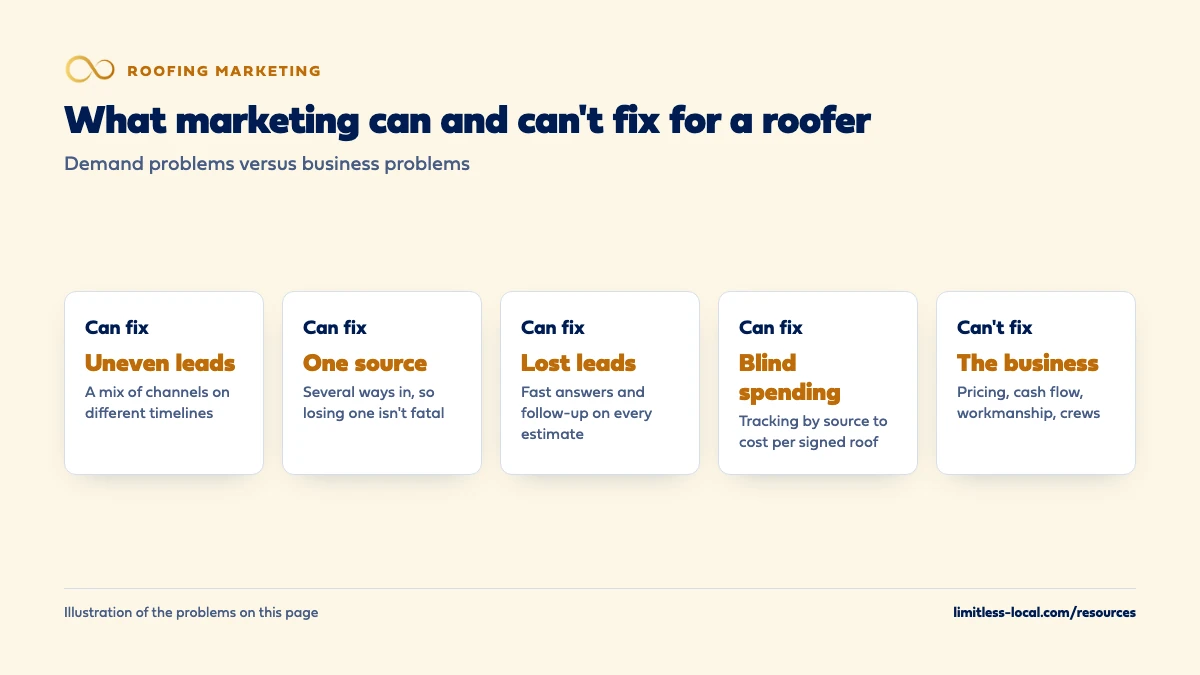
Good marketing works on demand, the flow of homeowners who need a roof and choose you. That covers four of the problems above:
- Uneven lead flow. A mix of channels that keeps calls coming in slow months, not just after storms.
- Depending on one source. Several ways in, so losing one doesn’t empty the schedule.
- Leads lost between the call and the contract. Fast answers, booked inspections and follow-up on every open estimate.
- Spending blind. Tracking that shows which marketing signed which roof, so money moves to what works.
Each of those gets its own section below, because each one is a separate fix. If you only have the budget or time for one, start with the leaks between the call and the contract. It’s the cheapest, because you’re already paying for those leads.
What can't marketing fix?
Pricing, cash flow, workmanship and crews. More leads don’t help a company that loses money on each roof; they help it lose money faster. The same goes for a company with more signed jobs than installers, or one whose callbacks are already eating the schedule.
Before you spend more on marketing, check three things:
- Do you make money on a typical job after materials, labor, warranty reserve and your share of overhead?
- Can you cover a month of payroll and materials if two or three jobs pay late?
- Can your crews install more roofs at the quality you want, without you on every roof?
If any answer is no, fix that alongside your marketing, or first. Marketing should grow a business that works, not prop up one that doesn’t. How a roofer runs a profitable business with marketing goes through the job-level numbers to check.
How does marketing smooth out feast-or-famine lead flow?
Storms and seasons make roofing lumpy. The fix is a mix of channels that do different jobs on different timelines:
- Ads can generate leads within days of launch, so they’re the lever you turn up in a slow month and down when crews are booked out.
- SEO and your Google profile typically take 3 to 6 months to show meaningful organic growth, but once they’re working they keep calls coming without paying for every click.
- Reviews and past customers bring repair calls, referrals and repeat work in every season.
The worst move in a slow stretch is usually cutting all marketing at once. An SBA article on getting the most from your marketing budget describes the chicken-and-egg trap: sales drop, so you cut marketing, so sales drop further. Trim the channels that aren’t signing roofs and keep the ones that are. What to fix first when the roofing phone stops ringing covers what to check before you cut anything.
Curious what your marketing is actually booking?
Get a free visibility audit — no obligation, no sales pitch.
Why is relying on one lead source so risky for a roofer?
Because you don’t control it. Door knocking depends on storms and on a team willing to knock. One builder can switch roofers. A lead service can raise prices or sell the same lead to three other companies. A single storm market dries up once the claims are done.
Spreading out doesn’t mean doing everything at once. A practical order for most roofers:
- Keep the source that’s working now.
- Build the free ones underneath it: a complete Google profile, steady reviews and regular contact with past customers.
- Add one paid channel you can track, usually Google Ads or Local Services Ads.
- Add SEO for the towns and jobs you want most, knowing it takes months.
When a roofer should stop relying on door knocking and referrals covers the move away from one source in more detail.
How many jobs does a roofer lose between the call and the contract?
More than most owners think, and it’s the easiest place to find money. The leaks look like this:
- Missed calls while everyone’s on a roof, with no callback for hours.
- Slow callbacks on web forms, by which time the homeowner has booked someone else.
- Inspections that don’t turn into estimates for days.
- Estimates that never get a follow-up after they’re sent.
Every one of those is a lead you already paid for, in ad spend, a door knock or years of reputation. Fixing them is often worth more than any new channel. Name one person who answers every call during business hours, call back missed calls and forms within minutes, and put every open estimate on a follow-up schedule. Following up on unsigned roofing estimates has the schedule and scripts.
Why does spending without tracking put a roofing company at risk?
Because you can’t cut what’s wasting money if you can’t see it. A roofer spending a few thousand a month across ads, lead services and sponsorships, with no idea which signed roofs, will keep paying for the ones that don’t work and may cut the one that does.
Tracking doesn’t have to start complicated. Asking every new customer how they heard about you is a fine start. From there, add:
- Call tracking numbers for each channel, so calls are tagged by source.
- A source on every lead in your CRM or job software.
- A stage for every lead: inspected, estimated, signed or lost, with the job value.
Then judge every channel by what each signed roof cost. Tracking which roofing leads turn into signed jobs shows the setup.
How much does a roofer's online reputation matter to survival?
A lot, because homeowners check you before they call and before they sign. A roofer with a strong, recent review history wins more of the same leads than one with a thin or angry profile, which lowers what every signed roof costs.
Reputation also decides where you show up. Google’s help page on improving your local ranking says local results are mainly based on relevance, distance and popularity, and that businesses with complete and accurate information are more likely to show up. Reviews, replies, photos and consistent details across the web all feed that. A roofing client got 3x map pack visibility in its target towns; better presence and consistent info across the web increased inbound calls.
Treat reviews as part of every job, not a side project: ask at the final walkthrough, reply to every review calmly and keep your business details the same everywhere they’re listed.
What should a struggling roofer fix first?
Work from cheapest to most expensive, and from the money problems to the marketing ones:
- Check pricing and cash. Make sure a typical job makes money and you can cover a slow month.
- Answer the phone. Every call answered or returned within minutes.
- Work your open estimates. Follow up on every unsigned estimate from the last few months.
- Use what’s free. Ask past customers for reviews and referrals, and tighten your Google profile.
- Cut what doesn’t sign roofs. Pause spending you can’t tie to a signed job.
- Then add or grow one tracked channel at a budget your crews can deliver on.
None of steps two to five needs a bigger budget. What a roofer can do this month to get more leads without waste lays out the month-one version.
When is more marketing the wrong move?
Hold off on spending more when:
- Jobs aren’t profitable at the prices you’re getting.
- Crews are already booked out and homeowners are waiting weeks.
- Callbacks and warranty work are rising.
- Nobody can answer the phone reliably.
- You can’t tell which of your current marketing is signing roofs.
In each case, more leads either cost you money, go cold or hide the real problem. Fix the bottleneck, then turn the marketing up.
Not sure which of these is costing you jobs?
A free visibility audit checks the Google profile, reviews, site and tracking, and shows what to fix first.
What's different about failure risk for roofing companies
Storm years distort everything. A hail season can double a company’s work for a year and convince the owner to add trucks, crews and overhead that the next quiet year can’t carry. Plan overhead for a normal year, not a storm year.
Big material bills come first. A roof replacement means paying for a full load of materials before the job is done, so a few slow-paying jobs hit harder than in a service trade.
Warranties last for years. Workmanship problems come back as callbacks long after the job was paid for, which is why quality is a survival issue, not just a reputation one.
A worked example: why more leads can't save a thin price
These numbers are made up to show the math, not a benchmark for your market. Say a typical roof replacement brings in $12,000, and your marketing costs about $900 for each signed roof.
At a 25% gross margin, each roof leaves $3,000 after materials and labor. Take out the $900 of marketing and $2,100 is left toward overhead and profit. More leads at that price make the business stronger.
At a 10% gross margin, each roof leaves $1,200. Take out the same $900 and only $300 is left toward overhead and profit. Doubling your leads at that price doubles the work and the risk without doing much for the bank account. Fix the price first, then grow the leads.
Frequently asked questions
Is a lack of leads the main reason roofing companies close?
Rarely on its own. Thin pricing, cash flow and crew problems sink more roofers, and a lack of leads tends to be the last straw on a business that was already stretched.
Should I cut marketing when cash is tight?
Cut what isn’t signing roofs, not everything. Stopping all marketing in a slow stretch usually makes the next month slower.
Can a marketing agency fix a roofing company's cash flow?
No. An agency can bring and track demand. Pricing, collections and overhead are owner decisions, often worked through with an accountant.
How long does it take marketing to steady a roofer's lead flow?
Ads can bring leads within days of launch. SEO typically takes 3 to 6 months to show meaningful organic growth, so start both early rather than waiting for a slow season.
Is storm work bad for a roofing business?
No, it’s a big part of the trade. The risk is building overhead around a storm year and having nothing underneath it when storms are quiet.
What's the cheapest marketing fix for a struggling roofer?
Answering every call and following up on every open estimate. Those leads are already paid for.
Key takeaways
- Roofers usually fail from pricing, cash flow and crew problems more than a lack of roofs.
- Marketing fixes demand: uneven leads, one-source risk, leads lost after the call, and blind spending.
- More leads on thin pricing or full crews make the problems bigger.
- Start with the leaks between the call and the contract; they cost nothing new.
- Track every channel to cost per signed roof, and cut what doesn’t sign.
Want a second set of eyes on your setup?
We'll look at how you show up locally and where calls are leaking, then send you a plain-English breakdown.
More in this section
- How does a roofer run a profitable business with marketing?
- Why is marketing important for roofing companies?
- What marketing should a roofing company add first to grow?
- What marketing skills does a growing roofing owner need?
- What happens to roofing marketing if my in-house marketer quits?
Sources
- Table 7. Survival of private sector establishments by opening year: Construction — U.S. Bureau of Labor Statistics
- Establishment Age and Survival Data — U.S. Bureau of Labor Statistics
- How to Get the Most From Your Marketing Budget — U.S. Small Business Administration
- Tips to improve your local ranking on Google — Google Business Profile Help