
Do star ratings or review count matter more to plumbing customers?

- When homeowners compare plumbers on Google, does the star rating or the number of reviews win?
- What's the difference between a star rating and a review count?
- Which one do homeowners look at first?
- Does a high rating with few reviews beat a lower rating with many?
- Is a perfect 5.0 rating a good thing for a plumber?
- How many reviews before the count stops mattering so much?
- Do rating and count affect where I show up on Google?
- Does how recent my reviews are matter as much as the count?
- What do the words in a review do that stars can't?
- What should I fix first: a low rating or a low count?
- How do I raise both without breaking Google's rules?
- What's different about reviews for plumbers
- A worked example: why review count steadies your rating
- Frequently asked questions
- Key takeaways
- More in this section
- Sources
The short version
- Review count decides whether homeowners believe your rating.
- Past a believable count, the rating and the review words take over.
- A perfect 5.0 isn't the goal; a high rating with real, recent reviews is.
- Your yardstick is the plumbers listed next to you in Maps.
- A review ask on every job builds both at once.
For plumbing owners losing calls to a competitor with more reviews, or with a higher rating, and trying to decide which one to work on first.
Get a free visibility audit · Book a growth call
When homeowners compare plumbers on Google, does the star rating or the number of reviews win?
Both matter, but they do different jobs: the review count tells a homeowner whether to believe your rating, and once you have enough recent reviews to look established next to the plumbers around you, the rating and what the reviews say take over. A 4.9 from a handful of reviews can look less safe than a 4.6 from a few hundred, and a perfect 5.0 with no criticism can look less believable than a rating in the high fours. The practical priority for a plumbing company is the same either way: a steady flow of honest reviews from every job, which builds the count and keeps the rating where your work really is.
Reviews are built into every one of our local SEO packages. Essentials, at $3,500 a month, includes review response and basic review generation alongside Google Business Profile management; Growth, at $4,500 a month, adds advanced review generation; and Scale adds automated review requests. Our plumbing marketing page shows how we work with plumbing companies, and the plumbing marketing questions library covers reviews, Maps and the rest one question at a time.
What's the difference between a star rating and a review count?
They’re two numbers shown side by side, and homeowners read them together. Google’s page on review scores says your score is the average of all ratings published on Google for your business, on a scale from 1 to 5 stars, and that it’s shown with the total number of reviews. It can take up to 2 weeks for a new review to change the score.
- The star rating answers “are they good?”
- The review count answers “how sure can I be?”
A rating means little on its own. A 5.0 from three reviews could be the owner’s family. A 4.6 from three hundred reviews is a track record. That’s why the question isn’t really which one matters more. It’s which one is holding you back right now.
Which one do homeowners look at first?
The stars catch the eye, the count decides whether to trust them, and then the homeowner reads a few recent reviews. How long each step takes depends on the job:
- Emergency calls. Someone with water on the floor scans the map results for a few seconds. A solid rating with a real number of reviews next to it is often enough to call. They’re not reading ten reviews at 11 p.m.
- Planned jobs. Someone pricing a water heater replacement or a repipe has time to read. They’ll open your profile and a competitor’s, and what the reviews say about price, cleanliness, timing and the tech can matter more than a tenth of a star.
So for emergency work, the rating and count do most of the selling. For bigger planned work, the content of the reviews carries more weight. Reviews generally matter more on bigger purchases, because the homeowner has more to lose by picking wrong.
Does a high rating with few reviews beat a lower rating with many?
Often not, when the gap in count is big. A homeowner comparing two plumbers sees:
- Plumber A: 4.9 stars, a dozen reviews.
- Plumber B: 4.6 stars, a few hundred reviews.
Many will call B. The few reviews behind A’s 4.9 could be friends, a lucky streak or a new company that hasn’t been tested. B’s rating has been through hundreds of real jobs, including the ones that went wrong.
The picture changes once A’s count is in the same range as B’s. Then the higher rating starts to win, and so do reviews that mention the job the homeowner needs.
If you’re Plumber A, the fix isn’t a better rating; it’s more reviews. If you’re Plumber B, the fix is protecting the rating and keeping new reviews coming, so the count keeps looking current. How many Google reviews a plumbing company needs covers how to set your own target.
Is a perfect 5.0 rating a good thing for a plumber?
Not as much as you’d think. Research from Northwestern University’s Medill Spiegel Research Center, first published in 2017 and based on online shoppers buying retail products, not plumbing customers, found that purchase likelihood typically peaked at ratings between 4.0 and 4.7 and began to decrease as ratings approached 5.0. Google’s own tips to get more reviews make a similar point: a mix of positive and negative feedback often feels more trustworthy.
For a plumbing company, that means:
- Don’t panic over a critical review. A few honest complaints, answered well, make the rest of your reviews more believable.
- Don’t chase perfection. Asking only the customers you know are thrilled skews your reviews and leaves you exposed when a real complaint lands.
- Reply to the critical ones. A calm, specific reply shows the next homeowner how you handle a problem, which is often what they’re really checking.
Curious what your marketing is actually booking?
Get a free visibility audit — no obligation, no sales pitch.
How many reviews before the count stops mattering so much?
There’s no fixed number for plumbers, and Google doesn’t publish one for Maps. For retail products, the extra benefit of each new review drops off quickly after the first five. A plumber, though, is competing against other plumbers on the same map, not against an empty page.
The useful yardstick is local. Search your main jobs, like “emergency plumber” or “water heater replacement”, from a few spots in your service area, and note the review counts of the plumbers showing up next to you. Once your count is in their range, extra reviews mostly keep you current rather than making you more believable, and the rating and review content matter more.
If you’re far below them, count is your problem, and it’s the one to work on first.
Do rating and count affect where I show up on Google?
Yes, on both Maps and Local Services Ads. Google’s page on improving your local ranking says local results are mainly based on relevance, distance and popularity, and that more reviews and positive ratings can help your business’s local ranking.
Local Services Ads are more direct. Google’s page on reviews and ratings on Local Services Ads says star ratings and number of reviews affect how your business is ranked there, and that providers with higher ratings and more reviews stand out and typically book more jobs.
So the two work twice: once to get you seen, and again when the homeowner compares you with the plumbers listed beside you.
Does how recent my reviews are matter as much as the count?
To homeowners, often yes. A 4.8 with two hundred reviews, the newest from last year, raises a question: is this company still in business, and is it still the same company? A 4.6 with a review from this week answers it.
Recent reviews also tell a homeowner about the team they’ll get now: the techs working today, your current prices and how fast you’re answering the phone this season. Old reviews about a tech who left years ago don’t help much.
That’s the case for a steady flow rather than occasional pushes. Whether steady review velocity helps plumbing rankings more than bursts covers the ranking side of that question.
What do the words in a review do that stars can't?
They answer the homeowner’s real question: will this plumber be good at my problem? A review that says “replaced our water heater the same day, cleaned up after, and the price matched the quote” sells a water heater job far better than a fifth star.
Reviews that do the most work for a plumbing company mention:
- The job: water heater, drain, sewer line, repipe, leak.
- Timing: “came out the same night”, “on time”.
- Price: “fair”, “matched the quote”, “explained the options”.
- The tech: by name, and how they treated the home.
You can’t write reviews for customers, but you can make specific ones more likely. When a tech asks, they can say, “If you mention it was the water heater, that helps other people with the same problem find us.”
What should I fix first: a low rating or a low count?
It depends on which side you’re losing on:
- Low count, good rating: work on volume. Ask on every job, make it a one-tap link or QR code, and follow up by text the same day.
- Good count, low rating: fix the cause before you push for volume. Read the last fifty reviews and look for the pattern: missed arrival windows, surprise prices, messy work. Then reply to the critical ones and keep asking everyone, so new reviews reflect the fixed problem. How to recover from bad reviews on your plumbing company covers that recovery.
- Both low: fix the cause first, then build volume. More reviews of the same problem only lock the low rating in.
Because your score is the average of every rating, a large count makes it steady. That works against you while you climb out of a low rating, and for you once you’re up there.
How do I raise both without breaking Google's rules?
Ask every customer, the same way, every time. You can ask customers to visit a Google link or scan a QR code to leave a review. Offering incentives, like free or discounted goods or services, in exchange for reviews is strictly prohibited.
A routine that builds both count and rating:
- The tech asks in person at the end of every job, when the problem is clearly fixed.
- The office sends the link by text the same day.
- One reminder a few days later if there’s no review yet.
- Reply to every review, good or bad, within a few days.
No discounts, no gift cards, no contests for reviews. How to get your plumbing techs to ask for reviews on every job covers getting the crew to make the ask a habit.
Not sure which of these is costing you jobs?
A free visibility audit checks the Google profile, reviews, site and tracking, and shows what to fix first.
What's different about reviews for plumbers
Emergencies are decided in seconds. Plumbing is emergency-heavy, and an emergency caller doesn’t read; they glance at stars and count and call. For that work, a believable count next to a strong rating is what wins the call.
Big tickets get read closely. Water heaters, repipes and sewer lines are large tickets, and homeowners compare reviews before they book. Reviews that name those jobs are worth more than generic praise.
You’re in people’s homes. Homeowners look for signs of trust: on time, clean, respectful, honest about price. Reviews that mention those things answer the worry that a star rating can’t.
Night calls make stories. A plumber who showed up at 2 a.m. and fixed a flood earns the kind of detailed review that sells future jobs. Ask for it the next day, while the relief is fresh.
A worked example: why review count steadies your rating
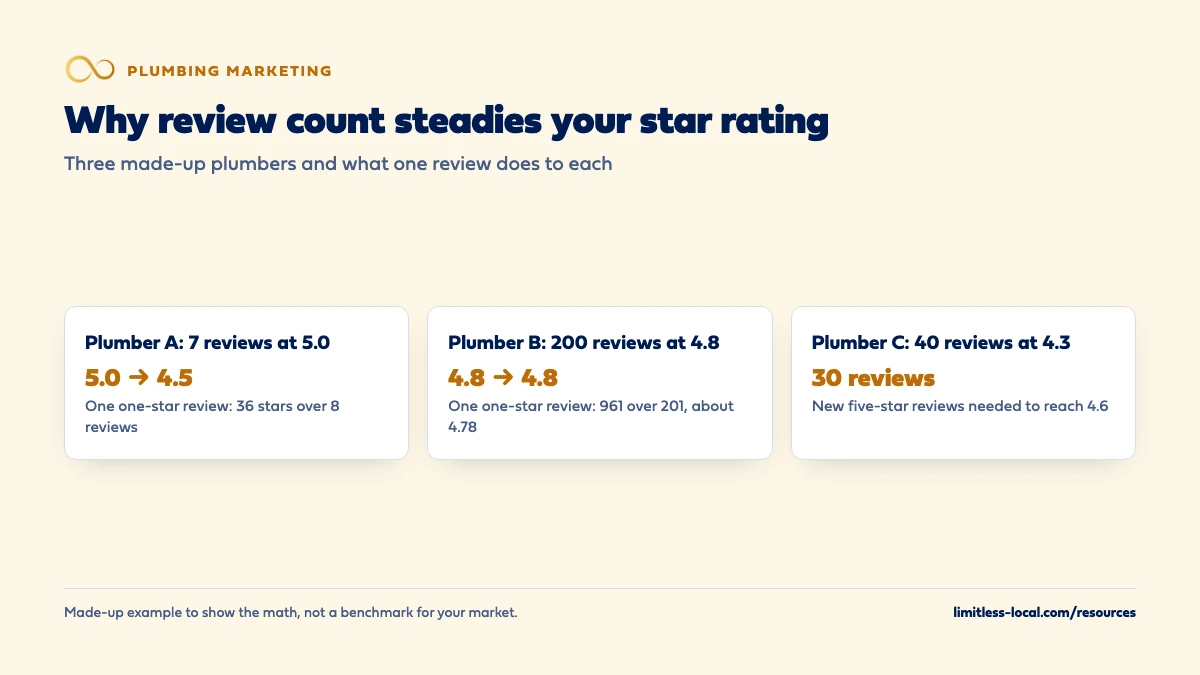
These numbers are made up to show the math, not a benchmark for your market. Google’s score is the average of every rating, so the count decides how far one review can move it.
- Plumber A has seven reviews, all five stars, for a 5.0. One one-star review arrives. The total is now 36 stars over eight reviews, which is 4.5.
- Plumber B has 200 reviews averaging 4.8, or 960 stars. The same one-star review makes it 961 over 201, which is about 4.78, still shown as 4.8.
- Plumber C has 40 reviews averaging 4.3, or 172 stars, and wants to reach 4.6. At 4.6, those 40 reviews would need 184 stars, so C is 12 stars short, and each new five-star review closes 0.4 of the gap. That takes 30 new five-star reviews.
A small count makes your rating fragile: one bad night can knock off half a star. A large count makes it steady, which protects you once you’re there and slows you down while you climb.
Frequently asked questions
Should I ask only my happiest customers for reviews?
No. Ask everyone, the same way. It keeps your reviews honest, makes them more believable to homeowners, and stops one complaint from looking like your whole story.
Do reviews on Yelp, Angi or Facebook count toward my Google rating?
No. Google’s score is the average of ratings published on Google. Your profile may sometimes show reviews from other sites, but they aren’t part of the Google star rating.
Can I get a bad review removed to raise my rating?
Only if it breaks Google’s content policies, such as fake or misleading content. An honest bad review stays, so answer it well and keep new reviews coming.
Why hasn't my rating changed after a new review?
A new review can take up to 2 weeks to update your score. If you already have a lot of reviews, one more may not change the rounded number at all.
Is a 4.5 rating good enough for a plumber?
It depends on the plumbers next to you in Maps. If they’re at 4.8 with similar counts, a 4.5 can cost you calls; if they’re lower, it may be one of the best in your area. Compare locally, then work on the cause of any complaints.
Do review replies change my star rating?
No, replies don’t change the score. They change how homeowners read the reviews, which matters most on the critical ones.
Key takeaways
- Review count decides whether homeowners trust your rating; the rating and review words matter more once your count looks established.
- A 4.9 from a handful of reviews can lose to a 4.6 from hundreds.
- A perfect 5.0 isn’t the goal; honest, recent reviews in the high fours are believable.
- Measure yourself against the plumbers next to you in Maps, not a national number.
- Ask every customer on every job, never with incentives, and reply to every review.
Want a second set of eyes on your setup?
We'll look at how you show up locally and where calls are leaking, then send you a plain-English breakdown.
More in this section
- Do coupons and discounts attract good plumbing customers?
- Can AI help my plumbing company get more 5-star reviews?
- How many Google reviews does a plumbing company need?
- How do I get my plumbing techs to ask for reviews on every job?
- How do I get more Google reviews for my plumbing company?
Sources
- Understand review scores for local places & businesses — Google Business Profile Help
- How Online Reviews Influence Sales — Medill Spiegel Research Center, Northwestern University
- Tips to get more reviews — Google Business Profile Help
- Tips to improve your local ranking on Google — Google Business Profile Help
- Reviews and Ratings on Local Services Ads — Google Local Services Help