
Does steady review velocity help plumbing rankings more than bursts?
- Is it better for a plumber to get Google reviews steadily or in big pushes?
- What is review velocity?
- What has Google said about reviews and local rankings?
- Do bursts of reviews hurt my plumbing rankings?
- Why does a steady flow of reviews still beat a burst?
- Which review pushes are fine, and which cross the line?
- How do I build a steady review routine?
- Can I give my plumbers a review target?
- How many new reviews a month should a plumbing company get?
- What if my reviews have stalled for months?
- Do my replies to reviews matter too?
- What's different about reviews for a plumbing company
- A worked example: a steady habit compared with a yearly push
- Frequently asked questions
- Key takeaways
- More in this section
- Sources
The short version
- Google hasn't named review velocity as a ranking factor or said bursts of real reviews are penalized.
- More reviews and positive ratings can help local rankings, according to Google.
- A steady flow keeps your latest reviews fresh and stays inside the rules more easily.
- Ask every customer after every job, and let your software send the link.
For plumbing owners deciding between a big review push and a slow, steady habit, and wondering which one Google rewards.
Get a free visibility audit · Book a growth call
Is it better for a plumber to get Google reviews steadily or in big pushes?
Google hasn’t said that review velocity is a ranking factor, and it hasn’t said that a burst of genuine reviews hurts you. What it does say is that local results are mainly based on relevance, distance and popularity, and that more reviews and positive ratings can help your local ranking. A steady flow still beats a burst for a plumbing company, because it keeps your newest reviews recent for the homeowners reading them, it’s far easier to keep inside Google’s review rules, and it adds up month after month. Build the review ask into every finished job instead of running a campaign once a year.
Reviews are one piece of how a plumbing company shows up on Maps, alongside the Google profile, the website and listings across the web. Every plumbing marketing package includes review responses and review generation: basic on Essentials, advanced on Growth, and automated review requests on Scale. More on how that fits our local SEO work is on that page, and the rest of the plumbing marketing questions library goes question by question.
What is review velocity?
Review velocity is how fast new reviews arrive: ten a month, two a week, fifty in one week and none for the rest of the year. It’s a term marketers use, not one Google uses in its help pages.
Two shops can have the same number of reviews and very different velocity. One got most of its reviews years ago and few since. The other gets a few every week. Owners ask about velocity because they want to know whether the pace matters, or only the total.
Google talks about how many reviews you have and your rating, not about pace. But pace matters a lot to the homeowner deciding who to call, and to whether your review count keeps climbing.
What has Google said about reviews and local rankings?
Google’s tips to improve your local ranking say local results are mainly based on relevance, distance and popularity. In the section on prominence, which Google describes as how well-known a business is, it says the factor is based partly on how many websites link to your business and how many reviews you have, and that more reviews and positive ratings can help your local ranking.
The same page says there’s no way to request or pay for a better local ranking, and that Google keeps the details of its search algorithm confidential.
That’s the official picture. Reviews help, count and rating both matter, and anyone who tells you the exact weighting, or a precise number of reviews per week that unlocks the map pack, is guessing. For a plumbing shop, that means the safe plan is the same as the useful one: get more genuine reviews, keep them coming and keep the rating strong. Getting into the map pack covers the other levers.
Do bursts of reviews hurt my plumbing rankings?
Google hasn’t published anything saying a burst of genuine reviews is penalized. If you have a huge week after a freeze and thirty happy customers leave reviews, that’s real work showing up.
What Google does remove is review activity that isn’t genuine. Its Maps content policy says fake engagement is not allowed and will be removed, including:
- Reviews that aren’t based on a real experience.
- Reviews paid for, directly or in kind.
- Content posted from multiple accounts by or at the request of one person.
So the risk isn’t the burst. It’s what usually causes one. A sudden pile of reviews often comes from a push that slipped into incentives, pressure or reviews from friends and family, and those are exactly what gets removed. Google also says reviews it removes for policy violations won’t be restored.
Two timing details worth knowing: Google’s page on missing or delayed reviews says policy checks can take a few days before a review appears, and Google’s help on review scores says an updated score can take up to 2 weeks after a new review.
Why does a steady flow of reviews still beat a burst?
Even with no ranking penalty either way, steady wins for a plumbing company:
- Homeowners read the dates. Someone with a leaking water heater scans your newest reviews. Last week reads very differently from eight months ago.
- Fresh reviews describe the shop you are now. Your current crew, your current prices, your current response times.
- It covers more jobs and towns. A steady habit picks up drain calls, water heaters, sewer jobs and repipes from across your service area, instead of whoever was on one email list. Whether reviews from other towns help you show up there is covered in ranking on Google Maps outside your office area.
- It’s easier to keep clean. A habit of asking every customer stays inside Google’s rules. One big push invites shortcuts.
- It compounds. A few reviews every week adds up to more over a year than most one-off pushes, and it never stops.
Bursts aren’t wrong. They’re just a poor plan on their own. If you do one, follow it with the steady habit so the count doesn’t stall again.
Curious what your marketing is actually booking?
Get a free visibility audit — no obligation, no sales pitch.
Which review pushes are fine, and which cross the line?
Fine:
- Sending your Google review link to recent customers who never got asked.
- A busy stretch, like a freeze, that brings in lots of real reviews.
- Adding the review link to invoices and thank-you emails.
Not fine, under Google’s policy:
- Offering payment, a discount, a gift card or a free service for a review.
- Asking only the customers you expect to be happy, or discouraging negative reviews.
- Pressuring customers to leave a review, or asking them to include specific things in it.
- Asking staff to bring in a set number of reviews, or reviews that name a particular staff member.
The law sets limits too. The FTC’s final rule on fake reviews, announced in 2024, prohibits buying or selling fake reviews, paying or rewarding people for reviews that express a particular sentiment, and certain undisclosed reviews from company insiders, among other things. Reviews from your employees, your managers or their relatives are a bad idea on both counts.
How do I build a steady review routine?
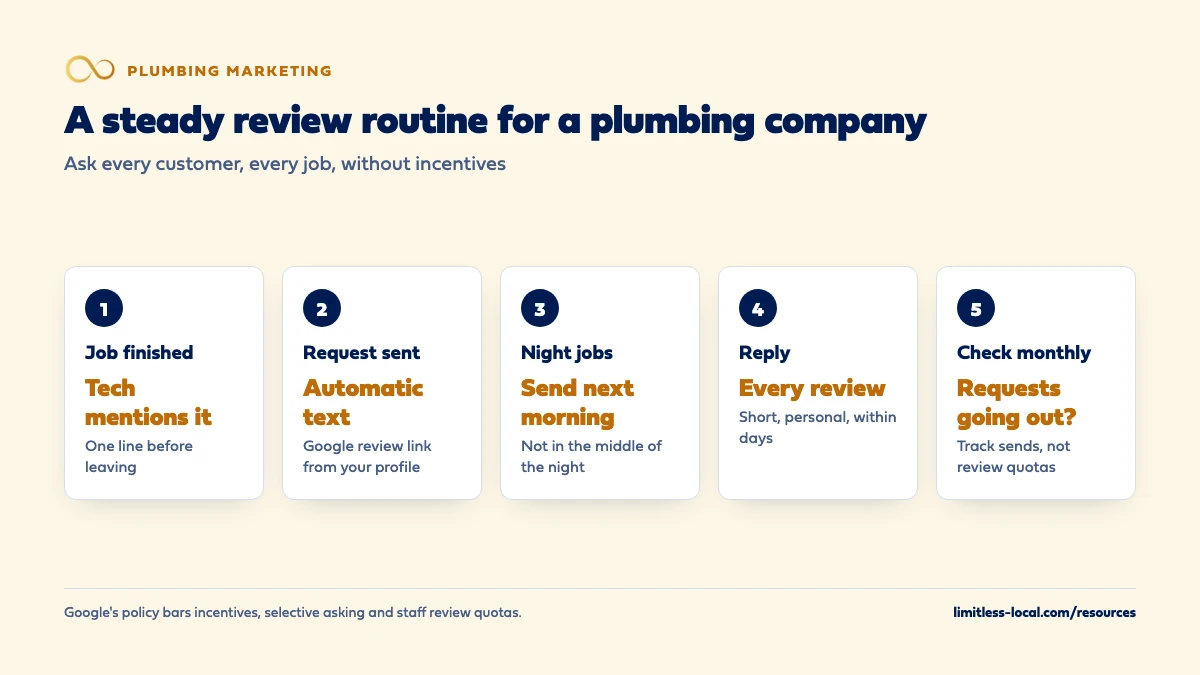
Make the ask automatic and tie it to the end of every job.
- Get your review link. Google lets you create a link or QR code to request reviews from your Business Profile, and suggests putting it on receipts, in thank-you emails and at the end of chats.
- Let your software send it. Most field software can text or email a review request automatically. Housecall Pro’s review requests, for example, go out by default when a job is marked finished, or when it’s paid if you change the setting.
- Have the tech mention it. One line at the end of the job, so the text doesn’t come out of nowhere. Getting plumbing techs to ask for reviews covers what to say.
- Reply to every review within a few days.
- Check the count monthly. If new reviews slow down, look at whether requests are still going out.
Sending it after every job, not just the ones that went well, keeps you inside the rules and gives you a fair picture of how you’re doing.
Can I give my plumbers a review target?
Not a target for reviews themselves. Google’s policy says businesses shouldn’t ask staff to bring in a certain number of reviews, or reviews with specific content, including content that names a staff member.
What you can track is the part your team controls: whether the review request went out on every job. That number should be close to every job, every week. If it isn’t, something in the process or the software settings slipped.
You can also share good reviews with the crew. Reading a customer’s thanks out loud at the Monday meeting does more for the habit than a quota ever would.
How many new reviews a month should a plumbing company get?
There’s no Google number to hit. The useful way to think about it is as a share of your jobs: if you ask every customer, your review count grows with your job count.
Look at the plumbers who show up above you on Maps in your main towns. How many reviews do they have, and how recent are their newest few? That tells you roughly how far you have to go and how fast you’d need to move to close the gap. How many Google reviews a plumbing company needs walks through that comparison.
The worked example below shows the math for a steady habit compared with a once-a-year push.
What if my reviews have stalled for months?
It happens, usually because the review text stopped going out after a software change, or the office got busy and stopped sending links by hand. To restart:
- Fix the automatic request first, so every new job gets one from now on.
- Ask your recent customers, from the last month or two, who never got a request. Keep the message simple and the same for everyone.
- Skip the incentive, however tempting. A discount for a review is against Google’s policy.
- Reply to the reviews that come in, including the older ones you never answered.
That will create a small burst, and that’s fine. The point is that it’s genuine, and that the steady habit picks up right behind it.
Do my replies to reviews matter too?
Google’s tips to get more reviews say replying shows customers their feedback matters, and recommend keeping replies short, personal and conversational rather than promotional. Google also says a mix of positive and negative feedback often feels more trustworthy.
For a plumbing company, replies do two jobs. They show the next homeowner that someone at the shop pays attention, and they give you a chance to answer a bad review calmly, which often matters more to readers than the review itself. Recovering from bad reviews covers the harder ones.
Want to see where your company stands?
A free visibility audit shows where you show up on Google, Maps and AI answers, and what it's costing you in calls.
What's different about reviews for a plumbing company
Emergency customers are grateful but busy. Someone whose basement just stopped flooding is relieved, but also mopping. A text with the link later that day often works better than asking on the spot.
Night calls need a different send time. If the on-call plumber finishes in the middle of the night, set the request to go out the next morning, not the minute the job closes.
Big jobs make the best reviews. A water heater swap, a sewer line or a repipe gives the customer more to say, and those details help the next homeowner looking for the same job. Make sure those jobs get the request too, even when the invoice is paid weeks later.
A worked example: a steady habit compared with a yearly push
These numbers are made up to show the math, not a benchmark. Say a plumbing shop finishes 60 jobs a month and sends a review request after every one. If about one in six customers leaves a review, that’s 10 new reviews a month, or 120 over a year, with the newest review rarely more than a few days old.
Now say the same shop skips the habit and sends one email to 600 past customers once a year. If about one in twelve responds, that’s 50 reviews in a week, then little or nothing for the rest of the year. By month eleven, the newest review on the profile is months old.
The push isn’t wasted, and it isn’t against the rules if it’s done cleanly. But the steady habit brings in more reviews over the year and keeps the profile looking current every week of it.
Frequently asked questions
Will Google flag my profile if I get a lot of reviews in one week?
Google hasn’t said genuine reviews are penalized for arriving together. It removes reviews that break its policy, such as paid, incentivized or fake ones, so make sure every review comes from a real customer asked the same way.
Do older reviews still count toward my ranking?
Google talks about how many reviews you have and your rating, and the review score is the average of all published ratings. Homeowners, though, pay closest attention to the newest ones.
Can I ask customers from years ago for a review?
You can ask any real customer for an honest review, without an incentive. Recent customers remember the job better, so start with the last month or two.
Why did some of my new reviews disappear?
Google checks reviews against its policies, which can delay them by a few days, and removes ones that break the rules. Reviews removed for policy violations aren’t restored.
Should I ask for reviews on other sites too?
It can help homeowners who use those sites, but Google reviews show on your profile in Search and Maps, so make Google the default link in your request.
Is it OK to ask the customer to mention the tech's name?
No. Google’s policy says businesses shouldn’t request specific content in reviews, including content that identifies a staff member. Let customers write what they want.
Key takeaways
- Google hasn’t named review velocity as a ranking factor, or said bursts of genuine reviews are penalized.
- Google says more reviews and positive ratings can help local rankings.
- A steady flow keeps your newest reviews recent and stays inside the rules more easily than a push.
- Never offer incentives, ask only happy customers or give staff review quotas.
- Automate a review request on every finished job and reply to every review.
- Track whether requests go out, not how many reviews each tech brings in.
Not sure what's working right now?
Start with a free visibility audit: rankings, Google profile, reviews and tracking, checked against your service area.
More in this section
- Do I have a plumbing lead volume, quality or closing problem?
- How does competition affect how fast plumbing SEO works?
- How do I get my plumbing techs to ask for reviews on every job?
- How do I keep plumbing calls coming in during slow months?
- Do coupons and discounts attract good plumbing customers?
Sources
- Tips to improve your local ranking on Google — Google Business Profile Help
- Prohibited & restricted content — Maps User Generated Content Policy Help
- About missing or delayed reviews — Google Business Profile Help
- Understand review scores for local places & businesses — Google Business Profile Help
- Federal Trade Commission Announces Final Rule Banning Fake Reviews and Testimonials — Federal Trade Commission
- Create a Google link or QR code to request reviews — Google Business Profile Help
- Reviews FAQs — Housecall Pro Help Center
- Tips to get more reviews — Google Business Profile Help