
What does cost per lead mean in plumbing marketing?

- How do plumbers calculate cost per lead, and how is it different from cost per job?
- What does cost per lead mean for a plumbing company?
- What counts as a lead for a plumber?
- How is cost per lead different from cost per click?
- Is Google Ads' cost per conversion the same as cost per lead?
- How do Local Services Ads charge for leads?
- How is cost per lead different from cost per booked job?
- Why does cost per lead mislead on its own?
- When is a higher cost per lead the better deal?
- How do I work out my own cost per lead?
- What cost per lead should a plumber aim for?
- What's different about cost per lead for plumbing companies
- A worked example: the cheap lead that costs more
- Frequently asked questions
- Key takeaways
- More in this section
- Sources
The short version
- Cost per lead = a channel's total cost ÷ the real new-customer leads it produced.
- How you define a lead changes the number more than anything else.
- Cost per booked job = cost per lead ÷ booking rate; that's the number to manage.
- A higher cost per lead can be the better deal if those leads book and pay more.
For plumbing owners comparing channels, agencies and lead sellers who all quote a cost per lead, and want to know what the number really tells them.
Get a free visibility audit · Book a growth call
How do plumbers calculate cost per lead, and how is it different from cost per job?
Cost per lead is what a marketing channel cost you in a period, divided by the number of real new-customer leads it produced in that period. For a plumber, a lead is a call, form, text or chat from a new customer asking for work you do, in an area you serve; spam, wrong numbers, existing customers and vendors don’t count. On its own it can mislead, because cheap leads that rarely book can cost more per booked job than pricier leads that book most of the time, so always read it next to your booking rate and cost per booked job.
Every one of our packages includes a monthly performance report with a cost-per-lead breakdown, call tracking with recording and transcription, form and chat tracking and source tagging, so cost per lead sits right next to the calls behind it. Our local ads page covers how we run Google Ads and Local Services Ads, our plumbing marketing page shows how that works for plumbers, and the plumbing marketing questions library goes through lead costs and budgets one question at a time.
What does cost per lead mean for a plumbing company?
It’s the price of getting one new customer to reach out. Take everything a channel cost you in a month and divide it by the real leads it brought in that month.
“Everything” means the whole cost, not just the ad spend:
- What you paid the platform: clicks, leads or placements.
- Management fees for whoever runs the channel.
- Software tied to it, like a call tracking number or a landing page tool.
If you leave out the fees, a channel run by an agency looks cheaper than it is, and one you run yourself looks free when it’s costing you evenings. Count your own hours too, at least roughly, when you compare a channel you manage against one somebody else runs.
Cost per lead is the first number most platforms and lead sellers show you. That’s because it’s the one they control. Whether those leads turn into jobs depends on things they don’t control, like the job type, your phones and your prices.
What counts as a lead for a plumber?
This is where most cost-per-lead numbers go wrong. A useful definition for a plumbing company:
- Counts: a call, form, text or chat from a new customer asking for work you do, in an area you serve.
- Doesn’t count: spam and robocalls, wrong numbers, existing customers calling about a job, warranty callbacks, suppliers, salespeople and job seekers.
- Count separately: people asking about work you don’t do, or outside your area. They’re real people, but they show you where the targeting is off.
Use the same definition for every channel, or you’re comparing different things. One platform counting every call over a few seconds against your own count of real customers will always make the platform look cheaper. What a qualified lead costs in your area, and how to tell, is in what a qualified plumbing lead costs in your market.
How is cost per lead different from cost per click?
A click is someone landing on your website or call button. A lead is someone actually reaching out. With Google search ads you pay per click: you set a maximum you’re willing to pay, and Google’s cost-per-click definition says you’ll often be charged less, sometimes much less.
The link between the two is how many clicks turn into calls or forms:
Cost per lead = cost per click ÷ the share of clicks that become leads.
So two plumbers paying the same per click can have very different costs per lead. One sends clicks to a fast page with a big call button and a page for each service. The other sends them to a slow homepage. Same clicks, very different leads. If your ads get clicks but the phone stays quiet, the problem is usually the page or the targeting, and why plumbing Google Ads get clicks but no calls walks through it.
Is Google Ads' cost per conversion the same as cost per lead?
Only if your conversions are set up to count real leads. Google Ads reports cost per conversion based on whatever actions you’ve told it to count. If that list includes page views, button taps or very short calls, the cost per conversion will look lower than your real cost per lead.
Counting settings matter too. Google’s conversion rate definition notes that if you track more than one conversion action, or count every conversion, the rate can go over 100% because one ad interaction can be counted more than once. That’s useful for some businesses, but for a plumber it can turn one call into two “conversions.”
It also affects your bidding. With Target CPA bidding, you set the average cost per conversion you want and Google sets bids to get as many conversions as it can. If the conversions aren’t real leads, Google gets better at buying the wrong thing. Which conversions to track in plumbing Google Ads covers setting them up so cost per conversion means cost per lead.
Curious what your marketing is actually booking?
Get a free visibility audit — no obligation, no sales pitch.
How do Local Services Ads charge for leads?
Local Services Ads are about as close to a pure cost per lead as Google gets: you pay for each valid lead, not each click. Google’s help page How leads work says lead prices may vary by location, job type, lead type and bidding mode, and that each lead counts toward your budget. It also says leads judged invalid or low quality when the customer first makes contact aren’t charged, and charged leads can be reassessed later and credited automatically if found to be low quality.
Even so, the price Google charges isn’t your full cost per lead. Add any management fee, and remember that a charged lead still isn’t a booked job. Track how many LSA leads your office books, the same as any other channel.
How is cost per lead different from cost per booked job?
Cost per booked job adds one more step: how many of those leads your office turned into a scheduled visit.
Cost per booked job = cost per lead ÷ booking rate.
Field software can do the booking rate for you. Housecall Pro’s ROI Table, for example, counts a record as booked when it’s scheduled, in progress or completed, and works the rate out from new jobs and estimates, or from new customers, in the date range you pick.
Go one step further and you get cost per sold job, by dividing again by your close rate. For emergency service calls, booked and sold are often nearly the same. For water heaters, repipes and sewer lines, the estimate books first and the sale comes later, if it comes.
Cost per booked job is the number to manage, because it’s the one that turns into money. Fold in your close rate and the profit on each job, and you know whether a channel is paying for itself.
Why does cost per lead mislead on its own?
Because it says nothing about what happens after the phone rings. The common traps:
- Cheap leads that don’t book. Price shoppers, people outside your area, and leads sold to several plumbers at once can look cheap per lead and cost a lot per job.
- Job mix. A drain-cleaning lead and a water heater replacement lead are both “one lead.” They’re not worth the same.
- Your phones. If calls go to voicemail at lunch or after hours, every channel’s leads book less, and every channel looks worse than it is.
- Timing. A big estimate can take weeks to close, so a channel that brings planned work looks expensive in the month it runs.
- Loose definitions. A cost per lead that counts spam and existing customers is just a smaller number, not a better one.
Read cost per lead as the first number in a chain, never the last.

When is a higher cost per lead the better deal?
When those leads book more often, pay more, or both. Three common cases for plumbers:
- Urgent calls. Someone with water on the floor who calls you directly usually books. A pricier lead that books most of the time can beat a cheap one that books rarely.
- High-ticket work. A water heater or sewer line lead can be worth many service calls. Paying more for it can still leave far more profit.
- Exclusive leads. A lead only you received usually books better than one sold to several plumbers at once.
The most you can pay for a lead depends on what the job is worth and how often those leads turn into paid work. How much you can afford to pay for a plumbing lead works out that ceiling step by step.
How do I work out my own cost per lead?
Once a month, for each channel:
- Add up the cost: spend, fees and channel-specific software.
- Count the leads: calls from that channel’s tracking number, plus forms, texts and chats, filtered to real new customers.
- Divide: cost ÷ leads = cost per lead.
- Add the next two numbers: booked jobs from that channel, from your field software, and cost per booked job.
- Add revenue: what those jobs invoiced, including later invoices for big work.
Keep the five numbers side by side in a simple sheet, one row per channel. Small numbers jump around, so judge a channel on a few months, not one. If you can’t tell which channel a call came from, that’s the first fix; what attribution means in plumbing marketing covers giving each job the right source.
What cost per lead should a plumber aim for?
There’s no honest single number. What a lead is worth to you depends on your average ticket, how many leads your office books, how many visits turn into paid work, and the profit on each job. Lead prices also change with your area, the job type and how many plumbers are bidding.
Work it backward instead. Start with the most you’re willing to spend to win a job, multiply by your booking rate, and you’ve got a ceiling for cost per lead in that channel. Anything under it is working. Anything over it needs a better booking rate, better targeting or a different channel.
Then check the result against what you’re actually paying. A realistic cost per booked plumbing job by channel shows how to build your own range from your numbers.
Want to see where your company stands?
A free visibility audit shows where you show up on Google, Maps and AI answers, and what it's costing you in calls.
What's different about cost per lead for plumbing companies
Emergency leads book fast or not at all. A burst-pipe caller books with whoever answers first. If your office misses those calls, your cost per booked job climbs even when your cost per lead looks fine.
Wide ticket spread. A drain clear and a whole-house repipe are both one lead. Split cost per lead by job type where you can, or at least by emergency and planned work.
Lots of non-lead calls. Repeat customers, maintenance plan members, warranty callbacks and suppliers all call plumbing companies. Filter them out, or your cost per lead will look better than it is.
Seasonal swings. A freeze can flood the phones with leads for a few days. Judge cost per lead over several months, not just the busy week.
A worked example: the cheap lead that costs more
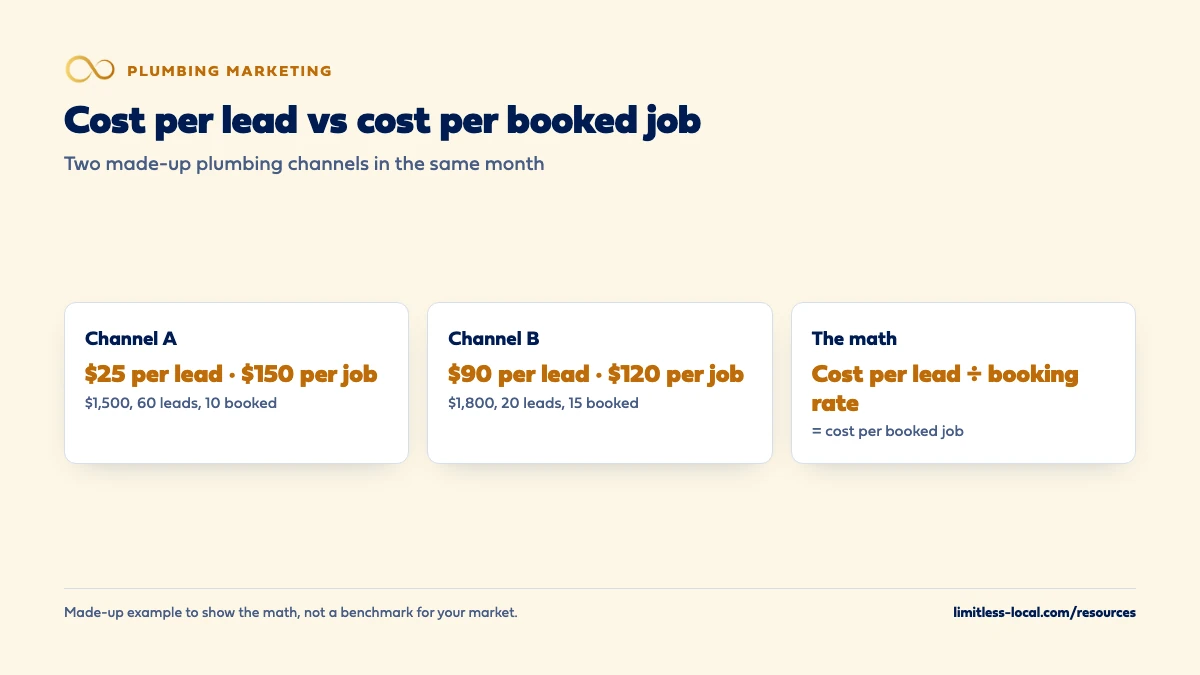
These numbers are made up to show the math, not a benchmark for your market. A plumbing shop runs two channels for a month.
- Channel A costs $1,500 and brings 60 leads, so cost per lead is $25. Many are price shoppers or outside the area, and the office books 10 of them, about one in six. Cost per booked job: $1,500 ÷ 10 = $150.
- Channel B costs $1,800 and brings 20 leads, so cost per lead is $90. Most are urgent calls in the shop’s main towns, and the office books 15, three in four. Cost per booked job: $1,800 ÷ 15 = $120.
On cost per lead, Channel A looks more than three times cheaper. On cost per booked job, Channel B wins, and that’s before counting the bigger jobs urgent callers often bring. An owner who cut Channel B to save on lead cost would end up paying more for every job.
Frequently asked questions
Is cost per lead the same as cost per acquisition?
No. Cost per lead stops when someone reaches out. Cost per acquisition usually means what it cost to win a paying customer, which also depends on your booking and close rates.
Should I include my own time in cost per lead?
Roughly, yes, when you compare a channel you run yourself with one someone else runs. Otherwise the do-it-yourself channel always looks free.
Do repeat customers count as leads?
Not in cost per lead for a marketing channel. They’d usually call without new spend, so counting them makes whichever number they dial look better than it is.
How often should I check cost per lead?
Monthly, next to booking rate and cost per booked job. Judge changes over a few months, because one slow or busy month can swing it a lot.
Why do lead sellers quote cost per lead instead of cost per job?
Because cost per lead is the part they control. Whether a lead books depends on the lead’s quality and on your office, so ask them how often their leads book for plumbers in your area and check it against your own numbers.
Key takeaways
- Cost per lead is a channel’s full cost, including fees, divided by the real new-customer leads it brought.
- Define a lead the same way for every channel, and leave out spam, existing customers and vendors.
- Cost per booked job is cost per lead divided by booking rate; that’s the number to manage.
- Check that Google Ads conversions count real leads before trusting cost per conversion.
- A higher cost per lead can be the better deal when those leads book more and pay more.
Not sure what's working right now?
Start with a free visibility audit: rankings, Google profile, reviews and tracking, checked against your service area.
More in this section
- What share of plumbing marketing budget goes to fast leads?
- How much do lead generation services cost for plumbers?
- Is it worth paying for plumbing leads?
- What does a qualified plumbing lead cost in my market?
- Is $75 per lead too high for plumbing ads?
Sources
- Cost-per-click (CPC): Definition — Google Ads Help
- Conversion rate: Definition — Google Ads Help
- About Target CPA bidding — Google Ads Help
- How leads work — Local Services Help
- Marketing Dashboard: ROI Table — Housecall Pro Help Center