
Exclusive pay-per-call leads or my own ads for restoration?

- Should a restoration company buy exclusive pay-per-call leads or run its own ads?
- What's the real difference between buying calls and running my own ads?
- Who owns the customer, the number and the data with bought calls?
- What do I own when I run my own ads?
- When do exclusive pay-per-call leads make sense?
- When do my own ads make more sense?
- How do I compare the cost of each fairly?
- What should I ask a pay-per-call seller before I sign?
- Can I run my own ads that only bring phone calls?
- Can I buy calls and run my own ads at the same time?
- How do I move from bought calls to my own ads without a gap?
- What's different about pay-per-call for restoration companies
- A worked example: bought calls vs your own ads over six months
- Frequently asked questions
- Key takeaways
- More in this section
- Sources
The short version
- Bought calls are fast and predictable, but you rent the brand, the number and the data.
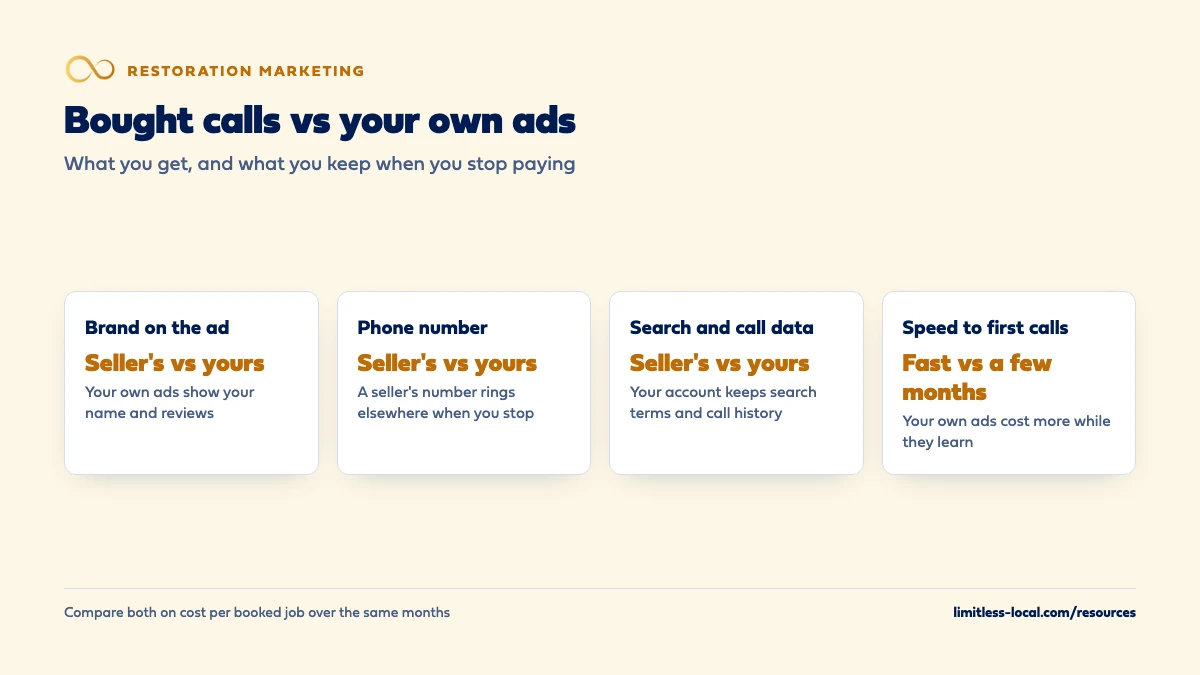
- Your own ads take a few months to tune and leave you with an account and history you keep.
- Compare both on cost per booked job, including management fees and disputed calls.
- Run both for a while, then move money to whichever wins on booked jobs.
For restoration owners weighing a per-call lead seller against running Google Ads in their own name.
Get a free visibility audit · Book a growth call
Should a restoration company buy exclusive pay-per-call leads or run its own ads?
Buy exclusive pay-per-call leads when you need calls this month and don’t have the time or history to run ads well; run your own ads when you want lower cost per booked job over time and an asset you keep. With bought calls you rent someone else’s ads, brand and phone number, so the calls stop the day you stop paying and you’re left with nothing to build on. With your own ads, the account, the search data, the call history and the brand homeowners saw stay yours. Many restoration companies start with both and shift money to their own ads once those beat the seller on cost per booked job.
We build campaigns in your name: Google Ads, and on Growth and Scale, Local Services Ads, with call tracking, recording and source tagging in every package so you can compare them against any lead source you’re buying. Essentials is $3,500 a month with Google Ads management up to $2,500 a month in spend; Growth is $4,500 a month. Ad spend is paid to Google directly. See our local ads work, how we help restoration companies, the restoration marketing guide, or more restoration marketing questions.
What's the real difference between buying calls and running my own ads?
Both put a homeowner on the phone with you. The difference is everything around that call. A pay-per-call seller runs its own ads, usually under its own name, sends the call to you through its tracking number and charges you per qualifying call. Exclusive means the seller says that call goes only to you. With your own ads, you pay Google for clicks and calls, your company name is on the ad, and the homeowner calls a number that’s yours.
So the choice isn’t really about who has better leads. It’s about whether you rent demand or build it. Renting is faster and needs less of your time. Building takes a few months but leaves you with something you keep. The difference between shared, exclusive and pay-per-call restoration leads covers the lead types themselves.
Who owns the customer, the number and the data with bought calls?
Once a homeowner is on the phone and you book the job, the customer is yours. Everything before that belongs to the seller:
- The brand the homeowner saw. They searched, saw an ad that may not have had your name on it and called. They remember the job, not the ad.
- The phone number. It’s the seller’s tracking number. When you stop paying, the same number rings at another company.
- The search data. Which searches, towns and times of day produced the calls stays in the seller’s account, not yours.
- The ad history. Months of learning what works in your market stay with the seller.
None of that makes bought calls bad. It means the money buys this month’s calls and nothing after.
What do I own when I run my own ads?
If the Google Ads account is set up in your company’s name and you hold admin access, you own the account itself, every campaign, the search terms report and the conversion history. Google’s page on access levels lists what only an admin can do, including giving account access, changing access levels and unlinking manager accounts, so an agency can run the account while you keep control. Google also recommends adding at least one more administrator, since an account with only one may lose access to its tags if that person becomes unavailable.
The same goes for your Google Business Profile. A profile can have several owners but only one primary owner, who has full control, according to Google’s page on owners and managers. Make sure that’s you. Who should own the website and ad accounts when you hire an agency goes into the paperwork side.
When do exclusive pay-per-call leads make sense?
- You’re new. No reviews, no rankings and no ad history means your own ads will be expensive while they learn. Bought calls can keep crews busy in the meantime.
- You’re testing a new town or service. Paying per call is a cheap way to see whether a market has demand before you build pages and campaigns for it.
- You have no one to run ads. If nobody on your team or an outside partner can watch search terms and budgets every week, a seller’s price per call is simpler.
- You need a predictable cost per call. Some owners prefer a fixed price per call to the swings of an auction.
- Overflow. A storm week can push demand past what your own campaigns are set to handle.
Curious what your marketing is actually booking?
Get a free visibility audit — no obligation, no sales pitch.
When do my own ads make more sense?
- You answer fast and book well. A company that books a high share of its calls gets more from every click, which can bring its own cost per job below what a seller charges.
- You want control. Your own ads let you choose the towns, services, hours and searches you pay for, and change them the same day.
- You want the brand to grow. Every ad that shows your name, reviews and photos makes the next call a little easier to win, on Maps and everywhere else.
- You’ve been in business a while. Strong reviews raise how many clicks turn into calls, which a seller’s generic ad can’t borrow.
- You think in years, not weeks. The account history and data you build keep paying off.
How restoration lead costs compare across Google Ads, LSAs, SEO and Maps covers how each channel charges you.
How do I compare the cost of each fairly?
Put them on the same yardstick: total cost divided by booked jobs, over the same months.
- Bought calls: every call you were charged for, minus credits you actually received, divided by the jobs that booked.
- Your own ads: ad spend plus management fees, divided by the jobs that booked.
Read the seller’s definition of a billable call closely. A call counted after a short connection or charged before you could screen it changes the math. On your own ads, give the campaign a few months before you judge it, because the first month is the most expensive one. What close rate restoration PPC needs to be profitable shows how to turn cost per lead and gross profit into a break-even.
What should I ask a pay-per-call seller before I sign?
- How do you get the calls? Ask to see the ads and the landing pages. You want to know what the homeowner was promised before they called you.
- Is it really exclusive? Ask how they make sure the call doesn’t also go to another company.
- What counts as a billable call? Minimum length, repeat callers, wrong services and out-of-area calls.
- How do disputes work? How long you have, and what proof they need.
- Can I set towns, job types and hours? And will they stop sending calls when crews are full?
- Do I get the recordings? You’ll want them to coach whoever answers the phone.
- What’s the contract term? And what’s the notice to stop.
The first question matters more than it looks. In August 2025 the FTC settled with an online lead generator it said misled people shopping for health insurance, and the head of its consumer protection bureau called addressing unlawful lead generation a priority, as Inside Privacy summarizes. A homeowner who was misled by an ad starts the job with you already suspicious.
Can I run my own ads that only bring phone calls?
Mostly, yes, though the setup is changing. Google’s call ads page says all options to create new call ads were removed in February 2026, and existing call ads stop receiving impressions in February 2027. To keep getting calls straight from the ad, add your phone number to responsive search ads as a call asset.
With call reporting turned on, Google assigns a forwarding number to the ad so you can see call details and count calls as conversions, and caller ID still works, according to Google’s page on call reporting. A tap to call is charged like a click. If you’d rather use your own call tracking, you can turn call reporting off so your business number shows instead.
Can I buy calls and run my own ads at the same time?
Yes, and many owners should for a while. Give each source its own tracking number so you can tell them apart, and tag every booked job by source in your job software. Ask the seller whether it bids on your company name or calls itself by a name like yours. You don’t want to pay a seller for homeowners who were already looking for you.
Watch for overlap in the towns you care about most. If the seller’s ads and yours compete for the same searches, you can end up raising the price of your own clicks.
How do I move from bought calls to my own ads without a gap?
- Start your own ads in your core towns first, where your reviews are strongest and arrival times are shortest.
- Keep buying calls for the outer towns and overflow while your campaigns learn.
- Compare cost per booked job by source every month.
- Shift money one step at a time as your own ads match or beat the seller.
- Keep the seller as a backup for storm weeks, if the contract allows it month to month.
If you’re also buying from a shared lead service, whether those leads are worth it for a restoration firm covers that side.
Not sure which of these is costing you jobs?
A free visibility audit checks the Google profile, reviews, site and tracking, and shows what to fix first.
What's different about pay-per-call for restoration companies
Speed decides most water jobs. A homeowner with water on the floor often books the first company that picks up. Exclusive calls help because no one else got the same call, but only if you answer.
Insurance work raises the stakes of the first impression. A homeowner filing a claim wants a company they trust. If the ad they called from had a different name than the truck that arrives, you spend the first minutes explaining.
Demand comes in bursts. Freezes and storms send call volume past what any one channel was set for. Bought calls can fill a gap, but your own ads with raised budgets and your Google profile carry the surge better over time.
Reviews compound. Every job you win under your own name can turn into a review. A seller’s generic brand can’t show your reviews, so it can’t help them work for you on the next call.
A worked example: bought calls vs your own ads over six months
These numbers are made up to show the math, not a benchmark for your market.
- Bought calls: $90 per billable call. You’re charged for 40 calls in a month, or $3,600, and book 14 jobs. Each booked job cost about $257, and it stays near that every month.
- Your own ads, month two: $3,400 in ad spend and management brings 30 real leads and 12 booked jobs. Each job cost about $283, more than the seller.
- Your own ads, month six: after trimming search terms and fixing the landing page, the same $3,400 brings 38 real leads and 16 booked jobs. Each job now costs about $213.
By month six your own ads win on cost per job, and you have six months of search terms, call history and conversion data in an account you own. If you’d quit the seller in month one, you’d have had a costly few months. If you’d never started your own ads, you’d still be paying $257 a job with nothing to show for it beyond the jobs.
Frequently asked questions
Are exclusive pay-per-call leads better than shared leads?
Usually, for emergency water work, because no other company got the same call. They cost more per call, so judge them on cost per booked job.
Can a pay-per-call seller use my company name in its ads?
Ask before you sign, and get the answer in writing. You don’t want to pay for calls from homeowners who were already searching for you.
How long until my own ads beat bought calls?
It depends on your market, your reviews and how fast you answer. Ads can bring leads within days, but give a new campaign a few months of tuning before you compare it with a seller.
Do I need an agency to run my own ads?
No. Some owners run them well themselves. The catch is time: search terms, budgets and call quality need checking every week, especially in storm season.
What if the seller's calls keep coming from towns I don't serve?
Dispute them under the contract’s terms, tighten your towns with the seller, and track how often it happens. Frequent out-of-area calls raise your real cost per job.
Should I stop buying calls once my own ads work?
Not necessarily. A month-to-month seller can be a useful backup for storm weeks and towns your ads don’t cover yet.
Key takeaways
- Bought calls rent the seller’s ads, brand, number and data; your own ads build an account you keep.
- Exclusive pay-per-call fits new companies, market tests and overflow.
- Your own ads win over time when you answer fast, book well and want control.
- Compare both on cost per booked job, with credits, disputes and management fees counted.
- Run both for a while, then shift money to whichever books jobs for less.
Want a second set of eyes on your setup?
We'll look at how you show up locally and where calls are leaking, then send you a plain-English breakdown.
More in this section
- Restoration leads: shared, exclusive or pay-per-call?
- Is $100 cost per lead too high for restoration PPC with bigger jobs?
- What does a restoration lead cost on Local Services Ads?
- Lead gen or recruiting first when a restoration budget is tight?
- What can a restoration company use for leads while SEO ramps up?
Sources
- About access levels in your Google Ads account — Google Ads Help
- Manage your Business Profile owners & managers — Google Business Profile Help
- About call ads — Google Ads Help
- About call reporting — Google Ads Help
- FTC Takes Aim at Online Lead Generator — Inside Privacy (Covington & Burling)