
Are HomeAdvisor and CraftJack leads worth it for a restoration firm?
- Are bought leads from HomeAdvisor or CraftJack worth the money for a water damage company?
- How do HomeAdvisor and CraftJack leads work?
- What do restoration leads from these services cost?
- Why do bought leads struggle for emergency water damage?
- Which bad leads can I get credited for?
- How do I work out whether lead services are worth it for my firm?
- Who owns the customer when I buy a lead?
- When does buying leads make sense for a restoration firm?
- What should I check before signing up?
- How do I test a lead service without getting burned?
- What should I build so I'm not dependent on bought leads?
- What's different about lead services for restoration firms
- A worked example: one month of bought restoration leads
- Frequently asked questions
- Key takeaways
- More in this section
- Sources
The short version
- You pay per lead, win or lose, and leads go to more than one company.
- Losing the job to someone faster isn't a reason for a credit.
- They fit best as a short-term filler while your own channels grow.
- Decide on cost per booked job, not cost per lead.
For restoration owners deciding whether to keep paying a lead service, test one, or put that money into calls they own.
Get a free visibility audit · Book a growth call
Are bought leads from HomeAdvisor or CraftJack worth the money for a water damage company?
HomeAdvisor and CraftJack leads can be worth it for a restoration firm that calls back within minutes, has a clear limit on what it can pay per booked job, and needs work while its own channels are still thin. They rarely pay off for emergency water damage, because the homeowner is usually matched with several companies and you’re charged for each lead whether or not you win the job. Judge them on what each booked job cost you over a couple of months, and compare that with Local Services Ads, Maps and referral partners, where the customer and the reviews stay yours.
The math that decides lead services, cost per booked job, is the same math we use across every channel. Our restoration marketing packages build calls you own through Google Ads, Local Services Ads (from Growth up), your Google profile and reviews, with call tracking that shows which source booked each job. For the full channel picture, read the restoration marketing guide, or browse more restoration marketing questions.
How do HomeAdvisor and CraftJack leads work?
Both sell you leads: contact details for homeowners who asked for help with a job you do. You choose your services and the ZIP codes you serve, and the service sends you matching requests. HomeAdvisor’s page for contractors is plain about two things that matter most:
- You pay per lead, not per job. You’re charged for each lead you receive, whether or not you win the job, and whether or not the homeowner hires anyone.
- Your spend target isn’t a cap. It’s an estimated dollar amount over a 28-day period that the service tries to meet. It’s possible to go over it, and Instant Booking and Job Opportunity leads are charged outside it.
HomeAdvisor’s own service professional FAQ, now branded Angi Leads, says it uses each homeowner’s request to connect them with multiple service professionals. So the homeowner you’re calling is often hearing from other companies too.
As for CraftJack, its website now opens Angi’s sign-up page for pros. Whichever name a sales rep uses, read whose terms, pricing and credit rules you’re actually agreeing to before you sign.
What do restoration leads from these services cost?
There’s no published price list. The price of a lead varies by the type of work you do and by region, and you’re quoted current prices for your area when you call to join. Water damage in a busy metro won’t cost what a small mold job costs in a rural county.
Look past the price per lead to the full monthly cost:
- The leads themselves, including any charged outside your spend target.
- Any membership or subscription fee.
- Add-ons a rep offers during sign-up, such as software or profile upgrades.
- The office time spent calling back leads that never pick up.
Then set the only number that settles it: what each booked job cost. A $40 lead that books one time in ten costs you $400 per job before you’ve rolled a truck.
Why do bought leads struggle for emergency water damage?
Speed. A homeowner with water spreading across the floor doesn’t fill out a form and wait. If they do fill one out, they’re usually also calling the first companies they find on Google, and whoever arrives first gets the job. When a lead goes to several companies at once, you’re racing all of them plus everyone the homeowner reached on their own.
That’s why bought leads tend to work better for restoration work that isn’t an emergency: a mold inspection, odor removal, a rebuild quote after someone else did the drying, or a small leak the homeowner found days later. Those homeowners compare options, and a fast, clear callback can win.
If you’re weighing which kind of bought lead to try, shared, exclusive or pay-per-call, restoration leads: shared, exclusive or pay-per-call compares the formats in detail.
Which bad leads can I get credited for?
Fewer than most owners expect. HomeAdvisor’s lead credit guidelines say credits are at the company’s discretion, must be requested within 30 days of the charge, come as store credit toward future leads, and expire six months after they’re issued if unused.
Situations that may be eligible include:
- A duplicate request from the same homeowner.
- A wrong ZIP code, where the correct one isn’t in your profile.
- A wrong job type, where the correct one isn’t in your profile (partial credit is considered when it is).
- A competitor testing the system.
- Contact details that are all wrong or disconnected.
What isn’t eligible matters more for restoration: the homeowner already found someone, isn’t calling you back, changed their mind, is just shopping, or you didn’t win the job. In water damage, “already found someone” is the most common way a slow callback ends, and it’s priced into the lead.
Curious what your marketing is actually booking?
Get a free visibility audit — no obligation, no sales pitch.
How do I work out whether lead services are worth it for my firm?
Track every lead to an outcome for at least two full months, then do the math:
- Total spend: every lead charge, minus credits, plus any membership or add-on fees.
- Booked jobs: leads that became signed work, not estimates or callbacks.
- Cost per booked job: total spend divided by booked jobs.
- Your ceiling: the most you can pay for a booked job of that type and still make the money you want on it.
If the cost per booked job sits comfortably under your ceiling, the service is earning its place, even if the leads feel messy. If it doesn’t, cutting the spend target rarely fixes it; the leads usually just get fewer. What a good cost per booked job is for a restoration company shows how to set that ceiling for water, mold, fire and sewage work separately.
Run the same math on your own channels for the same months. A lead service only looks expensive or cheap next to something.
Who owns the customer when I buy a lead?
You do, once you win the job, but the path matters. A homeowner who came through a lead service found the service, not you. The next time they have a problem, or a neighbor asks who to call, they may go back to the same site instead of calling you.
Compare that with work from your own channels. A homeowner who found you on Google Maps leaves a Google review that helps your next customer find you. A plumber who sends you a job will send the next one. A homeowner who saved your number from a truck or yard sign calls it again. That’s work that compounds.
Bought leads can still be profitable. They just tend to stay a cost you pay every month, while your own channels get cheaper per job as reviews, rankings and relationships build.
When does buying leads make sense for a restoration firm?
A few situations where it can be the right call:
- You’re new. No reviews, no rankings, and you need jobs on the schedule while you build both.
- You’re testing a new territory before putting money into Maps and ads there.
- Crews are idle in a slow stretch and planned work such as mold or rebuild jobs would fill the gap.
- You have a fast, disciplined callback process and someone whose job it is to work these leads.
And where it usually doesn’t:
- Nobody can call back within minutes during business hours.
- Most leads land outside your best ZIP codes or are for work you don’t want.
- Your average booked job is small, so even a modest lead price eats the margin.
- You have no way to tell which leads booked.
If you can’t call back fast, fix that first. How fast a restoration company needs to answer emergency calls covers why minutes matter in this trade.
What should I check before signing up?
Ask for these in writing, and read the account settings before the first lead arrives:
- How many companies each lead is sent to.
- Every fee: membership, per lead, and any lead types charged outside your spend target.
- How the spend target works and how far over it you can go in a month.
- The credit rules and the deadline for asking.
- How to pause, change ZIP codes and job types, and cancel.
It’s also worth knowing the history. In January 2023 the FTC announced a proposed order requiring HomeAdvisor to pay up to $7.2 million after a complaint alleging, among other things, that many service providers got leads that didn’t match their services or areas, and that the company claimed job conversion rates it couldn’t back up. The proposed order would also bar unsupported claims about how often its leads turn into paying jobs. At the time, the FTC said providers generally paid an annual membership fee of $287.99 plus a fee for each lead. So treat any promise about how many jobs you’ll win as a sales pitch, and trust your own tracking instead.
How do I test a lead service without getting burned?
- Narrow the settings. Only the ZIP codes your trucks reach fast and only the job types you want.
- Set a low spend target and read your invoices every week, since the target can be exceeded.
- Call every lead within minutes, then text, then try again later the same day.
- Log every lead with its cost and outcome: booked, lost to someone else, no answer, not a fit.
- Request credits for every eligible lead well inside the deadline.
- Decide on a date. After two full months, compare cost per booked job with your ceiling and your other channels, then keep, adjust or cancel.
A lot of what comes through will be tire-kickers and price shoppers. How to filter junk leads and price shoppers helps your office spot them in the first minute of the call.
What should I build so I'm not dependent on bought leads?
Calls that come straight to you. For most restoration firms that means:
- A complete Google Business Profile with real job photos and a steady flow of reviews, so you show up in Maps.
- Local Services Ads, where you also pay per lead, but the homeowner chose your listing and calls you directly.
- Search ads for the emergency searches in the towns you want most.
- Referral partners: plumbers, property managers and insurance agents who see water damage before anyone else. Building a referral network with plumbers and property managers covers how.
None of these replaces a lead service overnight. Start them while the lead service carries some of the load, then shift money as your own channels book jobs at a lower cost.
Not sure which of these is costing you jobs?
A free visibility audit checks the Google profile, reviews, site and tracking, and shows what to fix first.
What's different about lead services for restoration firms
Emergencies punish slow callbacks. A form lead for water damage can be cold within the hour. Lead services tend to work better for planned work like mold, odor and rebuilds than for active leaks.
Job size varies widely. A small cleanup and a whole-floor water loss can come from the same lead type. Track which kind each booked lead became, or your cost per job will mislead you.
Insurance work is slow to pay. A bought lead you pay for this month may not turn into money for weeks. Count the job when it’s booked and check the math again once it’s paid.
Referrals run the trade. Plumbers, property managers and insurance agents send a lot of restoration work. Money spent on bought leads is money not spent building those relationships.
A worked example: one month of bought restoration leads
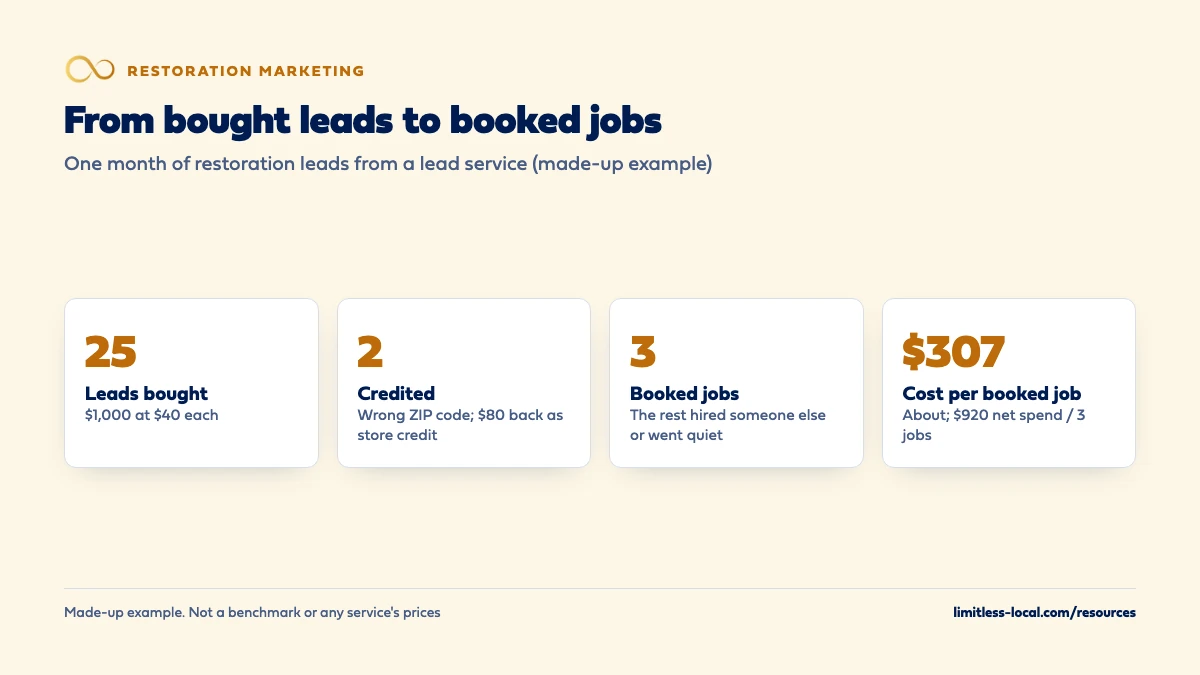
These numbers are made up to show the math, not a benchmark for your market or any service’s prices. Say a restoration firm buys 25 leads in a month at an average of $40 each, for $1,000.
- Credits: 2 leads came in with a ZIP code outside the firm’s profile and get credited, so $80 comes back as store credit. Net spend: $920.
- Outcomes: most of the rest hired someone faster, never answered or were too small to take. The firm books 3 jobs.
- Cost per booked job: $920 divided by 3 is about $307, before any membership fee.
Whether $307 is good depends on the firm’s ceiling. If its ceiling for a water mitigation job is a made-up $600, the service is earning its place this month. If those 3 jobs were small cleanups with thin margins, it isn’t, and that money could go toward Local Services Ads or the Google profile instead.
We don’t sell leads. Our packages build calls you own: Essentials ($3,500 a month) covers your Google profile, SEO and Google Ads management up to $2,500 a month in ad spend; Growth ($4,500 a month) adds Local Services Ads management. Ad spend is paid to Google separately. A free visibility audit can show how your own channels compare.
Frequently asked questions
Do HomeAdvisor leads help my Google ranking?
Not in any way Google documents. A paid lead plan buys leads, not rankings. Whether Angi or HomeAdvisor listings help restoration companies rank covers the details.
Can I pause HomeAdvisor during a busy storm week?
You can mark when you’re busy to narrow your preferences while keeping an active pipeline, and change your spend target at any time. Check your settings before a storm, not during it.
Do I get a refund if the homeowner hired someone else?
No. A homeowner who already found someone, changed their mind or was just shopping isn’t eligible for a credit.
Are Local Services Ads just another lead service?
You pay per lead in both, but with Local Services Ads the homeowner picks your listing and contacts you directly, and Google’s automated systems filter out invalid activity such as spam or duplicate contacts.
How many lead services should I run at once?
One at a time is easier to judge. Running several makes it hard to tell which one booked jobs, and the same homeowner can show up from more than one.
Should I quit lead services cold turkey?
Only if they’re losing money. If they book jobs under your ceiling, cut them back gradually as your own channels start carrying more of the work.
Key takeaways
- You pay for every lead, win or lose, and the homeowner is often hearing from other companies too.
- Losing the job to a faster company isn’t grounds for a credit.
- Lead services suit planned work like mold and rebuilds better than active water emergencies.
- Track two full months to cost per booked job, then keep, adjust or cancel.
- Use bought leads as a bridge while you build calls you own.
Want a second set of eyes on your setup?
We'll look at how you show up locally and where calls are leaking, then send you a plain-English breakdown.
More in this section
- Do Angi or HomeAdvisor listings help restoration companies rank?
- What is a good cost per booked job for a restoration company?
- Is paying for SEO worth it for a restoration company?
- How do I get more water damage leads for my restoration company?
- What makes homeowners trust a restoration company they find online?
Sources
- How does HomeAdvisor work for contractors? — HomeAdvisor
- Service Professional FAQ's — Angi Leads (HomeAdvisor Pro)
- Lead Credit Guidelines — Angi Leads (HomeAdvisor Pro)
- Get Leads, Win Jobs, Grow Your Business — Angi Pro
- FTC Order Requires HomeAdvisor to Pay Up To $7.2 Million and Stop Deceptively Marketing its Leads for Home Improvement Projects — Federal Trade Commission
- How leads work — Google Local Services Help