
How do I get more water damage leads for my restoration company?
- What's the order to turn on water damage lead sources, and how do I judge each one?
- What counts as a water damage lead worth getting more of?
- First: can someone answer every water damage call, day and night?
- Next: is your Google Business Profile ready for water damage searches?
- Should Local Services Ads be the first paid source for water damage?
- When do Google search ads come next?
- What does my website need before it can bring in water damage calls?
- Which referral partners send water damage work?
- Should I buy water damage leads to get more volume?
- How do I judge each water damage lead source by booked jobs?
- In what order should I turn the sources on?
- What's different about getting water damage leads
- A worked example: the cheapest lead isn't the cheapest job
- Frequently asked questions
- Key takeaways
- More in this section
- Sources
The short version
- Answer every call first: missed calls during your business hours can still be charged and can hurt your Local Services Ads ranking.
- Fix the Google Business Profile before paying for anything; it feeds Maps and your ads.
- Local Services Ads have a water damage category; search ads cover the searches and towns you pick.
- Track each source separately and judge it by cost per booked job.
For restoration owners who want more water damage calls and need to know which source to fix or turn on first, and how to tell which ones are actually booking jobs.
Get a free visibility audit · Book a growth call
What's the order to turn on water damage lead sources, and how do I judge each one?
Get more water damage leads by fixing the things that decide whether a call reaches you and gets answered, then adding sources one at a time: a verified, complete Google Business Profile, round-the-clock call coverage, Local Services Ads in Google’s water damage category, Google search ads for the jobs and towns you want most, a website page built for water damage, and referral partners such as plumbers and property managers. Give every source its own tracking number, and keep or cut each one by what a booked job from it costs you, not by how many leads it sends.
Cost per booked job is the number we build restoration marketing around, so every source gets its own tracking from day one. Our packages line up with this sequence: Essentials ($3,500 a month) covers the Google Business Profile, local SEO and Google Ads management up to $2,500 a month in spend for one location, and Growth ($4,500 a month) adds Local Services Ads management and Google Ads up to $5,000 in spend. Ad spend is paid to Google directly in every tier. Our restoration marketing page explains how we work with water, fire and mold companies. The water damage leads guide covers buying versus generating leads, the restoration marketing guide covers every channel, and the restoration marketing questions library takes the narrower questions one at a time.
What counts as a water damage lead worth getting more of?
A lead worth more of is a homeowner or property manager inside your service area, with a water problem you handle, who reaches someone at your company and books. Everything else (wrong service, wrong town, a price shopper with a damp carpet, a caller who hung up on voicemail) still costs money and still shows up in a lead count.
That’s why the order below starts with fixing leaks in your own setup before adding sources. In our judgement, most restoration companies asking for more water damage leads would book more jobs by first answering the calls they already get and tightening where their ads and profile show up. Turning up spend on top of a leaky setup mostly buys more of the same misses.
Keep one number in mind through every step: what a booked job from each source costs you. Leads are an input; booked jobs are the result you’re paying for.
First: can someone answer every water damage call, day and night?
Water damage doesn’t wait for business hours, and the platforms notice who answers. Google’s Local Services Ads ranking page says missed calls may negatively affect your responsiveness, which is one of the factors that decides where your ad shows. Its page on how leads work says a missed call during your business hours still counts as a valid, charged lead once the caller stays on the line for more than 20 seconds.
So before adding any source, decide who picks up at night, on weekends and while crews are on a job: an on-call tech, an office rotation or an answering service trained on water calls. If nights aren’t covered yet, Local Services Ads let you schedule your ad to run all day, only during your business hours or on custom hours, so you can match the ad to the hours someone answers.
Of everything on this list, answering faster is usually the cheapest fix.
Next: is your Google Business Profile ready for water damage searches?
Your Business Profile is what customers see in local results on Google Maps and Search. Google’s local ranking tips say verifying your business makes it more likely to show up in search results, that businesses with complete and accurate info are more likely to show up in local results, and that more reviews and positive ratings can help your local ranking. Local results are mainly based on relevance, distance and popularity.
For water damage, that means a primary category that matches the work, a description that says you handle water damage and drying, accurate hours (including whether you run around the clock), real photos of your crews and equipment, and a steady stream of reviews from finished jobs.
Set the service area to where your trucks really go. In our judgement, most restoration companies should draw it around the towns they can reach fast at night, not every town they’d drive to on a slow week, because distance is one of the three things local results are based on.
Should Local Services Ads be the first paid source for water damage?
For many restoration companies, yes. Google’s list of US Local Services Ads categories includes water damage services, so you can run them for the job that matters most. You pay for valid leads (answered calls, qualifying missed calls, messages, voicemails and booking requests) rather than clicks, and Google says leads it decides are invalid or low quality aren’t charged.
Where you show depends on your bid and on how likely your ad is to produce a lead. Google lists responsiveness, how relevant your business is to the search, and profile quality: your rating, number of reviews, average response time, high-quality images and the verification checks you’ve completed. That’s why the first two steps come first; they’re the same things LSAs reward.
You’ll need to pass at least Google’s preliminary checks before your ad goes live, so start the application early. Getting verified for Local Services Ads walks through it for a restoration company.
Curious what your marketing is actually booking?
Get a free visibility audit — no obligation, no sales pitch.
When do Google search ads come next?
Add Google search ads when you want control that LSAs don’t give you: the exact searches you pay for, the towns you push hardest, and the page people land on. Google’s ad review page says most ads are reviewed within one business day (more complex reviews can take longer), and once an ad is Eligible it starts to run, so search ads can start producing calls quickly once they’re built.
In our judgement, a water damage search campaign should start narrow: emergency and burst-pipe searches, the towns closest to your shop, and only the hours someone answers. Block the searches that waste money, such as DIY, rentals of drying equipment and job seekers.
Search ads are usually paid per click, not per lead, so a page that doesn’t turn visitors into calls makes them expensive fast. That’s the next step.
What does my website need before it can bring in water damage calls?
At minimum, a dedicated water damage page: what you handle (burst pipes, appliance leaks, flooded basements, ceiling leaks), the towns you cover, how fast you respond, what happens on the first visit, and a phone number that’s easy to tap on a phone. Search ads and SEO both need it, and a general services page rarely does the job for either.
Organic search is the slow source on this list. SEO typically takes 3-6 months to show meaningful organic growth, so it starts now and pays later, while the paid sources above carry the calls. Pages for the towns you serve can help when each one says something true and specific about working there; in our judgement, near-identical city pages built only to rank are worth skipping.
How to build city pages that rank for a restoration company covers what a useful town page contains.
Which referral partners send water damage work?
Plumbers are often at the leak before anyone calls a restoration company. Property managers need a reliable call for every unit and every after-hours flood. HVAC companies, roofers, home inspectors and real estate agents see water damage on their own jobs. None of these leads touch a search result, and none get sold to three other companies.
In our judgement, what earns referrals is how you treat their customer: showing up fast, keeping them informed, and not making them look bad for recommending you. Never offer payment for referrals; build it on the service.
Building a referral network with plumbers and property managers covers who to approach first and how to track what each partner sends.
Should I buy water damage leads to get more volume?
Bought leads add volume without setup, but they belong last in the order, not first. Some are sold to several companies at once, which turns every water damage call into a race to call back first. Others are exclusive or priced per call, which in our judgement usually cost more per lead.
If you try them, judge them the same way as everything else: their own tracking, a record of which ones booked, and cost per booked job next to your LSAs and search ads. In our judgement, a lead source that looks cheap per lead often turns out to be the most expensive per job, which the worked example below shows.
Shared, exclusive and pay-per-call restoration leads breaks down the models.
How do I judge each water damage lead source by booked jobs?
Give each source its own phone number and record what happens to every call. CallRail’s source tracking guide says it’s best to use one source tracking number per campaign to prevent inaccuracies in your reports, and that a source tracking number can be used for online and offline campaigns, so the same idea covers your profile, ads, website, door hangers and truck wraps.
Then, once a month, divide what each source cost by the booked jobs it produced. Include the leads you couldn’t take, because they tell you whether a source is pulling in the wrong work. Tracking which marketing brings in booked restoration jobs covers the setup with your job management software.
Give each source enough time before you judge it: weeks for paid sources, months for SEO. Cut sources only on booked-job math over a fair period, not on one slow week.
In what order should I turn the sources on?
In our judgement, this order works for most water damage companies:
- Call coverage and tracking. Someone answers every call; every source has its own number.
- Google Business Profile. Verified, complete, real photos, reviews coming in.
- Local Services Ads in the water damage category, scheduled to the hours you answer.
- Google search ads for your best towns and emergency searches, with a water damage landing page.
- SEO on the website, starting alongside the first paid source because it’s slow.
- Referral partners, built steadily in the background.
- Bought leads, only if the numbers beat your own sources.
Add the next source when the current one is answering, tracked and producing booked jobs at a cost you can live with. If you can only fund one paid source for now, which marketing channel a restoration company should start with compares the options.
Not sure which of these is costing you jobs?
A free visibility audit checks the Google profile, reviews, site and tracking, and shows what to fix first.
What's different about getting water damage leads
Every call is an emergency. Someone with water on the floor calls the first company that looks ready and keeps calling until one answers. In our judgement, that makes call coverage worth more in water damage than in trades where customers book a week out.
Weather moves demand overnight. A hard freeze or a big storm can bring more calls in a day than a normal week. Keep ad budgets easy to raise for a few days and bring back down, and make sure your crews can take the work before you turn spend up.
Insurance changes when the money arrives. Many water jobs are paid through the homeowner’s insurance, so the invoice can be paid weeks after the call. Judge sources on booked jobs first and paid revenue later; don’t cut a source because last month’s checks haven’t arrived. This is general business guidance, not insurance advice.
Water calls bring other work. Some water jobs turn into mold work later. Tag those in your tracking so the original source gets credit.
A worked example: the cheapest lead isn't the cheapest job
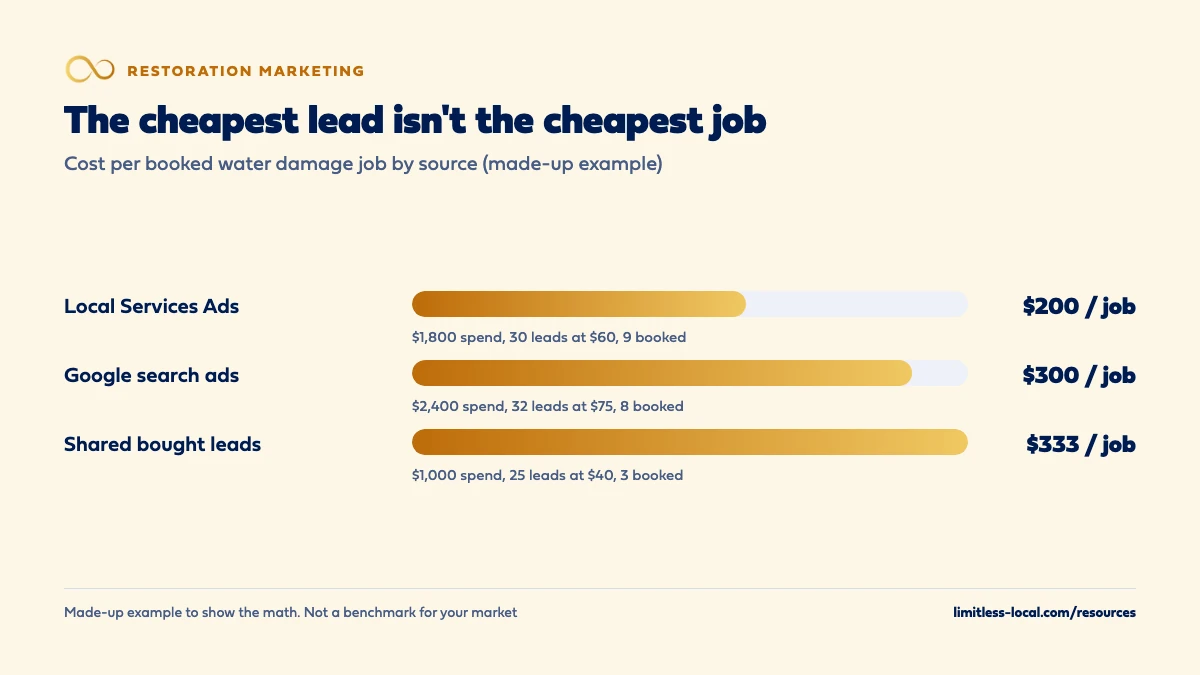
These numbers are made up to show the math, not a benchmark for your market. A restoration company runs three water damage sources for a month and tracks each one separately.
- Local Services Ads: $1,800 for 30 charged leads, or $60 a lead. 9 booked, so $200 per booked job.
- Google search ads: $2,400 for 32 leads, or $75 a lead. 8 booked, so $300 per booked job.
- Shared bought leads: $1,000 for 25 leads, or $40 a lead. 3 booked, so about $333 per booked job.
By cost per lead, the shared leads look best. By cost per booked job, they’re the most expensive of the three, because other companies called the same homeowners first. The owner’s next move is to put more budget into LSAs, keep search ads for the towns LSAs don’t reach well, and drop or cap the bought leads. If an agency manages any of these, add its fee to the spend before dividing.
Frequently asked questions
Do Local Services Ads have a category for water damage?
Yes. Google’s list of US Local Services Ads categories includes water damage services. It doesn’t list separate fire damage or mold categories, so that work needs another channel, such as Google search ads.
Will I be charged for water damage calls I miss?
With Local Services Ads, a missed call during your business hours counts as a valid lead once the caller stays on the line for more than 20 seconds, according to Google. Leads Google decides are invalid or low quality aren’t charged.
Can I run water damage ads only at night or on weekends?
Yes. Local Services Ads can run all day, only during your business hours, or on custom hours you choose. Match the schedule to when someone can answer.
Should I advertise water damage in towns far from my shop?
In our judgement, start with the towns you can reach fast and widen only when those are answering and booking. Distance is one of the main factors in Google’s local results, and far-off emergency calls are harder to win and to staff.
How many water damage leads should I expect each month?
Nobody can honestly promise a number; it depends on your market, competition, budget, reviews and how fast you answer. Track your own leads and booked jobs for a few months and plan from those.
Is it worth paying to be listed on lead directories?
Only if the tracked cost per booked job beats your own sources. Give the directory its own number so you can tell.
Key takeaways
- Fix call coverage and your Google Business Profile before paying for more water damage leads.
- Local Services Ads have a water damage category and reward fast answers, reviews and complete profiles.
- Add Google search ads for control over searches, towns and landing pages; start SEO early because it’s slow.
- Build referral partners steadily and buy leads last, if at all.
- Give every source its own tracking number and keep or cut it by cost per booked job.
Want a second set of eyes on your setup?
We'll look at how you show up locally and where calls are leaking, then send you a plain-English breakdown.
More in this section
- How do restoration companies get insurance-related water damage jobs?
- Which channel brings the best water, fire, or mold restoration leads?
- What marketing mistakes keep restoration companies from leads?
- How should a restoration company follow up on leads that don't book?
- How many water damage jobs a month do I need to hit my revenue goal?
Sources
- How leads work — Google Local Services Help
- About ad rankings — Google Local Services Help
- Getting started with Local Services Ads (United States) — Google Local Services Help
- About ad scheduling — Google Local Services Help
- Tips to improve your local ranking on Google — Google Business Profile Help
- About the ad review process — Google Ads Help
- Source tracking basics — CallRail Help Center
- Cost-per-click (CPC): Definition — Google Ads Help