
How do I get more panel upgrade and EV charger jobs?
- How can an electrical contractor book more panel upgrades and EV charger installs?
- Why market panel upgrades and EV chargers separately from general electrical work?
- What does a homeowner shopping for an EV charger install need to hear?
- What makes homeowners start looking for a panel upgrade?
- How do EV charger leads turn into panel upgrade jobs?
- Should I still mention the federal EV charger tax credit?
- Do I need separate website pages for panel upgrades and EV chargers?
- Should I run Google Ads for panel upgrade and EV charger jobs?
- How do I show up on Google Maps for EV charger and panel upgrade searches?
- Can past customers and partners bring in more of this work?
- How do I follow up on panel and EV charger estimates that don't sign?
- How do I know if this work is paying off?
- What's different about selling this work as an electrician
- A worked example: what an EV charger campaign really books
- Frequently asked questions
- Key takeaways
- More in this section
- Sources
The short version
- Give panel upgrades and EV chargers their own pages, profile services and ad campaigns.
- Run a capacity check on every EV charger estimate; some homes need more capacity for Level 2 charging.
- Take expired federal EV charger tax credit claims out of your ads and pages.
- Follow up on every estimate, and judge each service by cost per booked job.
For electrical contractors who want more of their schedule filled with panel upgrades and EV charger installs instead of small service calls.
Get a free visibility audit · Book a growth call
How can an electrical contractor book more panel upgrades and EV charger installs?
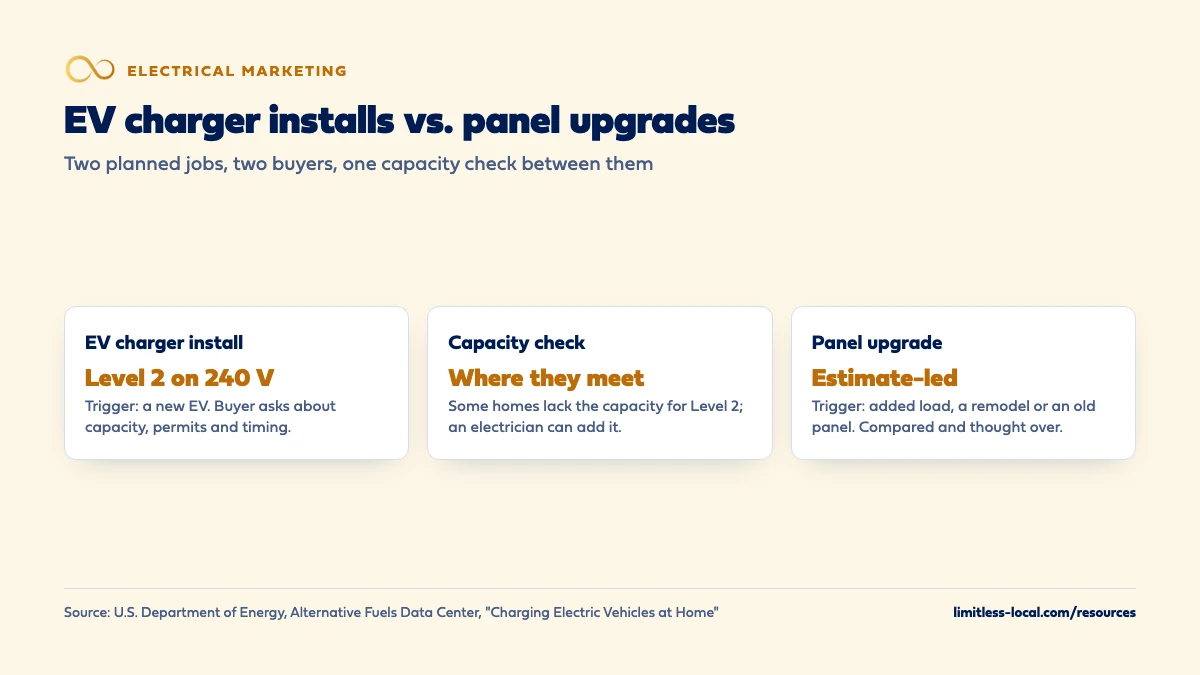
Market panel upgrades and EV charger installs as their own services, with their own website pages, Google Business Profile services and ad campaigns, instead of folding them into general electrical work. The two jobs are linked: the Department of Energy notes that some homes don’t have enough electrical capacity for Level 2 charging and that an electrician can tell homeowners whether theirs does, which makes a capacity check on every EV charger estimate a natural place for panel upgrade work to start. Then follow up on the estimates, because both are planned purchases that homeowners often compare and think over.
Building demand for specific high-ticket jobs is what our local ads work is set up for: campaigns around the jobs and towns you want, tracked to booked jobs. Panel upgrades and EV charger installs are named on our electrical contractor marketing page for that reason, and the electrical marketing questions library covers the channels one question at a time.
Why market panel upgrades and EV chargers separately from general electrical work?
A service call and a panel upgrade come from different people with different questions. Someone with a dead outlet wants an electrician today. Someone planning a panel upgrade or an EV charger is usually comparing options, asking about price and permits, and getting more than one estimate. A website, profile and ads built around “electrician near me” speak to the first person and mostly miss the second.
In our judgement, the shops best placed to book more of this work treat each one as its own product: a page that answers the buyer’s questions, a listed service on the Google profile, an ad campaign with its own budget, and an estimate process that follows up. Each piece below is one of those.
What does a homeowner shopping for an EV charger install need to hear?
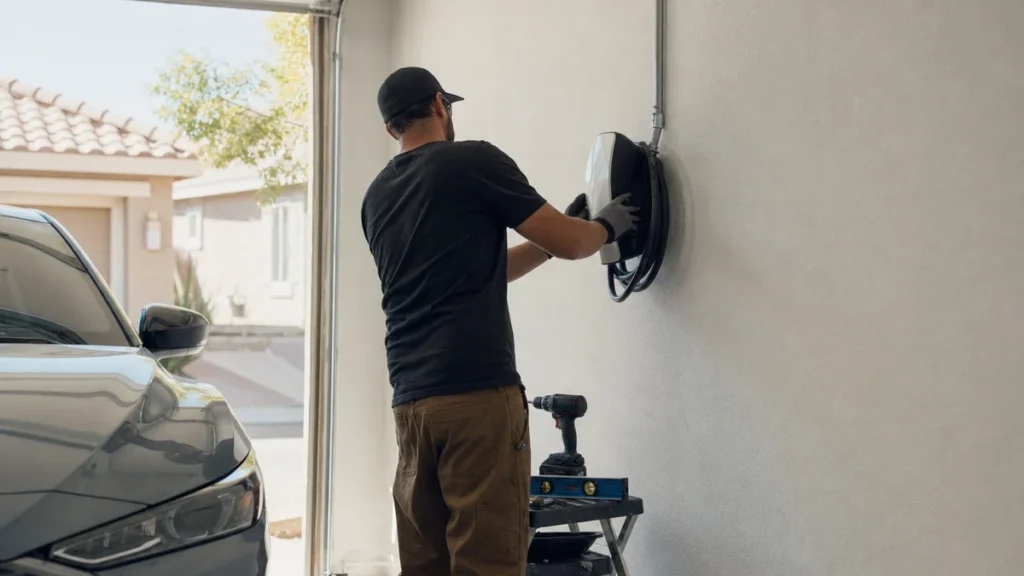
The Department of Energy’s page on charging EVs at home covers what this buyer is working through. Level 2 equipment runs on 240 V for faster charging. Many drivers get by on Level 1, the cordset that comes with the car, if there’s an outlet on a dedicated branch circuit near where they park. Some homes don’t have enough electrical capacity for Level 2, and a qualified electrician can add circuits to provide it. Installations must meet local and state codes, permits may be required, and in many areas a site plan has to be approved before the work starts.
That gives you the outline for your EV charger page and ad copy: whether they need Level 2 at all, how you check their panel’s capacity, who pulls the permit, and what happens if the panel can’t handle it. A homeowner who reads those answers on your page has fewer reasons to call three other shops.
What makes homeowners start looking for a panel upgrade?
Few homeowners wake up wanting a new panel. In our judgement, most panel upgrades start with something else: a new EV, a heat pump or electric range, a home addition or remodel, a home inspection that flagged an old panel, or breakers that keep tripping. That’s useful for marketing, because it tells you where the buyer is before they search for “panel upgrade”.
Write your panel upgrade page around those triggers, not around amp ratings alone. A homeowner searching “can my panel handle an EV charger” or “breaker keeps tripping” is a better prospect than one searching a technical term they half understand. And make sure each trigger has a clear next step: book a capacity check or an estimate.
How do EV charger leads turn into panel upgrade jobs?
Because the Department of Energy says electricians can tell homeowners whether their home has adequate capacity for charging, the capacity check is a natural part of every EV charger estimate. When it shows the panel can carry the load, you quote the charger. When it doesn’t, you explain the options, which may include adding capacity or a panel upgrade, and quote them clearly.
Do this honestly and it builds trust. Quote a panel upgrade only when the check shows the home needs one, and say so plainly when it doesn’t. The homeowner will compare estimates, and the electrician who explained the panel calmly usually looks better than the one who either ignored it or pushed it on every job. That is our judgement, not a rule, but it’s why the check should be written into your estimate process rather than left to whoever goes out.
Should I still mention the federal EV charger tax credit?
Not for new installs. The Department of Energy’s listing for the Alternative Fuel Infrastructure Tax Credit (the 30C credit) shows it as expired on 06/30/2026. It covered home charging equipment installed from January 1, 2023 through June 30, 2026, at up to 30% of the cost, up to $1,000, and only in qualified locations. Ads, pages and estimate templates that still promise customers a federal credit on a new install are out of date, and a customer who finds out at tax time won’t blame the government.
The same Department of Energy page on home charging notes that state and utility incentives may be available. If you mention any incentive, check that it’s current in your area, link to the program, and leave tax questions to the customer’s tax preparer. This is a summary of the Department of Energy listing, not tax or legal advice.
Curious what your marketing is actually booking?
Get a free visibility audit — no obligation, no sales pitch.
Do I need separate website pages for panel upgrades and EV chargers?
In most cases, yes. A single “electrical services” page can’t answer the EV charger buyer’s questions and the panel upgrade buyer’s questions well at the same time, and an ad for EV charger installs works best when it lands on a page about EV charger installs. Google’s advice on organizing ad groups says that for many businesses the website’s structure, with each ad group representing a page, is a good place to start, which works best when each service has its own page.
Each page should cover the questions from the sections above, show real photos of your installs, say whether you handle permits, and make booking a capacity check or estimate easy on a phone. What an electrician’s website should have covers the rest of the site.
Should I run Google Ads for panel upgrade and EV charger jobs?
If you want more of this work soon, ads are the fastest lever, but give each job its own campaign or ad group, its own keywords and its own landing page. Before you spend, check demand in Keyword Planner, which shows estimated monthly searches for a keyword and what it costs to show your ad. Google notes that results also depend on your bid, budget, ad quality and location targeting, so treat the numbers as a guide.
In a small market, searches for these specific jobs can be thin, and in our judgement that’s a reason to draw a wider service area for panel and EV work than for small service calls, since a bigger ticket justifies a longer drive. Which campaign types to use and in what order is covered in which Google Ads campaigns work best for electricians.
How do I show up on Google Maps for EV charger and panel upgrade searches?
Google lets service businesses list services on their Business Profile, and says that when local customers search for an offering you provide, that service may be highlighted on your profile. Add EV charger installation and panel upgrades as services, as custom services if they aren’t suggested, with a short description of what’s included. Google rejects custom service names that include prices or phone numbers, so keep those out of the name.
Photos of real installs, and reviews from customers who mention the job, help too. Optimizing your electrician Google Business Profile walks through the rest.
Can past customers and partners bring in more of this work?
Your past customers already trust you, and some of them will buy an EV, add a heat pump or remodel in the next few years. A short note to past service-call customers about EV chargers and capacity checks costs little. On the ad side, Google’s guide to campaign types notes that Display and Video campaigns can show ads to people who have already visited your site, which suits planned purchases that take weeks to decide.
Other trades see these jobs before you do: remodelers, HVAC companies installing heat pumps, and solar installers all run into panels that can’t carry the new load. In our judgement a few good working relationships there are worth more than a big ad budget, as long as the referral runs on good work and fast scheduling, not payments.
How do I follow up on panel and EV charger estimates that don't sign?
Both jobs are considered purchases, so plenty of good estimates sit unsigned for a week or two while the homeowner compares, checks their budget or waits on a car delivery date. A follow-up schedule (a same-day text with the estimate, a check-in a few days later, and another before the estimate expires) wins back work that otherwise goes to whoever called last. Following up on electrical quotes automatically covers how to set that up without adding office hours.
How do I know if this work is paying off?
Track panel upgrades and EV charger installs as separate job types from the first call, so you can see what each one costs to book and what it brings in. A campaign that produces fewer leads but more signed panel upgrades can be the better one. Tracking which electrical marketing brings in real jobs covers the setup.
Not sure which of these is costing you jobs?
A free visibility audit checks the Google profile, reviews, site and tracking, and shows what to fix first.
What's different about selling this work as an electrician
Codes and permits are part of the sale. The Department of Energy notes that EV charging equipment is treated as a continuous load under the National Electrical Code, that most of the applicable rules are in NEC Article 625, and that installations must comply with local and state codes. Rules and permit steps vary by jurisdiction, so explain how you handle them in your area instead of quoting general rules.
Licensed versus handyman. Homeowners don’t always know the difference, and a charger can be bought before anyone has looked at the panel. The Department of Energy recommends safety-certified equipment along with a certified electrical contractor. If you’re licensed and insured, make that obvious on your EV and panel pages.
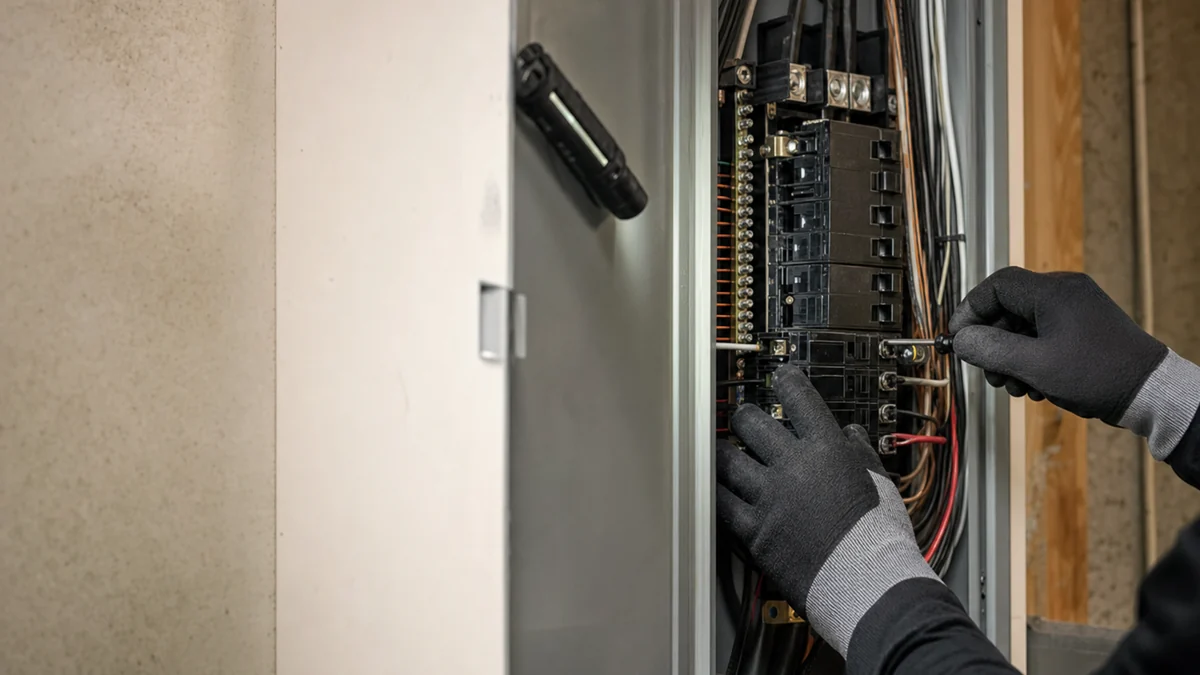
The panel is the bottleneck. Many electrification projects run through the panel. That makes the capacity check your most useful sales tool, and the reason EV charger marketing and panel upgrade marketing belong together.
A worked example: what an EV charger campaign really books
These numbers are made up to show the math, not a benchmark for your market. Say an electrician spends $900 in a month on an EV charger campaign and gets 12 estimate requests. Four of them sign for a charger install, so each booked install cost $900 divided by 4, or $225. During the capacity checks, one of those homes needs a panel upgrade too, and signs for both.
Judged only as an EV charger campaign, that’s $225 per install. Judged on everything it booked, including the panel upgrade, it may look much better. That’s why tracking job type and ticket size by lead source matters more than counting leads.
For reference on management cost: our Essentials package is $3,500 a month, with Google Ads management up to $2,500 a month in ad spend and a content sprint of up to 10 pages, which can cover pages like these. Ad spend is paid to Google separately. A free visibility audit shows what panel and EV searches look like in your own towns.
Frequently asked questions
Can homeowners still claim the federal tax credit for a home EV charger?
Not for new installs. The Department of Energy lists the 30C credit as expired on 06/30/2026; it applied to qualifying installs through that date. Point customers to their tax preparer for anything already installed.
Does an EV charger install need a permit?
It can. The Department of Energy says permits may be required by local building and permitting authorities, and in many areas a site plan must be approved first. Check with your local authority and tell customers how you handle it.
Can I list EV charger installation as a service on my Google Business Profile?
Yes. If it isn’t among the suggested services, add it as a custom service with a description. Google rejects custom service names that include prices or phone numbers.
Should I quote a panel upgrade with every EV charger estimate?
No. Run the capacity check on every EV charger estimate, and quote a panel upgrade only when the check shows the home needs more capacity. Overselling the panel costs you trust with homeowners who are comparing estimates.
Do all EV owners need a Level 2 charger installed?
No. The Department of Energy says many drivers meet their daily range by charging overnight on Level 1, provided there’s an outlet on a dedicated branch circuit near where they park. Level 2 suits longer commutes, irregular schedules or large batteries.
How do I know if there's enough EV charger demand in my area for ads?
Check Keyword Planner for estimated monthly searches and costs for EV charger and panel terms in your service area. If searches are thin, lean more on your profile, your website and past customers.
Key takeaways
- Treat panel upgrades and EV charger installs as their own services, with their own pages, profile services and campaigns.
- Make a capacity check part of every EV charger estimate, and quote a panel upgrade only when it’s needed.
- Remove federal EV charger tax credit claims for new installs; the Department of Energy lists the credit as expired.
- Use past customers and other trades as a steady source of this work, alongside ads.
- Follow up on every estimate and judge each service by cost per booked job.
Want a second set of eyes on your setup?
We'll look at how you show up locally and where calls are leaking, then send you a plain-English breakdown.
More in this section
- How do I follow up on electrical quotes automatically?
- What should an electrician's website have to get more calls?
- How should a new electrical contractor get its first customers?
- How do I track which electrical marketing brings in real jobs?
- How do I optimize my electrician Google Business Profile?
Sources
- Charging Electric Vehicles at Home — U.S. Department of Energy, Alternative Fuels Data Center
- Alternative Fuel Infrastructure Tax Credit — U.S. Department of Energy, Alternative Fuels Data Center
- Use Keyword Planner — Google Ads Help
- Manage your services on your Business Profile — Google Business Profile Help
- Organize your account with ad groups — Google Ads Help
- Choose the right campaign type — Google Ads Help