
How fast should a roofing company call back a new lead?
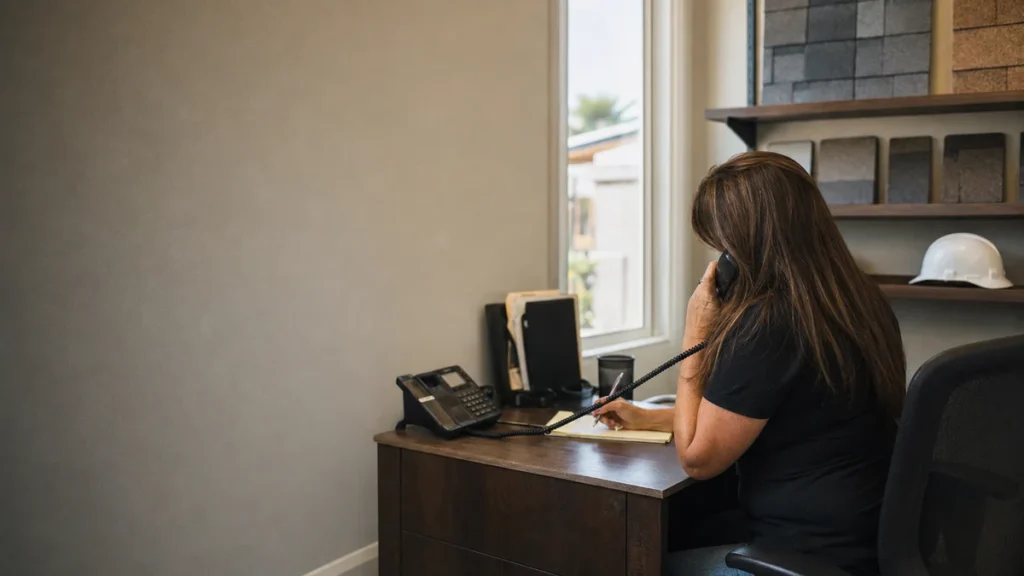
- What's a good speed-to-lead time for roofing calls and estimate requests?
- What does a fast response mean for a roofing lead?
- Why does a few minutes make that much difference?
- How fast should the phone be answered for roofing leads?
- What should happen when we miss a call because the crew is on a roof?
- How fast do web forms, LSA messages and texts need an answer?
- How quickly should a new roofing lead turn into a booked inspection?
- How should a roofer handle the flood of leads after a storm?
- How should we handle leads that come in after hours or on weekends?
- What follow-up sequence should we use when a homeowner doesn't answer?
- Who should own lead response at a roofing company?
- How do we measure our response time?
- What's different about speed to lead for roofing companies
- A worked example: what a slow callback costs in a storm week
- Frequently asked questions
- Key takeaways
- More in this section
- Sources
The short version
- Answer live when you can; call back missed calls and form or message leads within about five minutes.
- Book the inspection on the first conversation instead of promising a call later.
- After hours, text back automatically and call first thing in the morning, sooner for active leaks.
- In Local Services Ads, missed calls can hurt your ranking and still cost you.
For roofing owners whose crews are on roofs when the phone rings, and who want a callback standard the office can actually hit.
Get a free visibility audit · Book a growth call
What's a good speed-to-lead time for roofing calls and estimate requests?
A roofing company should answer new calls live and call back missed calls and web or message leads within about five minutes during business hours, then try to book the inspection on that first conversation. After hours, send an automatic text the moment a call is missed and call back first thing the next morning, sooner for an active leak. Speed matters because the odds of reaching a web lead drop sharply within minutes, homeowners often contact several roofers, and Google counts responsiveness when it ranks Local Services Ads.
Fast follow-up is the part of marketing most roofers can fix without spending more on ads. After-hours answering, unified messaging, automated follow-up and AI website chat are automation add-ons that plug into any of our roofing marketing packages. For where leads come from in the first place, roofing lead generation covers the channels, and the rest of the roofing marketing questions library goes question by question.
What does a fast response mean for a roofing lead?
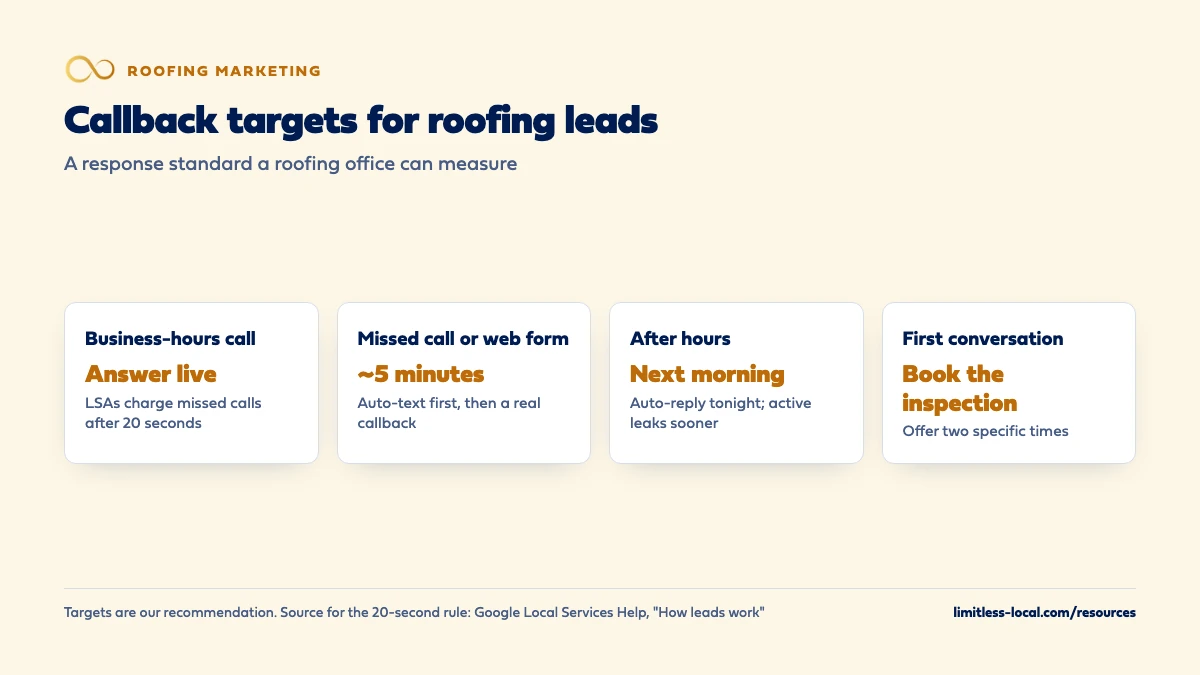
Set a standard your office can measure, not a feeling. A workable one for most roofers:
- Calls during business hours: answered live by a person, not a crew lead on a ladder.
- Missed calls: an automatic text right away and a callback within about five minutes.
- Web forms, Local Services Ads messages and texts: a call or reply within about five minutes.
- After hours: an automatic reply that night, a callback first thing the next morning, and a faster path for active leaks.
- Every first conversation: ends with an inspection on the calendar, or a set time for the next contact.
Five minutes isn’t a magic number. It’s a target short enough to beat most competitors to the homeowner and long enough for a real office to hit. That’s our judgement; the research behind it is in the next section.
Why does a few minutes make that much difference?
The best-known study on lead response is older than most owners expect, and it wasn’t done on roofing, so treat it as a direction, not a benchmark. The 2007 lead response study by InsideSales.com and MIT researcher James Oldroyd looked at web-form leads across six companies and found the odds of contacting a lead dropped 100 times when the first call came at 30 minutes instead of 5, and the odds of qualifying it dropped 21 times. It also found the odds of contacting a lead fell more than tenfold within the first hour. The study measured whether leads were reached and qualified, not whether a sale closed. Oldroyd and colleagues later wrote in Harvard Business Review that most companies weren’t responding to online leads nearly fast enough.
Roofing adds its own pressure. In our judgement, a homeowner with a leak or a hail-damaged roof often calls or fills out forms for several roofers at once, and the first one who calls back and offers an inspection time has the best chance of getting in the door.
How fast should the phone be answered for roofing leads?
Live, on the first few rings, whenever someone’s in the office. If you run Local Services Ads, Google’s rules make ring time costly: a missed call during your business hours counts as a charged lead once the caller stays on the line more than 20 seconds, and a call that goes to voicemail or an automated greeting during business hours is treated as connected and charged after 20 seconds, whether or not they leave a message. So a one-minute answer time isn’t just slow; with LSAs, you can pay for that call and still lose it.
Google also says your responsiveness to customer inquiries is part of how it ranks Local Services Ads, and that missed calls may hurt it. More on that in whether LSAs are worth it for roofers.
If calls ring through a phone menu, keep it short. For LSAs, Google starts the 20-second clock after the caller’s first key press.
What should happen when we miss a call because the crew is on a roof?
Two things, in this order:
- An automatic text, right away. Call tracking tools can do this. CallRail’s automated response, for example, texts a caller whose call you missed so they know when to expect you. Its help center notes the limits: the caller won’t get the text if they gave a landline or a number that can’t receive texts, if they hung up within 15 seconds (CallRail classes that as abandoned), or if the tracking number is toll-free, since toll-free numbers can’t send texts. Business texting also requires registering for text messaging compliance.
- A real callback within minutes. The text buys you a little time; it doesn’t replace the call. Decide who makes it: the office, the owner, or an answering service, never “whoever’s free.”
Then log the call with its source, even if the homeowner isn’t ready to book, so it can be followed up and credited later. Tracking which leads turn into signed jobs covers that setup.
How fast do web forms, LSA messages and texts need an answer?
Treat them like a missed call: a reply within minutes during business hours. A form submitted from your website is a homeowner who’s ready to talk now; an hour later they may be talking to someone else.
Local Services Ads make message speed visible. Google says that if you have 2 or more message leads in the last 90 days, an estimated messaging response time may appear in your ads, ranging from “a few minutes” to “one day”, calculated differently depending on whether you’ve set business hours. Google recommends responding to leads as soon as they come in and says a consistently fast response time could improve your ad’s ranking and your ability to receive leads.
On your Google Business Profile, you can add a text messaging or WhatsApp option to your contact info, where available. If you turn it on, someone has to watch it with the same five-minute standard; an unanswered text is a missed call in a different form.
Curious what your marketing is actually booking?
Get a free visibility audit — no obligation, no sales pitch.
How quickly should a new roofing lead turn into a booked inspection?
Ideally, on the first conversation. The callback’s job isn’t to collect information and promise to get back to them; it’s to put an inspection on the calendar while the homeowner is on the phone. Offer two specific times rather than asking when works.
In our judgement, the gap between the first call and the inspection matters about as much as the callback itself, because a homeowner who’s comparing roofers will often book whoever can come out first. If your estimators are booked out a week, say so, offer the earliest slot, and send a confirmation text so the homeowner has your name in writing.
What happens after the inspection is its own speed problem. If estimates sit unsigned, following up on unsigned estimates covers the cadence.
How should a roofer handle the flood of leads after a storm?
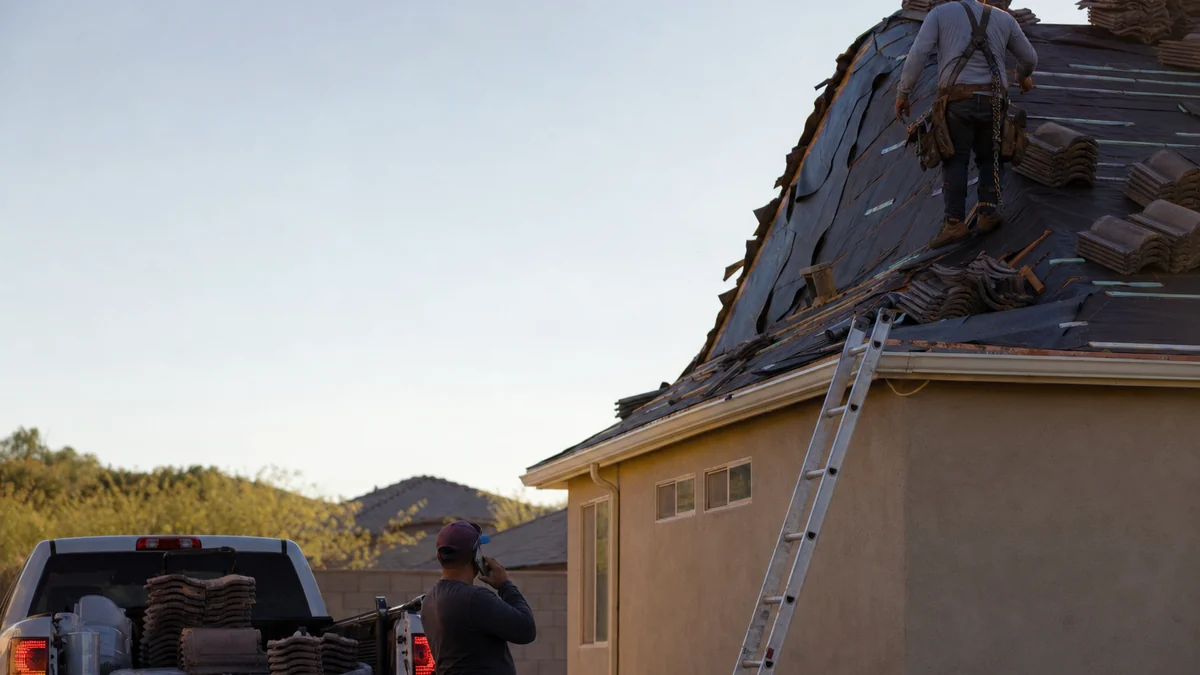
After hail or high wind, calls can spike past what the office can handle, and that’s when response time slips. Plan for it before storm season:
- Triage by urgency. Active leaks and open roofs first; inspection requests for visible damage next.
- Text every lead you can’t call back right away with an honest timeframe.
- Log every inquiry with a source and a follow-up date, so nothing gets lost in the surge.
- Add phone coverage for the surge, whether that’s a second person or an answering service.
- Turn paid leads down if you can’t answer them. Google lets you pause Local Services Ads when you’re too busy to take new requests.
The triage order and staffing advice are our judgement; the pause option is Google’s.
How should we handle leads that come in after hours or on weekends?
Decide your after-hours promise and make your tools match it. For Local Services Ads, Google defines business hours as the hours on your Google Business Profile, so a missed call outside those hours isn’t charged under the 20-second rule, and if your ad schedule differs, unanswered calls are only charged when they fall inside both.
Google also suggests message and booking leads as a way for customers to reach you on nights and weekends when you can’t answer. For roofing, a sensible setup is an automatic text reply after hours, a callback first thing the next business morning, and a separate path, such as an on-call phone or answering service, for active leaks. Which leaks count as emergencies is your call.
What follow-up sequence should we use when a homeowner doesn't answer?
One call isn’t follow-up. A simple sequence a roofing office can run:
- Minute one: call, then text if there’s no answer.
- Same day: a second call at a different time of day.
- Next morning: call and text again.
- Day three: one more call, plus an email if you have the address.
- About a week later: a last text that leaves the door open.
This cadence is our judgement, not a sourced standard. Google’s Local Services Ads inbox treats a lead with a call or message in the past 15 days as active, which is a reasonable window to keep working a lead before you mark it lost.
Who should own lead response at a roofing company?
One named person per shift, not a team. At a small shop that’s often the owner’s spouse, an office manager or the owner. As you grow, it becomes a CSR or a booking role. Whoever it is needs the lead alerts on their phone, the authority to book inspections, and a backup for lunch and days off.
Crew leads and estimators shouldn’t be the first responders. They’re on roofs or in driveways, and asking them to answer leads is how calls ring out. If nobody’s available during the day, an answering service that books inspections is usually better than voicemail. That’s our judgement, not a sourced rule.
How do we measure our response time?
Spot-check it weekly. Pull every new lead from the week, note when it came in and when someone first reached out, and count how many got a response within your target. Call tracking software and field software both record timestamps you can use, and Local Services Ads may show your messaging response estimate right in the ad.
Measure the outcomes too: how many leads got an inspection on the first conversation, and how many inspections signed. If response is fast but leads still don’t book, the issue may be earlier in the chain; ads getting clicks but no calls covers the ads side.
Talk it through with someone who runs this every day
A 15-minute growth call: your market, your numbers, and what a realistic budget looks like. No pressure.
What's different about speed to lead for roofing companies
Nobody’s at a desk. Roofing owners and crews spend the day on roofs, where answering a phone isn’t safe or practical. Speed for a roofer depends on who’s on the ground or in the office, and on automation that covers the gaps.
Storm surges. Volume can jump overnight after hail or wind. The roofers who keep response times short in a surge are the ones who planned coverage and triage before it hit.
The inspection is the real first step. In many trades the callback books the job. In roofing it books an inspection, and the estimate and contract come later, so speed to inspection matters as much as speed to callback.
Leaks don’t wait. A homeowner with water coming through the ceiling wants someone today. Separate active leaks from replacement shoppers so the urgent calls never wait behind the routine ones.
A worked example: what a slow callback costs in a storm week
These numbers are made up to show the math, not a benchmark. Say a storm week brings in 36 leads, and 12 of them are calls the office misses because everyone’s on a roof or on another line. If those 12 get called back the next morning and 3 book inspections, versus a five-minute callback where 6 book, the slow callback cost 3 inspections.
If about 1 in 3 of your inspections usually signs, that’s roughly one signed roof lost in a single week, from leads you already paid to get. If any of those missed calls came from Local Services Ads, you were likely charged for them either way, so the callback is the difference between a lead you paid for and an inspection you booked.
Fixing that rarely means spending more on ads. After-hours answering, unified messaging and automated follow-up are add-ons that work with any of our packages, with pricing shared on the discovery call, and every package includes call tracking so you can see how many calls you’re missing in the first place.
Frequently asked questions
Is a one-minute answer time too slow for roofing leads?
For Local Services Ads it can be costly. Google charges a missed call during business hours once the caller stays on more than 20 seconds, so a call that rings for a minute and goes unanswered can cost you a lead you never spoke to.
Does a voicemail greeting count as answering for Local Services Ads?
No. Google treats a call that reaches voicemail or an automated greeting during business hours as a connected call, and charges it once the caller stays on more than 20 seconds, whether or not they leave a message.
Can an automatic text replace calling the homeowner back?
No. It tells the homeowner you saw the call and when to expect you, but it doesn’t book an inspection. Follow it with a real callback within minutes.
Should roofers use an answering service?
If nobody can reliably answer during working hours, an answering service that can book inspections is usually better than voicemail. That’s our judgement; the test is whether it gets inspections on the calendar.
Will my Local Services Ads show how fast I reply?
They can. Google says an estimated messaging response time may appear in your ads once you have 2 or more message leads in the last 90 days.
How long should we keep following up a roofing lead that won't answer?
About a week of calls and texts on a set schedule is a reasonable default, then mark it lost with a reason. Google’s Local Services Ads inbox treats leads with contact in the past 15 days as active.
Key takeaways
- Aim to answer live and to call back missed calls, forms and messages within about five minutes.
- The callback’s job is to book an inspection, not to promise another call.
- Missed-call text-back covers the gap while crews are on roofs, but a real callback still has to follow.
- With Local Services Ads, slow answers can cost you twice: in ranking and in leads you’re charged for.
- Plan storm-surge coverage and triage before storm season, not during it.
Ready to compare options?
Book a short growth call and we'll walk through the math for your service area, including when we're not the right fit.
More in this section
- How should a roofing company follow up on unsigned estimates?
- How do I track which roofing leads turn into signed jobs?
- What should a roofing website include to get more estimate requests?
- How should a roofing company market commercial roofing?
- How do I know if my roofing marketing agency is getting results?
Sources
- The InsideSales.com/MIT Lead Response Management Study — InsideSales.com and James Oldroyd, MIT (2007)
- The Short Life of Online Sales Leads — Harvard Business Review
- How leads work — Google Local Services Help
- About ad rankings — Google Local Services Help
- Manage leads and jobs — Google Local Services Help
- Chat with customers from your Business Profile — Google Business Profile Help
- Automated responses for missed calls — CallRail Help Center