
Can AI write social media posts for an electrical business?
- How can I use AI to keep my electrical company's Facebook and Instagram active?
- Can AI really write an electrician's social posts?
- What should I give the AI before it writes anything?
- What kinds of posts should I have AI draft?
- How do I write a week of posts in one sitting?
- What should I check before anything goes live?
- Should I use AI-generated photos?
- Can AI write customer reviews or testimonials for my posts?
- How do I make AI posts sound like my shop?
- Should the same post go on Facebook, Instagram and my Google profile?
- How do I know if the posts are doing anything?
- What's different about AI social posts for electricians
- A worked example: what AI saves in a month
- Frequently asked questions
- Key takeaways
- More in this section
- Sources
The short version
- AI is good at drafting captions; it doesn't know your jobs unless you tell it.
- Pair AI-written text with real job photos, not AI-made pictures.
- Check every post for safety and code claims, promises and customer privacy.
- Batch a week of posts in one sitting and schedule them.
For electrical shop owners who want to keep Facebook and Instagram going without spending their evenings writing posts.
Get a free visibility audit · Book a growth call
How can I use AI to keep my electrical company's Facebook and Instagram active?
Yes. AI tools like ChatGPT can draft a week of Facebook and Instagram posts for an electrical business in a few minutes, as long as you give them your real services, towns and recent jobs. Use AI for the words and your own job photos for the pictures, then read every post before it goes out for wrong safety or code claims, work you don’t do and anything that sounds like a promise. Never let it invent customer reviews or testimonials.
Organic posting is usually something your shop can run in-house with a routine like this. Where social turns into booked jobs is paid: our Growth package adds Meta remarketing, showing ads on Facebook and Instagram to people who already visited your site, along with ad design and creative. Our local ads page covers how that works, our electrical contractor marketing page shows the full picture for an electrical shop, and the electrical marketing questions library has more on social and AI.
Can AI really write an electrician's social posts?
It can write the words, and it’s good at it. Give ChatGPT or a similar tool a few facts about a job and it’ll turn them into a friendly caption faster than you can type one on your phone. The U.S. Small Business Administration’s guide to marketing and sales lists generating and scheduling social media posts among the ways small businesses can use AI, and for free AI tools it recommends having another person review everything they produce.
What AI can’t do is know your business. It doesn’t know you finished a panel swap in a 1960s ranch house on Tuesday, that your crew is the one with the white vans, or that you don’t do low-voltage work. Left alone, it writes generic posts that could belong to any electrician in the country. The value comes from what you feed it and what you fix after.
What should I give the AI before it writes anything?
A short “about us” note you can paste in every time:
- What you do and don’t do: service calls, panel upgrades, EV chargers, generators, lighting, commercial work, and anything you turn down.
- Where you work: the towns and neighborhoods you actually serve.
- How you talk: two or three past posts or texts to customers that sound like you.
- Rules: no prices unless you give them, no guarantees, no safety advice beyond “call a licensed electrician,” no customer names or addresses.
Then, for each post, add the real details: what the job was, the problem the homeowner had, what you did and the town. Leave out anything that identifies the customer, like a street address or a name, unless they’ve said yes. AI tools aren’t the place for customer data, so keep it out of what you paste in.
What kinds of posts should I have AI draft?
The ones that show real work and real people. For an electrical shop, these tend to hold up well:
- Job spotlights: a photo of a finished panel, EV charger or lighting job with a short story of what the homeowner needed.
- Before and after: the old fuse box next to the new panel, the dark backyard next to the lit one.
- Seasonal reminders: generator checks before storm season, outdoor lighting before the holidays, and what to do if the power goes out.
- Common questions: why breakers keep tripping, what an EV charger install involves, when a panel upgrade makes sense.
- Your team: a new tech, an anniversary, the crew at a community event.
- Review highlights: a real customer review, shared with their permission.
Which platforms matter most for your shop is covered in which social platforms help an electrician get local leads.
How do I write a week of posts in one sitting?
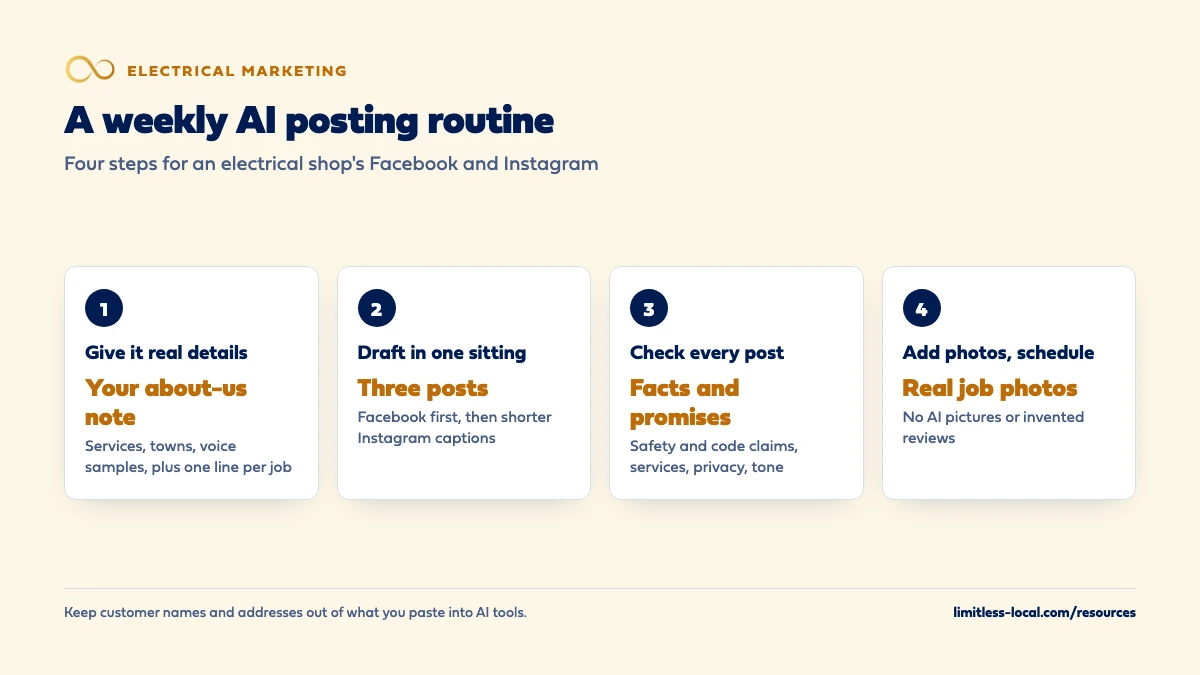
Once a week, set aside about half an hour:
- Pick three photos your techs took that week, from jobs where the customer is fine with you sharing.
- Write one line of notes for each: “200-amp panel upgrade, 1970s house in Riverside, old panel was a known problem brand, done in a day with permit and inspection.”
- Paste your about-us note and the three lines into the AI and ask for three short Facebook posts, each under 80 words, friendly, no hashtags except your town, ending with a line about calling or booking online.
- Edit each one (more on that below), then ask for a shorter Instagram caption version of each.
- Schedule them. Meta Business Suite lets you schedule posts, Stories and Reels for Facebook and Instagram ahead of time, so the whole week is done in one go.
Three posts a week, every week, does more than ten posts one week and nothing for a month.
Curious what your marketing is actually booking?
Get a free visibility audit — no obligation, no sales pitch.
What should I check before anything goes live?
Read every post as if a homeowner and an inspector were both looking at it. AI tools can be confidently wrong. OpenAI’s own help article on whether ChatGPT tells the truth says it can produce incorrect or misleading answers, sometimes sounding confident even when it’s wrong, and encourages checking important information with reliable sources. Look for:
- Safety and code claims. Anything about code requirements, permits, amperage or what’s “safe” needs to be right for your area, or cut.
- Work you don’t do. AI loves to list services. Delete the ones you don’t offer.
- Promises. Claims like same-day service or lowest prices only stay if they’re true every time.
- Made-up details. Numbers, years, brand names or stats you didn’t give it.
- Privacy. No customer names, addresses or house numbers visible in the text or the photo.
- Tone. If it sounds like an ad agency wrote it, cut the adjectives.
Should I use AI-generated photos?
Not for your work. A homeowner looking at an electrician’s page wants to see your panels, your trucks and your crew. An AI picture of a perfect-looking install is a picture of a job you didn’t do, and people can often tell.
Meta also labels it. In its approach to labeling AI-generated content, Meta says it adds “AI info” labels to video, audio and image content when it detects industry-standard signals that AI made it, or when people disclose that it did. An “AI info” tag on a photo of a supposed job doesn’t build trust.
Instagram rewards your own material, too. Its guidance on original content says posting original content gets the best reach and distribution, and recommends regularly posting content and captions you produce yourself. Phone photos from your own jobs are the easiest original content you have. Ask techs to take one before and one after on every job worth showing.
Can AI write customer reviews or testimonials for my posts?
No, and this one isn’t a style question. The Federal Trade Commission’s final rule on fake reviews and testimonials covers reviews and testimonials from someone who doesn’t exist, such as AI-generated fake reviews, or from someone who didn’t actually use the business, and it prohibits businesses from creating or selling them. It also bars buying followers or views you know are fake to look more influential for a commercial purpose.
What you can do is share real reviews. Copy a customer’s actual Google review into a post, with their first name or none at all, ideally after asking them. AI can help you write the post around the review (“Thanks to Dana in Oak Hill for this one”), but the review itself has to be real and unchanged. If you want more of them, getting more Google reviews for your electrical business covers the ask.

How do I make AI posts sound like my shop?
Show it, don’t describe it. “Friendly and professional” gets you the same voice as every other company. Paste in two or three things you’ve actually written, like a text to a customer or an old post that got a good response, and tell it to match that.
Then edit the first line yourself. That’s the line people see in the feed, and it’s where AI drifts into filler like “Are you looking for a reliable electrician?” Replace it with something only your shop could say: “Third panel swap this month on Maple Ridge, all original 1970s boxes.” Add one local detail the AI couldn’t know, like a street name, a school or a weather event everyone remembers. Two minutes of editing is the difference between a post that reads like you and one that reads like a template.
Should the same post go on Facebook, Instagram and my Google profile?
The same job can, but trim each version. Facebook handles a few sentences and a link. Instagram is photo first, with a shorter caption. Your Google Business Profile posts show up where people are already looking for an electrician, so keep those focused on the service and the town, with a clear “call” or “book” button.
AI is handy here: ask it to turn one Facebook post into an Instagram caption and a Google profile post. Just check that each still says something true and specific. If you’re also writing web pages with AI, the same checks apply, and using AI to write electrical website content covers what Google says about it.
How do I know if the posts are doing anything?
Don’t judge them by likes. For most electricians, organic social is a trust and repeat-work channel: past customers remember you, neighbors see your work, and someone checking you out after a referral finds an active page instead of a dead one. That’s worth something, but it rarely shows up as a flood of new service calls.
Track what you can. Ask new customers how they heard about you and mark it in your field software. Watch for messages through your Facebook Page and calls that mention a post. If after a few months social is taking an hour a week and nothing ties back to a job, cut it to the minimum and put the time somewhere else. Whether social media is worth it for electrical leads lays out where it usually earns its place.
Not sure which of these is costing you jobs?
A free visibility audit checks the Google profile, reviews, site and tracking, and shows what to fix first.
What's different about AI social posts for electricians
Safety claims carry real risk. Electrical work is about safety, and AI will happily write “this is safe to do yourself” or quote a code section. Keep posts to what you did and why it mattered, and leave how-to safety advice out.
Permits and codes vary by place. A rule that’s true in one state or city may not be in yours. If a post mentions a permit, an inspection or a code requirement, make sure it matches your jurisdiction, or keep it general.
Your best content is already on the job. Panels, meter bases, EV chargers, generators and lighting jobs photograph well. The before-and-after of an old fuse box is more convincing than anything AI can write.
Homes are personal. Garages, basements and backyards can show house numbers, cars and family photos. Check the background of every photo before it goes out.
A worked example: what AI saves in a month
These numbers are made up to show the math, not a benchmark. Say you post three times a week.
- By hand: about 15 minutes per post to think of something and type it, so 45 minutes a week.
- With AI: about 10 minutes to paste your notes and get three drafts, plus five minutes each to edit, so 25 minutes a week.
- Time saved: 20 minutes a week, or about 87 minutes a month (20 times 4.33).
That’s real but not huge, because the editing and the photos still take time, and they should. The bigger win is consistency: when posting takes 25 minutes in one sitting, it actually happens every week.
Frequently asked questions
Which AI tool should I use?
Any of the common chat tools can draft captions. The tool matters less than the details you give it and the edit you do after.
Do I have to say a post was written with AI?
No federal or state law currently requires businesses to disclose AI use, though it’s becoming an expected best practice. Meta’s AI info labels are aimed at images, video and audio, so if you post an AI-made image, expect it may be labeled.
Can I let AI post automatically without me reading it?
Don’t. One wrong safety claim or a customer’s house number in a photo costs more than the time you saved.
How often should an electrician post?
Two or three times a week, every week, is plenty for most shops. Steady beats bursts.
Can AI reply to comments and messages on my page?
It can draft replies, but send them yourself. A message on your Page can be a real lead, and it deserves a person, fast.
Will AI posts get me more leads?
Rarely on their own. Organic posts mostly build trust and keep past customers aware of you. Paid ads and your Google profile do more of the lead work.
Key takeaways
- AI can draft good captions if you give it your real services, towns and job details.
- Use your own job photos; Meta can label AI-made images, and Instagram favors original content.
- Check every post for safety and code claims, services you don’t offer, promises and privacy.
- Never post AI-written reviews or testimonials; share real ones with permission.
- Batch and schedule a week of posts in one short sitting, and judge social by trust and repeat work, not likes.
Want a second set of eyes on your setup?
We'll look at how you show up locally and where calls are leaking, then send you a plain-English breakdown.
More in this section
- Can I use AI to write electrical website content without hurting SEO?
- How can an electrician use AI to create ads that bring in leads?
- How do I show up in AI search answers for my electrical business?
- Should an electrician use an AI receptionist for after-hours calls?
- Should my electrical company market smart home installs?
Sources
- Marketing and sales — U.S. Small Business Administration
- Does ChatGPT tell the truth? — OpenAI Help Center
- Our Approach to Labeling AI-Generated Content and Manipulated Media — Meta
- About original content on Instagram — Instagram Help Center
- Federal Trade Commission Announces Final Rule Banning Fake Reviews and Testimonials — Federal Trade Commission
- Schedule Facebook and Instagram content on Meta Business Suite mobile app — Meta Business Help Center