
What close rate do HVAC service calls need for paid ads to pay off?

- What's the break-even close rate on HVAC service calls from Google Ads and LSAs?
- Is there a standard close rate HVAC service calls need for ads to pay off?
- What counts as closing an HVAC service call?
- How do I work out the break-even close rate?
- How do diagnostic and trip fees change the math?
- Where do I get my cost per booked service call?
- Why use gross profit and not the invoice total?
- Should I count replacements and maintenance plans that start as service calls?
- How do I measure my service-call close rate by lead source?
- My close rate is below break-even. Is it the ads or the techs?
- How many calls do I need before I trust my close rate?
- Does the break-even close rate change with the season?
- How do I use the break-even number to manage my ads?
- What's different about service-call close rates for HVAC
- A worked example: break-even close rate with the full cost counted
- Frequently asked questions
- Key takeaways
- More in this section
- Sources
The short version
- Break-even close rate = ad cost per booked call ÷ gross profit per sold call.
- Use gross profit, not the invoice total.
- Diagnostic fees on calls that don't sell lower the close rate you need.
- Measure close rate on ad calls separately from referrals and repeat customers.
For HVAC owners paying for ads that fill the board with service calls and wondering how many of those calls have to sell for the spend to be worth it.
Get a free visibility audit · Book a growth call
What's the break-even close rate on HVAC service calls from Google Ads and LSAs?
Your break-even close rate is your ad cost per booked service call divided by the gross profit on a service call that sells. For example, if a booked call costs you $50 in ads and a sold call leaves $250 after parts and the tech’s time, you need to close 20% just to break even, and more to keep any profit. Diagnostic fees on unsold calls lower that bar, and there’s no national number to aim for, because cost per call and ticket size vary too much by market.
This is the math we run before turning up any ad budget: what each booked call costs, and how many have to sell for it to pay. Google Ads management with call tracking and attribution is part of our local ads work in every one of our HVAC marketing packages. The HVAC lead generation guide covers where calls come from, and the HVAC marketing questions library goes question by question.
Is there a standard close rate HVAC service calls need for ads to pay off?
No. The close rate you need comes from two of your own numbers: what a booked service call costs you in ads, and what a sold call leaves you in gross profit. A shop paying a lot per call in a crowded metro needs a much higher close rate than a shop paying little per call in a quiet market, even with the same techs.
That’s why a benchmark someone quotes for “HVAC close rates” doesn’t settle the question. Close rates on replacement estimates are a different animal. What a good close rate for HVAC replacement estimates looks like covers that side. This page is about the everyday service call: the no-cool, the no-heat, the noisy blower motor.
What counts as closing an HVAC service call?
Decide this before you measure anything, because it changes the number a lot. ServiceTitan’s technician close rate report gives a useful model: a job counts as converted when the invoice subtotal is above the company’s “job sold threshold.”
Set your own threshold so it means something:
- Diagnostic-only visits where the homeowner pays the fee and declines the repair don’t count as closed.
- A sold repair above your threshold counts.
- A replacement estimate set by the tech is a separate result, tracked on its own.
- Cancellations and no-shows stay in the count of booked calls, because you paid for them too.
Whatever you choose, keep it the same month to month, so a change in the number means a change in the business.
How do I work out the break-even close rate?
Start from the idea behind the SBA’s break-even point calculator: fixed costs divided by price minus variable costs gives the number of units you need to sell to break even. Turned around for a single ad-booked service call, the question becomes: what share of these calls has to sell to cover what each one cost to get?
Break-even close rate = ad cost per booked service call ÷ gross profit per sold call.
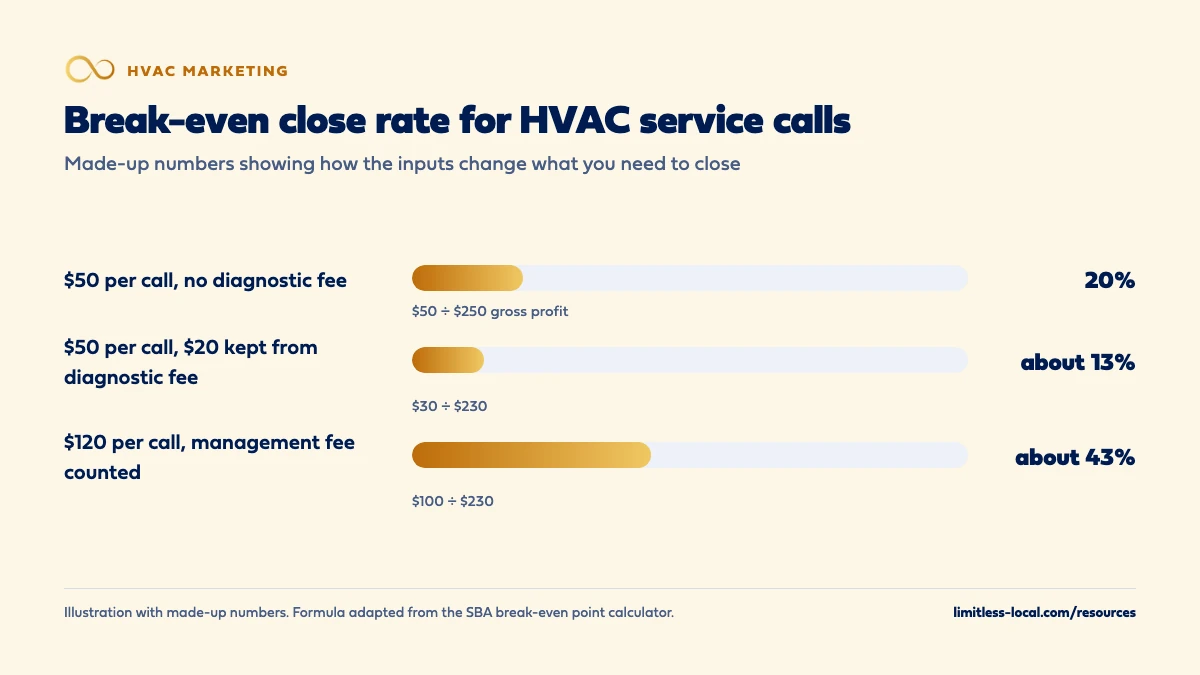
These numbers are made up to show the math: if a booked call costs $50 in ads and a sold call leaves $250 in gross profit, $50 divided by $250 is 20%. Close fewer than 1 in 5 ad calls and the ads lose money. Close exactly 1 in 5 and the ads ate all the profit from those jobs, leaving nothing for the trucks, the office or you.
So treat break-even as the floor, not the goal. If you want ads to take no more than half the gross profit from those calls, double the break-even rate. In the made-up example, that’s 40%.
How do diagnostic and trip fees change the math?
A lot, in your favor. If the homeowner pays a diagnostic fee even when they decline the repair, an unsold call isn’t a total loss. The fuller version of the formula subtracts what an unsold call still earns:
Break-even close rate = (ad cost per booked call − gross profit on an unsold call) ÷ (gross profit on a sold call − gross profit on an unsold call).
Same made-up numbers, plus a diagnostic fee that leaves $20 after the tech’s time: $50 minus $20 is $30, and $250 minus $20 is $230. $30 divided by $230 is about 13%. The fee cut the close rate you need by about a third.
The reverse is true too. If you waive the diagnostic fee as a promotion, unsold calls earn nothing, or cost you the tech’s time, and the close rate you need goes up.
Where do I get my cost per booked service call?
Ad spend for the month divided by the service calls those ads booked. The hard part is the bottom number, because ad platforms don’t count bookings on their own.
Google’s page about phone call conversion tracking explains that for calls from ads and calls to the forwarding number on your website, you set a minimum call length, and every call at least that long counts as a conversion. That’s a call, not a booked job. Google also lets you import call conversions from another system, which gives you more control, for example counting a call only when it included a sale and including the value of that sale.
So the reliable count comes from your office: tag every booked call with its source, then divide. If the cost per booked call looks high, the cause is usually either the ads or the phones. A good ad-click-to-booked-call rate for HVAC shows how to tell which.
Curious what your marketing is actually booking?
Get a free visibility audit — no obligation, no sales pitch.
Why use gross profit and not the invoice total?
Because parts and the tech’s time were never yours to spend on ads. If you divide by the invoice total, the break-even close rate looks lower than it really is, and you’ll think ads are paying when they aren’t.
Your bookkeeper or your field software’s job costing can give you average gross profit on sold service calls. If you can only get one average for the whole company, start there. What cost per booked call an HVAC company should aim for goes deeper on gross profit by job type.
Should I count replacements and maintenance plans that start as service calls?
Yes, but count them separately, or the math gets muddy fast. A paid service call can lead to three extra kinds of value:
- A replacement estimate the tech sets on a system that isn’t worth fixing.
- A maintenance plan sold at the end of the visit.
- A repeat customer who calls you directly next time instead of searching again.
Work the break-even on the service call alone first. If ads pay on service calls by themselves, everything else is upside. If they don’t, then look at whether replacement estimates and plan sign-ups from those calls make up the gap, using real numbers from your job software, not hopes. Just don’t count the same replacement twice: once as a service-call win and again in your replacement campaign’s results.
How do I measure my service-call close rate by lead source?
Your job software already has most of this, as long as the office records the lead source on every job.
- Housecall Pro has lead conversion reports by date, employee and lead source, for companies using its Pipeline feature.
- Jobber’s lead source report shows which sources your clients came from.
- ServiceTitan’s technician close rate report shows each tech’s converted jobs and average invoice for converted jobs.
The number you want is close rate on calls from paid ads, kept apart from referrals, repeat customers and maintenance members. Those customers already trust you, so they close at a higher rate, and blending them in makes the ads look better than they are.
My close rate is below break-even. Is it the ads or the techs?
Compare close rates by source before blaming either one.
- If ad calls close far below your referral and repeat calls, look at the ads: service areas drawn too wide, job types you don’t want, wording that pulls in price shoppers. Fixing HVAC leads that are mostly junk covers the usual causes.
- If every source closes low, it’s more likely pricing, how techs present options, or dispatch sending the wrong tech to the wrong job.
- If one tech closes far below the others on the same kind of calls, it’s coaching, not marketing.
Also check what happens before the tech arrives. Calls booked days out tend to cancel or go with whoever came sooner, and a cancellation counts against your close rate just the same.
How many calls do I need before I trust my close rate?
More than a week’s worth. With 24 booked calls, one job going the other way moves your close rate by about 4 points. With a full month of calls from a single campaign, the number starts to mean something.
Look at it monthly, and compare against the same months last year where you can. Don’t kill a campaign after a bad week, and don’t double the budget after a good one.
Does the break-even close rate change with the season?
Yes, because both inputs move. In a heat wave or a cold snap, homeowners call with urgent no-cool and no-heat problems, so more calls tend to sell, but clicks can also cost more as every HVAC company turns its budget up. In spring and fall, more calls are tune-ups and small fixes with lower tickets.
Work the numbers by season instead of once a year: a summer cost per call and close rate, a winter one, and the shoulder months. A campaign can pay well in July and lose money in April without anything being wrong except the calendar.
How do I use the break-even number to manage my ads?
Turn it around into a spending ceiling. Your close rate times gross profit per sold call is the most a booked call can cost before the ads lose money. Then decide how much of that you’re willing to spend.
Made-up numbers again: at a 40% close rate and $250 gross profit, a booked call is worth $100 in gross profit to you. If you’ll let ads take half, your ceiling is $50 per booked service call, which is the same answer as the doubled break-even rate above, worked the other way. Campaigns, service areas or job types that cost more than that per booked call get fixed or cut. How much an HVAC company should spend on Google Ads turns that ceiling into a monthly budget.
Not sure which of these is costing you jobs?
A free visibility audit checks the Google profile, reviews, site and tracking, and shows what to fix first.
What's different about service-call close rates for HVAC
Emergency calls close differently from tune-ups. A family with no heat in January is likely to approve a repair on the spot. A tune-up customer may decline every recommendation. Track close rate by job type, not just overall.
Repair-or-replace visits blur the line. Many HVAC service calls end with a tech recommending a new system. Count the repair close rate and the replacement leads set by techs as two separate results.
Maintenance members skew the average. Members already pay you and trust you. Keep their calls out of the paid-ads close rate.
Diagnostic fees are a pricing decision with marketing effects. A free service call can bring in more ad calls, but it raises the close rate those calls need. Decide it with the break-even math in front of you.
A worked example: break-even close rate with the full cost counted
These numbers are made up to show the math, not a benchmark for HVAC costs, tickets or close rates. Use the same per-call numbers as above: a sold service call leaves $250 in gross profit, and an unsold one still leaves $20 from the diagnostic fee.
Ad spend only. Say you spend $2,500 on Google Ads in a month and it books fifty service calls: $50 per booked call. The break-even close rate is ($50 − $20) ÷ ($250 − $20), or about 13%.
With management counted. Now count everything you pay. Our Essentials package is $3,500 a month and manages up to $2,500 a month in Google Ads spend, which is paid to Google separately: $6,000 in all. Essentials also covers SEO, your Google profile and reviews, so counting the whole fee against ads is the strictest view. Spread over the same fifty booked calls, that’s $120 per booked call, and the break-even close rate is ($120 − $20) ÷ $230, or about 43%.
If your ad calls close at 55%, you’re comfortably ahead on either view. At 30%, ads alone pay, but the full program needs more from SEO, replacements or plan sign-ups to earn its keep. That’s the conversation a growth call is for.
Frequently asked questions
Is a 50% close rate on HVAC service calls good?
It depends on what each booked call cost you and what a sold call earns. Run the break-even formula with your own numbers; half your calls selling can be very profitable in one market and break-even in another.
Should I count calls that cancel before the tech arrives?
Yes. You paid for the call, so it belongs in the booked-call count. Track cancellations separately too, because a high cancellation rate usually points at slow scheduling.
Do Local Services Ads change the math?
The formula is the same, but your cost input is the cost per charged lead divided by the share of those leads that book. At $40 a lead with half of them booking, that’s $80 per booked call. Use cost per booked call, not cost per lead.
Should I stop running ads if I'm below break-even?
Not straight away. First check whether the problem is the leads, the phones or the techs, and fix the cheapest one. Cutting ads fixes the loss but not the cause.
Can Google Ads bid toward sold jobs instead of calls?
If you import which calls led to sales, and their value, Google Ads can count those as conversions instead of every call over a set length. That takes clean data from your office first.
What close rate should my techs aim for?
Set the bar from your break-even math, then compare techs on the same job types. A tech target that ignores what the calls cost is just a number.
Key takeaways
- Break-even close rate = ad cost per booked service call ÷ gross profit per sold call.
- Diagnostic fees on unsold calls lower the close rate you need; free service calls raise it.
- Break-even is the floor; decide how much of the gross profit you’ll let ads take.
- Measure close rate on paid-ad calls separately from referrals, repeat customers and members.
- Work the numbers by season, because cost per call and job mix change with the weather.
Want a second set of eyes on your setup?
We'll look at how you show up locally and where calls are leaking, then send you a plain-English breakdown.
More in this section
- What is a good ad click to booked call rate for HVAC?
- Do Facebook ads work for getting HVAC calls?
- How do I get HVAC calls without paying for ads?
- Should I pay an HVAC agency fee or spend more on ads?
- What's a good close rate for HVAC replacement estimates?
Sources
- Break-even point calculator — U.S. Small Business Administration
- About phone call conversion tracking — Google Ads Help
- About offline conversion imports — Google Ads Help
- Technician Close Rate by Job Type Legacy Report — ServiceTitan Help
- Conversion Rate Reporting — Housecall Pro Help Center
- Lead Source Report — Jobber Help Center