
Do roofing reviews on Facebook, Yelp, or the BBB matter?
- Should a roofing company care about Facebook, Yelp and BBB reviews, or just Google?
- Do homeowners actually look at Facebook, Yelp or the BBB before hiring a roofer?
- Can reviews from other sites show up on my Google profile?
- Do Facebook, Yelp or BBB reviews help my ranking on Google Maps?
- How does the BBB grade a roofing company?
- Should a roofer pay for BBB accreditation?
- Why shouldn't I ask roofing customers for Yelp reviews?
- Then what should a roofer do on Yelp?
- Do Facebook reviews matter for a roofing company?
- Do these sites affect whether ChatGPT or other AI tools recommend me?
- How should a roofer split review time between Google and the rest?
- What if there's a bad review or complaint on one of these sites?
- What's different for roofing companies
- A worked example: what one ignored complaint file does to a BBB grade
- Frequently asked questions
- Key takeaways
- More in this section
- Sources
The short version
- Google reviews do the most work: they show in Search and Maps, and Google says reviews help local ranking.
- The BBB grade comes from complaint history and how you respond, not from customer reviews.
- Yelp says not to ask anyone for reviews; its software may not recommend reviews it thinks were requested.
- Facebook shows a Page rating only with recommendations on and at least 5 public reviews.
For roofing company owners who already ask for Google reviews and want to know how much time the other review sites deserve.
Get a free visibility audit · Book a growth call
Should a roofing company care about Facebook, Yelp and BBB reviews, or just Google?
They matter, but less than Google and each in a different way. The FTC tells homeowners hiring after a storm to check review sites they trust and search for complaints, and Google can show reviews from other websites on your Business Profile, but the BBB letter grade ignores reviews entirely and is built mostly on how you handle complaints. Yelp asks businesses not to request reviews at all, and Facebook shows a rating only when recommendations are turned on. For most roofers that means claiming all three, keeping the details accurate and answering every complaint, while putting the active asking into Google.
Reviews are one part of how homeowners size up a roofer, and the profiles they land on have to agree with each other. That’s why listing cleanup, review responses and review generation are part of the local SEO work in every roofing marketing package we run. For the bigger picture on Google reviews and your profile, our plain guide to roofing marketing covers where reviews fit among the other channels, and the roofing marketing questions library takes the rest one question at a time.
Do homeowners actually look at Facebook, Yelp or the BBB before hiring a roofer?
Some do, and the ones who do are often the most careful buyers. The FTC’s advice to homeowners hiring after a storm is to use online review sites they trust to see what others are saying, and to search a contractor’s name with words like scam, review or complaint. That second search is the one that turns up a BBB complaint file, an old Yelp page or a Facebook thread you forgot existed.
So the honest answer is that a homeowner may never open Yelp, but you can’t count on it. In our view, the job of these sites for a roofer is mostly defensive: when someone goes looking for a reason not to hire you, they shouldn’t find one. That’s a different job from Google reviews, which most homeowners see without looking, right next to your name in Search and Maps.
Can reviews from other sites show up on my Google profile?
Yes. Google says Business Profiles on Search and Maps may display third-party reviews from websites that aren’t Google, and that the type of business and where it’s located decide which ones show and how they look. A review snippet is usually the average rating from that other site.
Google is also clear about what you can’t do. You can’t choose which website a review comes from, you can’t stop reviews from other websites appearing, and for a problem with one of those reviews you have to contact the other website directly. Google can’t fix a Yelp rating for you.
That’s the practical reason to care about the other sites even if you think homeowners ignore them: a weak score somewhere else can end up sitting under your name on the profile you work hardest on.
Do Facebook, Yelp or BBB reviews help my ranking on Google Maps?
Google doesn’t say. Its help page on local ranking says results are mainly based on relevance, distance and popularity, and that how well known a business is draws partly on info like how many websites link to it and how many reviews it has. It adds that more reviews and positive ratings can help your local ranking. It doesn’t say whether reviews on other websites count toward that, or how much.
Our judgement: treat Google reviews as the ones that move your Maps position, because they’re the ones Google clearly describes and the ones you can most directly grow. Treat the other sites as part of how well-known your business looks across the web, which is worth keeping clean but isn’t worth chasing for ranking. If your map position is the real worry, why a roofer is missing from Maps works through the causes in order.
How does the BBB grade a roofing company?
Not with reviews. The BBB says a rating is built from information in your BBB file: complaint history, type of business, time in business, transparent business practices, failure to honor commitments to the BBB, licensing, and advertising issues. Its ratings page states outright that customer reviews are not used in the letter-grade calculation, and its FAQ repeats it: complaints can affect a business’s rating, reviews do not.
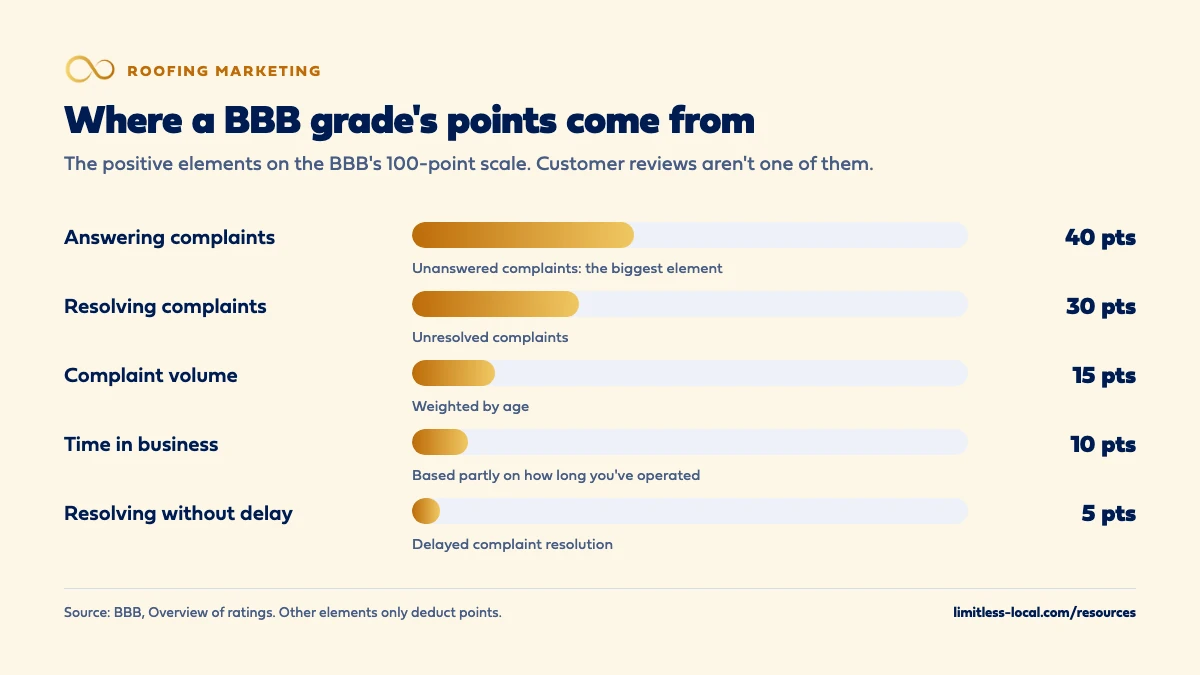
The scoring is published. Each element adds or takes away points on a 100-point scale, and the biggest element that adds points is unanswered complaints, worth up to 40. Unresolved complaints are worth up to 30, complaint volume weighted by age up to 15, time in business up to 10, and delayed complaint resolution up to five. Grades run from A+ at 97 and above down to F below 60.
For a roofer, the lesson is simple: the BBB rewards answering and resolving complaints, not collecting praise. A complaint that sits unanswered does more damage to the grade than any number of five-star reviews can repair.
Should a roofer pay for BBB accreditation?
That’s a business decision, and the BBB itself separates it from the grade. Its FAQ says accreditation is voluntary, that a business can have an A+ rating without being accredited, and that accreditation dues don’t buy a rating or remove a complaint. To apply, a business needs a B rating or better and at least six months of serving customers. Accredited businesses can display the BBB Seal and get access to dispute resolution.
In our view, accreditation is worth a look if your homeowners are the kind who check, such as older homeowners or insurance-claim customers who want reassurance, or if you’d put the Seal on trucks, yard signs and estimates. It isn’t a marketing channel on its own. Either way, the free part matters more: claim your BBB profile, keep your details accurate, and answer every complaint.
Curious what your marketing is actually booking?
Get a free visibility audit — no obligation, no sales pitch.
Why shouldn't I ask roofing customers for Yelp reviews?
Because Yelp asks you not to. Its support page titled Don’t Ask for Reviews says asking for reviews may hurt your Yelp rating, because its automated software may not recommend reviews that seem to be prompted or encouraged by the business. Yelp’s guidance is not to ask anyone, whether customers, mailing lists, friends or family, not to have staff compete for reviews, and not to follow a survey or feedback form with a request for a Yelp review.
That’s very different from Google, which lets you ask every customer for an honest review. So the review text you send after a finished roof should point to Google, and Yelp gets left alone. Yelp says asking can hurt your Yelp rating for exactly that reason, so pushing customers there can cost you the review and some of the customer’s goodwill.
Then what should a roofer do on Yelp?
Less than you’d think, and none of it is asking. Claim the page so you control the business name, phone, hours and service area, and keep those details identical to your Google profile and website. Add real photos of your roof work. Read what’s there now and then, and reply calmly to anything that needs a public answer.
Beyond that, Yelp’s own advice is that great reviews come from a memorable customer experience with no request attached. For a roofer, the time is better spent on the Google ask and on the follow-through that makes a homeowner want to tell someone.
Do Facebook reviews matter for a roofing company?
More for how your Page looks than for anything else. Facebook says a Page’s rating is based on reviews and recommendations people share about the business on Facebook, that only Pages with recommendations turned on can show a rating, and that a Page may have no rating until it has at least 5 reviews. Only recommendations shared publicly count toward the score, and Facebook says it does not verify that reviewers actually used the service.
If you run Facebook ads or post your finished jobs there, homeowners will tap through to your Page, and an empty or stale Reviews tab looks odd for a company that’s been roofing for years. In our view, it’s reasonable to mention Facebook as a second option to customers who say they don’t use Google, but not to split your main review ask between the two. If you’re weighing Facebook as a lead source, whether Facebook ads work for roofers covers that separately.
Do these sites affect whether ChatGPT or other AI tools recommend me?
Nobody outside those companies can say exactly. OpenAI’s help page on ChatGPT search says it partners with other search providers, and that it may share a general location, based on your IP address, with those third-party search providers to find local results. It doesn’t publish which listings or review sites it draws on, or how it weighs them.
Our judgement is that AI tools tend to repeat what the web already says about you, so a roofer with a clean BBB file, accurate listings and steady Google reviews gives them less to trip over. We wouldn’t spend money on any of these sites for AI reasons alone. Getting recommended by ChatGPT covers what a roofer can actually control there.
How should a roofer split review time between Google and the rest?
- Google first, every job. This is the only site where you should actively ask every customer. Getting more Google reviews after a replacement covers who asks, when and how.
- BBB complaints next. Claim the profile and answer every complaint promptly, since unanswered complaints carry the most points in the grade.
- Make the details match. Business name, phone, address and service area should read the same on Google, Facebook, Yelp and the BBB. Matching your info on every listing explains why.
- Facebook as a backup. Turn recommendations on and reply to the reviews you get.
- Yelp: claim it, don’t ask. Keep the page accurate and leave the reviews to customers who come on their own.
For most roofing companies this is a once-a-month check, not a daily job, except for complaints, which deserve a same-week answer.
What if there's a bad review or complaint on one of these sites?
Handle it on the site where it lives. Google says issues with a third-party review have to go to the other website directly, and each site has its own rules on what it will remove. A BBB complaint is a formal request for help with a dispute: the BBB forwards it to you and asks for a response, and the complaint becomes part of your public profile. Answering it, and making a good-faith effort to resolve it, is exactly what the grade measures.
For a review you think is unfair, the same principles apply as on Google: a short, factual reply, no private details about the job, and nothing offered in exchange for changing it. Handling an unfair Google review walks through the reply itself.
Want to see where your company stands?
A free visibility audit shows where you show up on Google, Maps and AI answers, and what it's costing you in calls.
What's different for roofing companies
Storms send homeowners looking for red flags. After hail or high winds, homeowners hear a lot about out-of-town crews, and the FTC’s storm advice tells them to search a contractor’s name with words like scam and complaint. A local roofer with a long, quiet BBB file and an accurate Facebook Page has an easy story to tell. One with an ignored complaint from three summers ago does not.
Insurance jobs produce complaints that aren’t about the roof. In our experience, a homeowner unhappy with a claim outcome sometimes files against the roofer because the roofer was the face of the job. Those complaints still count on the BBB if they go unanswered. Answer them on the facts of your work, without commenting on the insurer’s decision.
Roofs are bought rarely. A homeowner may hire a roofer once in many years, so there’s no regular customer base checking back on your pages. That makes the profiles they find on the one day they search matter more, and it’s why the details on every site need to be current, not just the ones you set up when you started.
A worked example: what one ignored complaint file does to a BBB grade
This uses the BBB’s published point ranges, with a made-up roofer to show the math. The positive elements top out at 40 points for answering complaints, 30 for resolving them, 15 for complaint volume, 10 for time in business and five for resolving complaints without delay, which adds up to the full 100.
- Say a roofer has a few complaints from a busy storm season and never answers any of them. In the worst case, the unanswered-complaints element scores zero, so the best score left is 60 points: 100 minus 40.
- On the BBB’s letter scale, 60 sits at the bottom of the D- band. Every other element would have to be perfect just to hold that.
- Now say the same roofer has dozens of glowing BBB reviews from happy homeowners. None of them changes those points, because the BBB doesn’t use reviews in the grade.
The real calculation depends on how many complaints, how old they are and the size of the business, so a real file rarely lands exactly on these numbers. The point holds anyway: on the BBB, answering complaints is worth more than collecting praise.
If you’d rather not keep track of this yourself, our Essentials package is $3,500 a month for one location and includes business listing cleanup, review responses and basic review generation alongside Google Business Profile management.
Frequently asked questions
Can I ask a customer to copy their Google review to Yelp?
Yelp’s guidance is not to ask anyone for a Yelp review, and its software may not recommend reviews that seem to have been prompted. Keep your ask on Google and let Yelp reviews come on their own.
Does a BBB A+ mean I'm accredited?
No. The BBB says accreditation and the rating are separate, and a business can have an A+ without being accredited. The profile shows both.
Can I pay for reviews on the BBB?
No. The BBB says it requires the reviewer’s name on a review, monitors IP addresses and rejects paid reviews. And since reviews don’t count toward the grade anyway, there’s nothing to gain.
Should I put my BBB rating or Facebook score on my website?
If it’s accurate and current, it can reassure careful homeowners. The BBB says a Seal shown off its own site may be out of date, and homeowners are told to check the profile on BBB.org, so link to it rather than just showing a badge.
Do Angi or Nextdoor reviews matter the same way?
The same thinking applies: know each site’s rules before you ask, keep your details accurate, and answer complaints. None of them replaces the Google reviews homeowners see in Search and Maps.
How often should I check these sites?
A monthly look is enough for most roofers, plus an alert or email notice for new BBB complaints, which deserve a prompt answer. Check more often after a storm, when more homeowners are searching your name.
Key takeaways
- Google reviews do the most work for a roofer; put the active asking there.
- Google can show other sites’ reviews on your profile, and you can’t choose or block them.
- The BBB grade ignores reviews and is built mostly on answering and resolving complaints.
- Don’t ask for Yelp reviews; Yelp says requested reviews may not be recommended.
- Facebook shows a rating only with recommendations on and enough public reviews.
- Claim every profile, keep the details identical, and answer complaints promptly.
Not sure what's working right now?
Start with a free visibility audit: rankings, Google profile, reviews and tracking, checked against your service area.
More in this section
- Can a roofing company use a Facebook page instead of a website?
- Do Facebook ads work for getting roofing leads?
- How do I get more Google reviews after a roof replacement?
- Can a roofer offer a discount in exchange for Google reviews?
- Do Local Services Ads help a roofer rank on Google Maps?
Sources
- About third-party reviews — Google Business Profile Help
- Tips to improve your local ranking on Google — Google Business Profile Help
- Overview of BBB ratings — BBB
- Frequently asked questions about BBB — BBB
- Don't Ask for Reviews — Yelp Support Center
- How Page review count and recommendation score are determined — Facebook Help Center
- How To Avoid Scams After Weather Emergencies and Natural Disasters — Federal Trade Commission
- ChatGPT search — OpenAI Help Center