
Can a roofer offer a discount in exchange for Google reviews?

- Is it OK to give roofing customers a discount, gift card or raffle entry for a Google review?
- Is it against Google's rules to give a discount for a review?
- Does it matter if I don't ask for five stars?
- What about a raffle, a drawing or a gift card for everyone who reviews?
- Can I donate to charity for every review instead?
- Can I knock money off the roof, or help with the deductible, for a review?
- Can I reward my salespeople or crews for getting reviews?
- What happens if Google catches incentivized reviews?
- Does the FTC care about review incentives too?
- What can a roofer offer instead of a discount?
- I already offered a discount for reviews. What should I do now?
- Do the same rules apply on Facebook, Yelp and other review sites?
- What's different about review incentives for roofing companies
- A worked example: what a review discount really costs
- Frequently asked questions
- Key takeaways
- More in this section
- Sources
The short version
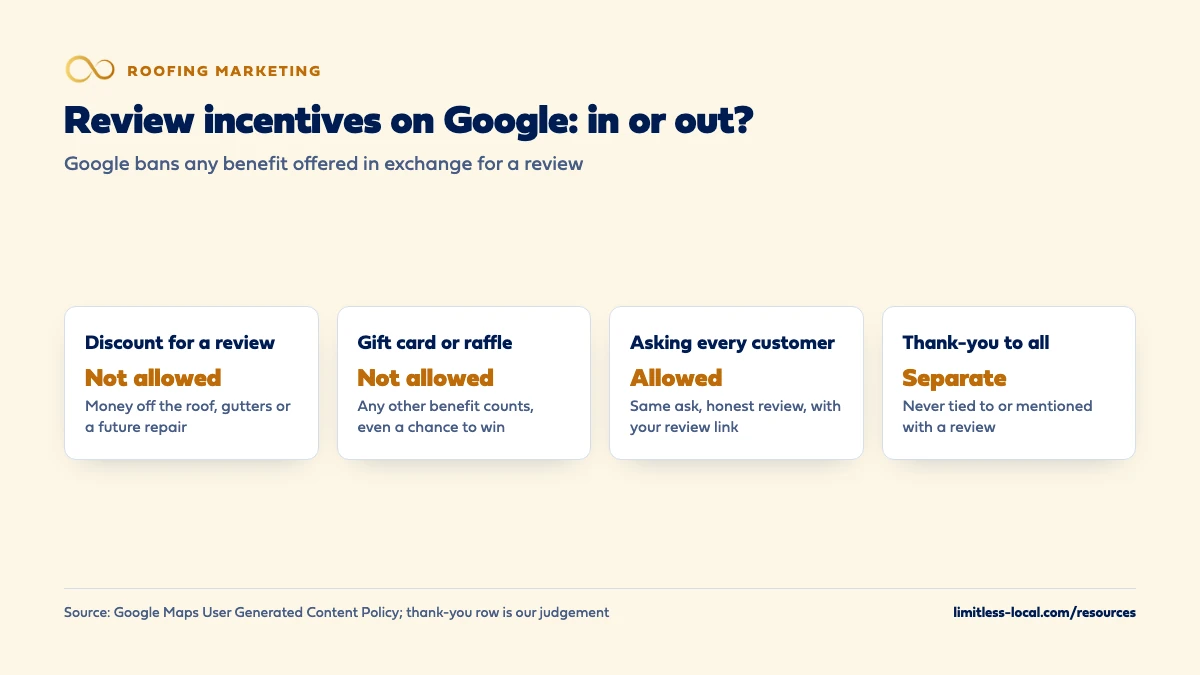
- Google bans discounts, gift cards, raffles and any other benefit offered for a review.
- "Honest reviews only" doesn't help: Google's ban covers any review, good or bad.
- Incentivized reviews are removed for good, and the profile can be restricted or labeled.
- Ask every customer the same way, with your review link, and offer nothing for it.
For roofing company owners tempted to trade a discount, a gift card or a prize drawing for more Google reviews.
Get a free visibility audit · Book a growth call
Is it OK to give roofing customers a discount, gift card or raffle entry for a Google review?
No. Google’s Maps content policy bans offering any incentive, including payment, discounts, free goods or services, for posting a review, even if you only ask for an honest one, and it removes incentivized reviews and can restrict the profile. That covers money off the roof, gift cards, raffle entries and similar rewards. Instead, ask every customer for an honest review the same way, make it easy with your Google review link, and keep any thank-you gift completely separate from the request.
Review response and review generation done within Google’s rules are part of our local SEO work for roofing companies, because reviews shape both who homeowners call and how your Google profile ranks. For where reviews fit among every other way to get roofing jobs, see our guide on how to get roofing leads, and the roofing marketing questions library takes the rest one at a time.
Is it against Google's rules to give a discount for a review?
Yes. Google’s Maps content policy says businesses must not offer incentives, such as payment, discounts, free goods or services, in exchange for posting any review, or for changing or removing a negative one. Content posted because of an incentive offered by a business counts as rating manipulation, which Google says is not allowed and will be removed from Maps. Source: Prohibited & restricted content.
Google’s definition is broad on purpose. It describes incentivized reviews as reviews and ratings influenced by a payment, discount, free goods or services, “or any other benefit offered to the reviewer”. Source: Incentivized or Biased Reviews. Its review tips for business owners repeat the point: offering free or discounted goods or services in exchange for reviews is treated as fake and misleading content. Source: Tips to get more reviews.
So “10% off your gutter cleaning if you leave us a review”, “$50 back when you post” and “a free inspection for your neighbor if you review us” are all the same thing to Google: a benefit in exchange for a review.
Does it matter if I don't ask for five stars?
Not on Google. This is where owners get mixed up, because the FTC and Google draw the line in different places.
The FTC’s reviews rule doesn’t ban incentives for reviews outright. It prohibits incentives that are conditioned, expressly or by implication, on the review saying something positive (or negative), and the FTC adds that failing to disclose an incentive can violate the FTC Act. Source: The Consumer Reviews and Testimonials Rule: Questions and Answers. The FTC’s own guide for marketers then says to know the platform’s rules first, because some platforms prohibit reviews from people who got an incentive even if the review discloses it. Source: Soliciting and Paying for Online Reviews.
Google is one of those platforms. Its policy bans incentives for posting any review, with no exception for honest, neutral or disclosed ones. So a discount offered for “an honest review, good or bad” may sit inside the FTC’s line and still break Google’s.
What about a raffle, a drawing or a gift card for everyone who reviews?
Same answer for Google. A chance to win a prize is still a benefit offered for posting a review, and Google’s definition covers “any other benefit offered to the reviewer”. Source: Incentivized or Biased Reviews. It doesn’t matter that only one customer wins, or that everyone who reviews gets the same small card.
The FTC treats small prizes as real incentives too. Its endorsement guidance says that even an entry in a sweepstakes or a contest, or a product worth only a few dollars, may need to be disclosed if knowing about it would affect how readers weigh the review. Source: FTC’s Endorsement Guides: What People Are Asking. And the FTC’s examples of an implied “must be positive” condition include a coupon offered for telling the business how much you loved your visit, and prizes for telling friends about all the fun you had. Source: Consumer Reviews and Testimonials Rule Q&A.
Can I donate to charity for every review instead?
The money doesn’t go to the customer, but we’d still leave it alone for Google reviews. Google’s pages don’t address donations specifically, and in our judgement it isn’t worth testing on the profile that brings in your calls.
The FTC addresses the donation question directly. It says that if readers would evaluate reviews differently knowing a donation motivated them, there should be a disclosure, and it suggests erring on the side of caution. Source: FTC’s Endorsement Guides: What People Are Asking. If you want to support a local cause, sponsor it as the company, separate from any review request.
Can I knock money off the roof, or help with the deductible, for a review?
No. A price reduction on the job is a discount, and Google’s policy names discounts by word. It makes no difference whether the money comes off the contract, the final invoice, a future repair or an add-on like gutters.
Insurance jobs deserve extra care. Many roof replacements involve a homeowner’s claim, and the final conversations are about the deductible, the supplement and the last check. In our judgement, a review request should never appear anywhere near those conversations, so that nothing about the money could look like it depends on the review. This is general information about review rules, not legal or insurance advice, and how your state treats deductibles is a separate question for your attorney.
If insurance work is part of how you market the company, mentioning insurance claims in your ads covers that side.
Curious what your marketing is actually booking?
Get a free visibility audit — no obligation, no sales pitch.
Can I reward my salespeople or crews for getting reviews?
Not in the way most roofing companies try it. Google’s policy says businesses shouldn’t ask staff to bring in a certain number of reviews, or to get reviews that include specific content, including content that names a staff member. Source: Prohibited & restricted content. A monthly review contest between reps, or a bonus per review that mentions the rep’s name, runs straight into both.
In our judgement, the fair version is to reward the ask, which the rep controls, rather than the review, which they don’t: did they ask on every completed job and text the link? Keep review totals at the company level. Your own staff and family shouldn’t review the company either, since Google counts current or former employment and family ties as a conflict of interest.
The full process for who asks, when and what they say is in getting reviews after a roof replacement.
What happens if Google catches incentivized reviews?
First, the reviews go. Google says incentivized reviews are not allowed and will be removed, and that reviews removed for policy violations won’t be restored. Sources: Prohibited & restricted content and About missing or delayed reviews.
Then the profile itself can be restricted. Google says that if it determines a business owner violated its fake engagement policy, it might place restrictions on the profile in addition to removing the reviews. Its examples:
- The profile can’t receive new reviews or ratings for a set period.
- The profile’s existing reviews and ratings are unpublished for a set period.
- The profile shows a warning telling customers that fake reviews were removed.
Google says it emails owners before applying a restriction, and that businesses can appeal. Source: Business Profile restrictions for policy violations. For a roofer, a warning label on the profile homeowners check before letting you on their roof is a far bigger cost than any discount saved.
Does the FTC care about review incentives too?
Yes, separately from Google. The FTC’s Rule on the Use of Consumer Reviews and Testimonials went into effect on October 21, 2024, and the FTC says it authorizes courts to impose civil penalties for knowing violations. Among other things, it prohibits providing compensation or other incentives conditioned on reviews expressing a particular sentiment. The FTC says paying incentives for five-star reviews violates the rule even if you ask reviewers to disclose the incentive, and that this applies on your own site and on third-party review platforms. Source: The Consumer Reviews and Testimonials Rule: Questions and Answers.
The FTC also warns that if you hire a reputation or marketing company to boost your reviews, you can be held responsible for what it does on your behalf, and review platforms could suspend or remove your listings. Source: Soliciting and Paying for Online Reviews. Ask any vendor exactly how the reviews come in. This page is general information, not legal advice.
What can a roofer offer instead of a discount?
Google’s policy says businesses may ask customers to post about a genuine experience, as long as they don’t offer incentives or try to influence the rating or the content. Source: Prohibited & restricted content. That leaves plenty of room:
- Ask every customer. Every completed replacement and repair, the same way, not just the ones you think went well.
- Make it easy. Google says you can ask customers to visit a Google link or scan a QR code to leave a review. Source: Tips to get more reviews.
- Do the job well and clean up. The nail sweep and the final walkthrough are what homeowners write about.
- Reply to the reviews you get. Google says honest, balanced reviews help customers decide, and recommends replying.
A thank-you that goes to every customer when the job closes, such as a handwritten card or a small gift, is a different thing from an incentive, in our judgement, as long as it’s never mentioned in the same breath as a review and never depends on one. If you can’t keep the two apart cleanly, skip the gift.
I already offered a discount for reviews. What should I do now?
In our judgement, the steps are simple:
- Stop the offer everywhere. Pull it from leave-behind cards, invoices, follow-up emails and texts, your website and social posts.
- Don’t replace it with a quieter version. A raffle, a donation or a “thank-you credit” tied to a review is the same problem.
- Switch to a plain ask. The same request to every customer, with the review link.
- Watch your email. Google says it emails owners before restricting a profile. If a restriction arrives, read it carefully before you appeal.
Expect that some reviews may disappear if Google decides they were incentivized. Losing a few reviews you shouldn’t have had is better than a warning label. If you’re rebuilding after a drop, a healthy monthly review pace gives you something steady to aim for.
Do the same rules apply on Facebook, Yelp and other review sites?
Each platform sets its own rules, and the FTC’s advice is to know them before you ask for reviews: some prohibit incentivized reviews even when disclosed, and others allow them with a proper disclosure. Source: Soliciting and Paying for Online Reviews. The FTC’s rule on conditioned incentives applies wherever the review appears.
In our judgement, the simplest policy for a roofing company is one rule for every site: ask, never pay. Whether those other sites are worth your effort at all is covered in roofing reviews on Facebook, Yelp and the BBB.
Not sure which of these is costing you jobs?
A free visibility audit checks the Google profile, reviews, site and tracking, and shows what to fix first.
What's different about review incentives for roofing companies
Big tickets make small discounts look harmless. Next to a roof replacement, a modest credit for a review feels like a rounding error. To Google it’s still a discount for a review, and the size doesn’t matter.
Money conversations are already crowded. Deductibles, supplements, financing and final checks all land at the end of a roofing job. In our judgement, that’s exactly why the review ask should stand alone, with no money nearby.
Storm-season pressure. After a big storm, new crews show up with fresh profiles, and some owners feel pushed to match their review counts quickly. A steady, honest ask on every job is slower but keeps your profile safe; incentives put the whole profile at risk.
Canvassing and leave-behinds. Roofers print a lot of cards and door hangers. Check that none of them still carry an old “review us and save” offer.
A worked example: what a review discount really costs
These numbers are made up to show the math, not a benchmark. Say a roofing company finishes 15 jobs a month and is thinking about offering $100 off a future gutter cleaning to every customer who posts a Google review. If every customer took it, that’s $1,500 a month, or $18,000 a year, in discounts.
Now the risk side. Under Google’s policy, those reviews can be removed and won’t be restored, and the profile can be blocked from new reviews, have its existing reviews unpublished for a period, or carry a warning about removed fake reviews. The company would have paid for reviews it then loses, plus a label on its profile during the months it most needs homeowners to trust it.
The alternative costs nothing per review: the person who sold or ran each of those jobs asks for an honest review and texts the link, every time. If you’d rather hand that off, review response and basic review generation are part of our Essentials package at $3,500 a month, and Growth at $4,500 a month adds advanced review generation, all within Google’s rules.
Frequently asked questions
Can I give a discount for a review on my own website instead of Google?
Google’s rules don’t govern your own site, but the FTC’s do. Its rule prohibits incentives conditioned on positive reviews wherever they appear, and the FTC says undisclosed incentives can violate the FTC Act. Source: FTC rule Q&A.
Can I offer a discount for a referral instead?
That’s a different question from reviews, and this page doesn’t cover it. What matters here is that nothing you offer customers is tied to posting, changing or removing a review.
Is it OK to ask for a review at the same time I hand over the warranty?
Yes, as long as the warranty doesn’t depend on the review and you don’t pressure them on the spot. Google says businesses shouldn’t require or pressure customers to leave reviews while on the premises.
Can I offer an incentive to remove a bad review?
Not on Google: its policy bans incentives for revising or removing a negative review. For your options with a review you think is unfair, see what to do about an unfair Google review.
Will Google know I offered a discount?
Don’t plan around whether it notices. Google says it removes content showing unusual review patterns that indicate efforts to manipulate a rating, and printed offers are easy to find.
Can I thank customers publicly in my review replies?
Yes. Google recommends replying to reviews, and a short thank-you in a reply is not an incentive.
Key takeaways
- Google bans discounts, gift cards, raffle entries and any other benefit offered for posting a review.
- Asking for an “honest” review doesn’t make a Google incentive acceptable, even if the FTC’s line is narrower.
- Incentivized reviews are removed and won’t be restored; the profile can be restricted or labeled.
- The FTC prohibits incentives conditioned on positive reviews and holds you responsible for vendors.
- Ask every customer the same way with your review link, and keep any thank-you gift separate.
- If you already offered a discount, stop it everywhere and switch to a plain ask.
Want a second set of eyes on your setup?
We'll look at how you show up locally and where calls are leaking, then send you a plain-English breakdown.
More in this section
- How many new Google reviews a month should a roofer get?
- What should a roofer do about an unfair Google review?
- How do I get more Google reviews after a roof replacement?
- Do Local Services Ads help a roofer rank on Google Maps?
- Are Google Local Services Ads worth it for a roofing company?
Sources
- Prohibited & restricted content — Maps User Generated Content Policy Help
- Incentivized or Biased Reviews — Maps User Generated Content Policy Help
- Tips to get more reviews — Google Business Profile Help
- Business Profile restrictions for policy violations — Google Business Profile Help
- About missing or delayed reviews — Google Business Profile Help
- The Consumer Reviews and Testimonials Rule: Questions and Answers — Federal Trade Commission
- Soliciting and Paying for Online Reviews: A Guide for Marketers — Federal Trade Commission
- FTC's Endorsement Guides: What People Are Asking — Federal Trade Commission