
Can a roofing company mention insurance claims in its ads?
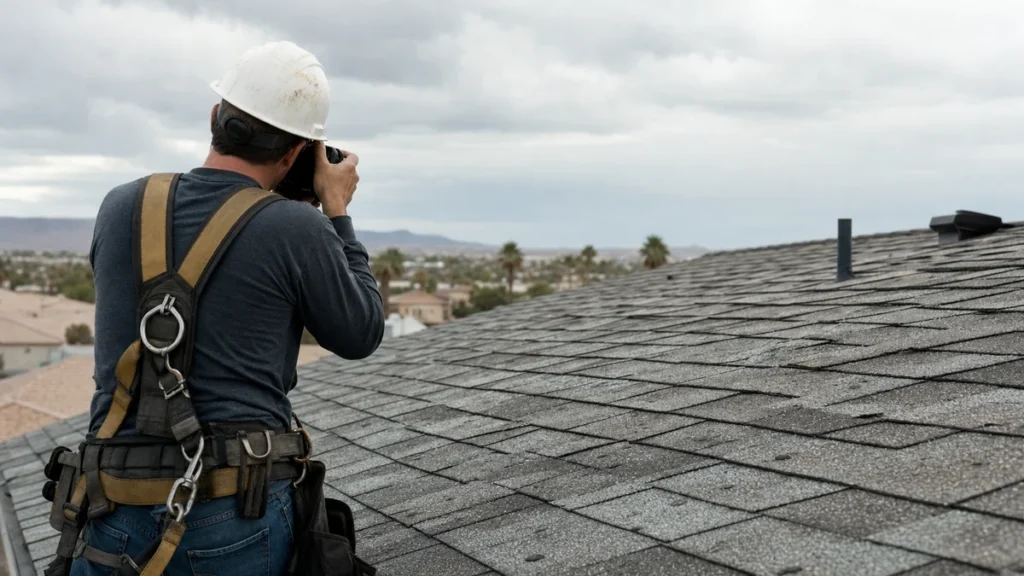
- What can a roofer say about insurance claims in storm ads without crossing a line?
- What can a roofing ad safely say about insurance claims?
- Which insurance claim phrases get roofing ads in trouble?
- What does Florida require in roofing ads about insurance claims?
- What does Texas say about deductibles and adjusting claims in ads?
- What about Minnesota and other states?
- Can I advertise a free roof inspection after a storm?
- Do storm and insurance ads break Google Ads policies?
- What should my landing page say about insurance work?
- Who's responsible if a canvasser or my agency writes the ad?
- What's different about insurance wording for roofing companies
- A worked example: rewriting a storm ad
- Frequently asked questions
- Key takeaways
- More in this section
- Sources
The short version
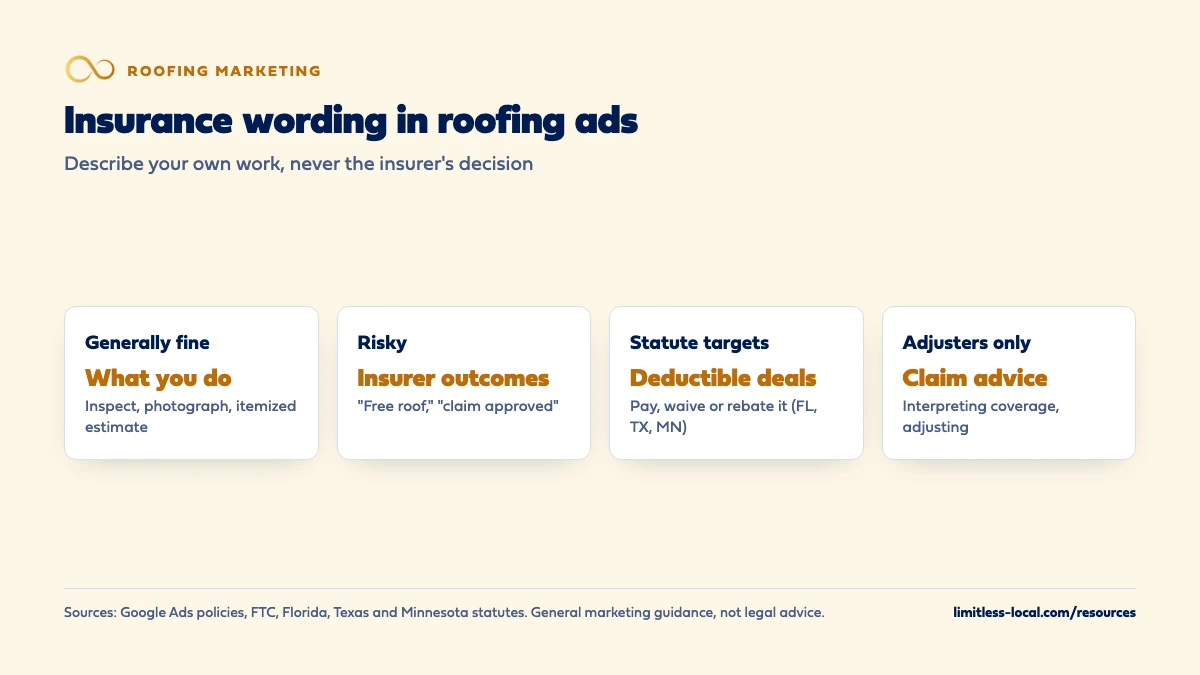
- Say what you do (inspect, photograph, write an itemized estimate), never what the insurer will do.
- Never advertise paying, waiving or rebating a deductible; Florida, Texas and Minnesota all have statutes against it.
- Don't offer to interpret a policy or handle the claim; Florida and Minnesota reserve that for licensed public adjusters, and Texas bars contractors from it.
- Google Ads bars misleading claims and ads that exploit a natural disaster or other sensitive event.
- Check your state's rules with an attorney; this is marketing guidance, not legal advice.
For roofing owners who want to run storm and insurance-claim ads without tripping Google’s ad policies or state rules, and without giving homeowners insurance advice. This is general marketing guidance, not legal advice.
Get a free visibility audit · Book a growth call
What can a roofer say about insurance claims in storm ads without crossing a line?
Generally yes: a roofing company can say it inspects for storm damage, documents what it finds and does insurance-claim work, as long as the ad is truthful and doesn’t promise what the insurer will pay or approve. The limits depend partly on the state: Florida, Texas and Minnesota, for example, have statutes aimed at offering to pay or waive a homeowner’s deductible, and Florida sets required disclosures for contractor ads that encourage a roof-damage claim. Google Ads separately bars misleading claims and ads that exploit natural disasters. This is general marketing guidance, not legal advice, so check your own state’s rules with an attorney before you run claim-related ads.
Insurance-claim wording is where storm ads most often go wrong, and the fix is usually plainer copy, not less advertising. We write and run Google Ads for local contractors, including roofing companies, but we don’t give legal advice, so state-specific disclosures are something to confirm with your attorney. For the wider storm plan, storm season roofing marketing covers making the insurance process clear for homeowners, and the roofing marketing questions library takes one question at a time.
What can a roofing ad safely say about insurance claims?
The FTC’s advertising guide for small businesses sets three rules: advertising must be truthful and non-deceptive, advertisers must have evidence to back up their claims, and ads can’t be unfair. It adds that every state has its own consumer protection laws governing ads that run there (FTC).
In our judgement, the safe pattern is to describe what your company does and leave what the insurer does out of it. Lines like these describe your work:
- “We inspect roofs for hail and wind damage and photograph what we find.”
- “You get a written, itemized estimate.”
- “We do insurance-claim and retail roofing jobs.”
- “We can be there when your adjuster inspects, if you’d like.”
What a roofing ad shouldn’t do is tell a homeowner what’s covered, what the claim will pay, or that it will be approved. Those are the insurer’s decisions, and Florida and Minnesota, for example, reserve coverage advice for licensed public adjusters.
Which insurance claim phrases get roofing ads in trouble?
Phrases we’d keep out of any roofing ad, landing page, door hanger or text:
- “We’ll pay (or cover, or waive) your deductible.” Florida, Texas and Minnesota each have a statute aimed at this (below).
- “Free roof” or “no cost to you.” Google’s Misrepresentation policy bars pricing that creates a false or misleading impression of cost and requires the full expense a user will bear to be clearly disclosed (Google Ads policy). A homeowner with a claim still owes the deductible.
- “We’ll get your claim approved.” The same policy bars claims that entice users with an improbable result as the likely outcome. You don’t control the approval.
- “We handle your claim” or “We’ll deal with your insurance company for you.” In our judgement this reads as adjusting the claim, which Texas bars contractors from advertising and Florida and Minnesota reserve for licensed public adjusters.
- An insurer’s name or logo, or “approved by” wording, when you have no such relationship. Google bars making it seem you’re supported by another brand, organization or government entity when you’re not.
Misleading promises also tend to bring calls that never sign; roofing ads getting clicks but no calls covers that side.
What does Florida require in roofing ads about insurance claims?
Florida has the most detailed rule we found, in section 489.147 of the Florida Statutes (Florida Senate). Read the statute itself; this is a summary, not legal advice.
- “Prohibited advertisement.” The statute defines it as any written or electronic communication by a contractor that encourages, instructs or induces a consumer to contact a contractor or public adjuster to make an insurance claim for roof damage, if it doesn’t state that the consumer pays any deductible, that it’s a third-degree felony for a contractor to knowingly pay, waive or rebate a deductible with intent to defraud, and that it’s a third-degree felony to intentionally file a false, incomplete or misleading claim. The disclosures must be in at least 12-point type and at least half as large as the largest font in the communication. The statute names door hangers, business cards, magnets, flyers, pamphlets and e-mails as included.
- Soliciting with one. A contractor may not solicit a residential property owner by means of a prohibited advertisement. “Soliciting” is defined as contacting in person, by electronic means directed to a specific person, or by delivery to a specific person.
- Nothing of value for an inspection or a claim. A contractor may not offer a rebate, gift, gift card, cash, coupon, deductible waiver or any other thing of value in exchange for letting it inspect the roof or for making a claim.
- No paid referrals for services paid for by property insurance proceeds.
- No coverage advice. A contractor may not interpret policy provisions, advise an insured about coverages or duties, or adjust a claim unless it holds a public adjuster license.
- Penalties. Violations bring disciplinary proceedings and a fine of up to $10,000 per violation.
The statute also sets contract notices, which belong in your paperwork rather than your ads. How the advertising definition applies to a specific search ad, social post or landing page is a question for a Florida attorney.
What does Texas say about deductibles and adjusting claims in ads?
Two Texas statutes matter here (summarized, not legal advice):
- Deductibles. Section 27.02 of the Business and Commerce Code makes it an offense, a Class B misdemeanor, for a seller to advertise or promise a good or service paid from a property insurance claim where the seller will, without the insurer’s consent, pay, waive or absorb the deductible, give a rebate or credit that offsets it, or otherwise help the insured avoid paying it (Texas Business and Commerce Code). Contracts of $1,000 or more expected to be paid from claim proceeds must carry a notice, in at least twelve-point boldface, that Texas law requires the insured to pay the deductible.
- Adjusting. Section 4102.163 of the Insurance Code says a contractor may not act as a public adjuster or advertise to adjust claims for any property it is or may be doing contracting work on, whether or not it holds an adjuster license (Texas Insurance Code).
In our judgement, the second rule is the easy one to trip over, because “we handle the insurance for you” sounds like good service. Describe the inspection and the estimate instead.
Curious what your marketing is actually booking?
Get a free visibility audit — no obligation, no sales pitch.
What about Minnesota and other states?
Minnesota section 325E.66 applies to residential contractors, including residential roofers, doing work paid from a property or casualty insurance policy (Minnesota Statutes). It says they shall not:
- advertise or promise to pay all or part of any deductible, or offer compensation for allowing an inspection, making a claim, or referring the contractor’s services when insurance proceeds are payable;
- give an agreement authorizing repairs without a good faith, itemized estimate; or
- interpret policy provisions, advise on coverage, or adjust a claim without a public adjuster license.
The contractor must also give a written notice of these requirements with its initial estimate, and if it breaks the rule, the insurer isn’t obligated to consider its estimate.
Other states: we’ve only summarized the three statutes we read on each state’s own website. If you work elsewhere, check your state’s contractor licensing board and insurance department, or ask an attorney, before you write claim-related copy. Don’t assume another state’s rule applies, or that it doesn’t.
Can I advertise a free roof inspection after a storm?
That depends on the state and on what comes with it, so treat this as a question for your attorney rather than something to settle from an ad template. Florida bars offering any “thing of value” in exchange for letting the contractor inspect the roof or for making a claim, and Minnesota bars offering compensation for allowing an inspection. Whether a no-charge inspection by itself counts is a legal question we can’t answer for you.
What’s clearly risky, in our judgement, is stacking incentives onto the inspection: a gift card for booking one, deductible help if you find damage, or a referral bonus for neighbors who file claims. Each runs into the rules above in at least one of the three states.
Lead instead with things you control: how fast you come out for an active leak, photos of what you find, a written estimate, your license and local reviews. Incentives raise a separate set of rules for reviews, too; see offering discounts for Google reviews.
Do storm and insurance ads break Google Ads policies?
Not by default, but two policies apply directly.
Sensitive events. Google lists natural disasters and civil emergencies among its examples of sensitive events, during which Google Ads may take a variety of actions. It prohibits products or services that exploit the event, including price gouging, and using keywords related to the event to try to drive more traffic (Google Ads policy). Google decides what counts as one, so don’t build a storm campaign on the guess that yours won’t.
Misrepresentation. Beyond the pricing and unreliable-claims rules above, Google bars clickbait or sensational text and imagery, inconsistencies between the ad and the landing page, and offering services you don’t have the licenses or qualifications for (Google Ads policy).
If an ad is disapproved, Google says you can edit it and it will be re-reviewed, which typically takes 24 to 48 hours, or appeal if you believe there was an error. For planning spend around storms, see storm-season ad budget changes.

What should my landing page say about insurance work?
Google’s Misrepresentation policy covers ads and destinations. The FTC adds that a disclosure needed to keep an ad from being deceptive should be clear and conspicuous and placed close to the claim, and fine print can’t contradict the ad (FTC).
In our judgement, a roofing page about insurance work should cover:
- Your process: inspection, photos, a written itemized estimate, and whether you’ll be there for the adjuster’s visit if the homeowner wants you.
- Who decides what: the insurer decides coverage and payment; the homeowner pays the deductible.
- Where to check coverage: the homeowner’s insurer or agent. The FTC tells homeowners not to rely on a contractor to tell them what’s covered (FTC Consumer Advice), so saying the same thing builds trust.
- Any state disclosures your attorney says apply, placed near the claim language, not in the footer.
- Proof you’re local: license, insurance, address and reviews.
For the rest of what a roofing page needs to turn visits into calls, see a roofing website that gets estimate requests.
Who's responsible if a canvasser or my agency writes the ad?
Usually you are, and possibly they are too. Florida’s statute says the acts of anyone acting on a contractor’s behalf, including a compensated employee or a non-employee paid to solicit, are treated as the contractor’s own. The FTC’s guide says an advertising agency may also be held legally responsible for misleading claims and has a duty to check the substantiation itself rather than rely on the advertiser’s word.
In our judgement, the practical fix is a short written list of approved and banned insurance phrases, shared with everyone who writes for you: office staff, canvassers, your agency. Update it when you add a state.
What's different about insurance wording for roofing companies
Insurance work runs through roofing. Hail and wind damage turn into claims, so roofers write insurance-adjacent copy often, and the Florida and Minnesota statutes name roofs and roofers specifically.
Storms compress everything. After a storm, roofers launch ads, door hangers and texts in days. In our judgement, that’s exactly when banned phrases slip in, so write and approve your storm copy before the season, not the morning after.
Homeowners have been warned. The FTC tells them to be skeptical of anyone promising immediate repairs after a weather emergency. Copy that sounds like the warning works against a local roofer, even where it’s legal.
Not sure which of these is costing you jobs?
A free visibility audit checks the Google profile, reviews, site and tracking, and shows what to fix first.
A worked example: rewriting a storm ad
This is an illustration, not a real client or a legal review. Picture a roofer whose post-storm search ad reads: “Hail damage? Get a FREE roof paid by insurance. We cover your deductible and handle your claim. Call now!”
- “FREE roof paid by insurance” implies no cost and an outcome the roofer doesn’t control.
- “We cover your deductible” is what the three state statutes target.
- “Handle your claim” reads as adjusting.
A rewrite that describes only the roofer’s own work: “Hail damage roof inspections in [town]. Photos of what we find and a written, itemized estimate. Licensed and insured.” The landing page explains the process, says the homeowner pays the deductible and confirms coverage with their insurer, and carries whatever state disclosures the roofer’s attorney says apply.
Fixing copy like this is part of ordinary ad management. Our Essentials package is $3,500 a month and includes Google Ads management for up to $2,500 a month in ad spend, which is paid to Google separately; Growth adds Local Services Ads. Neither includes legal review, and no package can promise a storm will bring calls.
Frequently asked questions
Can I say "we work with all insurance companies" in a roofing ad?
Only if it’s true and doesn’t imply a relationship you don’t have. Google’s Misrepresentation policy bars making it seem you’re supported by another brand or organization when you’re not, so leave out insurer names and logos unless you have permission.
Do Florida's disclosure rules apply to my Google search ads?
Florida’s definition covers written or electronic communications that encourage a roof-damage claim, and its soliciting rule covers electronic contact directed to a specific person. How that applies to a given search ad is a question for a Florida attorney, not an ad template.
Can I pay customers or neighbors for referrals on insurance jobs?
Florida bars offering or paying compensation for referrals of services paid by property insurance proceeds, and Minnesota bars offering compensation for referrals when insurance proceeds are payable. Elsewhere, ask an attorney before you offer one.
Can my ad say "Hail damage? We can help with your claim"?
In our judgement, “help with your claim” is too close to adjusting. “We inspect and document hail damage and give you a written estimate” says what you do without it.
Do these rules apply to Google Business Profile posts and door hangers?
The same principles apply to everything you publish. Florida’s definition covers any written or electronic communication and names door hangers specifically.
Who should check my insurance-claim ads before they run?
An attorney who knows your state’s contractor and insurance rules. Whoever manages your ads can keep copy truthful and within platform policy, but that doesn’t replace legal review.
Key takeaways
- Ads can mention insurance-claim work; describe what you do, never what the insurer will pay or approve.
- Never advertise paying, waiving or rebating a deductible; Florida, Texas and Minnesota statutes target it.
- Offering to interpret coverage or handle the claim is reserved for licensed public adjusters in Florida and Minnesota and barred for contractors in Texas.
- Google Ads bars misleading pricing, improbable outcomes and ads that exploit a natural disaster.
- Write and approve storm copy before the season, for canvassers and agencies too, and have an attorney check state rules.
Want a second set of eyes on your setup?
We'll look at how you show up locally and where calls are leaking, then send you a plain-English breakdown.
More in this section
- How should a roofing company market commercial roofing?
- Can a roofing company use a Facebook page instead of a website?
- Does my roofing company info need to match on every listing?
- How should a roofing company market metal roof installs?
- How can my roofing company stand out from other roofers online?
Sources
- Florida Statutes 489.147: Prohibited property insurance practices; contract requirements — The Florida Senate
- Texas Business and Commerce Code, Chapter 27 — Texas Legislature
- Texas Insurance Code, Chapter 4102: Public Insurance Adjusters — Texas Legislature
- Minnesota Statutes 325E.66: Insurance claims for residential contracting goods and services — Minnesota Office of the Revisor of Statutes
- Misrepresentation — Google Advertising Policies Help
- Sensitive events — Google Advertising Policies Help
- Advertising FAQ's: A Guide for Small Business — Federal Trade Commission
- How To Avoid Scams After Weather Emergencies and Natural Disasters — FTC Consumer Advice