
How do Google Ads and LSAs compare for plumbing lead quality?
- How do Google Ads and Local Services Ads compare for plumbing lead quality and cost across job types?
- How do Google Ads and LSAs bring in a plumbing lead differently?
- What does lead quality actually mean when I compare them?
- Where do the bad plumbing leads come from on each?
- How does cost behave differently on LSAs and Google Ads?
- Which is better for drain cleaning and everyday service calls?
- Which is better for water heater repair and replacement leads?
- Which is better for sewer line, repipe and other big-ticket jobs?
- What about commercial or new-construction plumbing work?
- Which gives me more control over lead quality?
- How do I measure lead quality on each fairly?
- Should a plumbing company run both?
- What's different about comparing these two for plumbing companies
- A worked example: one month of LSAs and search ads side by side
- Frequently asked questions
- Key takeaways
- More in this section
- Sources
The short version
- LSAs: pay per valid lead, contact comes straight from the ad, no keyword control.
- Google search ads: pay per click, you choose the searches and the landing page.
- LSAs tend to win on service calls; search ads can win on targeted big-ticket jobs.
- Judge both on booked jobs and revenue per ad dollar, by job type.
For plumbing owners running, or about to run, both Local Services Ads and Google search ads, and trying to judge which brings better work.
Get a free visibility audit · Book a growth call
How do Google Ads and Local Services Ads compare for plumbing lead quality and cost across job types?
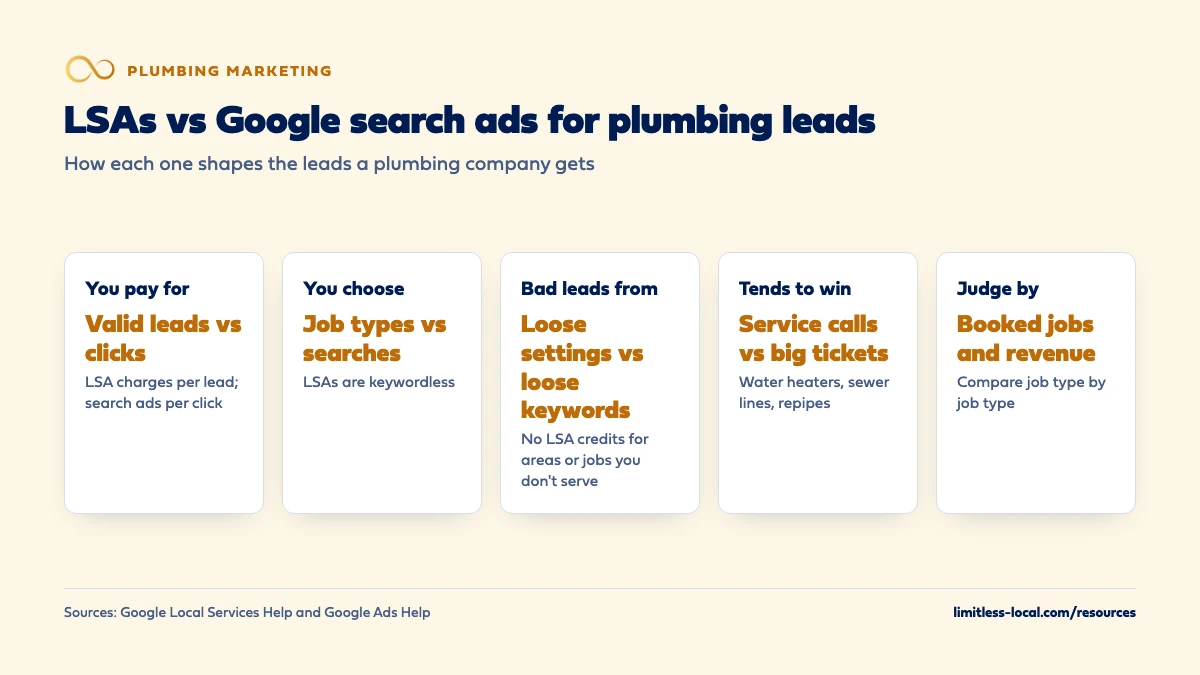
Local Services Ads usually bring plumbing leads that are ready to talk, because the customer calls or messages you straight from the ad and you pay only for valid leads, but you can’t pick the exact searches, so the job mix follows what people near you need. Google search ads charge per click and need a good landing page, but they let you choose the searches, so they’re better at targeting specific high-value work like water heater replacements, sewer lines and repipes. Neither is higher quality across the board: compare them on booked jobs and revenue per dollar, job type by job type.
Running both and reading them side by side is the kind of setup our local ads work is built for: Local Services Ads management comes in the Growth and Scale tiers of our packages, alongside Google Ads, call tracking and a monthly cost-per-lead breakdown. See how it fits plumbing companies, or browse more plumbing marketing questions.
How do Google Ads and LSAs bring in a plumbing lead differently?
The two work in opposite ways, and that shapes the leads you get.
- Local Services Ads. You choose service categories, job types and areas, not keywords. The homeowner calls, messages or requests a booking straight from the ad, and you pay for valid leads, not clicks. LSAs are moving into Google Ads as Performance Max campaigns with pay-per-lead goals, which stay keywordless, keep paying per lead and still show only on Google Search and Maps.
- Google search ads. You choose the searches you want to show for, write the ad and pick the page it sends people to. With cost-per-click bidding, you pay for each click on your ad, whether or not that person ever calls.
So LSAs hand you a conversation and let Google decide which searches bring it. Search ads hand you a visitor and let you decide exactly who that visitor is.
What does lead quality actually mean when I compare them?
Not how polite the caller was. For a plumbing company, a quality lead has four parts:
- Real and reachable. A homeowner or property manager, not spam, a vendor or a wrong number.
- The right job. Work you do and want, at a price that pays.
- The right place. Inside the towns your trucks cover.
- Likely to book. Ready to hire now, not just collecting prices for next year.
Then put a number on it: booked jobs per lead, and revenue per booked job. A channel can win on the first and lose on the second. That’s why a single “which is better” answer doesn’t hold up.
Where do the bad plumbing leads come from on each?
On Local Services Ads, Google filters spam and duplicate contacts before charging, and its models credit low-quality leads automatically over time. But Google no longer credits leads for job types you don’t service or areas you don’t serve. If your settings are loose, those leads are yours to pay for. The usual culprits are a service area drawn wider than your trucks go and job types left switched on that you don’t really want.
On Google search ads, bad leads come from searches you didn’t mean to buy: do-it-yourselfers looking up how to fix a running toilet, people looking for plumbing jobs, searches from outside your area and supply-house shoppers. You pay for the click either way. The fix is to read what people really searched and add the junk as negative keywords; Google’s guide to finding negative keyword ideas in the search terms report shows how. More junk-lead fixes for both channels are in how to cut down on junk plumbing leads.
How does cost behave differently on LSAs and Google Ads?
LSAs charge per valid lead. A valid lead includes a call you answer, a text or email, a voicemail, a booking request, or a missed call during business hours when the caller stays on the line more than 20 seconds, as Google lays out in How leads work. Lead prices may vary by location, job type, type of lead and bidding. Your cost per lead is fairly predictable; your cost per booked job depends mostly on how well your office answers.
Search ads charge per click. Your cost per lead depends on how many clicks turn into calls or forms, which depends on the landing page, the ad and the searches you bought. A good page and tight keywords can make search leads cheap; a weak page can make them very expensive.
Once LSAs move into Google Ads, their budgets become daily, with monthly spend capped at the daily average budget times 30.4, and manual bidding, such as setting a maximum cost per lead, is no longer supported.
Which is better for drain cleaning and everyday service calls?
Usually LSAs. Clogs, leaks, running toilets and no-hot-water calls are urgent, local and simple to describe, which is exactly what LSAs are built to catch. The customer calls from the ad, and you’re one of a handful of plumbers on the screen. LSAs also opt you into broad searches like “plumber near me” by default; Google’s page on industries, service areas and job types explains the setting, and you can opt out.
Search ads can work for service calls too, but you’ll compete for a lot of broad, expensive searches, and every click that doesn’t call still costs money. If your office answers fast, LSAs tend to give the lower cost per booked service call. For the emergency side in detail, see whether LSAs or Google Ads are better for emergency plumbing calls.
Curious what your marketing is actually booking?
Get a free visibility audit — no obligation, no sales pitch.
Which is better for water heater repair and replacement leads?
It’s closer. LSAs can bring water heater calls if those job types are switched on, but a “no hot water” lead could end in a $5 part or a full replacement, and you can’t choose which.
Search ads let you go after replacement intent directly: “water heater replacement,” “tankless water heater install,” and the like, sent to a page about your water heater work. Those leads often cost more to win, but a bigger share of them are replacement jobs. If water heater replacements are a big part of your plan, run both and track replacement jobs separately from repairs.
Which is better for sewer line, repipe and other big-ticket jobs?
Usually search ads, as part of the mix. Sewer line replacements, trenchless repairs, whole-house repipes and slab leak work are searched less often but are worth far more per job. Search ads let you bid on exactly those searches, write ads about them and send people to a page that builds trust for a large job.
LSAs can still bring big jobs, but they arrive mixed in with everything else your job types allow. The lead price doesn’t change much with the size of the eventual ticket, which is great when a sewer job comes in and less great when you’re paying the same lead price for small calls. Choosing which searches to buy is covered in what keywords plumbing Google Ads should target.
What about commercial or new-construction plumbing work?
LSAs are set up around job types and service areas, not around the kind of customer. If you want property managers, restaurants or builders, keyword control matters, because you can target searches that describe commercial work and send them to a page that speaks to those buyers. Before counting on LSAs for commercial calls, check which job types your plumbing category offers and switch on only the ones you want.

Which gives me more control over lead quality?
Search ads give more levers: keywords, negative keywords, locations, ad schedule, ad text and landing page. More levers means more ways to improve quality, and more ways to get it wrong if nobody checks the account every week.
LSAs give fewer, simpler levers: job types, service areas, hours, the broad-search setting and budget. Google’s page on how LSA bidding works notes that responsiveness and reviews still matter to where you show up. Fewer things can go wrong, but when quality slips you have fewer ways to fix it. If you’re paying for leads that shouldn’t have counted, the steps in disputing bad Local Services Ads leads still apply.
How do I measure lead quality on each fairly?
- Separate the sources. LSA leads show in Google Ads with a charge status. For search ads, set up phone call conversion tracking with a minimum call length, so short calls that probably aren’t jobs don’t count, and track forms too.
- Tag every lead in your field software with its source, so you can follow it to a booked job and an invoice.
- Compare by job type. Service calls against service calls, water heaters against water heaters.
- Give both enough time. A couple of months of steady spend says more than a week.
- Look at two numbers: cost per booked job and revenue per ad dollar.
For how these two stack up against your other channels, like Maps, SEO and referrals, see which plumbing channel brings the highest-quality leads.
Should a plumbing company run both?
Often, yes, once the basics are in place. A common split: LSAs for the everyday and emergency calls at the top of the page, and search ads focused on the high-value jobs you want more of, sent to matching pages. They don’t have to compete for the same budget if each one has a clear job.
Start with one if money or office time is tight. If you answer fast and have solid reviews, LSAs are usually the simpler first step. If you mostly want bigger jobs and have good service pages, search ads may come first. Either way, keep score by booked jobs and revenue, not by leads.
Not sure which of these is costing you jobs?
A free visibility audit checks the Google profile, reviews, site and tracking, and shows what to fix first.
What's different about comparing these two for plumbing companies
The same lead can be a quick service call or a five-figure job. Plumbing has one of the widest spreads between small and large tickets. A lead count alone hides that, so revenue per booked job matters as much as cost per lead.
Emergencies punish slow answers on both. On LSAs, a missed business-hours call can still be charged. On search ads, you paid for the click that rang out. Either way, the caller is already dialing the next plumber.
Freezes change the mix overnight. After a hard freeze, both channels fill with burst-pipe calls. Know how your budgets and job types should shift before that morning, so the spend goes to calls your crew can reach.
A worked example: one month of LSAs and search ads side by side
These numbers are made up to show the math, not a benchmark for your market. A plumbing shop puts $1,500 into each channel for a month.
Local Services Ads: 25 charged leads, or $60 a lead. 10 book, so each booked job cost $150. They’re mostly service calls and drains, averaging $320 a job, for $3,200 in revenue. That’s a bit over twice the ad spend back.
Google search ads: aimed at water heater replacement and sewer searches, 18 calls and forms, or about $83 a lead. 8 book, so each booked job cost about $188, more than on LSAs. But they average $900 a job, for $7,200 in revenue, close to five times the ad spend.
On cost per booked job, LSAs win. On revenue per ad dollar, search ads win. The shop keeps both, and moves search ad budget toward the job types that book. A free visibility audit can put your own two channels side by side the same way.
Frequently asked questions
Are LSA leads exclusive to my plumbing company?
The contact comes to you from your own ad, but the homeowner may also contact other plumbers shown on the same screen. Answering first still matters.
Can I choose which plumbing jobs I pay for with LSAs?
Partly. You switch job types on or off and set your service area, but you can’t pick individual searches the way you can with keywords.
Why do my search ads get clicks but no calls?
Usually the landing page, the searches you’re buying or both. Check the search terms report and test the page on a phone before raising the budget.
Do I need a website for Local Services Ads?
Customers contact you straight from the ad, so the website matters much less than for search ads. Your Google Business Profile and reviews matter more.
Which one is faster to set up?
LSAs have fewer settings, since there are no keywords, ad text or landing pages to build. Search ads take longer to set up well.
Should I turn off the broad "plumber near me" setting on LSAs?
Only if those leads book poorly for you. Turning it off may cut your lead volume, so check how broad-search leads book before you opt out.
Key takeaways
- LSAs charge per valid lead and connect you straight to the caller; search ads charge per click and depend on your landing page.
- LSA quality depends on tight job types and service areas, since Google no longer credits leads outside them.
- Search ad quality depends on the searches you buy; negative keywords cut the junk.
- LSAs tend to win on everyday service calls; search ads can win on targeted water heater, sewer and repipe work.
- Measure both on cost per booked job and revenue per ad dollar, by job type.
Want a second set of eyes on your setup?
We'll look at how you show up locally and where calls are leaking, then send you a plain-English breakdown.
More in this section
- Are LSAs or Google Ads better for emergency plumbing calls?
- Should my plumbing company start with LSAs, Google Ads or SEO?
- Should a plumber use lead form extensions in Google Ads?
- Are Google Local Services Ads worth it for plumbers?
- What is Google Ads Quality Score, and does it affect plumbing costs?
Sources
- How leads work — Google Local Services Help
- About Automated Local Services Ads lead credits — Google Local Services Help
- Edit your industries, service areas, and job types — Google Local Services Help
- Local Services Ads transition to Performance Max campaigns with pay-per-lead goals — Google Ads Help
- Cost-per-click (CPC): Definition — Google Ads Help
- Get negative keyword ideas using the search terms report — Google Ads Help
- About phone call conversion tracking — Google Ads Help
- How bidding works for Local Services Ads — Google Local Services Help