
How much faster can SEO work if my plumbing site exists?
- Does an existing plumbing website give SEO a head start, and how much?
- Does an existing website make plumbing SEO faster?
- What can an existing plumbing site give SEO a head start on?
- How do I check what my current site already has?
- What can an SEO audit reuse from my current site?
- What has to be fixed before SEO can move faster?
- When does an existing site slow plumbing SEO down?
- Should I rebuild my plumbing website or improve the one I have?
- How quickly do changes to an existing site show up on Google?
- Which plumbing searches move first on an existing site?
- Should I run ads while SEO ramps up on my existing site?
- How do I tell if SEO is working faster on my existing site?
- What's different about existing plumbing websites
- A worked example: auditing an existing plumbing site
- Frequently asked questions
- Key takeaways
- More in this section
- Sources
The short version
- An indexed site with some links and history is a head start, not a shortcut.
- The typical ramp to meaningful organic growth is still 3 to 6 months.
- Narrow job-and-town searches tend to move first; broad ones take longer.
- Technical problems, thin pages or a past penalty can make an old site slower than a new one.
For plumbing owners who already have a website, maybe an old one, and want to know whether it shortens the wait for SEO calls or holds them back.
Get a free visibility audit · Book a growth call
Does an existing plumbing website give SEO a head start, and how much?
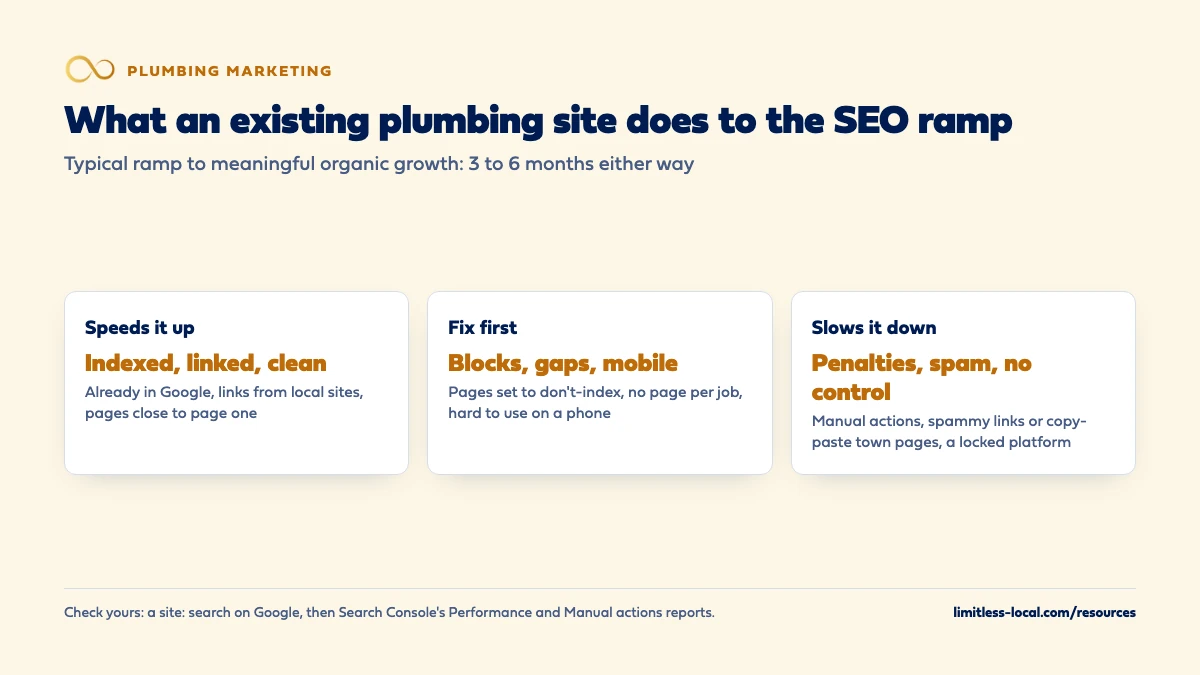
An existing plumbing website can give SEO a head start, because Google may already have it indexed and it may already have links, history and some searches it shows up for. It doesn’t skip the ramp, though: SEO typically takes 3 to 6 months to show meaningful organic growth, and an existing site mostly decides whether you land at the faster or slower end of that. A site that’s indexed, clean and has a page for each main job moves sooner; one with technical problems, thin pages or a past penalty can be slower than starting fresh.
Working out what your current site can keep and what it needs first is how our local SEO work starts, alongside your Google Business Profile, in every one of our plumbing marketing packages. The rest of the plumbing marketing questions library covers the SEO timeline from other angles.
Does an existing website make plumbing SEO faster?
Usually a little, sometimes a lot, and occasionally not at all. It depends on what the site already has going for it.
A site that’s been live for a while may already be in Google’s index, may already show up for your business name and a few service searches, and may have other websites linking to it. None of that has to be built from zero, so the work goes straight to improving what’s there.
But the bigger part of the SEO timeline isn’t building the site. It’s Google noticing your improvements, testing your pages against other plumbers’ pages, and seeing enough reviews and links to trust you for the searches you want. That part still takes months, which is why the ramp to meaningful organic growth is typically 3 to 6 months either way. How long plumbing SEO takes to bring in calls covers that ramp from scratch.
What can an existing plumbing site give SEO a head start on?
- Being in the index. If Google has already found and indexed your pages, new and improved pages on the same site tend to get found sooner.
- Links from other websites. Supply houses, local directories, the chamber of commerce, a sponsor page for a Little League team. Google’s help on improving your local ranking says local results are mainly based on relevance, distance and popularity, and that prominence is partly based on how many websites link to your business and how many reviews you have.
- Searches you already show up for. Even a page sitting on page two for “drain cleaning” in your town is closer than a page that doesn’t exist.
- Content worth keeping. Real job photos, an about page with your license and history, testimonials.
- Your domain name. Keeping the same address means links and history stay attached to it.
How do I check what my current site already has?
Two free checks tell you most of it.
First, search Google for your site. Google’s SEO Starter Guide suggests searching with the site: operator, for example site:yourplumbingsite.com. If results show up, you’re in the index. If nothing shows up, something technical is stopping Google, and that’s the first fix.
Second, open Search Console. The Performance report shows how many times your site appeared in search results (impressions), how many times people clicked, your average position, and which search queries showed your site. Sort by queries and look for three things:
- How much of your traffic is just people searching your business name.
- Which job searches you already show up for, even far down the page.
- Which towns show up in those searches.
If you haven’t set up Search Console yet, do that first. It costs nothing and every later decision leans on it.
What can an SEO audit reuse from my current site?
A good audit starts by deciding what to keep, not what to throw out:
- Pages that already show up for job or town searches. Improve them in place, at the same address, instead of replacing them.
- Pages other sites link to. Keep them, or redirect them carefully if they must move.
- Your domain and business details, so your name, address and phone number match your Google Business Profile.
- Photos and job stories that show real work in real neighborhoods.
What usually gets rewritten: a single “Services” page that lists everything in one paragraph, generic text that could be any plumber in any city, and town pages that are copies of each other with the town name swapped.
What has to be fixed before SEO can move faster?
Some problems block everything else, so they go first:
- Pages Google can’t index, often because a “don’t index” setting was left on from when the site was built.
- No page for each main job. Water heaters, drain cleaning, sewer lines, leak detection, repipes and emergency service each need their own page. How many service pages a plumbing website needs goes through which ones.
- A site that’s hard to use on a phone, where most emergency searches happen, or a phone number that isn’t tap-to-call.
- Broken pages and links left over from old redesigns.
- Business details that don’t match your Google profile and directory listings.
What needs fixing before you launch plumbing marketing covers the non-website side of the same list.
Curious what your marketing is actually booking?
Get a free visibility audit — no obligation, no sales pitch.
When does an existing site slow plumbing SEO down?
An old site isn’t always an asset. Watch for these:
- A past penalty. Search Console’s Manual actions report shows whether a human reviewer at Google found pages that don’t follow its spam policies. If a site has a manual action, some or all of it won’t be shown in search results. Fixing it and asking for reconsideration comes before anything else.
- Spammy links or pages from a past vendor, like hundreds of low-quality directory links or dozens of near-identical city pages.
- A site you don’t control, built on a platform where you can’t edit pages, add tracking or take the content with you.
- A site so dated that every page needs rewriting anyway.
In those cases the head start shrinks, and cleaning up can take as long as building fresh.
Should I rebuild my plumbing website or improve the one I have?
Improve it if it’s indexed, shows up for some job searches, you control it, and it works on a phone. Most of the head start lives in the pages and addresses Google already knows.
Rebuild if you can’t edit it, it’s broken on mobile, or it would need every page rewritten anyway. If you do rebuild, protect what you have. Google’s guide to site moves and migrations recommends permanent redirects, such as 301s, from old addresses to new ones, says to expect temporary ranking fluctuation during a move, and says a small to medium-sized site can take a few weeks for most pages to move. A rebuild that drops old pages without redirects can throw away the very head start you were counting on.
How quickly do changes to an existing site show up on Google?
Faster than a brand-new site, often, because Google already visits it. But some changes might take effect in a few hours and others could take several months, so give a change a few weeks before you judge whether it helped.
You can nudge Google to look sooner. Google’s page on how to ask Google to recrawl your URLs says you can request indexing for individual pages with the URL Inspection tool or submit a sitemap, that crawling can take anywhere from a few days to a few weeks, and that requesting a recrawl of the same page again and again won’t get it crawled any faster. Request it once, after a real change, and move on.

Which plumbing searches move first on an existing site?
In roughly this order:
- Your business name. If people can’t find you by name, something is broken.
- Narrow job-and-town searches, like “water heater replacement” plus your town, especially if a page you already have is close.
- Nearby towns where fewer plumbers have strong pages.
- Broad searches, like “plumber near me” across a whole metro, which are the most crowded and take the longest.
How crowded your market is shifts that timing a lot. How competition affects how fast plumbing SEO works explains how to size it up.
Should I run ads while SEO ramps up on my existing site?
If you need calls this month, yes. Ads can generate leads within days of launch, while SEO typically takes 3 to 6 months to show meaningful organic growth, existing site or not.
There’s a bonus to doing both on an existing site: your ads send people to the same job pages you’re improving for SEO, so better pages help both. And the search terms that book jobs in your ads tell you which pages to work on first. Why plumbing SEO takes months when you need jobs this month covers what to do in the meantime.
How do I tell if SEO is working faster on my existing site?
Before the phone rings more, the numbers move in this order:
- Impressions for job and town searches go up in Search Console.
- Average position for those searches improves, especially pages moving from page two onto page one.
- Clicks from those searches follow.
- Calls from organic search and your Google profile, tracked separately from ads, start adding up.
- Booked jobs from those calls, tagged in your field service software.
Check monthly, not daily. Rankings bounce around week to week, and the trend over a few months is what tells you whether the work is paying off.
Talk it through with someone who runs this every day
A 15-minute growth call: your market, your numbers, and what a realistic budget looks like. No pressure.
What's different about existing plumbing websites
Many were built for the yellow pages era. A lot of plumbing sites are one home page, a phone number and a list of services. That’s a short head start: the domain and name searches carry over, but nearly every job page has to be built.
Emergency pages need extra care. Someone with a burst pipe at night wants a phone number and proof you’ll come now. An existing emergency page that buries the number or doesn’t mention after-hours service needs fixing before it’s worth ranking.
Big-ticket pages matter most. Water heaters, repipes, sewer lines and slab leaks are where the money is. If your site already shows up for any of those, that’s where the improvement work starts.
A worked example: auditing an existing plumbing site
These numbers are made up to show how an audit works, not a forecast. Say a plumbing company has an 8-year-old website with 12 pages. Search Console shows it appeared in search results 3,000 times over the last three months, but 70% of that was people searching the company’s name. One page, about drain cleaning, shows up for drain searches in the company’s home town at an average position around 14, the second page of results.
The audit keeps the domain, keeps the drain cleaning page at the same address and rewrites it, and adds missing pages for water heaters, sewer lines, leak repair and emergency service. It also finds that the services page had been set to “don’t index” since the site was built. That gets fixed and resubmitted first.
The drain page is the most likely early mover, because it’s already close. The new pages and the broad searches follow on the usual 3 to 6 month ramp, and no one can put a date on any single ranking. For reference, our Essentials package is $3,500 a month and includes a content sprint of up to 10 pages, 2 blog posts a month and Google Business Profile management, which is the kind of work this site needs.
Frequently asked questions
Is an older domain better for plumbing SEO?
Age on its own doesn’t do much. What helps is what an older site has collected: pages Google already knows, links from other sites, and searches it already shows up for.
Will changing my website's design hurt my rankings?
It can, for a while. If page addresses change, set up permanent redirects from the old ones and expect some temporary ranking movement while Google catches up.
Can I keep my website and switch SEO companies?
Yes, as long as you own the domain and the website. Make sure you have admin access to the site, your domain registrar and Search Console before you switch.
My old site was built by a past agency. Do I own it?
Check who the domain is registered to and who can log in to the site. If the answer isn’t you, fix that before any new SEO work, because everything built afterward sits on top of it.
Should I delete old pages that get no traffic?
Not without checking first. If other sites link to an old page or it shows up for any searches, improve it or redirect it to the closest current page instead of deleting it.
Does an existing Google Business Profile speed things up too?
Yes, in the same way: an established, verified profile with reviews is ahead of a new one. Make sure its name, address, phone and website link match your site.
Key takeaways
- An existing site can be a head start: indexed pages, links and searches you already show up for.
- It doesn’t skip the ramp: SEO typically takes 3 to 6 months to show meaningful organic growth.
- Check what you have with a site: search and Search Console’s Performance report.
- Fix index blocks, missing job pages and mobile problems first; check for manual actions.
- If you rebuild, keep page addresses or use permanent redirects so the head start isn’t lost.
- Run ads for calls now while the SEO improvements build.
Ready to compare options?
Book a short growth call and we'll walk through the math for your service area, including when we're not the right fit.
More in this section
- How does competition affect how fast plumbing SEO works?
- How long does plumbing SEO take to bring in calls?
- Why does plumbing SEO take months when I need jobs this month?
- How do I rank my plumbing website in Google's organic results?
- How do I judge a local SEO package for my plumbing company?
Sources
- SEO Starter Guide: The Basics — Google Search Central
- Performance report (Search results): Overview and basic setup — Search Console Help
- Ask Google to recrawl your URLs — Google Search Central
- Site Moves and Migrations — Google Search Central
- Manual actions report — Search Console Help
- Tips to improve your local ranking on Google — Google Business Profile Help