
How does a roofer market to hire roofing techs?

- How can a small roofing company attract good roofers when everyone's hiring?
- Why is hiring roofers a marketing problem now?
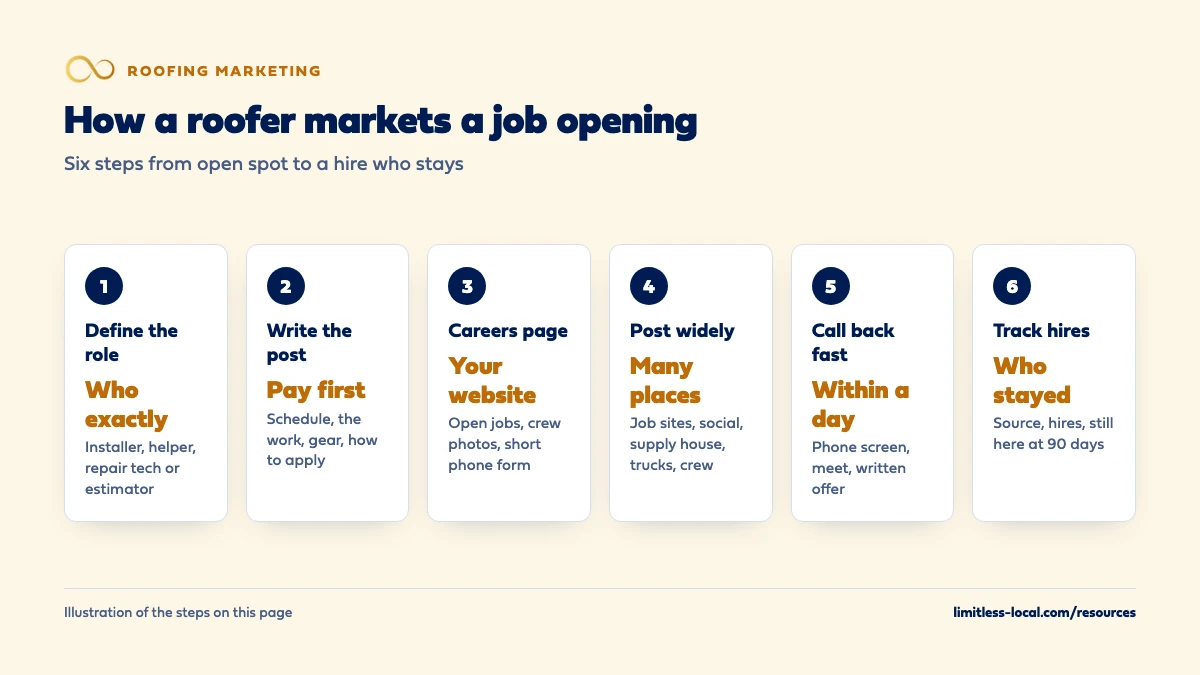
- Step 1: Who exactly am I trying to hire?
- Step 2: What should a roofing job post say?
- Step 3: What should my careers page include?
- Step 4: Where should I post roofing jobs?
- Step 5: Do my Google reviews and photos affect hiring?
- Step 6: Should I run paid ads to hire roofers?
- Step 7: How do I get my own crew to help recruit?
- Step 8: How fast should I get back to applicants?
- What should a one-truck roofer do first?
- How do I know which hiring channel is working?
- What's different about hiring for a roofing company
- A worked example: what one hire costs to find
- Frequently asked questions
- Key takeaways
- More in this section
- Sources
The short version
- Write a job post that leads with pay, schedule and the real work.
- Post it on your own careers page, job sites, social pages and at the supply house.
- Your reviews, photos and social pages are your employer reputation.
- Make applying quick on a phone and call back within a day.
- Track which channel brought the hires who stayed.
For roofing owners, including one-truck shops, who need more hands on the roof and want job posts, a careers page and a reputation that bring in applicants worth calling.
Get a free visibility audit · Book a growth call
How can a small roofing company attract good roofers when everyone's hiring?
Market the job the way you market a roof: a clear job post that leads with pay, schedule, the actual work and how fast you’ll call back, posted on a careers page on your own website, on the job sites roofers use and in front of your own crew and suppliers. Applicants check your Google reviews, photos and social pages before they apply, so those need to show a company people want to work for. Make applying take a couple of minutes on a phone, call every applicant back within a day, and track which channel brought the people you kept.
We don’t run recruiting campaigns. What we do is the customer side that makes hiring possible: a Google profile, website, reviews and ads that keep the phone ringing with jobs worth adding a crew for, and tracking that shows when the calls can carry a new hire. A careers page lives on the same website homeowners see, so the two jobs overlap more than you’d think. See what’s included in our marketing packages, how we work with roofing companies, or browse more roofing marketing questions.
Why is hiring roofers a marketing problem now?
Because good roofers have choices, and they shop employers the way homeowners shop roofers. The U.S. Bureau of Labor Statistics’ roofers outlook projects about 12,000 openings for roofers each year, on average, over the decade from 2025 to 2035, and says many of them come from replacing workers who move to other jobs or leave the workforce. It puts the national median wage for roofers at $55,440 in May 2025, with most roofers learning on the job.
So the roofer you want is probably working for someone else right now. A “now hiring” sign won’t move them. A clear offer, a company that looks well run and a fast, respectful process can.
Hire in step with the work, too. Bringing on a tech before the calls can support them is its own problem, and how to get enough roofing calls to justify hiring techs walks through that math.
Step 1: Who exactly am I trying to hire?
“Roofer” covers a lot of jobs. Write down which one you need, because each one reads different job posts and hangs out in different places:
- Experienced installer or crew lead who can run a tear-off and install without you on the roof.
- Helper or laborer you’ll train, who needs to show up, work safely and learn.
- Repair or service tech who can find leaks, talk to homeowners and work alone.
- Estimator or salesperson who runs inspections and writes estimates.
Then decide what you can offer that person: pay range, hours, truck or no truck, training, a path to crew lead. If you can’t say it in a sentence, the job post won’t say it either.
Step 2: What should a roofing job post say?
Write it for a roofer reading on a phone at lunch. Lead with what they care about and keep the rest short:
- A plain job title: “Roofing installer,” “Roof repair tech,” “Roofing helper, will train.”
- Pay: the hourly range or day rate, and how raises work.
- Schedule: start time, typical days, what happens on rain days and in slow months.
- The work: residential or commercial, shingles, metal, flat roofs, repairs or replacements.
- What you provide: safety gear, tools, a company truck, training.
- Who it’s for: the skills or experience the job really needs, and nothing it doesn’t.
- How to apply and when you’ll call back.
Watch the wording. The U.S. Equal Employment Opportunity Commission’s page on prohibited employment practices says it’s illegal for an employer to publish a job ad that shows a preference for, or discourages someone from applying because of, race, color, religion, sex, national origin, age (40 or older), disability or genetic information. It gives the example that an ad seeking “recent college graduates” may discourage people over 40. Describe the job and the skills, not the kind of person you picture doing it.
Step 3: What should my careers page include?
Most good applicants look you up before they apply, so give them somewhere to land. A careers page on your own website should show:
- Every open job with the same details as the job post, and a date so it doesn’t look abandoned.
- Real photos of your crews at work, in safety gear, and your trucks.
- What it’s like to work there: training, how you handle weather days, how long your crew leads have been with you.
- A short application that works on a phone: name, phone, experience, and an optional upload, not a five-page form.
Google can show job posts in its own job search results. Google Search Central’s guide to job posting structured data says adding that markup to your job pages makes them eligible for that job search experience. Its policies also say expired jobs shouldn’t stay up, people must be able to see the job details without logging in, and you can’t collect résumés for jobs you aren’t actually hiring for. If your website platform or job software adds the markup for you, check that closed jobs come down.
Step 4: Where should I post roofing jobs?
Go where roofers already are, and use more than one place:
- Job sites where tradespeople search, linked back to your careers page.
- Your Facebook and Instagram pages, with a photo of the crew and a link to apply. Ask your crew to share it.
- The supply house. Ask if you can leave a flyer, and tell the counter staff you’re hiring. They know who’s looking.
- Trade schools and apprenticeship programs near you, for helpers you’ll train.
- Your trucks and job-site signs. A short “Now hiring roofers” line with your careers page address, where other roofers drive by.
- Local community groups and veterans’ job programs.
Keep the same job post everywhere, pointing to the same page, so you can see which channel sends the people you hire.
Curious what your marketing is actually booking?
Get a free visibility audit — no obligation, no sales pitch.
Step 5: Do my Google reviews and photos affect hiring?
Yes. An applicant deciding whether to leave a steady job will look at the same things a homeowner does: your rating, how recent your reviews are, how you reply to complaints and whether the photos look like a company that does good work. A profile full of recent five-star reviews and real crew photos says you’re busy and organized. A profile with old reviews and angry, unanswered ones says the opposite.
So the customer-side work pays twice. Keep reviews coming from finished jobs, reply to every one calmly, and post fresh job photos with crews in safety gear. Which photos a roofer should post on the Google profile covers what to shoot, and how a roofer should reply to Google reviews covers the replies that applicants will read too.
Also look at what your own crew posts. If former employees left reviews about how they were treated, reply to those the same calm way you’d reply to a customer.
Step 6: Should I run paid ads to hire roofers?
Paid posts on Facebook and Instagram can reach roofers who aren’t searching for a job, which is most of the good ones. Know the rules before you build the audience. Meta treats employment ads as a Special Ad Category, which limits your audience options, and its page on audiences for employment campaigns spells out the limits for ads shown in the U.S.: you can target by city or region but not by ZIP code, a city audience includes a 15-mile radius, ages are generally fixed at 18 through 65+, audiences must include all genders, and Advantage+ lookalike audiences aren’t available.
That’s fine for a roofing company. Pick the area your crews work in, keep the ad about the job (pay, schedule, the work, a crew photo), and send people to a short application. Small budgets work: you’re looking for a handful of good applicants, not thousands of clicks.
Step 7: How do I get my own crew to help recruit?
Your best roofers know other good roofers. Make it easy for them to help:
- Tell the crew which job you’re hiring for and what you’re paying.
- Give them the link to the careers page to text to people they trust.
- Ask crew leads after every job: “Know anyone like you who’s looking?”
Don’t make word of mouth your only channel, though. Relying on word-of-mouth recruiting from a crew of mostly one background may violate federal law if nearly all new hires end up coming from that same background. Running a public job post alongside crew introductions keeps the door open to everyone.

Step 8: How fast should I get back to applicants?
As fast as you’d call back a homeowner with a leak. A roofer who applies on Monday is usually talking to other companies by Wednesday. Aim to:
- Call or text within a day of every application, even to say no.
- Do a short phone screen: experience, availability, pay expectations, transport.
- Meet in person quickly, at the shop or a job site, so they can see the crew and the work.
- Make the offer in writing, with pay, start date and what to bring on day one.
The same habits that book inspections book hires: one person owns the process, every applicant goes on one list, and nobody waits a week for an answer. How a roofer keeps up with leads coming in fast sets up that kind of list for customers, and it works for applicants too.
What should a one-truck roofer do first?
If it’s just you and maybe one helper, you don’t need a full recruiting setup. Start with:
- A one-page job post with pay, schedule and the work.
- A simple careers page on your website, or a clear post pinned on your Facebook page if the website isn’t ready.
- A word at the supply house and a line on your truck.
- A phone that gets answered, by you, within a day.
If you’re growing to a second or third crew, add job sites, a paid post during your busiest hiring months and a hiring list in your job software. How roofing marketing should change when you add more crews covers the customer side of that same growth.
How do I know which hiring channel is working?
Track hiring the way you track leads. For every applicant, note:
- Where they came from (job site, careers page, social post, crew introduction, supply house, truck sign).
- Whether you interviewed them, hired them, and whether they were still with you after 90 days.
- What you spent on that channel.
After a few hires, the pattern shows. A channel that brings 50 applicants and no keepers is worse than one that brings 5 applicants and 2 crew members. Judge by hires who stayed, not by applications.
Not sure which of these is costing you jobs?
A free visibility audit checks the Google profile, reviews, site and tracking, and shows what to fix first.
What's different about hiring for a roofing company
Roofing is seasonal and weather-bound. Applicants want to know what happens on rain days and in the slow months. Say it plainly in the post, because it’s the first thing an experienced roofer will ask.
Storm surges pull workers away. After big hail or wind events, out-of-town crews come in with short-term work. Start recruiting before the season, not during it.
Safety is part of the pitch. Roofers know which companies cut corners. Showing harnesses, training and proper gear in your photos and posts tells experienced roofers you take it seriously.
A worked example: what one hire costs to find
These numbers are made up to show the math, not a benchmark for your market. Say you spend $600 over a month on paid job posts and a boosted social post. That brings 30 applications. You reach 20 of them by phone, interview 6 and hire 2.
Your cost to find each hire is $600 divided by 2, or $300. Now say one of the two leaves within a month. Your real cost per hire who stayed is $600, and the channel that brought the one who stayed is where next month’s money goes.
Compare that to the cost of a crew sitting short-handed. If an empty spot means turning away even one roof replacement, the money you spend recruiting well is usually the smaller number.
Frequently asked questions
Should I put the pay in a roofing job post?
Yes. Pay is the first thing most roofers look for, and posts without it get skipped. A range is fine if pay depends on experience.
Can I post jobs on my Google Business Profile?
Your profile isn’t a job board. Use posts and photos there to show a busy, well-run company, and put the actual job on your careers page and job sites.
Should I hire experienced roofers or train helpers?
Most growing companies need both: one or two experienced crew leads who can run a roof, and helpers they can train. Hire the lead first, so there’s someone to do the training.
How long should a roofing job post stay up?
Only while you’re hiring for it. Take it down or mark it closed when the spot is filled, so applicants don’t apply to a job that’s gone.
Is a hiring sign on my truck worth it?
It’s cheap and it’s seen by other roofers on the road and at supply houses. Keep it short, with your careers page address, and treat it as one channel among several.
What if nobody applies?
Check the post first: pay, schedule and a clear job usually fix it. If the post is solid, widen where you post it and ask your crew and suppliers directly.
Key takeaways
- Treat hiring like marketing: a clear offer, put where roofers will see it.
- Lead job posts with pay, schedule and the real work, and describe the job, not the person.
- A careers page, recent reviews and real crew photos are your employer reputation.
- Employment ads on Facebook and Instagram come with audience limits, so keep them simple and local.
- Call every applicant back within a day, and judge channels by hires who stayed.
Want a second set of eyes on your setup?
We'll look at how you show up locally and where calls are leaking, then send you a plain-English breakdown.
More in this section
- How do I get enough roofing calls to justify hiring techs?
- How does a roofer run a profitable business with marketing?
- How does a roofer get commercial roofing leads?
- How does a roofer get high-intent customers in their local area?
- What is the fastest way for a roofer to get leads online?
Sources
- Roofers: Occupational Outlook Handbook — U.S. Bureau of Labor Statistics
- Prohibited Employment Policies/Practices — U.S. Equal Employment Opportunity Commission
- Job posting (JobPosting) structured data for Job Search — Google Search Central
- How to choose a Special Ad Category — Meta Business Help Center
- About audiences for housing, employment or financial products and services campaigns — Meta Business Help Center