
What marketing should an HVAC company fix before hiring more techs?

- What should I fix in my HVAC marketing before I put another tech on the road?
- Why fix the marketing before adding a tech?
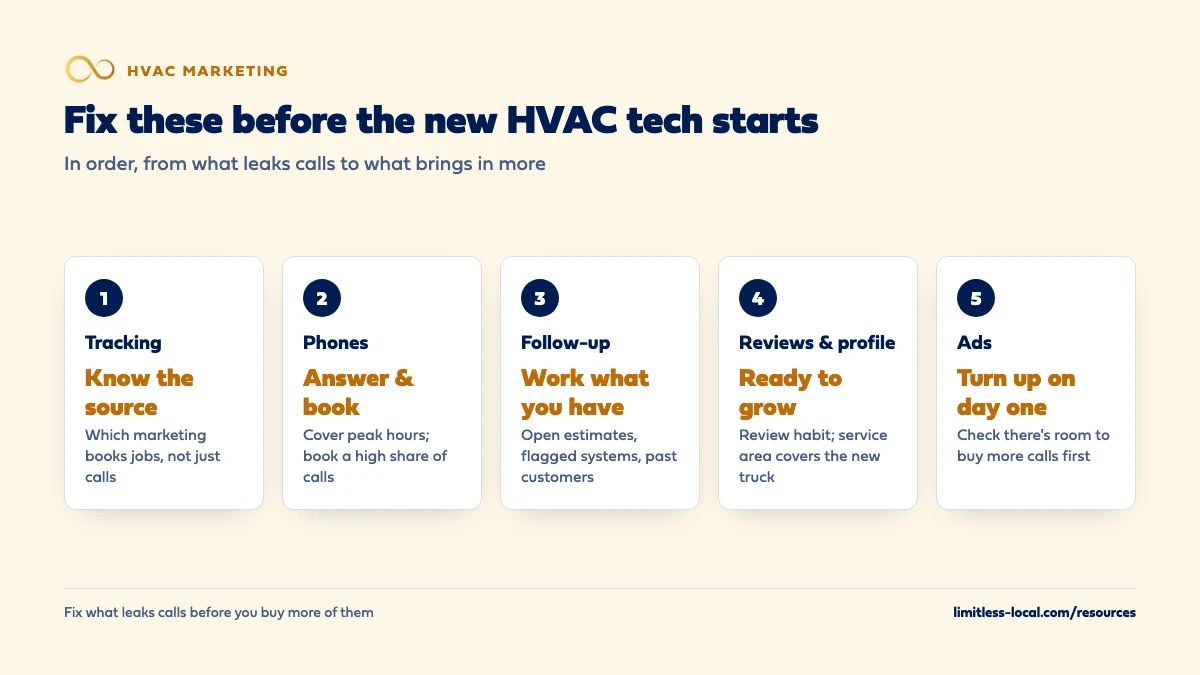
- Fix 1: Can you see which marketing books jobs?
- Fix 2: Are you answering nearly every call?
- Fix 3: Does the office book a high share of the calls it answers?
- Fix 4: Are open estimates and past customers being worked?
- Fix 5: Are your reviews keeping pace?
- Fix 6: Does your Google profile cover where the new truck will go?
- Fix 7: Is there room to buy more calls?
- Fix 8: Do you know how many booked jobs a new tech needs?
- What can wait until after the hire?
- In what order, and how far ahead of the start date?
- What's different about adding a tech at an HVAC company
- A worked example: filling a new truck by fixing the phones
- Frequently asked questions
- Key takeaways
- More in this section
- Sources
The short version
- Start with tracking, so you know which marketing to turn up when the tech starts.
- Answer nearly every call and book a high share of them; that's the cheapest extra work.
- Follow up on open estimates and past customers before buying new leads.
- Check reviews, your service area and ad headroom before the start date.
For HVAC owners about to add a tech or a truck who want to be sure the phones, the office and the marketing can keep that truck full.
Get a free visibility audit · Book a growth call
What should I fix in my HVAC marketing before I put another tech on the road?
Before hiring another HVAC tech, fix the things that decide whether a new truck stays busy: tracking that shows which marketing books jobs, a phone line that answers nearly every call, an office that books a high share of them, and follow-up on open estimates and past customers. Then make sure reviews keep pace, your Google profile covers the area the new truck will drive, and your ads have room to grow. Fixing those first often turns up enough extra booked jobs to fill part of the new schedule before you spend more on marketing.
Getting the foundation right before turning up lead flow is how we run every account: tracking, follow-up and a clean online presence first, then local SEO and ads around the towns and jobs you want. Every one of our marketing packages includes call tracking with recording and source tagging, plus monthly reports with a cost-per-lead breakdown, and our HVAC marketing page shows how that fits an HVAC company. The HVAC marketing guide covers every channel, and the HVAC marketing questions library goes question by question.
Why fix the marketing before adding a tech?
A new tech costs you wages, a truck and tools from the first day, whether the phone rings or not. If the calls aren’t there, or they come in and slip through the office, you pay for an idle truck and the hire looks like a mistake when it wasn’t.
Good techs are also hard to find. The Bureau of Labor Statistics projects about 40,600 openings for HVAC mechanics and installers each year over the decade, many of them to replace people who retire or leave the trade. When you finally land a good one, you want them running jobs from week one, not sitting in the shop. That’s why the order matters: fix what leaks first, then turn up what brings in calls, then hire. Whether to market before or after the hire covers the timing decision; this page is the checklist for the marketing itself.
Fix 1: Can you see which marketing books jobs?
When the new tech starts, you’ll want to turn something up. If you can’t tell which channel books jobs and which just makes the phone ring, you’ll guess, and guessing at this point is expensive.
The minimum setup: a tracking number for each paid channel, form and chat leads tagged by source, and someone marking in your field software (ServiceTitan, Housecall Pro, Jobber) which calls became booked jobs. With that, you can see cost per booked job by channel and know where an extra $1,000 a month would go furthest. How to track whether your HVAC marketing is paying off walks through the setup.
Fix 2: Are you answering nearly every call?
Missed calls are the most common leak, and they get worse as you grow, because the office gets busier at the same peak hours the calls come in. Before you hire, pull a month of call data and look at missed calls by hour and day. Call tracking tools show this directly; CallRail’s unanswered calls report, for example, breaks missed calls down by day of the week and hour of the day so you can see your peak times.
The pattern usually tells you the fix: lunch hours, the first hot afternoon, after 5 p.m., or Saturday mornings. Cover those with a second person on the phones, an overflow line or after-hours answering. How many missed calls is too many helps you set the bar.
Fix 3: Does the office book a high share of the calls it answers?
Answering isn’t booking. Listen to a dozen recorded calls that didn’t book and you’ll usually find the same few problems: no price guidance, no available time offered, the CSR waiting for the homeowner to ask, or a callback promised and never made. Each one is a job a new tech could have run.
Measure the share of real service calls that turn into booked jobs, and track it by person. What percentage of calls your HVAC office should be booking covers how to count it. This is where follow-up pays off fast: one HVAC client got 47% more booked estimates from speed to lead, automated reminders and better follow-up.
Fix 4: Are open estimates and past customers being worked?
The cheapest jobs to fill a new schedule are the ones already in your system. Unsold replacement estimates from the last few months, customers whose system your tech flagged as failing, and past customers due for a tune-up are all people who already know you.
Set up three simple habits before the hire: a follow-up call or text on every open estimate within a couple of days and again a week later, a list of flagged systems the office calls each month, and a spring and fall tune-up push to past customers. Those habits keep a new tech busy in the shoulder months, when new calls are slower.
Curious what your marketing is actually booking?
Get a free visibility audit — no obligation, no sales pitch.
Fix 5: Are your reviews keeping pace?
More trucks means more homeowners checking your reviews before they call. Google says on its local ranking help page that more reviews and positive ratings can help your local ranking, so reviews feed both the calls and the trust behind them.
If reviews come in only when someone remembers to ask, fix that before the new tech starts. Make the ask part of every job: the tech mentions it at the door, and the office sends a review link the same day. A new tech who picks up the habit from day one adds reviews instead of diluting them. How to get HVAC techs to ask for Google reviews has the scripts and the habit.
Fix 6: Does your Google profile cover where the new truck will go?
If the new tech means covering towns you used to turn down, your Google Business Profile has to say so. Service-area businesses can list up to 20 service areas by city, postal code or other area, and Google says the overall area shouldn’t be more than about 2 hours of driving time from where you’re based (see managing service areas).
List the towns the new truck will actually reach, and add a page on your website for each main town or service you want calls from. Service area changes can take a little time to show, so make them a few weeks before the start date, not on it.
Fix 7: Is there room to buy more calls?
Before you count on ads to fill a new truck, check whether more calls are actually available. In Google Ads, impression share is the share of possible impressions your ads got, and it’s a good way to understand whether your ads might reach more people if you increase your bid or budget (see how impression share works).
If your ads already show for most of the searches in your area, more budget won’t buy many more calls, and the extra work has to come from new towns, new services, Local Services Ads, SEO or past customers. If impression share is low because the budget runs out by noon, you have room, and you know which lever to pull the week the tech starts.

Fix 8: Do you know how many booked jobs a new tech needs?
Work it backward. Take what the new tech costs you each month, divide by the gross profit an average job leaves before that tech’s pay, and you have the number of jobs a month that truck needs just to break even. Then divide by your booking rate to get the calls you need.
Compare that with the extra calls you can realistically get from the fixes above and from more ad spend. If the math only works with a big jump in marketing, start the marketing earlier or hire later. How many booked calls your HVAC company needs walks through the full calculation.
What can wait until after the hire?
Not everything has to be done first. These can wait until the new tech is running jobs and you can see where the gaps are:
- A full website rebuild, unless the current site is broken or doesn’t work on a phone.
- New channels you’ve never tested, such as TV, radio or billboards.
- Pages for towns the new truck won’t reach this year.
- Brand-awareness campaigns with no way to track calls.
The rule of thumb: fix what loses calls you already get, then add what brings in calls you can track, then experiment.
In what order, and how far ahead of the start date?
- Two to three months out: tracking, missed-call coverage and booking scripts. These pay off right away, hire or no hire.
- One to two months out: estimate follow-up and past-customer lists, the review habit, and service-area updates.
- The week the tech starts: turn up Google Ads and Local Services Ads, because ads can generate leads within days of launch.
- Ongoing: SEO and reviews, which typically take 3-6 months to show meaningful organic growth, so start them early and let them build under the paid channels.
Not sure which of these is costing you jobs?
A free visibility audit checks the Google profile, reviews, site and tracking, and shows what to fix first.
What's different about adding a tech at an HVAC company
Seasonal timing. Hiring right before peak heat or the first cold snap means the tech starts when calls are plentiful, but the office is also at its busiest, so missed calls and slow booking hurt most then. Fix the phones before the season, not during it.
Service tech or install crew. A service tech needs repair and tune-up calls; an install crew needs sold replacements, which take longer to come in. Fix the marketing that feeds the kind of hire you’re making.
Maintenance plans smooth the schedule. A healthy plan list gives a new tech steady work in spring and fall, when repair calls are thinner.
Techs are part of the marketing. Every visit is a chance to ask for a review and flag an aging system for replacement follow-up. Teach those habits in the new tech’s first week.
A worked example: filling a new truck by fixing the phones
These numbers are made up to show the math, not a benchmark for HVAC call volume or booking rates.
Say a new service tech costs you $7,500 a month all-in, and an average job leaves $250 in gross profit before that tech’s pay. The truck needs 30 jobs a month to cover itself.
Now look at the phones. You get 400 real service calls a month, the office answers 80% of them (320 calls), and it books 60% of the calls it answers: 192 booked jobs. Fix the missed calls so the office answers 95% (380 calls), keep booking at 60%, and you get 228 booked jobs. That’s 36 more jobs a month, more than the 30 the new truck needs, without spending another dollar on ads.
Real results won’t be that neat, but the point holds: the jobs you’re losing on the phone are often enough to fill a good part of a new schedule. Fix them first, then decide how much new marketing the hire needs.
Frequently asked questions
Should I hire first if I'm already turning away calls?
Yes. If the schedule is full and calls go unbooked because nobody can run them, the bottleneck is people, not marketing. Fix the phones in parallel, but don’t hold the hire for it.
Is a new website needed before adding a tech?
Usually not. A site that loads fast on a phone, has a clear number and a page for each main service is enough. Fix tracking and the phones first.
Should the new tech have their own tracking number?
No. Track by marketing source, not by tech. Track tech performance through your field software: jobs run, close rate, review asks and replacement leads set.
How soon can ads fill a new truck?
Ads can generate leads within days of launch, so they’re the right lever to turn up the week the tech starts, as long as the tracking and phones are ready.
What if my booking rate is already high?
Then the extra jobs have to come from more calls: more ad budget if impression share shows room, new towns, more services, or past customers.
Can I add a tech without adding office staff?
Sometimes, but watch missed calls by hour after the hire. If they climb at peak times, the office is the new bottleneck.
Key takeaways
- Fix tracking first so you know which marketing to turn up when the new tech starts.
- Missed calls and unbooked calls are usually the cheapest extra jobs you can find.
- Work open estimates, flagged systems and past customers before buying new leads.
- Make sure reviews, your service area and ad headroom can support another truck.
- Turn up ads the week the tech starts; start SEO months earlier.
Want a second set of eyes on your setup?
We'll look at how you show up locally and where calls are leaking, then send you a plain-English breakdown.
More in this section
- Should I market more before or after hiring another HVAC tech?
- Which HVAC jobs should I market to get more repairs or installs?
- How do I grow my HVAC company with marketing?
- How should a commercial HVAC company market itself?
- What are the biggest marketing mistakes HVAC companies make?
Sources
- Heating, Air Conditioning, and Refrigeration Mechanics and Installers — U.S. Bureau of Labor Statistics, Occupational Outlook Handbook
- Unanswered calls report — CallRail Help Center
- Tips to improve your local ranking on Google — Google Business Profile Help
- Manage your service areas for service-area & hybrid businesses — Google Business Profile Help
- About impression share — Google Ads Help