
Which HVAC jobs should I market to get more repairs or installs?
- Should my HVAC company market more repairs, more installs, or more tune-ups this year?
- Is it really a choice between repairs and installs?
- Which HVAC jobs make the most money per hour of truck time?
- Do you have the crew to run more of the jobs you want?
- When should you push more repair calls?
- When should you push more replacements and installs?
- Where do tune-ups and maintenance plans fit?
- Should you market new construction or commercial work?
- How should the season change which jobs you market?
- How do you tell Google which jobs you want?
- How do you know if you picked the right mix?
- What mistakes do owners make when picking jobs to market?
- What's different about choosing the job mix for HVAC
- A worked example: comparing a day of repairs, installs and tune-ups
- Frequently asked questions
- Key takeaways
- More in this section
- Sources
The short version
- Rank job types by gross profit per hour of truck time, not by ticket size.
- Only market more of a job type if you have the crew and the salesperson to run it.
- Repairs feed replacements, and tune-ups feed both, so don't cut them off completely.
- Shift the mix with the season: tune-ups in spring and fall, repairs in peak heat and cold.
For HVAC owners deciding which kind of work they actually want more of before they decide where the marketing money goes.
Get a free visibility audit · Book a growth call
Should my HVAC company market more repairs, more installs, or more tune-ups this year?
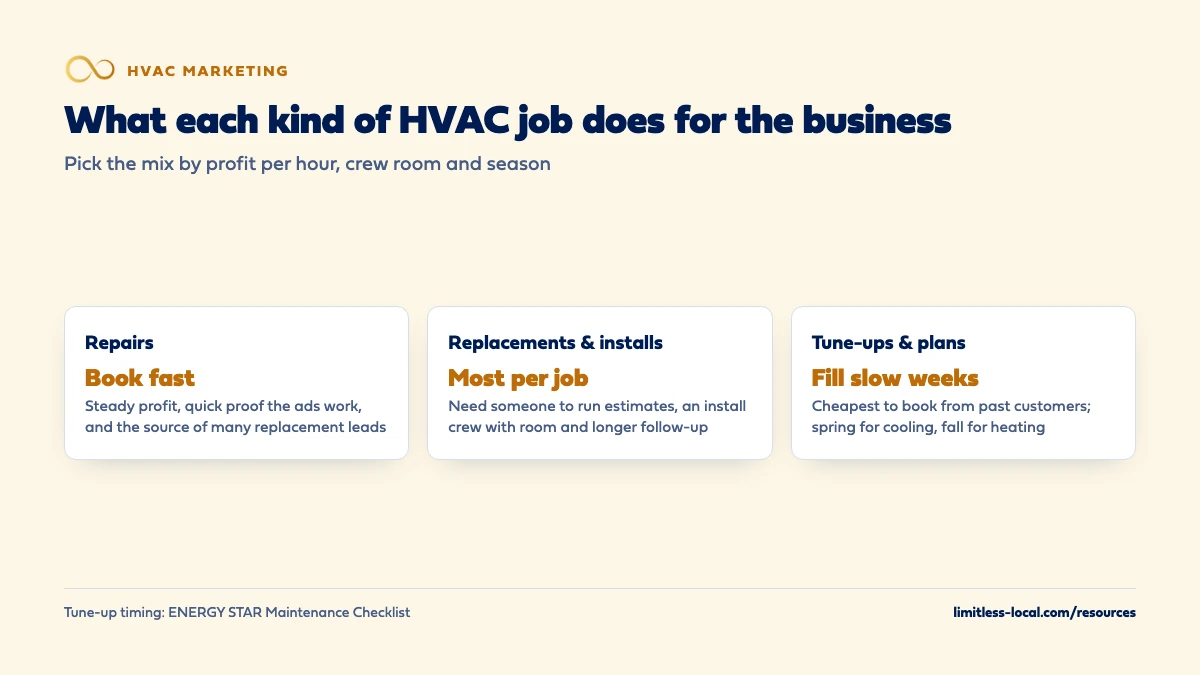
Market the jobs that leave the most gross profit per hour of truck time, that your crews can run right now, and that fit the season. Repairs book fast and feed replacement leads, replacements and installs pay the most per job but need someone to run estimates and a longer follow-up, and tune-ups and maintenance plans fill the slow weeks and keep both pipelines full. Most HVAC companies get the best mix by keeping repairs steady, pushing replacements when they have the sales capacity, and running tune-ups in spring and fall.
Choosing the mix comes before choosing the channel, and it’s where we start with an HVAC company: which jobs you want more of, what each one is worth, and what each booked job costs to win. Our HVAC marketing packages run local SEO, Google Ads and call tracking around the jobs and towns you pick. The HVAC marketing guide covers every channel, and the HVAC marketing questions library goes question by question.
Is it really a choice between repairs and installs?
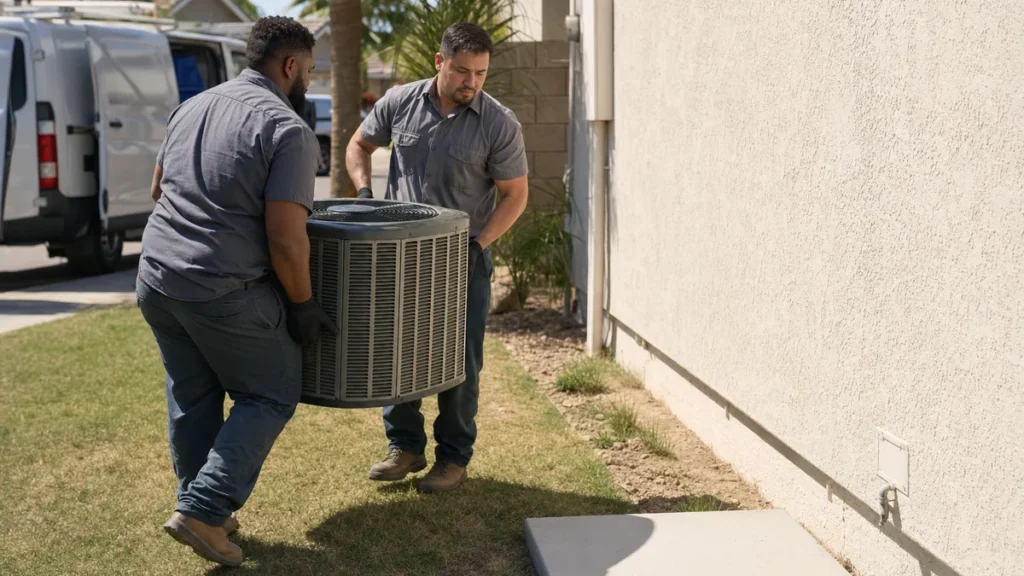
Not quite. Most HVAC companies sell four kinds of work: repair calls, system replacements, tune-ups and maintenance plans, and new installs for builders or commercial customers. Each one is bought differently. A repair call is urgent, and the homeowner usually calls whoever answers first. A replacement is a big decision that gets compared, financed and slept on. A tune-up is planned and price-sensitive. New construction and commercial work are won through relationships, not search ads.
So the real question is which of those you want more of this year, and in what order. Once you’ve picked, the marketing for each looks different, which is covered in how to market replacements differently from repairs. This page is about the choice itself.
Which HVAC jobs make the most money per hour of truck time?
Ticket size is the wrong yardstick. A replacement brings in far more revenue than a capacitor swap, but it also ties up an install crew for a day or more, needs a salesperson’s visit, and might take three estimates to sell one. A repair tech can run several calls in the same day. What you want to compare is gross profit per hour of truck time, after the marketing it took to book the job.
You probably already have the raw numbers. ServiceTitan, Housecall Pro and Jobber can all report revenue by job type, and most shops can pull labor hours per job from the same place. Pull the last twelve months, group the jobs into repairs, replacements, tune-ups and installs, and work out roughly what each one left you per hour. Then add a rough marketing cost per booked job for each. The order that comes out of that is your first draft of what to market, and the worked example below shows the math.
Do you have the crew to run more of the jobs you want?
This is where a lot of plans fall apart. More replacement leads are only worth paying for if someone can run the estimates within a day or two and an install crew has room on the calendar. More repair calls only help if a service tech can get there today. If the job type you want is the one your team is already short on, marketing more of it just buys calls you can’t run.
Check three things before you push a job type: who sells it, who installs or fixes it, and how far out you’re booked for it right now. Hiring doesn’t happen overnight either. HVAC techs typically need training from a trade school or community college, and those programs generally last from 6 months to 2 years. The Bureau of Labor Statistics notes that techs sometimes work overtime or irregular schedules in peak heating and cooling seasons. If you’re short-handed, market the jobs the crew you have can run, and read whether to market before or after hiring another tech before you change the plan.
When should you push more repair calls?
Push repairs when you have service techs with open slots, when you’re new and need reviews and repeat customers, and when the weather turns. Repairs are the fastest work to book with ads because the homeowner needs someone now, and they show within weeks whether your cost per booked job works.
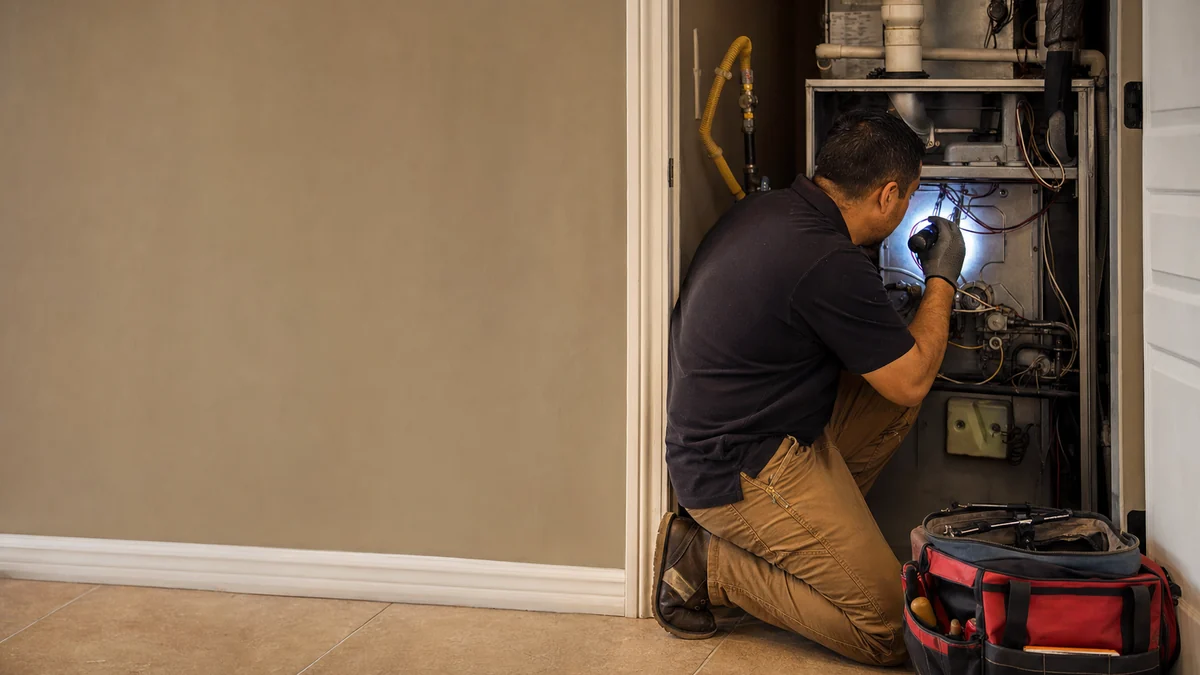
Repairs also do a second job: they’re where a lot of replacement leads come from. When a tech finds a twenty-year-old system with a cracked heat exchanger or a failing compressor, that’s a replacement conversation with a homeowner who already trusts you. A company that cuts repair marketing to chase installs often finds the replacement pipeline thins out a few months later.
The catch is volume. Lots of small repair calls can fill the board with low-margin work and push out the jobs you’d rather run. If your techs are booked out with quick calls that barely cover the trip, it’s time to tilt the mix.
When should you push more replacements and installs?
Push replacements when you have someone who can run estimates quickly, financing you can offer, and an install crew with open days. That’s often the shoulder months, when repair calls slow down and crews have room, and right after a heat wave or cold snap, when systems that limped through are finally done.
Replacement marketing is slower to pay off. The homeowner compares companies, asks about financing and takes days or weeks to decide, so you need follow-up on every open estimate, not just more leads. Before you buy more replacement leads, know your close rate on the ones you already get; what a good close rate for HVAC replacement estimates looks like covers how to measure it. If half your estimates go cold because nobody follows up, fix that first. It’s the cheapest replacement lead you’ll ever get.
Curious what your marketing is actually booking?
Get a free visibility audit — no obligation, no sales pitch.
Where do tune-ups and maintenance plans fit?
Tune-ups rarely make the most per hour, but they do three things the other jobs can’t. They keep techs busy in the slow weeks, they put a tech in front of the equipment before it fails, and they turn one-time customers into plan members who call you first.
Timing is built in. ENERGY STAR tells homeowners that contractors get busy once summer and winter come, so it’s best to check the cooling system in the spring and the heating system in the fall. That’s your calendar for tune-up pushes. Most of that work should come from past customers, who are the cheapest people to book. How to get tune-up bookings from past HVAC customers walks through the list, the message and the timing.
Should you market new construction or commercial work?
Only if you want it and are set up for it. Builder and commercial work is won through relationships, bids and reputation with general contractors and property managers, not through a homeowner searching on a Sunday night. It can fill install crews for months, but it pays slower, can come with retainage and tight schedules, and needs someone who bids and manages jobs.
If that’s a direction you want, treat it as a separate line of business with its own marketing: a portfolio page, a capabilities sheet, and time spent with the people who hand out the work. How a commercial HVAC company should market itself goes deeper. If you’re mainly residential, keep commercial and new construction off your homeowner ads so the budget goes to the calls you actually want.
How should the season change which jobs you market?
A simple calendar works for most residential shops:
- Spring: AC tune-ups for past customers and plan members, and a push on replacements for systems you flagged last summer.
- Early summer to peak heat: repair calls first. Keep replacement ads running, because systems fail and the homeowner wants a quote now.
- Fall: heating tune-ups, and the strongest window for planned replacements while crews have room.
- Winter cold snaps: heating repairs, with replacement follow-up on the systems your techs condemned.
The exact months depend on your climate. A shop in Phoenix and a shop in Ohio have different peaks, so build the calendar from your own call history, not a national chart.
How do you tell Google which jobs you want?
Your Google Business Profile, website and ads all need to say the same thing about the work you want. List the services you actually want on your profile, give each main service its own page on your site, and run separate ad campaigns for repairs and replacements so cheap repair clicks can’t eat the replacement budget.
Two Google tools help here. Keyword Planner shows estimates of how many searches each service gets and what it costs to show up for them, which tells you whether there’s demand for the job type you picked. And if you track which calls became booked jobs, you can give each kind of conversion a value in Google Ads, so the system can focus on high-value conversions instead of counting every call the same; the conversion values guide explains the setup. Which HVAC services to advertise first covers the ad side in more depth.
How do you know if you picked the right mix?
Check four numbers every month, split by job type:
- Booked jobs, and where each one came from.
- Marketing cost per booked job.
- Gross profit per job, and per hour of truck time.
- How many replacement leads your own techs set on repair and tune-up visits.
If replacements are growing but the install crew is sitting idle two days a week, you’re under-selling. If repairs are growing but gross profit per hour is falling, the mix has tilted toward small calls. Give any change a full season before you judge it, because an HVAC calendar swings too much to read one month on its own.
What mistakes do owners make when picking jobs to market?
- Chasing ticket size. Buying replacement leads without a salesperson or install crew to run them.
- Cutting repairs completely. It starves the replacement pipeline a few months later.
- Discounting tune-ups to the bone. A tune-up that loses money only pays off if your techs and office turn it into plans and repairs.
- One campaign for everything. Repairs and replacements fighting over one budget, with no way to see which one is working.
- Marketing work you don’t want. If you hate ductwork jobs or small commercial calls, take them off the profile and the ads.
Not sure which of these is costing you jobs?
A free visibility audit checks the Google profile, reviews, site and tracking, and shows what to fix first.
What's different about choosing the job mix for HVAC
Two peaks, two shoulders. HVAC demand swings with the weather twice a year. The mix you market in July shouldn’t be the mix you market in April.
The repair-to-replace path. A lot of replacements start as a repair call or a tune-up where the tech finds an old or failing system. That makes service techs part of the replacement marketing, and it’s why repair and tune-up volume matters even if installs are your goal.
Install crews and service techs aren’t interchangeable. More replacement leads need install days and someone to run estimates; more repair calls need service techs and fast dispatch. Plan the mix around which team has room.
Maintenance plans compound. Every plan member is a customer who calls you first when something breaks, so plan sign-ups pay off in repairs and replacements later.
A worked example: comparing a day of repairs, installs and tune-ups
These numbers are made up to show the math, not a benchmark for HVAC margins or marketing costs.
Repairs. A service tech runs 4 repair calls in a day, each leaving $150 in gross profit: $600. Each booked call cost $80 in marketing, so $320 for the day. That leaves $280 for one tech-day.
Replacements. A two-person install crew spends one day on a replacement that leaves $2,400 in gross profit. Each booked estimate cost $250 in marketing, and it takes 3 estimates to sell one, so the sale cost $750. That leaves $1,650 for the crew, or $825 per person-day, before you count the salesperson’s time.
Tune-ups. A tech runs 6 tune-ups for past customers at $40 each in gross profit: $240, with almost no marketing cost because the list is already yours.
On these numbers, replacements win per day, but only if you have the crew, the salesperson and the patience for the longer sale. Repairs pay steadily and feed replacements. Tune-ups pay least today but keep techs working in slow weeks and set up the next sale. Run the same math with your own numbers before you decide where the budget goes.
Frequently asked questions
Should I stop marketing repairs if I want more installs?
No. Keep repairs running at a level your service techs can handle, because a lot of replacement leads start on a repair visit. Shift budget toward replacements, but don’t switch repairs off.
Are tune-up specials worth running?
Only if you have a plan to turn them into maintenance members and repair or replacement work. A tune-up that loses money and leads nowhere just keeps techs busy at a loss.
Should heat pumps or ductless systems be marketed on their own?
If they’re work you want and can install well, yes. Give each its own service page and, if you advertise it, its own ad group, so you can see whether that work is paying off on its own.
Can my techs bring in replacement leads?
Yes, and they’re often the warmest leads you get. Give techs a simple way to flag aging or failing systems and make sure the office follows up on every one.
How long before a change in the mix shows up in revenue?
Repairs show up within weeks. Replacement changes take longer because the sales cycle is longer, so judge a shift toward installs over a full season, not a month.
Does my Google profile need to list every service I offer?
List the services you want to be found for. If you don’t want a type of work, leave it off, so the calls you get match the work you want.
Key takeaways
- Rank job types by gross profit per hour of truck time after marketing cost, not by ticket size.
- Only market more of a job type if the crew and salesperson to run it have room.
- Repairs and tune-ups feed replacements, so keep them running even when installs are the goal.
- Shift the mix with the season, using your own call history.
- Run repairs and replacements as separate campaigns and track booked jobs by job type.
Want a second set of eyes on your setup?
We'll look at how you show up locally and where calls are leaking, then send you a plain-English breakdown.
More in this section
- Which HVAC services should I advertise first?
- What marketing should an HVAC company fix before hiring more techs?
- Should I market more before or after hiring another HVAC tech?
- Should HVAC companies market replacements differently from repairs?
- Which HVAC marketing work should I outsource or keep in-house?
Sources
- Maintenance Checklist — ENERGY STAR
- Heating, Air Conditioning, and Refrigeration Mechanics and Installers — U.S. Bureau of Labor Statistics, Occupational Outlook Handbook
- Use Keyword Planner — Google Ads Help
- About conversion values — Google Ads Help