
Should a pool builder hire an in-house marketer or an agency?

- Should I hire a marketing employee for my pool company instead of an agency?
- What does a full-time marketing employee cost a pool company?
- What does an agency cost by comparison?
- Can one marketing employee do everything a pool builder needs?
- When does an in-house marketer make sense for a pool builder?
- Would a hybrid of in-house and agency work for my pool company?
- Should I hire a freelancer instead of an employee or an agency?
- Who should own the accounts if marketing is in-house?
- How do I hold an in-house marketer accountable?
- What about the winter, when the pool calendar slows down?
- How do I choose between an employee, an agency and a hybrid?
- What's different about this hire for pool builders
- A worked example: a marketing hire versus an agency, per year
- Frequently asked questions
- Key takeaways
- More in this section
- Sources
The short version
- BLS puts the May 2025 median pay for market research analysts at $78,760 a year, before benefits and payroll taxes.
- Benefits made up 30% of private-industry employer compensation costs in June 2026, per BLS.
- One employee rarely covers ads, SEO, website, tracking and content equally well; an agency spreads that across specialists.
- A common middle path: an in-house coordinator for photos, reviews and follow-up, with an agency on ads and SEO.
For pool builders weighing a marketing hire on payroll against an outside agency, a freelancer or a mix of both.
Get a free visibility audit · Book a growth call
Should I hire a marketing employee for my pool company instead of an agency?
Most pool builders get more for the money from an agency, or from one in-house coordinator paired with an agency, than from a single marketing employee expected to do everything. One hire costs a full salary plus benefits and payroll taxes, and rarely covers Google Ads, SEO, the website, tracking and content equally well. An in-house marketer starts to make sense when there’s enough steady work to fill the job year-round, such as photos, social posts, review requests and lead follow-up, and someone in the company can manage that person.
Agencies earn their place when they cover work one employee can’t, and we price ours in the open so you can compare it with a salary line by line. The full scope and the monthly fees are on the packages page, and the pool builder marketing page shows what we run for pool companies. We’ve also been on the builder’s side: the agency was an equity partner in a pool construction company, where it streamlined back-office operations, built the lead-generation engine and ran sales and marketing. That business did $2M+ revenue in year one. More hiring questions are in the pool builder marketing questions library.
What does a full-time marketing employee cost a pool company?
More than the salary. The Bureau of Labor Statistics reports a median annual wage of $78,760 for market research analysts in May 2025, which we use as a stand-in for a marketing generalist because BLS doesn’t publish a separate figure for that role. Source: Market Research Analysts, Occupational Outlook Handbook. Your local market and the person’s experience will move that number up or down.
Then add what employment costs on top of pay. BLS reports that in June 2026, wages and salaries made up 70.0 percent of employer compensation costs for private industry workers, and benefits the remaining 30.0 percent. Source: Employer Costs for Employee Compensation. The SBA notes that businesses with employees are responsible for state employment taxes, which often include workers’ compensation insurance, unemployment insurance taxes and temporary disability insurance. Source: Hire and manage employees.
Then add the tools the person needs: design software, a scheduling tool for social posts, call tracking and possibly an SEO tool. None of that is in the salary line. This is general information, not tax or legal advice; your accountant can give you the real loaded cost for your state.
What does an agency cost by comparison?
Agency pricing varies, so here’s ours as one public reference point. Our Essentials package is $3,500 a month for one location and includes Google Business Profile management, listing cleanup, content, link building, review response and basic review generation, Google Ads management up to $2,500 a month in ad spend, call and form tracking, a real-time dashboard and a monthly report. Growth is $4,500 a month and adds SEO for up to 2 locations, Google Ads up to $5,000 a month in spend, Local Services Ads management, Meta remarketing and monthly strategy calls. Scale is custom.
Ad spend isn’t included in any package; you pay Google and Meta directly. It isn’t included in an employee’s salary either, so leave it out of both sides when you compare. A full budget view, fees plus ads, is in how much a pool builder should spend on marketing.
Can one marketing employee do everything a pool builder needs?
Rarely, in our judgement. A pool builder’s marketing spans several different skills: Google Ads (keywords, bids, search terms, conversion tracking), local SEO and the Google Business Profile, the website and its consultation pages, call tracking and reporting, photography and video from job sites, social posts and review requests. A person who is strong at photos and social posts is often not the person who should be adjusting your conversion windows, and the reverse is just as true.
The result, when one person is asked to cover all of it, is usually that the visible work gets done (posts, photos, newsletters) and the technical work that decides cost per contract drifts. Ads keep running on searches nobody checks, and leads stop being matched to contracts. An agency spreads that work across people who each do one part of it every day.
If you do hire one person, decide which part of the job matters most and hire for that, then buy the rest.
When does an in-house marketer make sense for a pool builder?
In our judgement, a marketing hire starts to pay off when most of these are true:
- There’s enough steady work. Photos and video from every build, social posts, review requests, home show prep, lead follow-up and the CRM can fill a role year-round for a builder doing enough pools.
- The work depends on being on site. An employee can photograph the dig, the steel, the tile and the first fill. An agency can’t.
- Someone can manage the hire. A marketer with nobody to set goals and check results tends to drift toward busywork.
- You have more than one line of business, such as construction plus renovation or service, each needing its own campaigns and content.
For many builders, that describes a coordinator role rather than a full marketing department. What that person should post is covered in what a pool builder should post on Instagram and Facebook.
Curious what your marketing is actually booking?
Get a free visibility audit — no obligation, no sales pitch.
Would a hybrid of in-house and agency work for my pool company?
For many pool builders it’s the best fit, in our judgement. Split the work by who can do it best:
- In-house: job site photos and video, social posts, review requests at handover, answering and following up on leads, keeping the CRM clean, home show and community events.
- Agency: Google Ads management, local SEO and the Business Profile, the website and its landing pages, call tracking, attribution and the monthly numbers.
The hybrid works only if each task has one owner. A review request that both sides assumed the other would send never goes out. Write the split down, and make the in-house person the agency’s day-to-day contact so photos, job updates and lead outcomes flow back to the people running the ads.
This is also how you get the most from an agency: the photos and lead outcomes your coordinator feeds back are what the campaigns learn from.
Should I hire a freelancer instead of an employee or an agency?
A freelancer can be a good fit for one narrow job, such as running a single Google Ads campaign, writing website pages or shooting a finished pool. The trade-offs, in our judgement: one person means one point of failure when they’re sick, booked or gone, and you’ll be the one coordinating several freelancers if you hire more than one.
Paying a contractor also comes with paperwork. The IRS says the first step for someone you’ve determined is an independent contractor is to have them complete Form W-9, and that you must use Form 1099-NEC to report payments that meet the reporting threshold. Source: Forms and associated taxes for independent contractors. Whether someone is a contractor or an employee is a legal question; the SBA notes the distinction affects how you withhold taxes. This is general information, not legal or tax advice.
Who should own the accounts if marketing is in-house?
The company, never the person. If your marketer sets up the Google Ads account, the Business Profile or the website hosting under a personal login, you risk losing access when they leave.
- Google Ads: only users with Admin access can give account access and change access levels. Keep at least one admin login that belongs to the owner. Source: About access levels in your Google Ads account.
- Google Business Profile: a profile has one primary owner with full control, plus owners and managers. Keep primary ownership yourself and add staff as managers. Source: Manage your Business Profile owners & managers.
The same rule applies to an agency. Whoever does the work gets access; the company keeps ownership.

How do I hold an in-house marketer accountable?
The same way you’d hold an agency accountable: by consultations booked, proposals sent and contracts signed, by source, with a cost for each. In our judgement, an in-house marketer should report on the same numbers an agency would, and posting frequency or follower counts should be background, not the headline.
That means the marketer owns the lead log or CRM: every lead tagged with where it came from, and every outcome recorded when it closes, even months later. How to set that up is in tracking which marketing produces signed contracts. Without it, you can’t compare the employee’s work with an agency’s, or with doing nothing.
What about the winter, when the pool calendar slows down?
An employee is paid all year; an agency’s work can be scaled with the season if the contract allows it. In our judgement, that’s a real difference for pool builders whose inquiries and builds follow the weather.
A good in-house marketer uses the slower months well: editing the season’s photos and videos into project pages, asking past customers for reviews, updating the website, preparing for home shows and nurturing leads who said “next year”. If you can’t picture a winter workload like that for the person you’d hire, that’s a sign the role is part-time or better bought from outside.
How do I choose between an employee, an agency and a hybrid?
Answer four questions, in order:
- How much of the work is technical (ads, SEO, tracking) versus on-site (photos, reviews, follow-up)? Mostly technical points to an agency; mostly on-site points to a hire.
- Is there a year-round workload for an employee, including winter?
- Who will manage the person and check the numbers every month?
- What does each option cost per year, fully loaded, against the contracts it needs to help sign?
If the answers are mixed, the hybrid usually wins. Before you sign with any agency, run through what to ask before hiring a marketing agency, and if the niche question is on your mind, see pool-specific or general agency.
Not sure which of these is costing you jobs?
A free visibility audit checks the Google profile, reviews, site and tracking, and shows what to fix first.
What's different about this hire for pool builders
The best marketing material is on your job sites. Every dig, steel inspection, tile job and first fill is content. An in-house person who’s there to capture it has an edge no agency can match.
The technical work decides cost per contract. Pool keywords overlap with service, supply and repair searches, and contracts sign months after the click. That tracking and ad work is specialist work.
The season changes the workload. A builder’s marketing is busiest when homeowners are planning, not necessarily when crews are busiest, so plan the role around the sales calendar.
One contract pays for a lot. Because a pool is a large purchase, the right setup is judged by contracts gained, not by whether the salary or the fee looks smaller on paper.
A worked example: a marketing hire versus an agency, per year
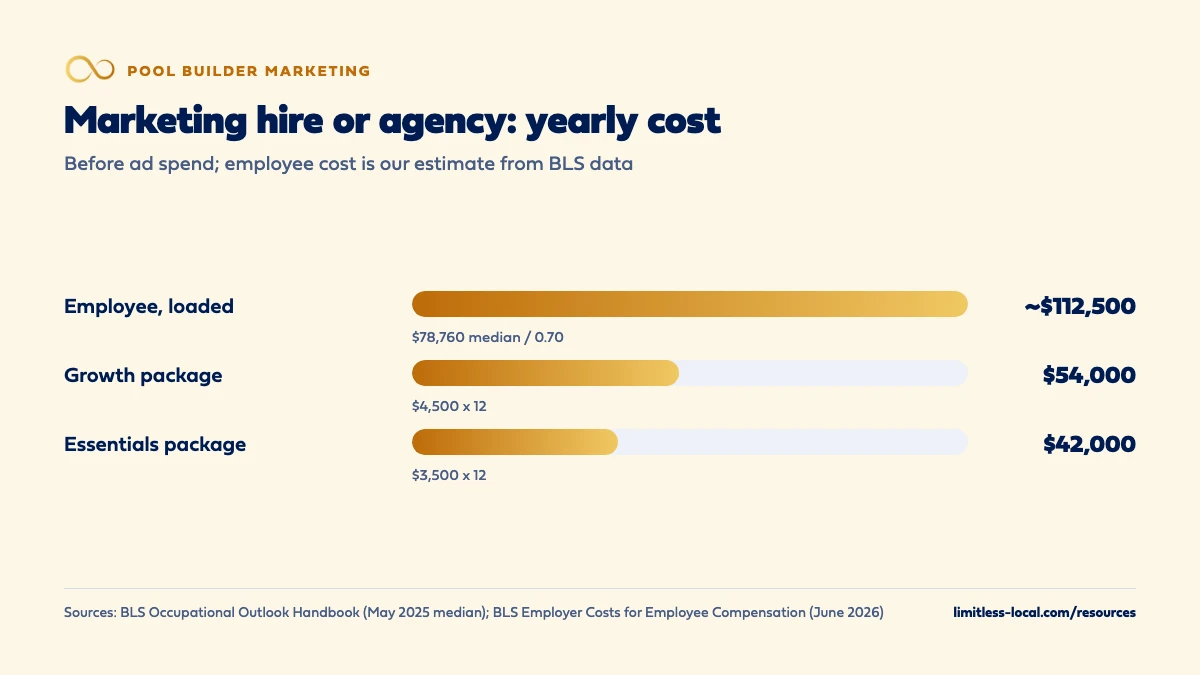
The salary input comes from BLS; the other inputs are illustrative, not a benchmark. Start with the $78,760 median wage. If wages are 70.0 percent of total compensation cost, as BLS reports for private industry, our rough approximation of the fully loaded cost is $78,760 divided by 0.70, or about $112,500 a year, before tools and ad spend. That’s our math applying a private-industry average to one salary, not a BLS figure, and your real number depends on your state, benefits and the person.
Compare that with our Essentials package at $3,500 a month, which is $42,000 a year, or Growth at $4,500 a month, which is $54,000 a year, also before ad spend. Now say your made-up gross profit per pool is $15,000. The employee needs to help sign about 7.5 more pools a year to cover their loaded cost ($112,500 divided by $15,000); Essentials needs about 2.8 ($42,000 divided by $15,000).
That doesn’t settle it on its own: the employee may also run your social, photos and follow-up, and a hybrid adds a coordinator’s cost to an agency fee. Put your own numbers in, and compare the options by the contracts each one needs to pay for itself.
Frequently asked questions
Is a part-time marketing coordinator enough for a small pool company?
Often, yes. A part-time coordinator can handle photos, posts, review requests and lead follow-up, while ads and SEO go to an agency or a specialist.
Can my office manager do the marketing?
They can own the on-site and follow-up tasks if they have the hours. Give them clear targets tied to consultations and contracts, and keep the technical ad work with someone who does it daily.
Should I hire a marketing manager before hiring an agency?
Only if you have enough work and budget for both a manager and the specialists they’d direct. BLS reports a May 2025 median of $166,790 for marketing managers, so this is usually a larger company’s move.
What happens to my marketing if my in-house marketer quits?
If the company owns every account and the lead log, someone else can pick up where they left off. If accounts are in their personal name, you may have to rebuild.
Does an agency replace the need for anyone in-house?
Not entirely. Someone at the company still has to supply job photos, ask for reviews, answer leads and record which ones signed.
Will I be locked into an agency contract if a hire works out?
Read the terms. Ours is month-to-month: we ask for three months and put it in the contract, but if you want to leave, we won’t make you stay.
Key takeaways
- A marketing employee costs a salary plus benefits and payroll taxes; BLS puts benefits at 30% of private-industry compensation costs.
- One person rarely covers Google Ads, SEO, the website, tracking and content equally well.
- In-house wins on job site photos, review requests and lead follow-up; an agency wins on technical ad and SEO work.
- A hybrid works when every task has one named owner.
- Keep every account in the company’s name and judge any option by cost per signed contract.
Want a second set of eyes on your setup?
We'll look at how you show up locally and where calls are leaking, then send you a plain-English breakdown.
More in this section
- Does a pool builder need a pool-specific or general marketing agency?
- Should I hire a pool marketing agency or do it myself?
- What should a pool builder ask before hiring a marketing agency?
- How does a pool builder restart marketing after a bad agency?
- How should a pool builder split its marketing budget?
Sources
- Market Research Analysts: Occupational Outlook Handbook — U.S. Bureau of Labor Statistics
- Employer Costs for Employee Compensation Summary — U.S. Bureau of Labor Statistics
- Advertising, Promotions, and Marketing Managers: Occupational Outlook Handbook — U.S. Bureau of Labor Statistics
- Hire and manage employees — U.S. Small Business Administration
- Forms and associated taxes for independent contractors — Internal Revenue Service
- About access levels in your Google Ads account — Google Ads Help
- Manage your Business Profile owners & managers — Google Business Profile Help