
Is $25 per lead good for my electrical ads?

- Is $25, $50 or $100 per lead a good price for an electrician's ads?
- How do I tell if $25 per lead is good for my electrical business?
- What's the most I can pay for a booked electrical job?
- What booking rate does $25 per lead need to pay off?
- Is $50 per lead good for an electrician?
- Is $100 per lead too high for my electrical ads?
- When is $25 per lead actually a bad price?
- Does $25 per lead mean the same thing on every channel?
- What should count as a lead when I work out my price?
- How many leads do I need before I trust the number?
- What if my booking rate is the problem, not the lead price?
- How do I find my real cost per booked job?
- What's different about lead prices for electricians
- A worked example: three lead prices, one owner
- Frequently asked questions
- Key takeaways
- More in this section
- Sources
The short version
- Cost per booked job = cost per lead ÷ share of leads that book.
- $25 a lead with one in five booking is $125 per booked job; with one in ten, $250.
- $50 or $100 a lead can be the better deal on bigger electrical jobs.
- Junk, wrong-area and price-shopper calls make cheap leads expensive.
For electrical shop owners looking at a cost-per-lead number in Google Ads, Local Services Ads or a lead site and wondering whether it’s a good deal or a slow leak.
Get a free visibility audit · Book a growth call
Is $25, $50 or $100 per lead a good price for an electrician's ads?
$25 per lead is good for an electrician’s ads if enough of those leads book to keep each job’s cost under the most you can afford to pay for it. Divide the lead price by your booking rate: at $25 a lead with one in five leads booking, each booked job costs $125, and with one in ten booking it costs $250. That’s why $50 or even $100 a lead can be the better deal on panel upgrades, EV chargers and generators, and why $25 can be too much when most of the calls are junk.
Cost per booked job is the number we hold ads to. Every package includes monthly reports with a cost-per-lead breakdown, call tracking with recording and transcription, and source tagging, so you can see which leads actually booked. Google Ads management is in every package and Local Services Ads management starts with Growth; our local ads page shows how they fit together, and ad spend is always paid to Google directly. For the whole picture for electrical shops, see our electrical contractor marketing page, or browse the rest of the electrical marketing questions library.
How do I tell if $25 per lead is good for my electrical business?
Not from the lead price alone. A lead price tells you what the phone call cost. What you need to know is what each booked job cost, and that depends on how many of those calls turn into work. The math is one line:
Cost per booked job = cost per lead ÷ share of leads that book
At $25 a lead, if one in five leads books, each booked job cost you $125. If one in ten books, each booked job cost $250. Same ads, same lead price, double the cost per job.
Then hold that number up against the most you can afford to pay for a booked job. If $125 sits comfortably under it, $25 a lead is a good price. If $250 is more than the job leaves you after labor and materials, $25 is too much, however cheap it sounds.
What's the most I can pay for a booked electrical job?
Start from the job, not the ad. Take what a typical job of that type brings in, subtract labor, materials, permits and other job costs, and you have the gross profit. Then decide what share of that profit you’re willing to spend to win the job. That’s your ceiling per booked job.
Electricians need more than one ceiling, because a breaker swap and a panel upgrade don’t leave the same profit. A simple split works for most shops:
- Service and repair calls. A lower ceiling, but they usually book on the first call if someone answers.
- Estimate jobs like panel upgrades, EV chargers, generators and rewires. A higher ceiling, but the homeowner may collect other quotes first.
- Commercial work. Its own ceiling and its own, longer timeline.
A customer who books again or sends a neighbor can be worth more than the first invoice, which is a fair reason to stretch the ceiling a little. What a good cost per booked job is for electrical marketing walks through setting each ceiling from your invoices.
What booking rate does $25 per lead need to pay off?
Flip the formula around and you get the most useful test for any lead price: the booking rate it needs to break even.
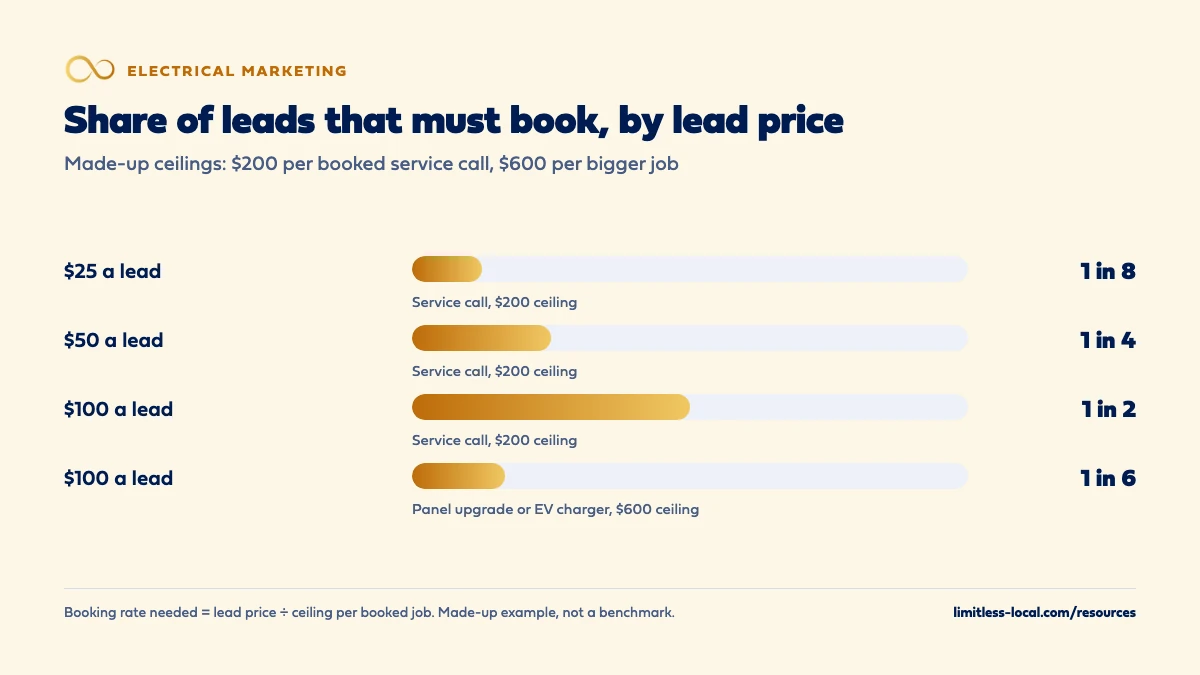
Booking rate needed = lead price ÷ ceiling per booked job
Say your ceiling for a booked service call is $200. Then $25 a lead works as long as at least one in eight leads books, which is 12.5%. If your records show you book more than that, $25 is a good price for that work. If you can’t say, that’s the first number to find.
Here’s the same test for all three lead prices at that $200 ceiling:
- $25 a lead needs one in eight leads to book.
- $50 a lead needs one in four.
- $100 a lead needs one in two.
These ceilings are made up to show the math, not a benchmark. Put your own in and the rest follows.
Is $50 per lead good for an electrician?
It can be better than $25. At the same $200 service-call ceiling, $50 a lead needs one in four leads to book. That’s a higher bar, so a $50 lead has to be a better lead: someone asking for a specific repair or install in a town you serve, not someone comparing prices on a small job or looking up how to wire a switch themselves.
On bigger work, $50 gets easy. Say a panel upgrade leaves enough profit that you’d happily pay $600 to win one. At $50 a lead, you need only one in twelve of those leads to book. Even if plenty of homeowners collect three quotes, one in twelve is a low bar.
So $50 a lead is good when it’s attached to the right job. It’s a problem when it brings in the same small calls a $25 lead would have, at twice the price.
Is $100 per lead too high for my electrical ads?
For small service calls, usually yes. At a $200 ceiling, $100 a lead needs half your leads to book, which leaves no room for a slow week, a no-show or a caller who only wanted a phone quote.
For bigger jobs, often no. At a $600 ceiling, $100 a lead needs one in six to book. A generator install, an EV charger that needs a panel upgrade, a whole-home rewire or a commercial tenant job can carry a $100 lead if your quotes close at a reasonable rate.
The trap is averaging. If one campaign brings $100 leads for panel upgrades and another brings $25 leads for service calls, the blended cost per lead might look fine while one of them quietly loses money. Track the lead price by job type, not just in total.
Curious what your marketing is actually booking?
Get a free visibility audit — no obligation, no sales pitch.
When is $25 per lead actually a bad price?
When a lot of what you’re paying for isn’t a real job. A cheap lead price can hide:
- Junk calls: job seekers, sales calls and robocalls counted as leads.
- Wrong work or wrong area: jobs you don’t do, or callers two towns past where your trucks go.
- Price shoppers calling around for the cheapest quote on a small job.
- Leads you pay for whether you win or not. On some lead sites, that’s simply how billing works. HomeAdvisor’s page on how it works for contractors says you’re charged for each lead you receive, whether or not you win the job and whether or not the customer hires anyone.
None of that shows up in the lead price. It shows up in the booking rate. If $25 leads are booking one in fifteen, you’re paying $375 for every job, and that isn’t cheap for a service call. How electricians tell a junk lead from a real job helps you sort them before they skew your numbers.
Does $25 per lead mean the same thing on every channel?
The math is the same. What you’re paying for isn’t.
- Local Services Ads charge per lead. Google’s page on how leads work says you pay for valid leads, such as an answered call, a message, or a missed call during business hours where the caller stays on the line more than 20 seconds, and that prices vary with your location, the job type, the type of lead and how you bid. Leads it decides are spam or duplicates aren’t charged, and it keeps checking lead quality over a 30-day period, crediting poor-quality leads automatically.
- Google search ads charge per click, so a cost per lead is something you work out. The Cost / conv. column in Google Ads divides your total cost by your conversions, as the guide to conversion tracking data explains. That only equals cost per lead if conversions are set up to count real calls and forms.
- Lead sites charge per lead, and the one above bills whether you win or not. Its lead credit guidelines list a customer who’s just shopping, who already found someone or who never calls back as situations that don’t qualify for a credit.
So $25 for a lead where junk gets credited back is a different deal from $25 for a lead you keep paying for when the customer was only shopping. Whether electricians should use LSAs, Search Ads or lead sites compares the three side by side.
What should count as a lead when I work out my price?
Decide once, write it down and use the same rules for every channel, or the comparison means nothing. Count calls long enough to be a real conversation about a job, quote requests with real details, and messages or booking requests. Don’t count spam, job seekers, suppliers, existing customers calling about a job that’s already booked, or the same person calling twice about the same job.
Then decide what goes on top of the platform’s price. If an agency or a freelancer manages the ads, add the monthly fee to the spend before you divide. Your Google Ads account might say $25 a lead, but if the management fee adds as much again, the real number is $50.
The same goes for call tracking or software that only exists to run that channel. What cost per lead is for electricians and what to target goes deeper on setting your rules.
How many leads do I need before I trust the number?
More than a handful. If you’ve had eight leads and one booked, your booking rate looks like one in eight. One more booking and it’s one in four. A single phone call can turn a lead price from fine to great, or the other way.
On a small budget, look at three months together instead of reacting to one. Judge estimate work on an even longer window, because a panel-upgrade lead from this month may not sign until next month. Tie each booked job back to the month its lead came in, so a slow-closing quote doesn’t make one month look awful and the next look great.
What if my booking rate is the problem, not the lead price?
Then cheaper leads won’t fix it. If the office misses calls, calls back the next morning or never follows up on quotes, every lead price looks expensive. Moving your booking rate from one in eight to one in four halves your cost per booked job without spending a dollar more on ads.
Check the unglamorous things first: who answers while everyone’s on a job, how fast a missed call gets a callback, and whether anyone follows up on a quote a few days after sending it. What a good close rate is for an electrical company breaks down the stages from first call to booked visit to sold job, so you can see where yours drops off.
How do I find my real cost per booked job?
Pull three numbers for the same month and the same channel: what you spent, fees included; how many real leads came in; and how many of those booked.
- Spend comes from Google Ads, the lead site’s billing page and your agency’s invoice.
- Leads come from call tracking and form notifications, after you’ve taken the junk out.
- Booked jobs come from your field software. Jobber’s Lead Source Report, for example, shows how many leads each marketing source brought in and the first revenue tied to them.
If none of that is set up yet, start simpler. The SBA’s article on getting the most from your marketing budget notes that tracking can be as simple as asking every new customer where they heard about you. Write the answer on the job, and in a month you’ll know more than any industry average can tell you. How to track which electrical marketing brings real jobs covers the full setup.
Talk it through with someone who runs this every day
A 15-minute growth call: your market, your numbers, and what a realistic budget looks like. No pressure.
What's different about lead prices for electricians
Job values swing a lot. One day’s calls can include a dead outlet and a whole-home rewire. A single lead-price target across all of that hides which work is paying for the ads.
Emergency calls book fast. No-power and burning-smell calls usually book on the spot if someone answers, so their booking rate is high and a higher lead price can still pay.
Estimate work takes weeks. Panel upgrades, EV chargers and generators often need a site visit, a quote and sometimes a permit before they’re booked. Judge their lead price over a longer window.
A worked example: three lead prices, one owner
These numbers are made up to show the math, not a benchmark for your market. An electrician spends $1,000 a month on each of three campaigns. The most they’ll pay is $200 for a booked service call and $600 for a booked panel upgrade or EV charger job.
- Campaign A, general electrician searches: $25 a lead, so 40 leads. Only 4 book, a 10% booking rate, so each booked job costs $250. That’s over the $200 service-call ceiling.
- Campaign B, specific repair searches: $50 a lead, so 20 leads. 8 book, a 40% booking rate, so each booked job costs $125. Well under the ceiling.
- Campaign C, panel upgrades and EV chargers: $100 a lead, so 10 leads. 4 book, so each booked job costs $250, comfortably under the $600 ceiling for that work.
The cheapest leads were the only ones losing money. Before cutting Campaign A, the owner should find out why only one in ten of its leads booked, because fixing that could make $25 a good price after all.
Frequently asked questions
Is $25 a click the same as $25 a lead?
No. Search ads charge per click, and only some clicks call or fill out a form. At $5 a click with one in five clicks becoming a lead, you’re paying $25 a lead; at one in ten, it’s $50.
Do I pay for junk leads from Local Services Ads?
Not for the ones Google catches. Leads it decides are invalid or low quality aren’t charged, and charged leads can be credited automatically later. If you keep getting the wrong kind of lead, narrow the service areas and job types in your campaign settings.
Can I tell Google Ads to aim for $25 per lead?
Yes, with Target CPA bidding, once conversion tracking is set up. You set the average cost per conversion you want, and some conversions will cost more and some less. Set it from your real numbers, not a hoped-for one.
How often should I recheck my ceiling per booked job?
Whenever your prices, labor costs or job mix change, and at least once a year. A price increase raises the ceiling, so a lead price that was too high last year might be fine now.
Are referrals worth tracking if they cost nothing?
Yes. They have no lead price, but counting them shows how much of your work arrives without paid ads.
Key takeaways
- A lead price only means something next to your booking rate: cost per booked job = cost per lead ÷ share of leads that book.
- The booking rate a lead price needs = lead price ÷ the most you’ll pay for a booked job.
- At a made-up $200 ceiling, $25 a lead needs one in eight leads to book, $50 needs one in four and $100 needs one in two.
- $100 a lead can be a good deal on panel upgrades, EV chargers and generators, where the ceiling is higher.
- Set separate numbers for service calls, estimate work and commercial jobs, and include management fees in the lead price.
Ready to compare options?
Book a short growth call and we'll walk through the math for your service area, including when we're not the right fit.
More in this section
- What is cost per lead for electricians and what should I target?
- Can an electrician get enough leads without paid ads?
- What is a good cost per booked job for electrical marketing?
- How many leads per month before an electrician hires an agency?
- Is social media worth it for getting electrical leads?
Sources
- How leads work — Google Local Services Help
- Understand your conversion tracking data — Google Ads Help
- About Target CPA bidding — Google Ads Help
- How does HomeAdvisor work for contractors? — HomeAdvisor
- Lead Credit Guidelines — HomeAdvisor Pro
- Lead Source Report — Jobber Help Center
- How to Get the Most From Your Marketing Budget — U.S. Small Business Administration